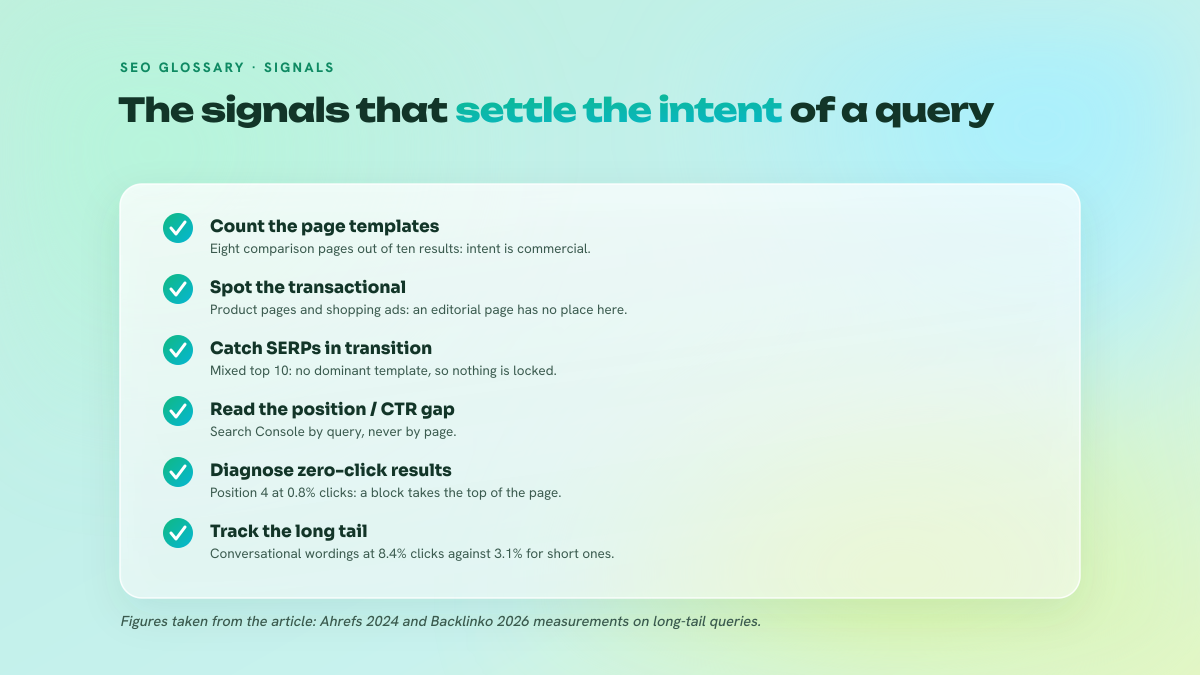
- →Commercial intent is a decision state, not a keyword pattern: the searcher has committed to buying and is now filtering options, which forces a comparison page rather than an explainer.
- →It is a narrow slice of demand. A 2025 summary of Semrush’s Search Intent Report 2024 puts commercial queries at 10 to 15 % of all searches, against 25 to 30 % navigational, so per-keyword value matters far more than volume.
- →Intent mismatch is measurable, not theoretical: the Ahrefs Intent Study 2024 reports 70 to 85 % lower CTR and 50 to 60 % higher bounce rates for pages targeting the wrong intent type.
- →Zero-click is now the baseline on these SERPs. SparkToro’s 2026 clickstream study found 68.01 % of US searches ended with no click, and Seer Interactive measured organic CTR falling from 1.76 % to 0.61 % when an AI Overview is present.
- →Cost per click in Keyword Planner remains the cheapest intent classifier available: advertisers have already paid to sort your keyword list for you.
- →Commercial pages deserve the link budget that most teams spend on informational content, because they are the pages that convert and the ones no one links to spontaneously.
What commercial intent actually is
Commercial intent describes a searcher who has accepted the premise of a purchase and is now arbitrating between options. The query reads like research, but every modifier around the head term is a purchase filter: « best », « vs », « alternative to », « for small teams », « review », « pricing ». That searcher is not asking to be educated. They are asking to be helped toward a decision they have already committed to making, and the page that helps fastest wins.
The distinction dictates page type before it dictates anything else. An informational query wants an explainer. A commercial query wants a shortlist with explicit criteria, honest trade-offs and a defensible verdict. Rank a definition page on a « best X » query and you will hold the position for a while, then bleed it to a comparison page that answers in one screen. Google has spent three algorithm generations learning to tell those two documents apart, and since the March 2024 core update folded the Helpful Content system into the core ranking systems, thin commercial content that ranked on technical optimisation alone has far less room to survive.
Volume-wise this is a narrow slice of search demand. A 2025 summary of Semrush’s Search Intent Report 2024 puts commercial intent queries at 10 to 15 % of all searches, against 25 to 30 % for navigational ones. Narrow, but it is the slice where a ranking maps to revenue with the fewest intermediate steps, which is why the competition per keyword is denser and why Google monetises those SERPs harder than any other.
A short visual primer on how the ad side of Google reads the same signal:
Commercial against transactional, and the taxonomy fight
Most glossaries blur the two. The working line is simple: commercial intent is choosing, transactional intent is executing. « best noise cancelling headphones for open offices » is a searcher building a shortlist. « sony wh-1000xm5 buy » is a searcher who has finished choosing and wants a checkout. Same product, same buyer, two documents, two calls to action, two entirely different SERP layouts.
Google’s own furniture tells you which one you are looking at. Transactional product queries lean on shopping listings, free product listings and local packs, to the point that a 2025 SERP guide from Softtrix classifies those features as the defining markers of transactional layouts, and Gen3 Marketing’s 2025 analysis of SERP changes calls a properly configured Merchant Center feed a requirement rather than an option on those queries. Commercial investigation SERPs still surface editorial roundups and comparisons, though the space allocated to them keeps shrinking. If you cannot decide which bucket a keyword belongs to, stop guessing and read the top ten: the page type that occupies the results is the answer Google already published.
On the taxonomy itself, there is a genuine mess worth naming. The « 3 C’s of search intent » circulates in two incompatible versions. Ahrefs’ original framing is operational and covers content type, content format and content angle, in other words what document you must produce to match the SERP. A newer set of 2026 posts recycles the same label as Commerce, Convenience and Community, which is a repackaging of buyer psychology rather than a diagnostic tool. Use the Ahrefs version. It tells you what to build; the other one tells you how the buyer feels, which you already knew. The classic four-bucket model of informational, navigational, commercial and transactional remains fine as a filing system, provided you accept that real queries sit on a gradient and that « best X for Y » is a commercial and informational blend that needs both depth and a verdict. Getting the document type right is also what lets a set of related pages hold together as a coherent cluster of pages built around one theme instead of a pile of near-duplicates.
What a commercial SERP looks like in 2026
This is where a 2021 playbook stops working. SparkToro’s 2026 clickstream study, built on Similarweb data from January to April 2026, found that 68.01 % of US Google searches ended with no click to any result, up from 60.45 % in 2024, a shift Search Engine Land also covered. When an AI Overview is present the figure is worse: Bain & Company’s December 2024 work with Dynata put zero-click at 83 % on those queries, and Semrush measured roughly 93 % in the conversational AI Mode interface in September 2025. Seer Interactive’s 2025 dataset quantifies the same erosion at page level: organic CTR falling from 1.76 % to 0.61 % when an AI Overview appears, a 61 % drop. Sistrix, cited in a 2026 analysis, estimates 265 million clicks lost per month in Germany alone as of February 2026.
Commercial and transactional queries are not incidental victims of this, they are the target. Google has been extending paid inventory into the AI surfaces since October 2024, when ads first appeared inside AI Overviews on US mobile, and PPC Land reported sponsored store modules and quick web result links inside AI Mode product panels in 2026. A Semrush analysis of 10 million keywords in 2025 found AI-generated overviews on 18 % of desktop queries, more than double the previous year. The commercial SERP is no longer ten blue links with a few ads bolted on. It is a commerce surface with an answer engine on top.
The senior reading is not that commercial keywords stopped mattering. It is that the KPI moved. Seer’s same 2025 data shows brands cited inside an AI Overview receiving 35 % more organic clicks and 91 % more paid clicks than uncited brands on the identical query. Being the source the answer is built from now carries measurable value on its own, independently of your blue link position. Track citations and assisted conversions alongside rank, and stop reporting a position that increasingly buys you nothing.
Finding and qualifying commercial intent keywords
The mechanical part is trivial: take your product or service noun and cross it with the modifier families, comparative, evaluative, qualifying, local, then expand with a keyword tool. Every research workflow you will read does this, and it takes an afternoon. The part that separates a useful list from a spreadsheet nobody acts on is qualification.
The cheapest intent classifier available is cost per click. Advertisers have already spent real money sorting your keyword list, so a term carrying a high bid estimate in Google Keyword Planner has commercial value someone has validated with their own budget, whatever the intent label your tool prints next to it. Semrush, Ahrefs and Moz all ship intent filters now and they are useful for a first pass, but they classify on patterns and they are wrong often enough that you should sanity-check the borderline terms against the actual SERP and against bid data. Search volume is the least informative column on the screen for this class of keyword: a term with 90 monthly searches and a 12 euro CPC is worth more to a B2B service than a 5 000 volume informational head term.
Long-tail is where the economics sit. A 2026 Backlinko analysis reports long-tail queries driving 74.3 % of all organic traffic, and pages optimised for conversational long-tail phrasing, precisely the « best X for Y » blends, reaching an 8.4 % average CTR against 3.1 % for short-tail equivalents. Competitor gap analysis is the fastest route to those terms: pull the commercial keywords your three closest competitors rank on and you do not, and treat the overlap as a validated demand map rather than a wish list. That exercise is the same one that surfaces a gap in your coverage worth filling, except you weight it by commercial value instead of volume.
A practical walkthrough of the same qualification logic:
Where commercial intent sits in a netlinking plan
Link equity is a budget, and most teams allocate it backwards. Informational content attracts links naturally because people cite studies, definitions and data. Commercial pages attract almost nothing spontaneously: nobody links to your comparison page or your service page out of enthusiasm. Those are precisely the pages that convert, so they are the ones that need deliberate acquisition, whether through internal linking from your informational cluster or through external placements.
In practice that means treating your commercial pages as the destination of the campaign rather than an afterthought. Point your strongest internal links at them from the explainers that already rank, and when you buy external links, favour contextual placements inside articles that treat the same purchase decision. An editorial page about choosing a supplier in your category passes something a generic homepage link never will, which is why it is usually worth commissioning a piece on a site that already covers the theme rather than chasing raw authority metrics. We run 50 owned French editorial media at Stringer and the pattern holds across the whole set: placements on thematically aligned media move commercial pages, placements chosen on Domain Rating alone move a dashboard. If you want to check that alignment before committing, the catalogue of media with their themes and traffic is public and browsable without an account, which is the minimum honest standard for this kind of purchase.
Rhythm matters as much as selection. A commercial page that receives eleven links in a fortnight and nothing afterwards reads as a campaign. Spreading acquisition across quarters, matched to the publication cadence of your own content, keeps the profile legible, and it is the main reason a serious operator plans link acquisition alongside the editorial calendar rather than as a separate line item.
What we see go wrong
Four failure patterns account for most of the damage in the audits we run. The first is mapping every commercial keyword to a product or service page. « best project management tool for agencies » does not want your product page, it wants a comparison, and your product page will never satisfy it no matter how much you optimise the title. Build the comparison, rank it, then link internally to the product page. That is one extra step and it is the whole game.
The second is thin commercial content that exists only to carry keywords. Since the Helpful Content system was folded into the core ranking systems in March 2024, pages that rank through technical optimisation while failing to satisfy the searcher are structurally exposed. A comparison with no first-hand testing, no pricing detail and no clear verdict is exactly that page. If you cannot say which option you would pick and why, you have not written a commercial page, you have written a directory entry.
The third is reporting on rankings rather than clicks and citations. Given the zero-click figures above, position three on a commercial query with an AI Overview and three shopping rows can deliver less traffic than position seven did two years ago. Pull the click and impression split from Search Console per query type and look at CTR trends, not average position.
The fourth is a single page trying to serve both commercial and transactional intent at once. It ends up with a comparison table nobody trusts and a checkout nobody reaches. Split them, and accept that the two documents need different link profiles: the comparison earns and buys links, the transactional page mostly receives internal ones. Teams that keep merging the two usually need someone to calibrate the whole acquisition plan over several months before the page-level fixes have any measurable effect.
On matching document type to intent, this covers the diagnostic well:
Nautilinks operates an owned network of editorial media. In-house written articles, transparency disclosures respected, anchor mix calibrated.
Frequently asked questions
Two keywords are worded almost identically. How do I decide which one is commercial?
Read the top ten and check the bid data, in that order. If Google serves comparisons, roundups and review pages, the query is commercial regardless of how it reads. If it serves definitions and how-tos, it is informational. Then look at cost per click in Keyword Planner: advertisers pay for decision-stage traffic, so a meaningful bid on a low-volume term is a stronger commercial signal than any intent label your keyword tool prints.
Should commercial and transactional queries ever share a page?
Almost never. Commercial queries want a shortlist with criteria and a verdict, transactional ones want the fastest path to checkout. Merging them produces a page that hesitates on both jobs. The exception is a narrow catalogue where the category page genuinely is the comparison, which happens in small product ranges. Even there, watch bounce rates: the Ahrefs Intent Study 2024 reports 50 to 60 % higher bounce on intent-mismatched pages, and merged pages fail that test quickly.
Is the four-bucket intent taxonomy still worth using in 2026?
As a filing system, yes. As a decision model, it is too coarse. Real queries sit on a gradient, and the highest-value terms are blends: « best CRM for a 5 person agency » is commercial in its decision state and informational in what it demands from the document. Use the four buckets to sort a keyword export, then re-read the SERP for anything you plan to build a page around. The SERP is the only classification that ranks you.
The 3 C’s of search intent: which version is the real one?
Two definitions circulate. Ahrefs’ original covers content type, content format and content angle, and it is diagnostic: it tells you which document to produce to match the results page. A more recent framing recycles the label as Commerce, Convenience and Community, which describes buyer psychology rather than page construction. Use the first. If someone quotes the second at you in an audit, ask what page they would build from it, and watch the answer stay vague.
With zero-click at these levels, are commercial keywords still worth targeting?
Yes, but the scoreboard changed. SparkToro measured 68.01 % of US searches ending without a click in early 2026, and Seer Interactive found organic CTR dropping from 1.76 % to 0.61 % when an AI Overview appears. The same Seer data shows brands cited inside those overviews taking 35 % more organic clicks than uncited ones on the same query. Being the cited source is now part of the objective, alongside the ranking, and both are earned by the same depth.
What share of a link budget should go to commercial pages?
More than most plans allocate. Informational pages accumulate links passively because people cite data and definitions. Commercial pages receive nothing spontaneously, so every link they get is one you planned. A working split is roughly half the external acquisition pointed at commercial pages and their supporting comparisons, with internal linking from ranked informational content doing the rest. Spread it across quarters rather than in bursts, and match the theme of the source media to the purchase decision.
Test your knowledge
Quiz: Commercial intent
1/3According to SparkToro’s 2026 clickstream study built on Similarweb data, what share of US Google searches ended with no click to any result?