- →AI Overviews now appear on roughly 20% of Google searches globally, up to 37.2% in some countries (SeoProfy 2026 cross-study synthesis), but exposure is intent-driven: around 60.7% of health queries trigger one versus about 14% of transactional queries. Audit your query portfolio before rewriting your strategy.
- →Presence costs clicks: organic CTR fell 61% on informational queries when an overview appeared (Seer Interactive, 2024-2025). Citation pays it back: cited brands saw organic clicks rise 35% and paid clicks 91%. Citation is the new position one.
- →Citation overlap with the organic top 10 collapsed from about 76% in mid-2025 to between 17% and 54% by early 2026 (QuickSEO roundup): ranking first no longer secures inclusion, so a purely rank-based link strategy underprices mentions.
- →Cited URL sets rotate constantly: Semrush found no keyword among 3,000+ tracked that kept the same cited URLs 100% of the time. Measure citation share as a trend, never as a one-off screenshot.
- →A broad footprint of editorially credible mentions across many mid-authority domains now does more for generative retrieval than a handful of high-DR trophy links aimed at a single ranking URL.
What AI Overviews really are
In a 2026 workflow, an AI Overview is the thing standing between your ranking and your click. It is the generative answer block Google injects at the top of the results page: a synthesized summary written by a language model from retrieved documents, with a panel of cited sources attached. Google rebranded the Search Generative Experience to AI Overviews and pushed it to all US users in May 2024, then expanded to more than 200 countries and 40 languages by May 2025 (Search Engine Journal). By early 2026 the feature reaches an estimated 2 billion users (Elementor's 2026 AI SEO statistics digest). This is not an experiment you can wait out. It is the default answer surface of the largest search engine.
The distinction that matters operationally: a featured snippet extracts one passage from one page and sends the click there. An AI Overview synthesizes across many pages and attributes credit to a rotating set of sources, most of which get no click at all. Your content can feed an answer without receiving traffic, and it can be cited without ranking anywhere near the top. It is also a different surface from the fully conversational Google AI Mode: overviews are injected into the classic SERP without the user asking for them, which is exactly why their reach dwarfs every chatbot.
The dictionary line, for completeness: an AI Overview is Google's AI-generated summary shown above organic results for queries the system judges answerable by synthesis. The operational line: it is a citation market layered on top of the ranking market, and the two are diverging.
How they fire, and how often
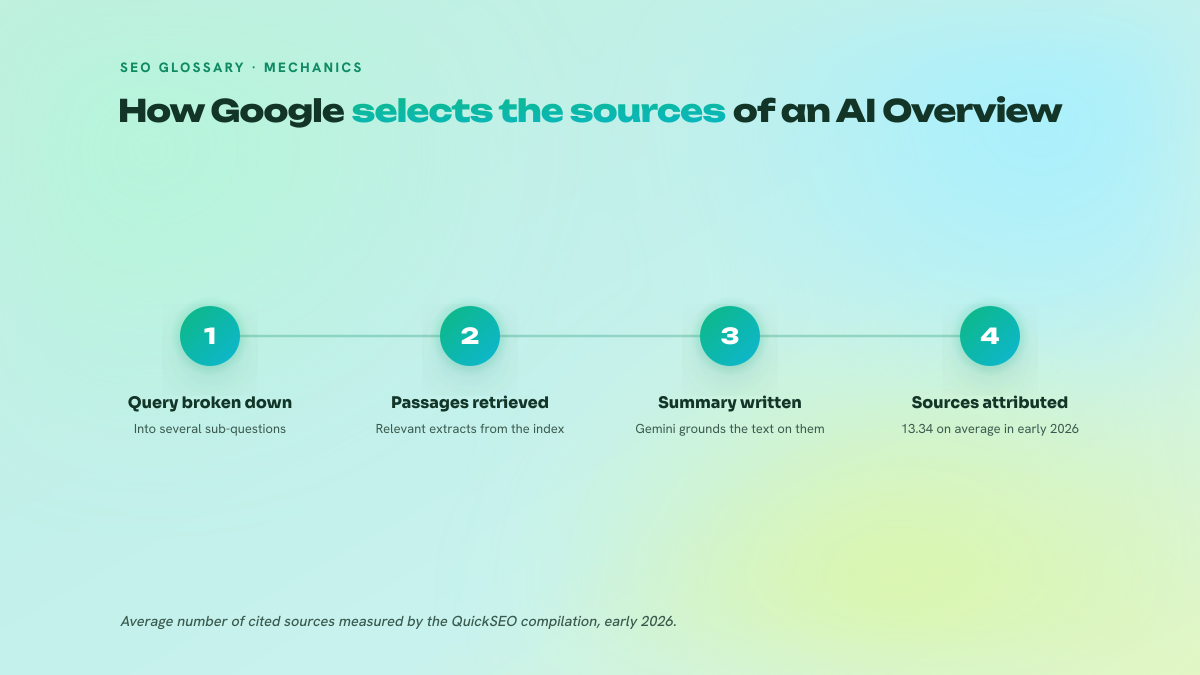
Mechanically, Google first classifies the query for eligibility, then decomposes it into sub-questions, retrieves candidate passages for each, and generates the summary with source attribution. That decomposition step is query fan-out, and it explains why pages that cover a question cluster in depth get cited on queries they never ranked for: the retrieval happens at sub-question level, not at the level of the keyword you tracked.
Trigger rates moved fast and then settled. Semrush measured the share of US searches triggering an overview rising from 6.49% in January 2025 to 13.14% in March 2025. A broader cross-study synthesis covering more than 30 million SERPs (SeoProfy, 2026) puts global presence around 20% of searches, peaking at 37.2% in some countries, with growth from 6.49% to 24.61% of queries across 2025 before stabilizing around 15 to 16% into 2026.
The distribution is brutally uneven, and this is the number most teams skip. Health queries trigger an overview in about 60.7% of cases. Transactional queries represented roughly 2% of triggers in early 2025 and rose to about 14% by late 2025, still the lowest of all intents (SeoProfy). So your real exposure is a function of your query mix. A publisher living on informational long-tail is fully exposed; an e-commerce catalogue ranking on transactional terms is, for now, largely spared. Audit the portfolio before panicking, and before buying anything labeled GEO.
The click economics
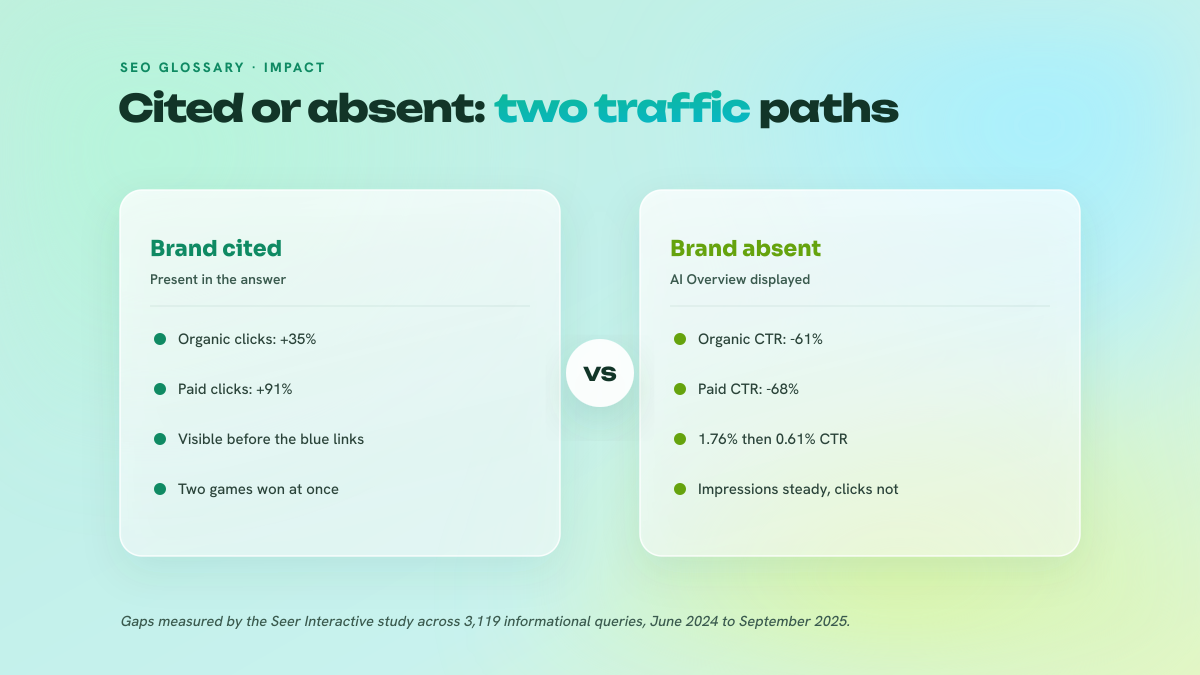
The click data is the reason this glossary entry exists. Seer Interactive tracked 3,119 informational queries representing 25.1 million organic impressions between June 2024 and September 2025: when an AI Overview was present, organic CTR fell 61%, from 1.76% to 0.61%, and paid CTR fell 68%, from 19.7% to 6.34%. Similarweb data shows zero-click searches rising from 56% to 69% between May 2024 and May 2025, exactly across the rollout window. Search Engine Journal's October 2025 analysis calls these losses structural, not cyclical, and the Chegg case backs that up: a 49% year-over-year decline in non-subscriber traffic between January 2024 and January 2025, referenced in Chegg's February 2025 antitrust suit.
But the same Seer dataset contains the counterweight: when a brand is cited inside the overview, organic clicks rise 35% and paid clicks rise 91% versus non-cited results. That asymmetry is the whole strategic picture. The overview taxes everyone on the page and pays a premium to the few brands it names. Citation has replaced position one as the asset you are actually competing for, which means measurement has to move from rank tracking to citation tracking, the kind of visibility you get from a structured audit of where your brand actually surfaces across AI answers rather than from a rank report that no longer describes the page users see.
For the macro trend, several 2026 tool reviews cite a Gartner forecast of organic search traffic falling 25% by 2026 and 50% by 2028. Treat vendor-circulated forecasts with the skepticism they deserve, but the direction matches every independent CTR dataset we have.
What it changes for netlinking
Three data points from the QuickSEO 2026 statistics roundup rewrite the link building playbook. First, the average number of sources per overview rose from about 6.82 in 2024 to 13.34 in early 2026: the citation pool is widening, not concentrating. Second, 43.42% of overviews now include links back to Google's own result pages, often 4 to 6 internal links per overview, which dilutes the share of external citations. Third, the overlap between cited sources and the organic top 10 weakened from about 76% in mid-2025 to between 17% and 54% in early 2026 depending on the study.
Add Semrush's finding that among more than 3,000 tracked keywords, not a single one showed the same set of cited URLs 100% of the time, and the conclusion is unavoidable: the classic chain of links, then rankings, then visibility has lost its final link. Buying authority to push one URL into the top 3 no longer guarantees the visibility that used to come with it. What generative retrieval rewards instead is corroboration: a brand and its claims appearing consistently across many editorially credible, topically relevant domains, so the model finds the same entity wherever it looks.
That favors breadth over trophy placements. Ten mentions on honest mid-authority media that actually get retrieved beat one DR 80 link aimed at a ranking that the overview will bury anyway. It is the operational logic behind placing brand mentions inside content that generative engines already retrieve: on an owned network like ours, the mention is written in-house, in context, on a page whose editorial history we control, which is precisely the shape of signal a retrieval pipeline treats as corroboration rather than advertising.
Earning citations in 2026
The prerequisites are unglamorous. AI Overviews are built on standard Google Search infrastructure, so there is no separate opt-out: if you want out, the only lever is the same one that removes you from Search, which is why almost nobody sane pulls it. Indexability, crawlability and clean structured data remain the entry ticket, because retrieval operates on what the index understands about your entities.
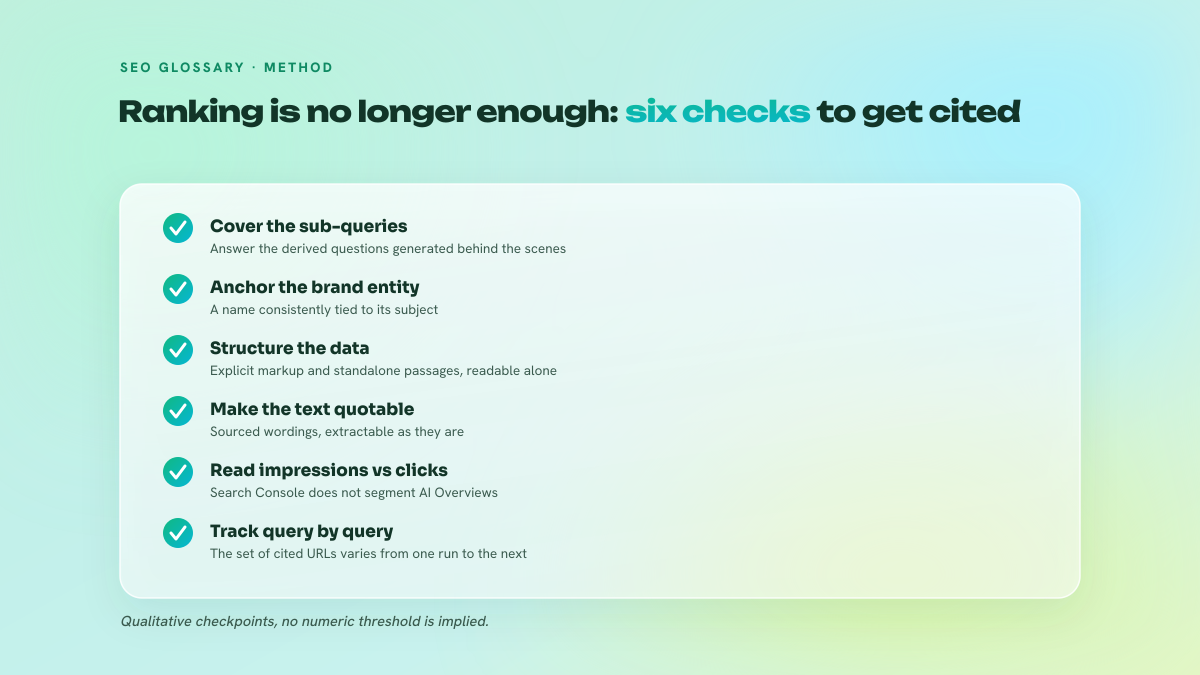
Above the floor, the work is passage-level. Overviews cite extractable passages: self-contained paragraphs that answer one sub-question completely, near a heading that names the question. From what we see in audits, pages that consolidate a full question cluster outperform ten thin pages targeting variants, because the fan-out retrieval pulls several sub-answers from the same URL and the model learns to trust it. The practical exercise is to map the sub-queries Google fans out from your target topics and check which ones your page answers in a liftable paragraph. Most content briefs written for 2019-era SEO fail that test on every sub-question but the head term.
Ahrefs walks through a six-step process that matches what we run internally:
For a broader 2026 playbook covering the same ground with additional tactics, this guide is worth the hour:
One warning on effort allocation: given the intent skew, spending your citation budget on transactional pages is fighting for the 14% of triggers where Google itself is most cautious. Put the informational cluster first, then let the brand corroboration you build there carry over.
Trust, manipulation and common mistakes
Can the output be trusted? Not blindly, and Google knows it. The system has shipped visible quality controls and user feedback loops since the 2024 launch incidents, and by January 2026 ads appear above and below the overview but not inside the generated text itself (QuickSEO roundup, drawing on Semrush and Discovered Labs). Yet the synthesis remains gameable, and it has been demonstrated publicly:
For a working SEO, the trust question is the user's problem; your problem is presence and accuracy. The mistakes we keep finding in audits: treating a citation screenshot as a durable asset when the URL sets rotate week to week; reporting AI Overview visibility from a rank tracker that never renders the overview; blocking AI crawlers in robots.txt as a reflex and quietly forfeiting citations across every generative surface at once; and mourning clicks on queries that were already high zero-click before the rollout, a pattern Evergreen Media flagged on the DACH launch of March 26, 2025. The overview often absorbed clicks that position one had already lost to the SERP itself.
The senior stance, since fence-sitting helps nobody: AI Overviews are not the death of SEO, they are a repricing. Rankings still matter as retrieval candidates, but the margin moved to citations, and citations respond to corroborated, extractable, entity-consistent content backed by mentions on media that retrieval systems actually read. Teams that keep buying links purely against a rank target are optimizing yesterday's bottleneck.
Nautilinks operates an owned network of editorial media. In-house written articles, transparency disclosures respected, anchor mix calibrated.
Frequently asked questions
Does ranking number one still get me cited in the AI Overview?
Less and less. The overlap between cited sources and the organic top 10 fell from about 76% in mid-2025 to between 17% and 54% by early 2026 depending on the study (QuickSEO roundup). Ranking keeps you in the retrieval candidate pool, but citation is decided at passage and entity level. A page ranking sixth with a liftable, self-contained answer regularly beats a vague page ranking first.
Should I optimize transactional pages for AI Overviews?
Not first. Transactional queries went from about 2% of overview triggers in early 2025 to roughly 14% by late 2025, still the lowest of all intents (SeoProfy). The exposure, and therefore the opportunity, sits on informational queries, where health topics trigger overviews about 60.7% of the time. Build citation strength on the informational cluster and let the brand corroboration carry into commercial queries as coverage expands.
How do I track AI Overview visibility given that cited URLs rotate?
As a trend, never as a snapshot. Semrush found that among 3,000+ tracked keywords, none kept an identical cited URL set 100% of the time. Mainstream suites started shipping AI visibility tracking in late 2025, Semrush One's AI Visibility Toolkit among them, covering overviews alongside ChatGPT and Perplexity. Measure citation share over weeks, segmented by topic cluster, and pair it with GSC impression data to see the click impact.
Can I block AI crawlers to stay out of AI Overviews without losing rankings?
No. AI Overviews are built on Google's standard Search infrastructure, so the only opt-out is the one that also removes you from organic results. Blocking third-party AI crawlers like GPTBot is a separate decision, and doing it reflexively forfeits citations on every generative surface at once, which the CTR data says is exactly the asset worth keeping.
Do citations in an AI Overview pass link equity like a backlink?
There is no evidence they pass PageRank-equivalent value, and 43.42% of overviews now route some of their links back to Google's own result pages anyway (QuickSEO 2026). Their value is measured in behavior: Seer Interactive found cited brands gained 35% more organic clicks and 91% more paid clicks versus non-cited results. Treat a citation as a visibility and referral asset with its own economics, not as a substitute for an editorial backlink.
Are AI Overviews reliable enough that being cited actually matters?
Reliability is uneven and manipulation has been publicly demonstrated, but user behavior settles the question: zero-click share rose from 56% to 69% during the rollout year (Similarweb) because people act on the summary. Whether the overview is right matters less to your P&L than whether it names you, and whether what it says about you is accurate. Monitoring your own brand claims inside overviews is now part of reputation work.
Test your knowledge
Quiz: AI Overviews
1/3By early 2026, what happened to the overlap between AI Overview citations and the organic top 10?