- →AI Mode went from beta in March 2025 to general availability for all U.S. users on May 20, 2025. Treat it as the destination and AI Overviews as the transition product, not the other way around.
- →The contest has shifted from position to retrieval and citation. Position 1 without a citation in the AI answer is increasingly a consolation prize on informational queries.
- →Zero-click searches climbed from 56% to 69% between May 2024 and May 2025 (Similarweb), but Seer Interactive tests reported in 2026 show an AI citation can lift CTR by more than 80% versus ranking alone: fewer clicks, concentrated on cited sources.
- →Query fan-out means you compete on sub-queries that never appear in Search Console. Cover intents at passage level instead of chasing one head keyword.
- →Links now have a second job: corroboration and retrievability for LLM-mediated answers, on top of their classic PageRank role. Anchor-obsessed link buying is the part that aged badly, not netlinking itself.
What AI Mode really is, beyond the chatbot framing
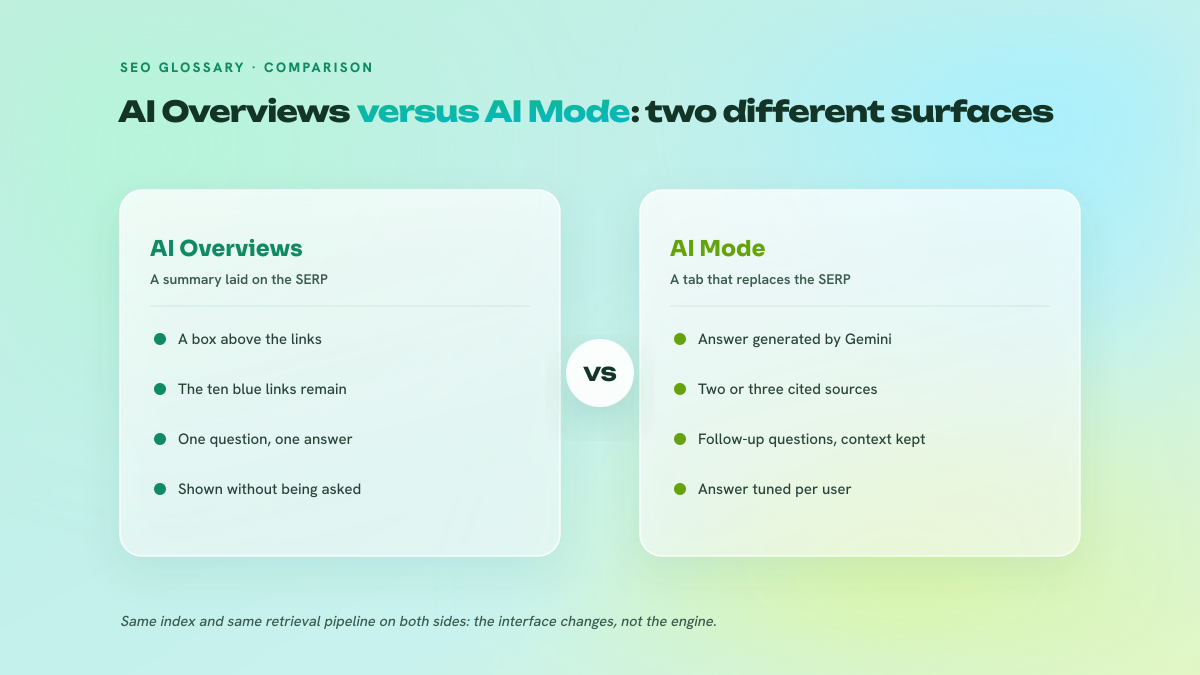
Google shipped AI Mode as a beta in March 2025 and opened it to every U.S. user on May 20, 2025, announced on stage at Google I/O. The framing matters more than the date: this is not a chatbot bolted onto the results page, and it is not an oversized featured snippet. AI Mode is a separate search surface where Gemini decomposes your question, runs a set of background searches, retrieves passages, and composes an answer that cites two or three sources above the fold. The ten blue links are not demoted on that surface. They are absent from the default view.
Read that against the trajectory of the last two years. SGE was rebranded as AI Overviews in May 2024, AI Overviews reached 1.5 billion monthly users and expanded to more than 200 countries and 40 languages by May 2025, and by August 2025 industry tracking (Xponent21) had them appearing on more than half of all queries, roughly double their coverage ten months earlier. AI Overviews were the transition: a generative layer sitting on top of a classic SERP that users could scroll past. AI Mode is the destination: the classic SERP becomes the fallback, not the default. Our position is blunt on this point: plan for the second stage, because the first is already being absorbed into it.
For a working SEO, the operational definition is this: AI Mode converts organic search from a position contest into a retrieval-and-citation contest. Whether your page holds position 1 matters less than whether the model retrieves a passage from it and judges that passage worth citing next to the synthesized answer. Everything else in this entry follows from that inversion.
How AI Mode works: fan-out, retrieval, citation
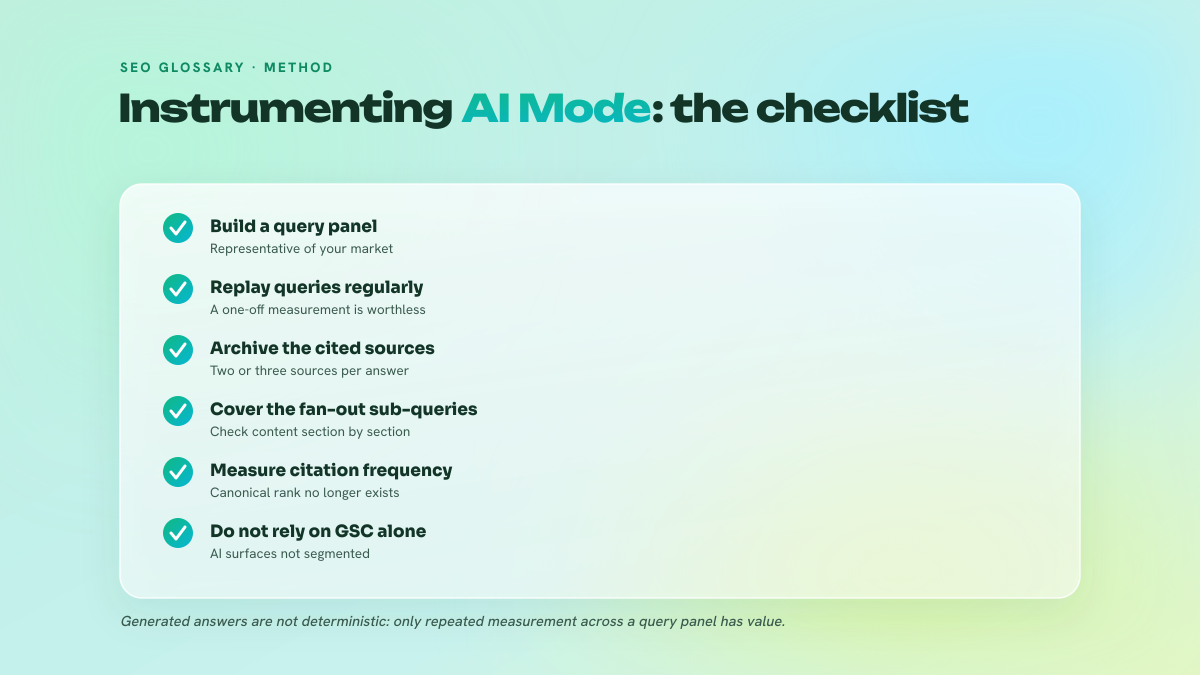
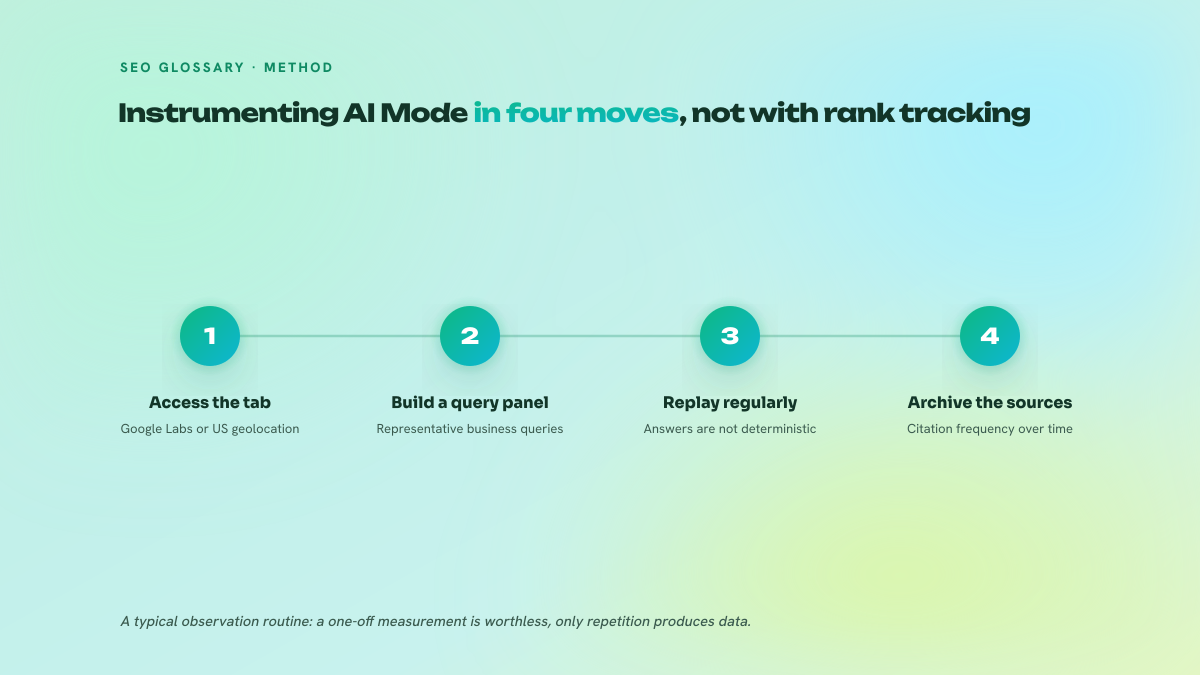
Under the hood, AI Mode runs query fan-out: it breaks the user's prompt into a set of implicit sub-queries, fires them against the index in parallel, retrieves candidate passages, then synthesizes a response with citations. The operational consequence is easy to state and uncomfortable to absorb: you are no longer ranking for one query, you are competing for retrieval across a cloud of sub-queries you never see in any keyword tool.
For a visual walkthrough of accessing and using the feature, this tutorial covers the flow step by step:
Access itself is deliberately frictionless: a dedicated tab on the results page for U.S. users, initially surfaced through Google Labs during the beta phase, on desktop and mobile alike. Users can ask follow-up questions inside the same session, refine, compare, and never touch a traditional result. That frictionlessness is the strategic point. Google is not testing whether people want conversational search; it is migrating them into it.
Measurement is the hard part. Search Console folds AI Mode activity into overall Search performance without a dedicated segment, so you cannot isolate it in the interface. From what we see in audits, the workable proxies are indirect: impressions growing while clicks stay flat or fall on informational queries, and AI agent fetches showing up in raw server logs. If you want to know which sub-intents your money pages actually cover before the model decides for you, an audit of the sub-queries your pages actually answer tells you more than another rank-tracking export.
Citation selection is the final mechanic worth internalizing: it does not follow the organic order. AI Mode and AI Overviews routinely cite well-structured, passage-extractable pages sitting at position 4, 7 or 12, because the selection optimizes for answer relevance and extractability, not for the ranking of the parent document. Clean heading hierarchy, self-contained paragraphs that survive being quoted out of context, and schema markup are what make a passage citable. This is also why Google's own AI search guidance published across 2025 and 2026 keeps hammering first-hand experience and structured, direct answers.
AI Mode vs AI Overviews vs the classic SERP
The confusion we correct most often: AI Mode and AI Overviews are not the same feature wearing two names. AI Overviews inject a generated summary at the top of an otherwise normal SERP; the links are still there, one scroll away. AI Mode is a full conversational experience where the synthesized answer, with its two or three visible citations, is the product. The difference sounds cosmetic. It is not: it determines how much residual traffic the page below the answer can still capture.
This first look shows the feature set and how the answers are assembled in practice:
The economics are documented. Similarweb measured zero-click searches climbing from 56% to 69% between May 2024 and May 2025, exactly the window of broad AI Overview rollout, and a SparkToro and Datos study had already put 58.5% of U.S. searches at zero clicks back in July 2024. A 2026 meta-analysis aggregating Ahrefs and GrowthSRC data (published by Navboost) estimates position-1 CTR drops roughly 32% when an AI Overview is present, and finds about 83% of searches featuring an AI Overview end without any click to the open web, versus roughly 60% for SERPs without one. AI Mode, which removes the link list from the default view entirely, only pushes that logic further.
The counterweight gets less airtime and matters more. Seer Interactive tests reported in 2026 show that being cited inside an AI Overview can lift CTR by more than 80% compared with ranking traditionally on the same query. The pool of clicks shrinks; the surviving clicks concentrate on cited sources. That concentration is the whole game, and it is why we treat «AI citation» as a visibility objective in its own right rather than a curiosity metric.
Who actually gets hurt is also on the record. Chegg's February 2025 antitrust filing documented a 49% year-over-year decline in non-subscriber traffic between January 2024 and January 2025, explicitly attributed to generative answers in search. Publishers monetizing thin informational pageviews are the ones being squeezed. Sites that sell something further down the funnel lose volume but keep the visits that carry intent: NerdWallet reportedly grew revenue 35% in 2024 while monthly traffic dropped 20%, the profile of fewer but better-qualified sessions.
What it changes for a netlinking operation
So what does a conversational answer engine do to link building? Less than the panic suggests, and more than the deniers admit. Links keep their classic job: they remain the primary off-page signal feeding crawl priority, topical authority and rankings, and rankings still feed the retrieval pool AI Mode draws from. But links gain a second job that most link sellers have not priced in: they are retrieval and corroboration infrastructure. LLM-mediated answers lean heavily on whether a brand or claim is corroborated across independent, crawlable, editorially credible sources. An editorial link inside a real article on a real site is simultaneously a PageRank vector and a citable passage an answer engine can retrieve.
The practical consequences follow. Anchor-text obsession matters less; the context surrounding the link matters more, because a linking page that genuinely answers one of the sub-queries in the fan-out cloud can put your brand inside the very passage the model quotes. Exact-match anchors on filler content buy you neither. This is, incidentally, why we run Nautilinks as an owned network with in-house editorial rather than a marketplace of anonymous placements: an article written to be retrievable does double duty that a templated sponsored post cannot.
Before reallocating budget on instinct, test where AI engines actually cite your brand today and compare that map against your organic footprint. The gap analysis usually lands in one of two places: a content coverage gap, where your pages simply do not answer the sub-intents, or a corroboration gap, where your content is fine but no independent source repeats your name next to the topic. If it is the second, a mention-building program designed for LLM retrieval closes it faster than another batch of positional links ever will.
One boundary case worth flagging: local. A May 2025 study covered by Search Engine Journal found AI Overviews appearing on 57% of local queries, concentrated on informational local intent rather than pure local-pack queries. If you operate local clients, the citation logic applies there too, earlier than most local SEOs expect.
The mistakes we keep seeing in audits
The first mistake is definitional: reporting AI Overviews exposure and calling it AI Mode readiness, or the reverse. They share a substrate but not a user experience, and blending them produces conclusions like «we are cited, we are fine» when the citation appears on a surface the client's audience barely uses yet.
The second is attribution panic. Every traffic decline since mid-2025 gets blamed on AI Mode by default. In the audits we run, a large share of those declines trace to ordinary causes: lost rankings after a core update, broken internal linking, indexation drift, cannibalization. AI answer surfaces are real headwind on informational queries; they are not an all-purpose explanation, and treating them as one means the actual fix never ships.
The third is defensive crawler-blocking. Blocking AI agents in robots.txt to «protect content» removes you from the answer layer while your competitors stay in it. For a publisher whose model is pageview arbitrage, that trade might be arguable. For anyone selling services or products, it is self-inflicted invisibility.
The fourth is strategic inertia on keyword selection. Queries where the answer fully satisfies the intent, definitions, quick how-tos, simple comparisons, are the ones AI Mode absorbs at over 70% coverage on informational segments by early 2026 (Digital Applied). Chasing volume there is buying impressions with no click attached. The queries worth fighting for are the ones where clicking is part of the intent: transactional pages, tools, catalogues, anything where the user needs to act rather than know. Prioritize those in your content plan and in your link targets, and accept that some informational rankings are now brand collateral rather than traffic assets.
The last mistake is waiting for clean data before acting. Search Console will not give you an AI Mode segment this year. The operators who adapt are the ones triangulating from logs, citation checks and query-level click erosion now, not the ones waiting for a dashboard to make the decision comfortable.
Nautilinks operates an owned network of editorial media. In-house written articles, transparency disclosures respected, anchor mix calibrated.
Frequently asked questions
Is AI Mode available outside the United States, and should non-U.S. sites care yet?
General availability landed for all U.S. users on May 20, 2025, with international rollout following progressively, typically surfacing first through Google Labs. Non-U.S. sites should care now regardless: AI Overviews, which share the same retrieval substrate, already covered more than 200 countries and 40 languages by May 2025. The optimization work, passage-level answers, structure, corroborated brand mentions, transfers directly. Waiting for local availability means starting the corroboration work eighteen months late.
Can I isolate AI Mode traffic in Search Console?
No. Google folds AI Mode impressions and clicks into overall Search performance without a dedicated filter, so the interface cannot separate them. The workable proxies are indirect: impressions rising while clicks stagnate on informational queries, click erosion concentrated on queries known to trigger AI answers, and AI agent fetches in raw server logs. It is triangulation, not measurement, and anyone promising you a precise AI Mode traffic number is selling confidence they do not have.
How does AI Mode choose which sources to cite?
Not by organic position. The model retrieves passages against its fan-out sub-queries and cites pages that are relevant, extractable and corroborated, which is why pages ranking at position 7 or 12 get cited over position 1 regularly. Self-contained paragraphs that survive out-of-context quoting, clean heading structure, schema markup and independent third-party mentions of your brand all weigh in. Optimizing a page to be quotable is now distinct work from optimizing it to rank.
Should I run separate strategies for AI Mode and AI Overviews?
No. They share the same underlying mechanics: query decomposition, passage retrieval, citation selection. One strategy covers both: cover sub-intents at passage level, structure content for extraction, and build corroboration across independent sources. Where they differ is user behavior, AI Mode sessions are conversational and multi-turn, so intermediate and comparison-stage content gets retrieved deeper into a session. Track them separately if you can; do not build two playbooks.
Does AI Mode make netlinking obsolete?
It makes one kind of netlinking obsolete: exact-match anchors on filler pages whose only function was positional. Links pointing at you from real editorial contexts gain value, because they feed both the classic ranking layer and the corroboration graph LLM answers rely on. A link inside an article that genuinely treats the topic is a retrievable passage carrying your brand. The budget question is not «links or GEO», it is which links do both jobs.
If clicks are collapsing, is the remaining traffic worth more?
The data points that way for commercially structured sites. NerdWallet reportedly grew revenue 35% in 2024 while monthly traffic fell 20%: fewer sessions, higher intent per session. Chegg, dependent on informational pageviews, filed suit in February 2025 over a 49% non-subscriber traffic decline. The dividing line is business model, not SEO skill. If your revenue depends on raw informational pageviews, AI Mode is an existential problem; if it depends on qualified visits, it is a filter.
Test your knowledge
Quiz: Google AI Mode
1/3When did Google AI Mode become generally available to all U.S. users?