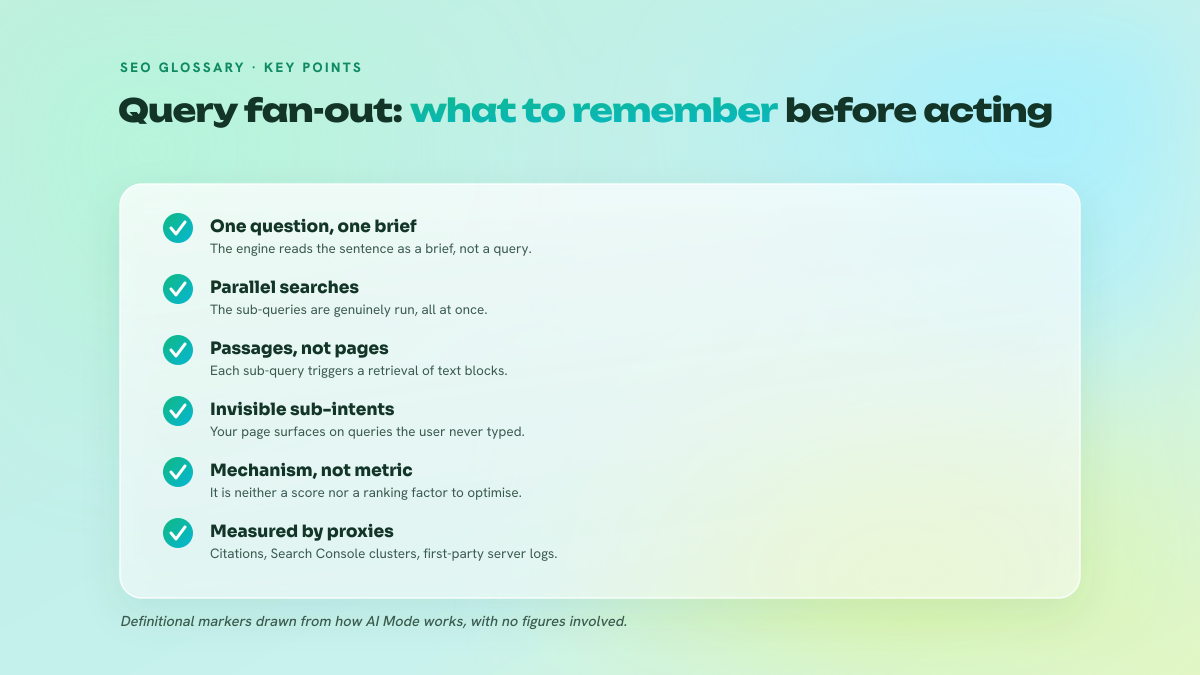
- →Fan-out means you compete on a distribution of 8 to 12 synthetic sub-queries you never see, not on the one keyword in your rank tracker.
- →A Surfer SEO study (December 2025, 173,902 URLs) found 68% of pages cited in AI Overviews were not in the top 10 organic results: classic rankings are no longer a proxy for AI visibility.
- →Authority still compounds: Search Engine Journal data (2025) shows sites with 32,000+ referring domains are 3.5× more likely to be cited by ChatGPT. Fan-out changed the target of links, not their value.
- →The mega-guide is the wrong asset: Growth Memo (2026) found pages covering 26 to 50% of fan-out sub-queries get cited more often than pages attempting 100% coverage.
- →Freshness is now a citation gate: a 2025 Passionfruit report found AI platforms cite pages updated within the last 30 days 76.4% of the time. A static evergreen hub decays out of the answer set.
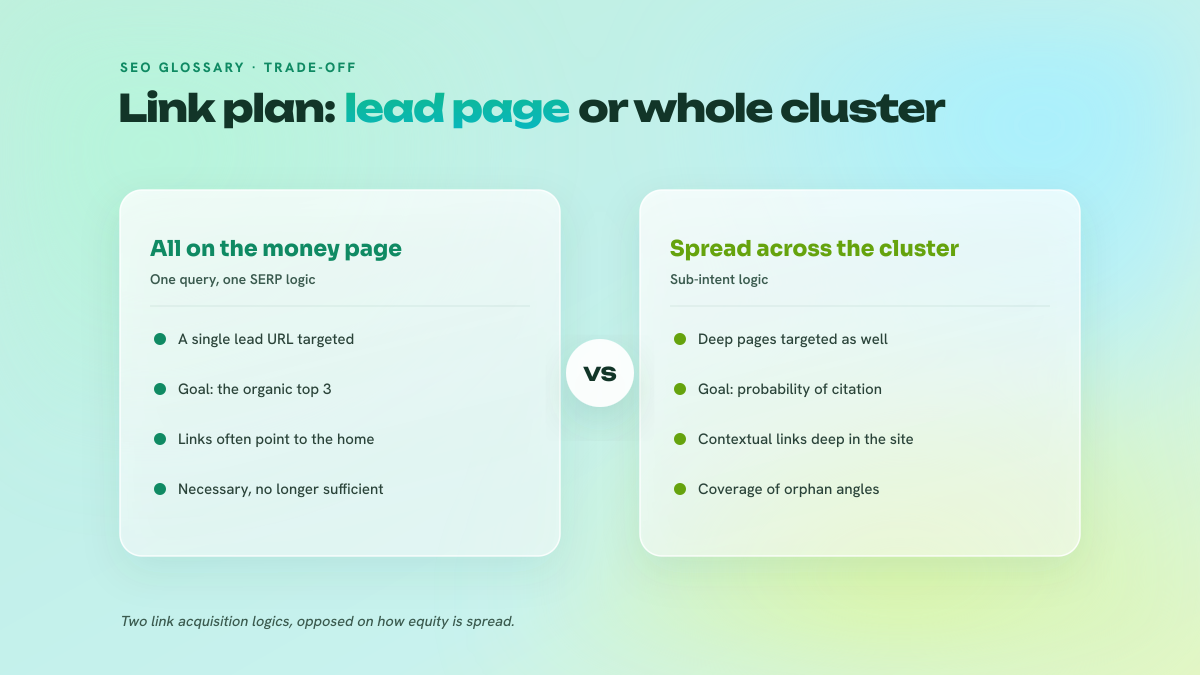
- →Map the fan-out space per money topic, build focused assets per sub-question cluster, and route link equity to those assets, not only to the head-keyword hub.
What query fan-out really is
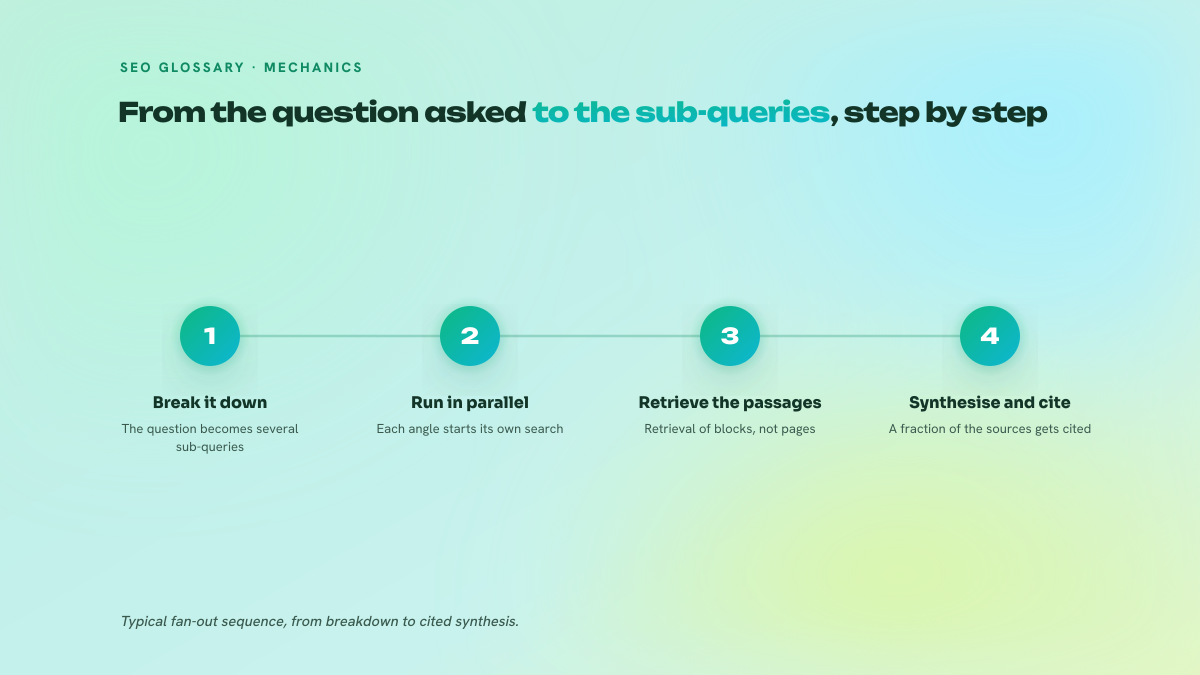
Query fan-out is the decomposition step inside AI search systems: the model takes one user prompt, rewrites it into a set of related sub-queries, runs them against the index in parallel, then aggregates the retrieved passages into a single synthesized answer with citations. Google itself describes fan-out as the core function of how AI Mode assembles its answers, and research across the major systems, Google AI Mode, Gemini, ChatGPT, Perplexity, converges on a typical fan-out of 8 to 12 sub-queries fired from a single user query.
The operational shift hides in that number. In classic search, one query produced one ranked list and your job was to be on it. Under fan-out, the ranked list still exists, but it has become an intermediate data structure the user never sees. The system consults several of them, one per sub-query, and picks passages, not positions. You are no longer competing for a keyword; you are competing for membership in a probability distribution of synthetic queries that no rank tracker shows you by default.
That is why treating fan-out as « AI Overviews jargon » is a mistake. It is the retrieval architecture underneath every generative answer surface that matters commercially in 2026, and it explains most of the divergence people observe between their organic rankings and their AI citations.
How fan-out works in 2026: mechanics and measurement
Mechanically, four stages: decomposition of the prompt into sub-queries, parallel retrieval for each, passage selection across the pooled results, and synthesis with citations. The sub-queries are not paraphrases. They slice the intent into facets: comparisons, pricing, constraints, recency checks. An analysis by 85sixty (2026) notes that time-stamped variants like « 2024 2025 » appear in roughly 6% of all fan-outs, even for evergreen topics, which tells you the system deliberately probes for freshness.
The fan-out set is also increasingly personal. Kopp Online Marketing (2025) measured that 43% of fan-out sub-queries now carry personalized context, up from 18% in 2024. Two users asking the identical question trigger overlapping but distinct fan-outs, which is why AI visibility numbers are inherently noisier than rank positions ever were.
Geographically, this stopped being a US-only concern some time ago: Google rolled AI Overviews out across European countries on 26 March 2025, and AI Mode reached Germany, Austria and Switzerland on 7 October 2025. If you sell links or content into any European market, fan-out already mediates part of your clients' visibility.
Measurement is the immature part. No official tool exposes the fan-out set for a given query. In practice you triangulate: prompt the model to expose its decomposition, mine People Also Ask and Search Console query clusters around the head term, and use dedicated audit tooling, Surfer SEO shipped a Query Fan-Out framework in January 2026 built exactly around this workflow, and Locomotive Agency offers a fan-out coverage audit tool. The metrics that matter are citation rate on the answer surfaces you care about, estimated coverage of the fan-out space, and where in the AI response you appear. None of these live in a classic rank tracker, which is precisely why so many teams still fly blind here.
Why fan-out rewires netlinking economics
Here is the number that should reframe your link strategy. A Surfer SEO study from December 2025, covering 173,902 URLs across 10,000 keywords, found that 68% of pages cited in AI Overviews were not in the top 10 organic results. Only about a third of citations came from pages that classic SEO would call winners. A link campaign whose sole objective is pushing one URL into the top 10 no longer buys AI visibility as a side effect. That correlation is broken, and pretending otherwise is the most expensive assumption in netlinking right now.
That does not mean links stopped working. Domain-level authority still compounds into citation probability: Search Engine Journal data (2025) shows sites with 32,000 or more referring domains are 3.5 times more likely to be cited by ChatGPT. And coverage of the fan-out space has independent value: ALM Corp data (2025) found that pages ranking only for fan-out sub-queries, without ranking for the head keyword at all, are 49% more likely to earn AI citations. Read those two findings together and the conclusion writes itself: link equity should be spread across a portfolio of focused assets that each own a slice of the fan-out space, instead of being concentrated on a single money hub chasing the head term.
We see this pattern directly on the French editorial media we run in-house at Nautilinks: the pages that earn LLM citations are rarely the category hubs we would have prioritized under a pure-rankings logic. They are narrow articles that answer one sub-question completely. If you want to know which slices of a fan-out space your pages actually cover before spending a euro on links, it is worth running a fan-out coverage audit on your money topics first, then calibrating link acquisition around the gaps that audit exposes rather than around a keyword list from 2022.
Where we see it go wrong
The most common failure is the mega-guide reflex: respond to fan-out by writing a 6,000-word page that tries to answer every conceivable sub-query. The data says this backfires. Growth Memo (2026) found that AI systems prefer focused, shorter content: pages covering 26 to 50% of the fan-out sub-queries get cited more often than pages attempting 100% coverage. The same research found that headlines directly answering the question get cited by ChatGPT 41% of the time versus 29% for loosely related headlines. Extraction favors precision, not exhaustiveness.
The second failure is letting assets go stale. A 2025 Passionfruit report found AI platforms cite content from pages updated within the last 30 days 76.4% of the time. Ahrefs data from 2025 points the same way: content cited by AI tools is on average 25.7% fresher than content ranking in traditional results. An evergreen page you have not touched in a year can hold its blue-link position while silently falling out of the answer set.
The third failure is the opposite excess: spinning out one thin page per sub-query and cannibalizing yourself. Fan-out coverage is about clusters of related sub-questions per asset, with clean topical boundaries between assets. Ten near-duplicate pages competing for the same facet confuse the retrieval layer the same way they always confused classic Google.
The last one is organizational: treating fan-out optimization as a separate « GEO budget » disconnected from SEO. It is the same content, the same links, the same entity signals. What changes is the unit of analysis, sub-query clusters instead of keywords, and the success metric, citation in generated answers alongside rankings.
A working playbook for fan-out coverage
Start by mapping the fan-out space for each topic that carries revenue. Combine model interrogation, People Also Ask mining, and Search Console query clusters until you have a list of 15 to 30 recurring sub-questions per topic. Then prioritize ruthlessly: sub-queries with commercial adjacency first, informational tail later. You are not trying to cover everything; the Growth Memo finding says partial, precise coverage wins.
Next, audit what you already have against that map. Most sites discover they hold fragments of answers buried in paragraphs of pages built for other keywords. Refit before you create: give each priority sub-question cluster one asset whose headline states the question and whose first paragraph answers it extractably. Put a refresh cadence on those assets, monthly for anything competitive, given the freshness numbers above.
Finally, point acquisition at the portfolio. Deep links to focused assets, from topically coherent editorial pages, do double duty: they move the classic rankings for the sub-queries and they raise the domain-level authority that the ChatGPT citation data rewards. This is slower and less glamorous than buying one big link to the money page, but it matches how the retrieval layer actually selects sources in 2026. The sites winning AI citations today are the ones that treated fan-out as an architecture constraint eighteen months ago, not a trend to monitor.
Nautilinks operates an owned network of editorial media. In-house written articles, transparency disclosures respected, anchor mix calibrated.
Frequently asked questions
Can I see the actual sub-queries Google fires for a given prompt?
Not through any official interface. You approximate: ask the model directly to decompose the question, mine People Also Ask and related searches, cluster Search Console queries around the head term, and cross-check with audit tooling like Surfer's Query Fan-Out framework (January 2026) or Locomotive Agency's coverage tool. Kopp Online Marketing (2025) measured 43% of sub-queries carrying personalized context, so treat any reconstructed fan-out set as a sample, not a spec.
Does ranking #1 on the head keyword still matter for AI visibility?
It helps but no longer suffices. Surfer SEO's December 2025 study of 173,902 URLs found 68% of pages cited in AI Overviews were not in the top 10 organic results. Meanwhile ALM Corp (2025) found pages ranking only for fan-out sub-queries were 49% more likely to earn citations. Head-keyword rankings and AI citations are now partially decoupled objectives; you have to plan for both explicitly.
Should I build one comprehensive guide or many focused pages?
Focused pages, with discipline. Growth Memo (2026) found pages covering 26 to 50% of a fan-out space get cited more than pages attempting full coverage, and direct-answer headlines get cited 41% versus 29% for loose ones. But one page per sub-query is over-fragmentation: group related sub-questions into clusters, one asset per cluster, with clean topical boundaries to avoid cannibalization.
How does fan-out change what I should buy links for?
It shifts the target from a single money URL to a portfolio. Domain authority still pays, Search Engine Journal data (2025) shows sites with 32,000+ referring domains are 3.5× more likely to be cited by ChatGPT, but the marginal link now often does more work pointed at a focused asset covering an uncovered sub-query than stacked on a head-term hub that already ranks.
Is fan-out behavior the same in ChatGPT, Perplexity and Google AI Mode?
The decomposition pattern is similar, research puts typical fan-out at 8 to 12 sub-queries across systems, but retrieval differs: different indexes, different browsing behavior, different freshness weighting. Ahrefs data (2025) shows AI-cited content averaging 25.7% fresher than traditionally ranking content, and that pressure is stronger on answer engines with live browsing. Audit each surface separately before assuming coverage transfers.
How do I measure whether fan-out optimization is actually working?
Track citation rate on the answer surfaces relevant to your market, estimated coverage of your reconstructed fan-out set, and position within the AI response, alongside classic rankings. Expect noise: personalization means two identical prompts can produce different fan-outs and different citations. Trend lines over weeks matter; single-prompt spot checks tell you almost nothing.
Test your knowledge
Quiz: Query fan-out
1/3According to Surfer SEO's December 2025 study of 173,902 URLs, what share of pages cited in AI Overviews were NOT in the top 10 organic results?