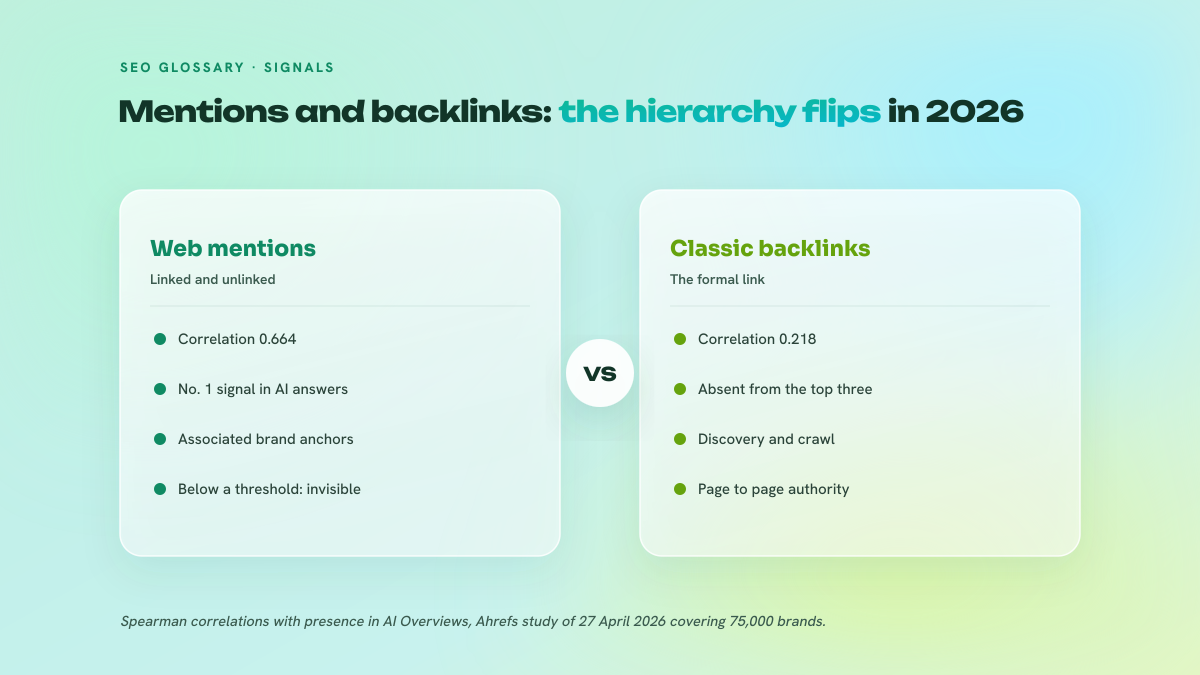
- →Ahrefs' April 2026 study across 75,000 brands measured a 0.664 correlation between branded web mentions and AI Overview visibility, versus 0.218 for backlinks. The entity footprint, not the link graph, decides who gets named.
- →Google's own patents formalized unlinked citations as « implied links ». Mentions were never a consolation prize for a link you failed to get.
- →Measure cited-source coverage, not raw mention volume: the share of sources an answer engine actually quotes for your category queries in which your brand appears.
- →Branded and brand-plus-category anchors do double duty as mention signals; a pure money-keyword anchor policy leaves entity value on the table.
- →Digital PR, ranking listicles and review platforms are the three mention channels with sourced evidence behind them in 2026. Scraped aggregators and junk directories add volume and nothing else.
- →Every editorial backlink is also a mention; the reverse is not true. A netlinking operation that ignores the surrounding text of its placements is using half the deliverable.
What a brand mention really is, beyond the citation count
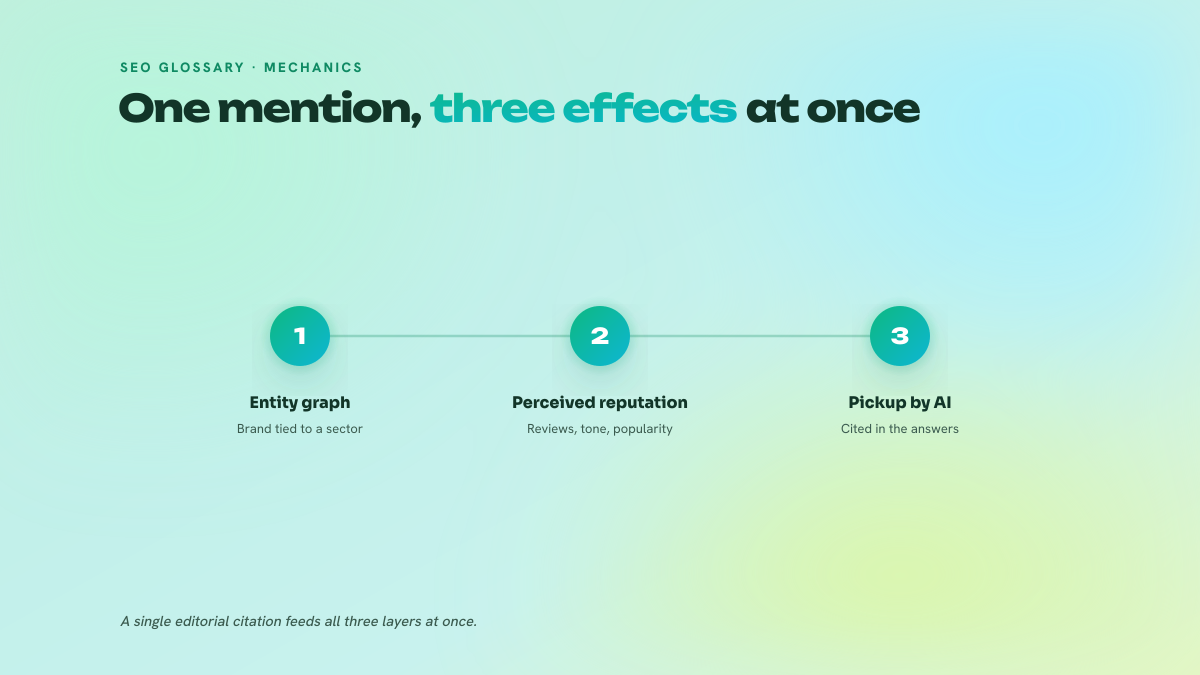
A brand mention is any occurrence of your brand name in a retrievable document: an article, a forum thread, a podcast transcript, a comparison roundup, a review. The industry taxonomy splits them into linked versus unlinked, and direct (the exact brand name) versus indirect (a product name, an executive, a common misspelling the entity graph still resolves). That taxonomy is accurate and mostly useless. The operational point it hides: search engines and answer engines both read mentions as entity evidence, and they have done so for longer than most link builders admit.
Google laid the groundwork in its own patents, which distinguish express links from « implied links »: references to a resource that carry no href but are treated as citation evidence for the target. The mention was never a second-class link. It was always a parallel signal, and the LLM retrieval layer that now sits on top of search has amplified it, because language models learn brand associations from co-occurrence in text, not from anchor tags.
The consequence for a netlinking operation is concrete. The deliverable is no longer just a dofollow link on a site with a respectable authority score. It is the placement of your brand name in a crawlable, citable editorial context, next to the category vocabulary you want to be associated with. The link still transfers PageRank. The mention builds the entity. You want both, but if you must rank them in 2026, the ordering has changed.
Why mentions now outweigh backlinks in AI search
The data shifted decisively across 2025 and 2026. Ahrefs correlated 75,000 brands against their presence in Google AI Overviews and published the results on April 27, 2026: branded web mentions, linked and unlinked combined, showed a Spearman correlation of 0.664 with AI Overview visibility. Traditional backlinks came in at 0.218. Brands sitting in the bottom half for web mentions were, in Ahrefs' phrasing, essentially invisible in AI Overviews.
One correlation study is not causation, but the pattern replicates. Analyze AI examined 74,130 brand mentions and 83,670 citations across ChatGPT, Claude and Perplexity between November 2025 and January 2026, and found the three strongest correlates of AI visibility were web mentions, branded anchor text and branded search volume. Traditional link metrics did not make the podium. Whatever the exact causal chain, the engines that now intercept a growing share of commercial queries select brands by mention footprint, not by link graph position alone.
This video walks through the SEO impact of brand mentions and how social listening surfaces them, which is a useful primer before the measurement discussion below.
Mechanically, none of this is mysterious. AI Overviews and their conversational cousins assemble answers through retrieval and synthesis: the engine fans a query out into sub-queries, pulls passages from sources it trusts, and names the brands those passages name. A brand that exists in the link graph but not in the text corpus gives the model nothing to quote. This is the founding premise of generative engine optimization: you optimize what the machine can cite, and a mention is the minimal citable unit.
How to track mentions across Google and AI engines
Tracking is where most programs are weakest, because the default stack was built for a smaller web. Google Alerts is free and misses most of what matters: it samples Google's own index on a lag, largely ignores review platforms and social conversations, and knows nothing about what AI engines are saying. Treat it as a smoke detector, not as monitoring.
For a concrete walkthrough of monitoring methods that go beyond alerts, this video covers four workable approaches.
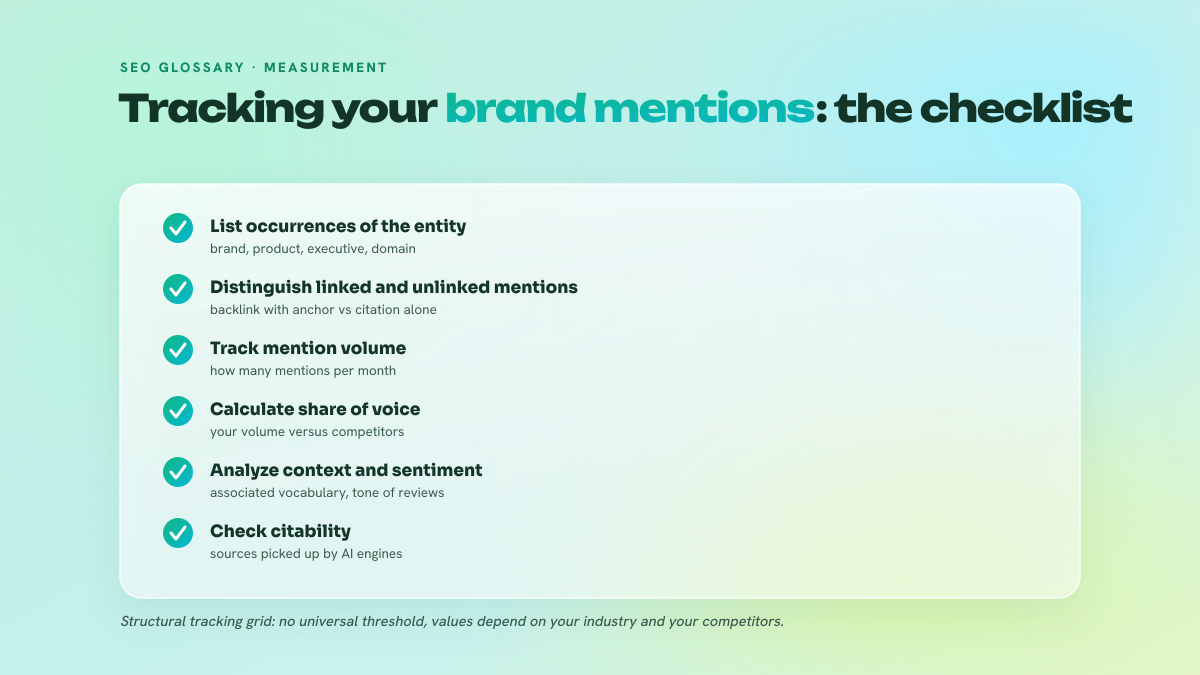
A working 2026 setup has three layers. First, classic mention monitoring (Ahrefs' Brand Radar, BrandMentions, Semrush's listening tools, the choice matters less than the discipline) for volume, sentiment and share of voice against two or three named competitors. Second, mention quality review done by a human: which domains, next to which vocabulary, in which position on the page. Fifty mentions in scraped aggregators are worth less than three in media the engines actually cite. Third, AI answer sampling: run a fixed panel of category prompts through ChatGPT, Perplexity and AI Overviews every month and log which brands get named. That output layer is what we productized in our AI visibility check for brands and their competitors, because almost everyone measures the input side of the mention equation and almost nobody measures whether the machine actually says your name.
The metric that matters is not raw mention count. It is cited-source coverage: the share of the sources an engine quotes for your category queries in which your brand appears. That number can be moved deliberately, source by source. Abstract mention volume cannot.
Where mentions fit in a netlinking operation
Mentions and links are not rival tactics. They are the same editorial act with different attributes. Every editorial backlink is also a mention; the reverse is not true. Which means a netlinking operation that already places articles in real media is sitting on the mention lever without using it: the surrounding text, the co-occurring vocabulary, the branded versus generic anchor mix are all part of the deliverable, whether or not anyone specified them.
In practice we adjust three things. Anchor policy first: branded and brand-plus-category anchors double as mention signals, and Analyze AI's 2026 data ranked branded anchor text among the top correlates of AI visibility, which is one more argument against the exact-match anchor habits that survived Penguin only by luck. Context second: a placement that names the brand once in a footer byline is a weaker entity signal than one that discusses the brand alongside its category terms in the body copy. Inventory third: mentions only count where engines look, which favors identifiable editorial media over the anonymous inventory that dominates link marketplaces. This is why we operate brand mention placements across our own editorial network as a distinct deliverable rather than a byproduct of link sales: the pages are ours, the editorial context is controlled, and the mention keeps working even if a link attribute changes someday.
How to earn mentions that actually count
Digital PR is the consensus engine for earned mentions, and for once the consensus has numbers behind it: in Editorial.link's 2026 survey of 518 practitioners, 48.6% rated digital PR the single most effective link building strategy, well ahead of guest posting. The mechanism is straightforward: one strong data asset gets picked up by many outlets, and every pickup is a mention whether or not the journalist links. If you can only fund one mention channel, fund original data.
Semrush's take on how brands get themselves named by ChatGPT is worth fifteen minutes here, because it maps the earning tactics to the AI surface directly.
Two other channels deserve more budget than they usually get. Listicles and comparison roundups first: answer engines lean heavily on « best X » pages whenever a query implies a choice, so being present in the roundups that already rank is one of the most direct routes to getting named in AI answers. We built a dedicated offer for placing brands in ranking listicles for exactly this reason. Reviews and local citations second: SearchAtlas reported in 2026 that unlinked mentions improved local Map Pack rankings in 63% of local SEO tests run between 2024 and 2025, which makes the mention a local signal too, not just a national brand play. Customer reviews are mentions your competitors cannot buy and your agency cannot fake, which is precisely why engines weight them.
Where brand mention programs go wrong
The most common failure is chasing volume. A monitoring dashboard rewards big numbers, so teams celebrate five hundred mentions a month while four hundred and eighty of them sit in scraped aggregators, autogenerated directories and syndication farms no engine cites. From what we see in audits, the mention profile of a mid-size B2B brand usually contains a minority of placements doing all the work, and nobody has identified which ones.
The second failure is treating unlinked mentions purely as link reclamation targets. Converting a mention into a link adds PageRank on top of an entity signal that already exists; it is worth doing on authoritative, topically relevant pages. But burning outreach goodwill to convert every mention everywhere misreads the situation: the mention is already an asset, not a defective link.
The third is measuring only inputs. A program that reports mention counts and sentiment but never samples actual AI answers is optimizing blind, because the engines weight sources in ways no dashboard fully reverse-engineers. And the fourth is ignoring co-occurrence: a mention next to generic praise teaches the model nothing, while a mention next to your category vocabulary (« editorial netlinking network », « owned media », « transparent catalogue ») is what builds the association you actually want retrieved. Write the context of the mention with the same care you once reserved for the anchor.
Nautilinks operates an owned network of editorial media. In-house written articles, transparency disclosures respected, anchor mix calibrated.
Frequently asked questions
Do unlinked mentions carry weight in classic blue-link rankings, or only in AI answers?
The strongest documented effects in 2026 sit on AI surfaces and local. Ahrefs' April 2026 study ties mentions to AI Overview visibility (0.664 correlation), and SearchAtlas measured Map Pack improvements in 63% of local tests from 2024–2025. For classic organic rankings the evidence is indirect: Google patents describe implied links, but nobody has isolated a clean unlinked-mention effect on blue links. Treat classic rankings as a secondary benefit, not the business case.
Should I still run link reclamation on unlinked mentions?
Yes, but reprioritized. The mention already works as an entity signal, so the incremental value of converting it is the PageRank and referral path, not the citation itself. Rank targets by page authority and topical fit, convert the top of that list, and leave the rest alone. Spending outreach goodwill to convert a mention on a page no engine cites is negative-ROI work.
How do I report mention performance without vanity metrics?
Fix a panel of 20 to 40 category prompts, run them monthly through ChatGPT, Perplexity and AI Overviews, and report cited-source coverage: in what share of the sources those engines quote does the brand appear, versus two or three named competitors. Pair that with mention share of voice from a monitoring tool. Raw mention counts and follower-style volume curves belong in an appendix, if anywhere.
Does the sentiment of a mention matter, or just its existence?
It matters more in AI answers than it ever did in classic search, because engines carry the framing into the response. A mention inside a negative comparison can surface almost verbatim when a user asks which provider to avoid. Monitor context, not just count: the vocabulary co-occurring with your brand is what the model learns to repeat.
What separates a mention AI engines pick up from one they ignore?
Three properties, in order: the page must belong to the set of sources the engine already cites for your category queries; the mention must co-occur with category vocabulary rather than sit isolated in a byline; and comparative formats (roundups, versus pages, buyer guides) get quoted disproportionately when queries imply a choice. A technically perfect mention on a page outside the cited set is invisible.
Test your knowledge
Quiz: Brand Mention
1/3In Ahrefs' April 2026 study of 75,000 brands, what Spearman correlation did branded web mentions show with AI Overview visibility?