- →GEO got a peer-reviewed definition at KDD 2024 (Aggarwal et al.): optimize for inclusion in a synthesized answer, not just a ranked link.
- →Google's July 2026 guidance treats GEO and AEO as still SEO, and tells you to skip chunking, llms.txt files and inauthentic mentions.
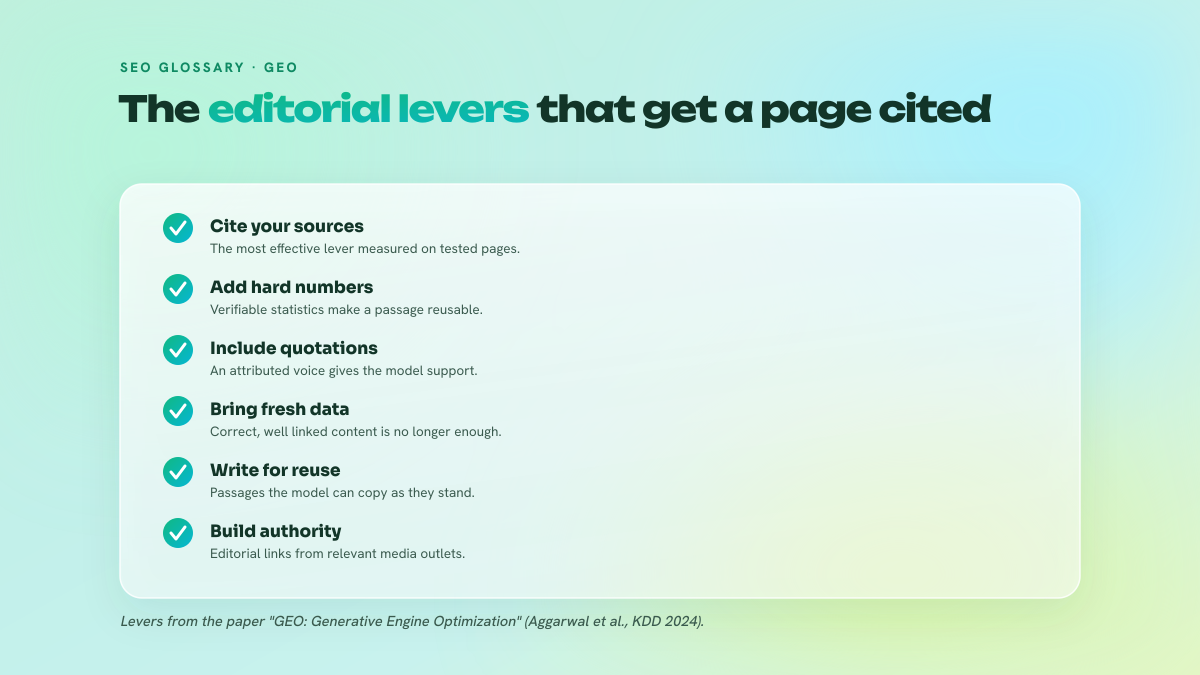
- →The tactics that measurably move visibility are content ones: quotations (+27.8%), statistics (+25.9%), citing sources (+24.9%) per GEO-bench.
- →Cited-in-answer beats ranked-below: Seer Interactive found brands cited in an AI Overview got 35% more organic clicks than non-cited ones.
- →Backlinks and AI citations are different outcomes; an owned network lets you test what content actually gets quoted, not just what ranks.
- →Measure citation share and AI referral traffic as first-class KPIs, because ranking alone no longer predicts clicks in a zero-click SERP.
What GEO actually is, beyond the buzzword
GEO stopped being a marketing coinage the day it got a peer-reviewed definition. The founding paper, «GEO: Generative Engine Optimization» by Aggarwal et al., was published at KDD 2024 (30th ACM SIGKDD), and it did something the acronym-sellers never bothered with: it built a benchmark, GEO-bench, over 10,000 queries across 9 data sources and 25 domains, then measured which content changes actually move a page into a generative answer. That is the useful frame. GEO is the practice of shaping content so a generative engine, ChatGPT, Perplexity, Google AI Overviews, cites it when composing an answer, as opposed to classic ranking where the goal is a blue link a human clicks.
Here is a plain explainer that gets the concept across without the hype:
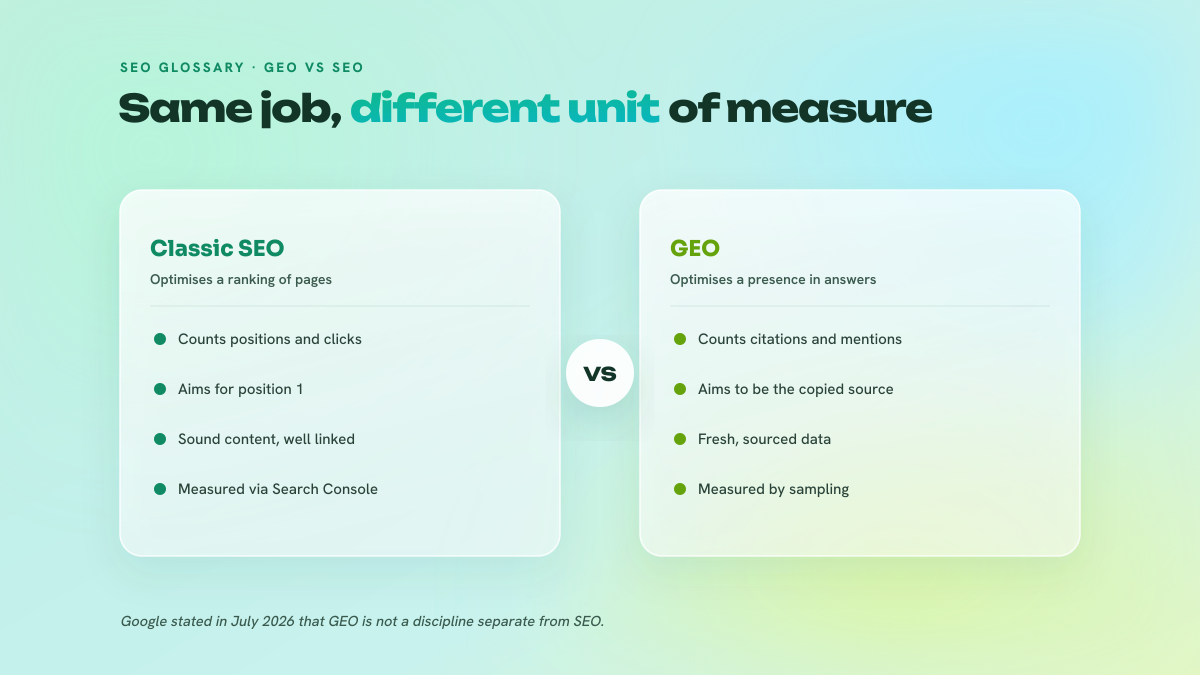
The distinction that matters operationally: SEO optimizes for a ranked list, GEO optimizes for inclusion in a synthesized paragraph. A page can sit at position 4 and never be quoted, while a page at position 8 with a clean statistic and a citable claim gets pulled into the answer. That inversion is what makes GEO its own workflow, not a rebrand of on-page SEO.
GEO vs SEO: same discipline, new surface
The honest position, and the one Google itself now takes, is that GEO is not a separate practice you bolt onto SEO. On July 9, 2026 Google published its «Guide to Optimizing for Generative AI Features», explicitly naming both AEO and GEO, and stated plainly that «From Google Search’s perspective, optimizing for generative AI search is optimizing for the search experience, and thus still SEO». Read that as a warning to anyone selling GEO as a brand-new channel with its own secret levers.
This video argues why generative optimization is becoming the center of gravity rather than a side project:
Where the two genuinely diverge is the objective function and the KPIs. SEO chases rankings, sessions and click-through. GEO chases citations, brand mentions inside answers, and referral traffic from the engines themselves. You still need the crawlable, well-structured, authoritative page SEO always demanded, so the inputs overlap heavily. What changes is the target: being the source a model quotes, measured by tracking your presence in AI answers rather than your rank among ten blue links. If you want the mechanics of how those answer boxes assemble, our entry on how AI Overviews are built covers the retrieval side in detail.
How generative engines choose their sources
A generative answer is not written from the model’s memory alone. Modern engines run a retrieval step: they expand your question into a spray of sub-queries, fetch candidate passages, then synthesize an answer and attach citations. Understanding that pipeline is the whole game, because you are optimizing for the retrieval and citation stage, not for the language model’s eloquence. The query-expansion mechanic in particular is worth studying on its own, since it decides how much of your topic an engine even considers before it writes a word.
The surface keeps growing, which is why this matters more each quarter. Semrush measured AI Overviews on 6.49% of queries in January 2025, doubling to 13.14% by March 2025. Conductor’s 2026 AEO/GEO Benchmarks, built on 21.9 million US queries sampled between September 15 and October 12 2025, found AI Overviews on 25.11% of searches, roughly one in four. Trackers disagree on the exact figure because it swings hard with query mix and methodology, but the direction is not in dispute. For a netlinking operation the takeaway is blunt: a rising share of the SERP real estate you are trying to influence is now a synthesized box, and getting cited there needs a different lever than a raw backlink.
What actually moves visibility inside answers
This is where the Princeton, Georgia Tech and IIT Delhi research earns its keep. Across GEO-bench, the team found that specific content modifications lift a page’s presence in generative answers by roughly 30 to 40% overall. The tactics that carried the most weight were not clever prompt tricks: adding quotations lifted visibility by 27.8%, adding relevant statistics by 25.9%, and citing your own sources by 24.9% (Aggarwal et al., KDD 2024). The «Cite Sources» tactic produced up to a 115.1% relative lift for pages that started around position 5 in the SERP, which tells you the upside is largest for the almost-ranked, not the already-dominant.
If you are starting from zero, this walkthrough is a solid first-move checklist:
Translated into an operating routine: write pages that make a claim, back the claim with a dated, attributable figure, and quote a credible source verbatim so a model can lift a clean sentence. That is the opposite of the thin, hedge-everything content that ranked fine in 2018. It also means auditing which sub-queries an engine expands your topic into before you write, so you cover the actual answer space, a diagnostic we run as part of mapping the questions an engine spins out of your core topic. Structured data helps a retriever parse you, but do not mistake schema for the main lever: the content substance is what gets quoted.
Where GEO meets a netlinking operation
Backlinks and GEO are not the same lever, and pretending otherwise is how agencies oversell. A link builds the crawl-and-authority foundation that makes you retrievable in the first place; a citation inside an AI answer is a separate outcome you earn through content models want to quote. The connection is real but indirect: authoritative, frequently-referenced sources are more likely to be surfaced, and consistent brand mentions across the open web feed the entity recognition these engines lean on. That is why being named as a source inside a model’s answer increasingly behaves like a new class of backlink, one you cannot buy directly.
This is where an owned network changes the math. At Stringer we operate our own media in-house, which means we can place a sourced, statistic-backed piece and observe whether it gets cited, rather than renting a link on a page we do not control and hoping. For teams that want to work this surface deliberately, we treat earning brand mentions inside generative answers as its own service line, distinct from classic link placement. The measurement discipline matters as much as the tactic: Conductor’s 2026 data put AI referral traffic at an average of 1.08% of all website traffic across enterprise sites, with ChatGPT accounting for about 87.4% of that AI-referred traffic. Small today, growing near 1% month over month.
Common mistakes we see go wrong
The first mistake is chasing hacks Google has explicitly told you to drop. That same July 2026 guidance called out artificial «chunking», llms.txt files and inauthentic mentions as things to ignore, noting that existing image, video and quality guidelines already cover generative features. If your GEO plan is a pile of technical gimmicks rather than better-sourced content, you are optimizing for a surface that is actively deprecating your tricks.
The second mistake is ignoring the traffic reality that makes GEO urgent. Zero-click search is the backdrop: SparkToro’s 2026 update (Similarweb data) put 68.01% of US Google searches at zero click, up from 60.45% in 2024. When an AI Overview appears the click hit is severe: Ahrefs’ February 4 2026 analysis found a 58% lower organic CTR for position-one URLs on those SERPs, and Seer Interactive measured organic CTR dropping 61% when an AI Overview was present, while brands cited inside the Overview saw 35% more organic clicks than non-cited brands on the same queries. That last number is the whole argument for GEO: presence inside the answer is now worth more than a rank beneath it.
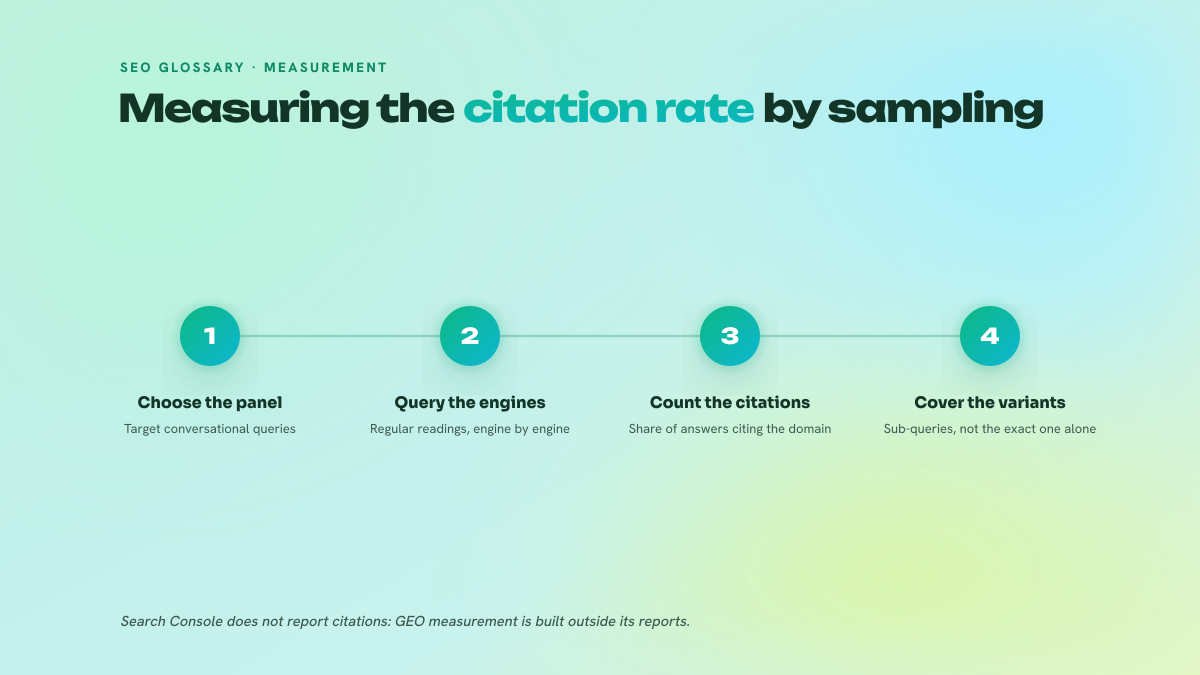
The third mistake is not measuring at all. If you cannot see whether your pages get cited, you are guessing. Track your citation share in the engines that matter to your market, watch AI referral traffic as its own segment in analytics, and treat position in an answer as a first-class KPI alongside ranking. A structured diagnostic, like the one behind our audit of where you already surface across AI engines, beats a dashboard of vanity ranking positions that no longer predict traffic.
Nautilinks operates an owned network of editorial media. In-house written articles, transparency disclosures respected, anchor mix calibrated.
Frequently asked questions
Is GEO replacing SEO, or is it a separate channel to staff?
Neither. Google’s July 2026 guidance states that optimizing for generative AI search is optimizing for the search experience, and thus still SEO. GEO does not replace SEO and it is not a separate department: it reuses the same crawlable, authoritative content foundation and adds a new target, being cited inside answers. Treat it as an extra KPI layer on your existing SEO program, not a parallel budget line with its own secret levers.
What is the concrete difference between optimizing for SEO and for GEO?
SEO optimizes for a ranked position a human clicks; GEO optimizes for inclusion in a synthesized answer a model writes. The mechanics diverge at the objective: rankings, sessions and click-through for SEO, versus citations, brand mentions and AI referral traffic for GEO. In practice a page can rank fourth and never be quoted, while a lower-ranked page with a clean, dated statistic gets pulled into the AI answer. Same inputs, different finish line.
Which content changes give the biggest visibility lift inside AI answers?
The GEO-bench study (Aggarwal et al., KDD 2024) measured it directly. Adding quotations lifted visibility by 27.8%, adding relevant statistics by 25.9%, and citing your own sources by 24.9%. For pages starting around position 5, the «Cite Sources» tactic reached up to a 115.1% relative lift. The pattern is consistent: make a claim, attach a dated figure, quote a credible source verbatim. Prompt tricks and keyword stuffing do not appear on that list.
Do backlinks still matter if the goal is getting cited by an AI engine?
Yes, but indirectly. A backlink builds the authority and crawl signals that make you retrievable in the first place, which is a precondition for being surfaced. But a link does not buy a citation: models quote content they can lift cleanly, so a sourced, statistic-backed page earns the mention. Think of links as the foundation and citations as a separate outcome you cannot purchase directly. Both belong in the plan, weighted differently.
How do you actually measure whether a GEO effort is working?
Stop treating ranking as the only signal. Track your citation share inside the engines relevant to your market (ChatGPT, Perplexity, AI Overviews), segment AI referral traffic separately in analytics, and log whether target pages appear as sources in answers. Conductor’s 2026 benchmark pegged AI referral traffic near 1.08% of enterprise traffic and rising, so the segment is small but growing. A citation-presence dashboard tells you more than a rank tracker in a zero-click SERP.
Should I build llms.txt files and chunk my content for the models?
Google’s July 2026 guide explicitly names artificial chunking, llms.txt files and inauthentic mentions as hacks to ignore, stating that existing quality, image and video guidelines already cover generative features. From what we see in audits, time spent on these gimmicks would return far more if redirected to sourcing claims and structuring genuinely useful pages. Skip the technical folklore; the retrievable, quotable, well-attributed page is what actually gets cited.
Test your knowledge
Quiz: Generative Engine Optimization
1/3In the GEO-bench study (Aggarwal et al., KDD 2024), which content modification produced the largest measured visibility lift?