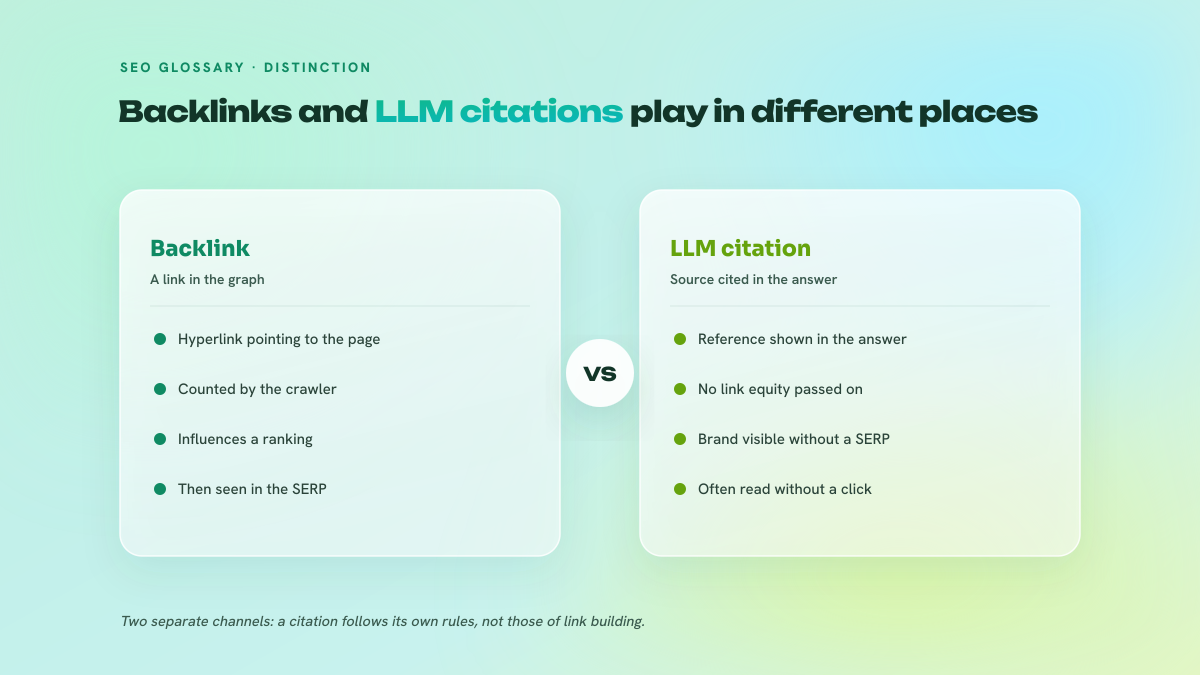
- →A citation is not a backlink: it is a probabilistic event re-rolled on every prompt, and implicit attribution matters more than the linked footnotes most tools count.
- →Citation sets are more concentrated than SERPs (top ten domains capture 54% per HubSpot's 2026 GEO data) and roughly 80% of cited domains don't rank in Google's top 100, so your ranking is a weak proxy.
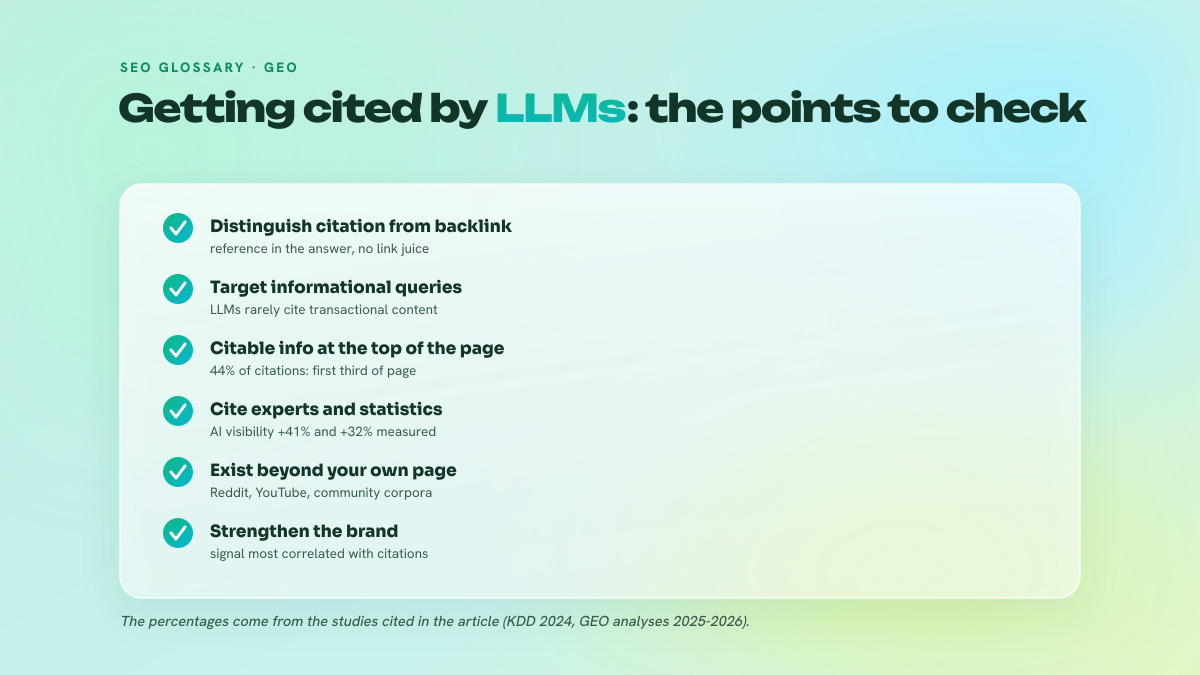
- →Brand search volume is the strongest measured predictor of citations (0.334 correlation, Digital Bloom 2025), which reframes brand demand as a GEO lever rather than a vanity metric.
- →Concrete content moves have measured weight: expert quotations +41%, statistics +32%, authoritative citations +30% (Princeton/Georgia Tech, KDD 2024), and 44% of citations come from the first third of the page.
- →Format is now a citation decision: video, YouTube and Reddit over-index in 2026 citation sets, so owned long-form alone is not enough.
- →Pages cited in AI Overviews earn 35% more organic clicks (Seer, November 2025), so a citation is a traffic protector, but you cannot force one.
What an LLM citation actually is
An LLM citation is a reference a large language model attaches to a claim in its generated answer, pointing back to the source it drew from. That is the dictionary line, and it hides the part that matters operationally: a citation is not a backlink. A backlink is a durable edge in a graph you can crawl and re-crawl. A citation is a probabilistic event, re-rolled on every prompt, that may or may not surface your URL even when the model demonstrably used your text.
The field splits citations into two shapes. An explicit citation is the footnoted, hyperlinked source you see under a GPT or Perplexity answer, the clickable reference. An implicit citation is when the model reproduces your information, your framing, your numbers, without linking back at all. Most SEO teams only count the first kind because it is the only one their tools can see. That blind spot is where the real work sits: implicit attribution shapes brand recall and model priors long before a linked citation ever appears.
Worth separating too: a citation versus a mention. A mention names your brand in the answer text. A citation ties a specific claim to your page. Both feed AI visibility, they are not the same lever, and conflating them produces reporting that looks precise while measuring almost nothing.
How citation works across models in 2026
Every major engine cites differently, and the differences are operationally significant. GPT-class models lean on explicit footnotes pulled from a retrieval pass. Perplexity is citation-first by design and will not answer without listing sources. Claude tends toward implicit attribution woven into the dialogue rather than numbered references. Gemini surfaces inline source links tied to Google's index. A single page can be cited by one engine and ignored by another for the same query, which is why a model-by-model view beats a single blended AI-visibility score.
The measurable reality of 2026 is concentration. Per HubSpot's 2026 GEO statistics roundup, the top five domains capture 38% of all LLM citations, the top ten reach 54%, and the top twenty reach 66%. Citation sets are a shorter head than classic SERPs. More striking: roughly 80% of LLM-cited domains do not rank in Google's top 100 for the same query (2025-2026 GEO research), which means the ranking you already own is a weak predictor of whether you get cited at all.
Scale is not hypothetical. One 2025 study analyzed 5,504,399 LLM responses across 748,425 queries between late August and late September 2025, confirming that citation frequency swings hard by model version. If you are watching a single model you are seeing a fraction of the picture. This is where our own monitoring of where the network gets picked up by generative engines earns its keep: the signal is only meaningful across engines and over time, not as a one-shot check.
How LLMs decide what to cite
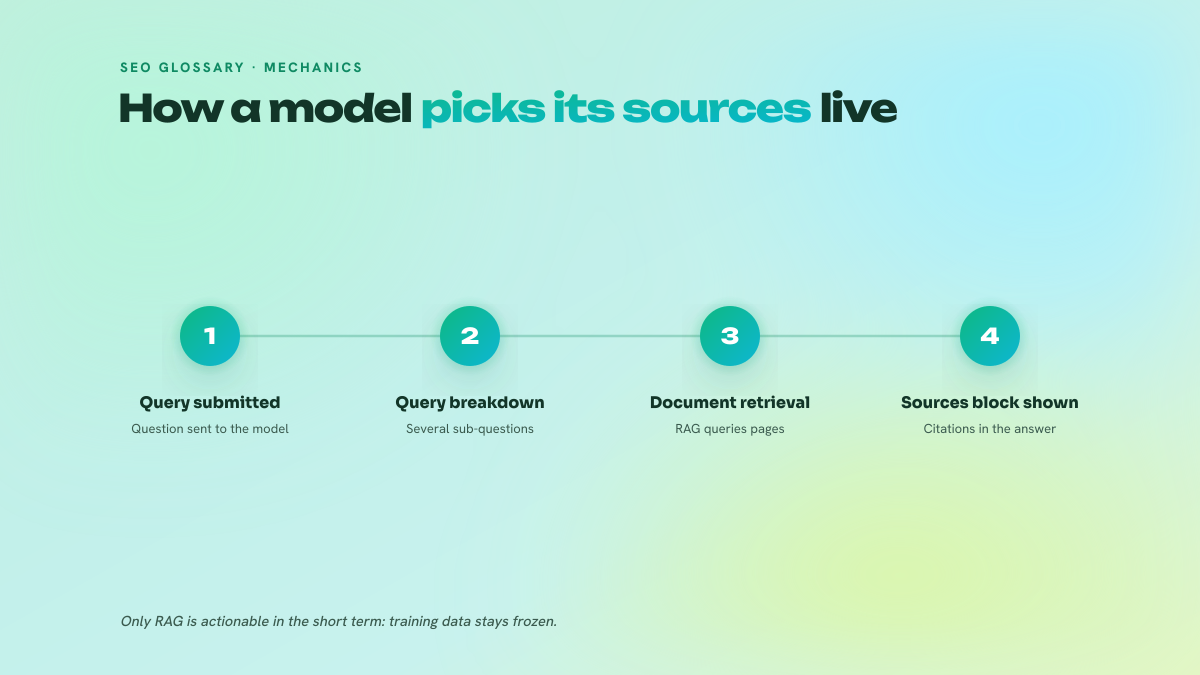
Citation selection is retrieval plus ranking plus a trust prior, not a mystery box. The model runs a query, usually reformulated into several sub-queries, retrieves candidate passages, and cites the ones it judges most relevant and trustworthy. The lever most teams underrate is that trust prior, and it correlates with something distinctly unglamorous.
A short walk through the signals behind those choices:
Per a 2025 Digital Bloom report summarized in a 2026 stats roundup, brand search volume is the single strongest predictor of LLM citations, with a correlation of 0.334. Read that plainly: demand for your brand name, the thing classic SEO often dismisses as a vanity metric, is the closest thing to a citation dial anyone has measured. Placement matters too. A 2024 KDD paper from Princeton and Georgia Tech found that 44% of AI citations come from the first third of a page, so burying your citable claim under 800 words of preamble is self-sabotage.
This is also where the way a single intent gets expanded into many sub-queries changes the game: you are not optimizing for one query, you are trying to be the passage that survives a dozen reformulations, each retrieving a slightly different candidate set.
Earning citations in a netlinking operation
The tactics that move citations are boringly concrete, and there is now data on their weight. The same 2024 KDD study measured content interventions: adding expert quotations lifted AI visibility by 41%, adding statistics by 32%, adding authoritative source citations by 30%. Structure compounds it: per HubSpot's 2026 GEO data, LLMs are 28 to 40% more likely to cite content with strong formatting, meaning headings, bullets, and tables.
Concrete content moves that earn citations:
Format choice is itself a citation decision now. Video is the single most cited content format in 2026, with YouTube alone accounting for nearly a quarter of citations across engines (HubSpot GEO roundup). Reddit surged too: one 2025 analysis put Reddit at the top of LLM citations around 40.1% with Wikipedia at 26.3%, and Reddit citations rose 450% between March and June 2025. The operational read is that owned long-form is necessary but not sufficient, you also need presence where models over-index.
And a citation strategy that holds up in AI search:
This is the point where netlinking and GEO stop being separate disciplines. Authority still feeds the trust prior, and that authority is built the way it always was, through relevant editorial links from real media. On our side we treat it as one motion: covering the reformulations a model tries before it settles on a source, and placing the brand mentions a model can attribute back to you. Nautilinks runs this on its own French media, in-house, so the citation and the link come from the same calibrated source rather than a black-box marketplace.
What we see go wrong
The recurring failure is measuring only explicit citations and declaring victory or defeat on partial data. From what we see in audits, teams track linked footnotes, miss every implicit attribution, and conclude GEO does not work for them. The second failure is chasing citations while ignoring the traffic reality underneath. Seer Interactive data updated November 2025 shows pages cited in AI Overviews earn 35% more organic clicks and 91% more paid clicks than non-cited pages on the same queries, so a citation is a traffic protector, not a trophy, but only where the surface actually shows its sources.
Third: trying to force a citation. You cannot make a model cite you on command, and the tactics that promise it, keyword-stuffed answer boxes and thin FAQ schema spam, degrade the very trust prior you need. Fourth, and most expensive for a link-selling operation: assuming your Google ranking carries over. It does not. With roughly 80% of cited domains sitting outside Google's top 100 for the query, a separate citation strategy is not optional. Pair it with an honest read of what generative-engine optimization can and cannot deliver and you avoid the two-year detour most teams are walking into.
Nautilinks operates an owned network of editorial media. In-house written articles, transparency disclosures respected, anchor mix calibrated.
Frequently asked questions
Can you force an LLM to cite your content?
No, and the tactics that promise it tend to backfire. A citation is a retrieval-plus-trust decision the model re-makes on every prompt, so there is no attribute or markup that guarantees inclusion. Keyword-stuffed answer boxes and thin FAQ schema spam actively erode the trust prior you depend on. What you can influence is the odds: put the citable claim in the first third of the page, add sourced statistics and quotations, and build genuine brand demand, which is the strongest measured predictor.
Do LLM citations affect my classic Google rankings?
Not directly. There is no confirmed signal where a ChatGPT or Perplexity citation feeds Google's ranking system. The relationship runs the other way and weakly: authority and brand demand that help you rank also feed the citation trust prior. But treat them as two scoreboards. With roughly 80% of cited domains outside Google's top 100 for the query (2025-2026 GEO research), a page can be cited constantly while ranking nowhere, and vice versa. Report them separately or you will misread both.
How do you track implicit citations that carry no link?
This is the hard part most tools skip. Explicit citations you can scrape from the answer's source list. Implicit attribution requires prompting the models across your target query set and matching their unlinked claims, numbers, and framing back to your content, at scale and repeatedly, since output varies per run. Manual spot checks catch the obvious cases. For anything systematic you need automated, cross-model sampling over time, because a single-model, single-run snapshot tells you almost nothing about your real citation footprint.
Why does my top-ranking page never get cited?
Because ranking and citation are decoupled. Per 2025-2026 GEO research, around 80% of LLM-cited domains do not appear in Google's top 100 for the same query. Models retrieve and re-rank against their own trust priors, weighted heavily toward brand search volume (0.334 correlation, Digital Bloom 2025) and content structure. A page can own position one and still lose the citation to a Reddit thread or a video, which is exactly why a GEO strategy has to be built separately from your SERP strategy.
Which model should I set up citation tracking for first?
Track more than one from day one. The 2025 study of over 5.5 million responses confirmed citation frequency swings sharply by model version, and each engine cites in a different shape: Perplexity is citation-first, GPT footnotes, Claude leans implicit, Gemini uses inline Google-index links. If your buyers skew toward one assistant, weight it, but a single-model view will systematically over or underestimate your visibility. Cross-engine monitoring over time is the only read that survives contact with reality.
Test your knowledge
Quiz: LLM Citation
1/3According to HubSpot's 2026 GEO data, what share of all LLM citations do the top ten domains capture?