- →ChatGPT SEO is generative engine optimization applied to one engine, not a new discipline: crawlability for OpenAI's bots, citable passages, and brand mentions in sources the model already trusts.
- →The channel is small but concentrated and converting: per Semrush clickstream data, over 30% of all ChatGPT outbound referrals go to just ten domains, and WebFX measured generative AI traffic converting about 1.2 times higher than organic search.
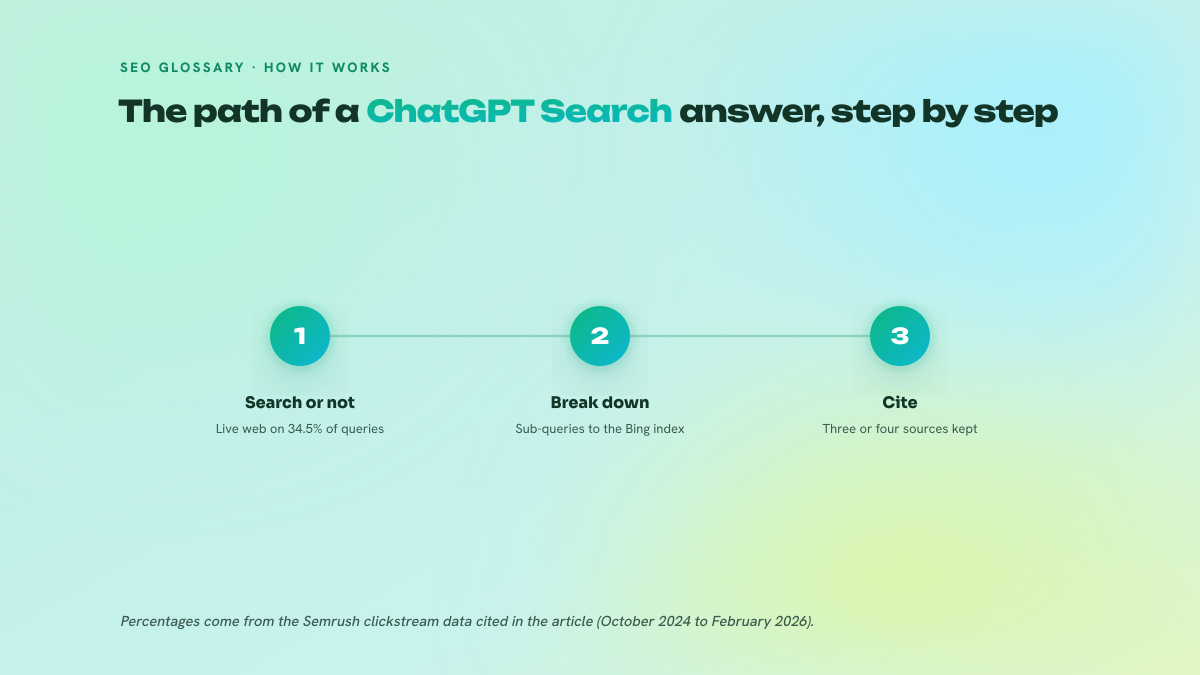
- →Only 34.5% of ChatGPT queries triggered a live web search as of February 2026 (Semrush), down from 46% in late 2024: most answers come from model memory, which is why mentions compound and page tweaks alone underperform.
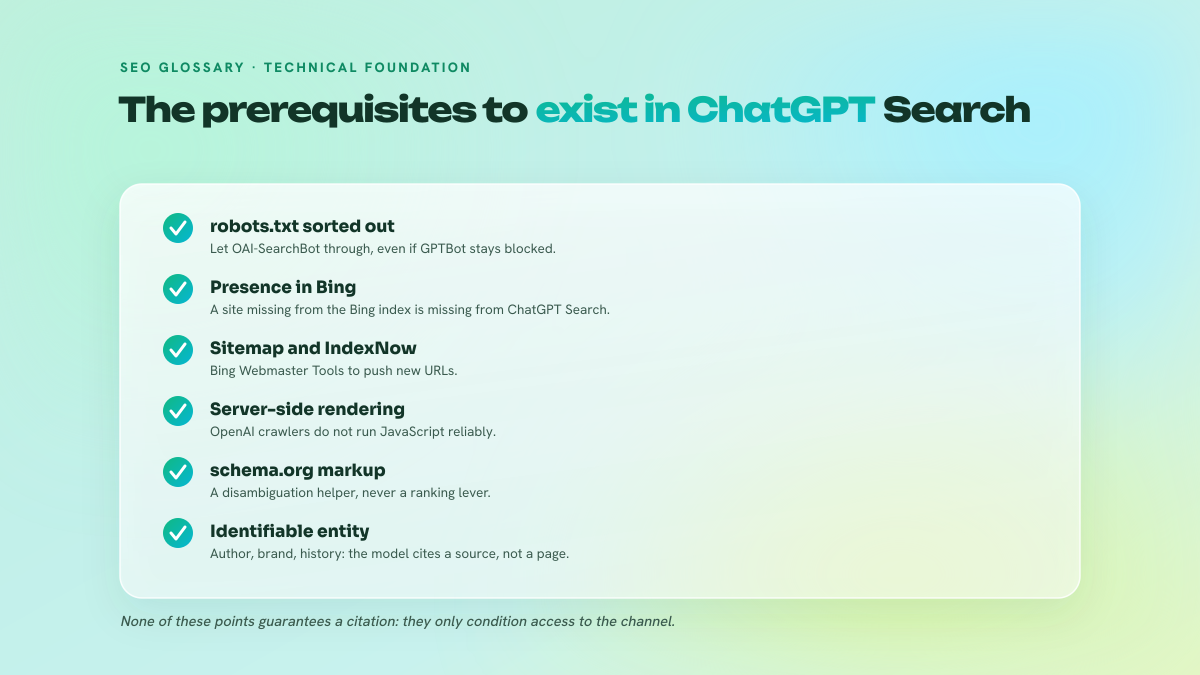
- →Bing indexation is a hard prerequisite for the retrieval layer: verify Bing Webmaster Tools and check server logs for OAI-SearchBot, GPTBot and ChatGPT-User before touching content.
- →Measure in GA4 referrals, raw server logs and citation tracking, never in rank trackers alone: the entire ChatGPT surface is invisible to position monitoring.
- →Blocking GPTBot as a reflex trades long-term presence in model memory for a content-protection benefit most link-selling and B2B sites do not actually need.
What ChatGPT SEO really is, beyond the buzzword
Strip the label and you find three concrete jobs: make sure OpenAI's crawlers can fetch and index your pages, make your content quotable enough to be cited inside answers, and build enough brand presence across the sources ChatGPT trusts that the model names you unprompted. That is the whole discipline. Everything else currently sold under the ChatGPT SEO banner is either classic on-page work wearing a new badge, or vapor.
Scale first, because the market oversells it. SE Ranking put AI platform traffic at roughly 0.15% of global internet traffic in 2025, against 48.5% for organic search. Nobody should reallocate a search budget on those numbers alone. What makes the channel worth deliberate work is its trajectory and its quality: WebFX's analysis of 2.3 billion sessions (January 2024 to December 2025) measured 796% growth in generative AI traffic, converting about 1.2 times higher than classic organic search, with ChatGPT alone accounting for 82.6% of all generative AI traffic over 2024-2025. Small pipe, fast growth, better-qualified visitors.
The second structural fact a practitioner needs: this traffic is brutally concentrated. Semrush's clickstream study of more than a billion US sessions (October 2024 to February 2026) found that over 30% of all ChatGPT outbound referrals go to just ten domains. The default outcome of doing nothing is not a small share, it is zero. ChatGPT SEO is the work of getting into that cited minority, and in practice it looks far more like generative engine optimization than like a separate specialty with its own toolbox.
How ChatGPT selects and cites sources in 2026
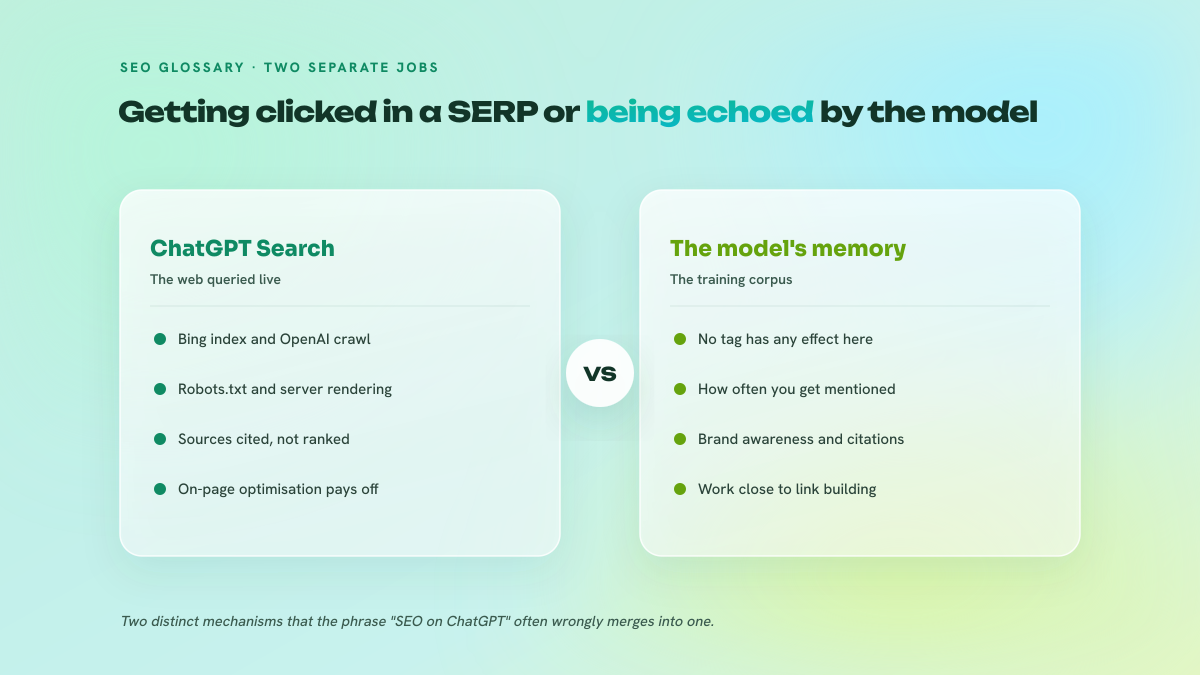
ChatGPT answers from two layers, and confusing them is the most common strategic error we correct. The first layer is model memory: training data and the brand associations baked into it. You influence it slowly, through years of consistent mentions across the pages crawlers ingest. The second layer is live retrieval, and it is smaller than most agency decks claim: per Semrush's clickstream data, ChatGPT triggered a live web search in 34.5% of queries as of February 2026, down from 46% in late 2024. Read that again: roughly two thirds of prompts are answered from memory. Mentions and entity presence compound in the layer that handles most answers, while page-level optimization only competes in the retrieval layer.
This case study walks through what actually moved when a site optimized for ChatGPT and Google AI simultaneously, and matches what the aggregate data suggests:
When retrieval does fire, the plumbing is unglamorous. ChatGPT's live search leans on Bing's index, which makes Bing Webmaster Tools a mandatory verification rather than the afterthought it has been for a decade of Google-only workflows. Then check your raw server logs for three distinct user agents: OAI-SearchBot (search indexing), GPTBot (training-data collection) and ChatGPT-User (real-time fetches when a user's session pulls your page). A page these agents cannot reach does not exist for the retrieval layer, whatever it ranks on Google.
Citability is the other half. Models lift passages that stand alone: a claim stated plainly, a number attributed to a source, a definition delivered in the first sentence of a section rather than buried under three paragraphs of throat-clearing. From what we see in audits, pages that already win featured snippets tend to get cited; pages built on narrative build-up rarely do, however strong their backlink profile.
Where it fits in a netlinking and visibility operation
The honest read for anyone buying links: large language models do not count backlinks the way PageRank does, but the pages they retrieve are still surfaced by classic search infrastructure, so authority signals reach ChatGPT indirectly. Link equity still buys you retrieval eligibility. What changes is the second payload of a placement. An editorial link that never gets clicked can still put your brand name inside a page an AI engine ingests, and that mention keeps working in the memory layer where anchor text equity is irrelevant to the model.
Comparison pages, roundups and glossaries are disproportionately represented among cited sources, which is why placing brand mentions in pages AI engines already cite has become a distinct line item in a netlinking budget rather than a side effect of it. From what we see in first-party logs across the owned media we operate at Nautilinks, chatgpt-user and oai-searchbot hits show up on every site, and they cluster on exactly these formats: structured comparisons, definitional entries, direct answers to specific questions.
Measurement has to change with the target. Three surfaces, none of them a rank tracker: referral sessions in GA4 (chatgpt.com as referrer), AI crawler activity in raw server logs, and prompt-level citation tracking, the kind of baseline you get from a structured audit of where your brand surfaces in AI answers. If a provider reports ChatGPT visibility through keyword positions, they are measuring a different channel and billing you for this one.
Using ChatGPT as a working SEO tool
The term's second meaning, using the model as labor inside an SEO workflow, deserves the same unsentimental treatment. Where it holds up: clustering keyword exports, extracting entities from a scraped SERP, drafting schema markup, reformulating meta descriptions against a character limit, summarizing crawl data. Transformations of material you supply, where hallucination has nowhere to hide because you can diff the output against the input.
This walkthrough covers the practical end of that workflow better than most written guides:
Where it fails, predictably: statistics, which it fabricates with confidence; net-new factual claims; and anchor text generated at scale, which converges on detectable patterns. The irony of the moment is quantifiable. Semrush's AI SEO statistics report, drawing on Previsible data across 19 GA4 properties, measured LLM referral traffic growing from 17,000 to 107,000 sessions comparing January-May 2024 against the same window in 2025, a 527% increase: the engines redistributing clicks became the industry's default drafting tool in the same eighteen months. Use the model as an accelerator on your own data. Never use it as a source.
What 2026 actually looks like: substitution, not replacement
Will ChatGPT replace SEO? The aggregate numbers describe redistribution, not collapse. Reuters and Chartbeat data reported Google search referrals to publishers falling by about a third year over year to November 2025, while Similarweb measured zero-click searches rising from 56% to 69% between May 2024 and May 2025 (via Search Engine Journal). On Google's own turf, Ahrefs' June 2024 study measured a 34.5% average drop in organic clicks when an AI Overview sits above the results. The click is being intermediated everywhere at once; ChatGPT is one intermediary among several, and per Wellows' 2025 synthesis it handled around 37.5 million search-equivalent queries per day in 2024, about 0.25% of global search volume. The disruption is real and the volumes are still asymmetric. Both things are true.
For a forward-looking playbook on positioning for this shift, this is a reasonable survey of the strategic options:
The skill shift underneath is more interesting than the traffic shift. Engines now decompose a single prompt into multiple sub-queries before assembling an answer, which rewards content built around how engines decompose a prompt rather than content built around one head keyword. The fundamentals converge with what good SEO always was: coverage, clarity, verifiable claims. The scoreboard changes: being cited, not just ranking.
Mistakes we keep seeing in audits
Blocking GPTBot as a reflex. The robots.txt block spread through 2024 as a content-protection stance, and for a news publisher monetizing exclusives it can be rational. For a B2B site whose entire goal is being known and recommended, it is self-harm: you exit the training layer, the one that answers most prompts, to protect content you published in order to be read.
Buying « AI SEO » retainers that are re-labeled on-page audits. The test is the deliverable: a real engagement names target prompts, establishes a citation baseline, and reports movement against it. If the deliverable is a title-tag spreadsheet, you bought 2019.
Measuring the channel with tools that cannot see it. Rank trackers observe none of this; server logs and GA4 referral segmentation observe all of it, and they are already paid for.
Chasing volume in a concentration game. With most referrals flowing to a handful of domains per topic, the play is depth on the questions you can own, not a thousand thin pages hoping for incidental retrieval. One glossary entry that answers a professional question completely outperforms twenty pages that each answer it partially, because the model only needs one source to quote.
Nautilinks operates an owned network of editorial media. In-house written articles, transparency disclosures respected, anchor mix calibrated.
Frequently asked questions
Is ChatGPT SEO actually different from GEO, or is it the same work under two names?
It is GEO scoped to one engine. The mechanics that generalize (citable passages, entity consistency, mentions in trusted sources) are shared with optimizing for Perplexity or Google's AI features. What is ChatGPT-specific is the plumbing: Bing indexation as the retrieval backbone, and the OAI-SearchBot, GPTBot and ChatGPT-User agents in your logs. Treat ChatGPT SEO as the operational checklist and GEO as the discipline.
How do I verify whether ChatGPT can actually see my site?
Three checks, in order. Confirm your pages are indexed in Bing Webmaster Tools, since ChatGPT's live search leans on Bing's index. Grep your raw server logs for OAI-SearchBot, GPTBot and ChatGPT-User to confirm fetches are happening and not blocked by robots.txt or a WAF rule. Then run your money queries directly in ChatGPT with search enabled and record which domains it cites: that is your competitive baseline.
Do backlinks still matter for ChatGPT visibility?
Indirectly, yes. The model does not compute link equity, but its retrieval layer pulls from search indexes where authority still decides who surfaces. A link's second payload matters more than before: the brand mention it carries persists into training data, where anchors are meaningless. In practice we treat placements in pages AI engines already cite as a distinct objective from classic equity transfer.
What share of traffic should I realistically expect from ChatGPT?
Low single digits at best today. SE Ranking measured AI platform traffic around 0.15% of global internet traffic in 2025 versus 48.5% for organic search, and Semrush notes some properties now exceed 1% of sessions from AI platforms. The argument for investing is not current volume: it is 206% year-over-year referral growth (Semrush clickstream, January 2025 to January 2026), above-organic conversion, and the fact that citations concentrate on the few sites that moved early.
Should I block GPTBot to protect my content?
Only if your business model depends on exclusivity of the content itself, as with paywalled journalism. For most B2B and service sites the calculus is inverted: GPTBot feeds the training layer, and per Semrush only 34.5% of queries trigger live search, so the memory layer answers most prompts. Blocking it removes you from the surface where the majority of recommendations are formed, in exchange for protection you rarely need.
Test your knowledge
Quiz: ChatGPT SEO
1/3As of February 2026, what share of ChatGPT queries triggered a live web search, according to Semrush's clickstream data?