- →The tail is defined by low volume plus specific intent, not by word count: a two-word query like « SEO Toulouse » can be deep tail while a four-word head term is not.
- →Long-tail queries aggregate 70 to 92% of search traffic and convert around 2.5 times higher than head terms (Ranktracker 2025), so they carry the revenue even at tiny per-term volume.
- →AI Overviews now trigger on nearly 48% of tracked queries (NuTech Digital, Feb 2025 to Feb 2026) and cut informational click-through up to 30% (BrightEdge, May 2025): target tail queries where the click still has a reason to happen.
- →Build external links into the pillar or hub and let internal links distribute equity into the tail: clusters hold rankings roughly 2.5 times longer and 86% of AI citations come from sites with at least five interconnected pages (Yext 2025).
- →Scaled thin tail pages are exactly what the 2025 to 2026 core and spam updates demote: specificity and unique insight beat raw volume.
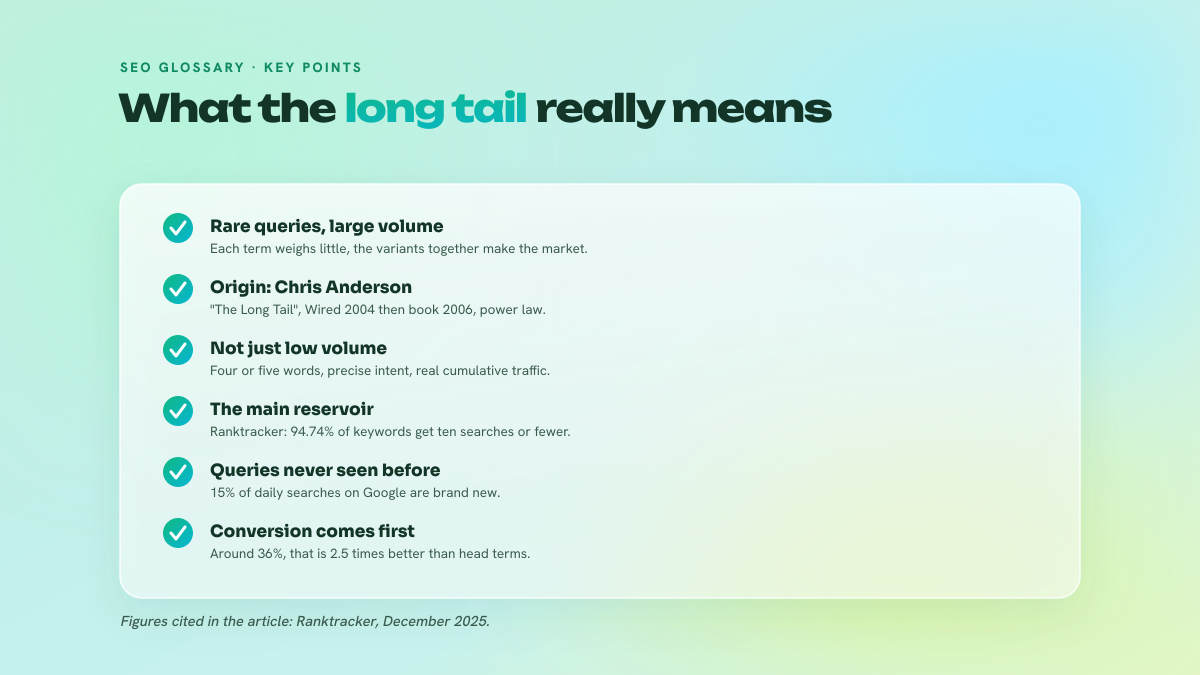
Beyond the curve: what the long tail actually describes
The term comes from Chris Anderson, who coined « The Long Tail » in Wired in 2004 and expanded it into a 2006 book. His argument was economic long before it was ever about SEO: in a market freed from shelf-space limits, the millions of low-demand products collectively outsell the handful of blockbusters. Plot demand against rank and you get a short, tall head and a long, flat tail that never quite touches zero.
Ported to search, the long tail is the shape of keyword demand. A few head terms carry enormous volume, then an almost endless tail of specific, low-volume queries. Ranktracker's December 2025 keyword research data puts a hard number on it: 94.74% of keywords receive ten searches a month or fewer, and roughly 15% of all Google searches have never been seen before. That last figure is the one that matters most. You cannot keyword-research a query nobody has typed yet, which is why the tail is structurally impossible to fully map.
Here is where most tutorials get lazy. They define a long-tail keyword as « three words or more ». That is a proxy, not a definition. Word count correlates with specificity, it does not equal it. « Assurance » is a head term, « assurance emprunteur délégation loi Lemoine » is deep tail, but a two-word query like « SEO Toulouse » is long-tail by every metric that counts: low volume, precise intent, high conversion. What defines the tail is the combination of low search volume and specific intent, not the number of words. Treat it as a demand-shape and an intent-depth question and the concept stays useful. Treat it as a word-count rule and you will misclassify half your targets.
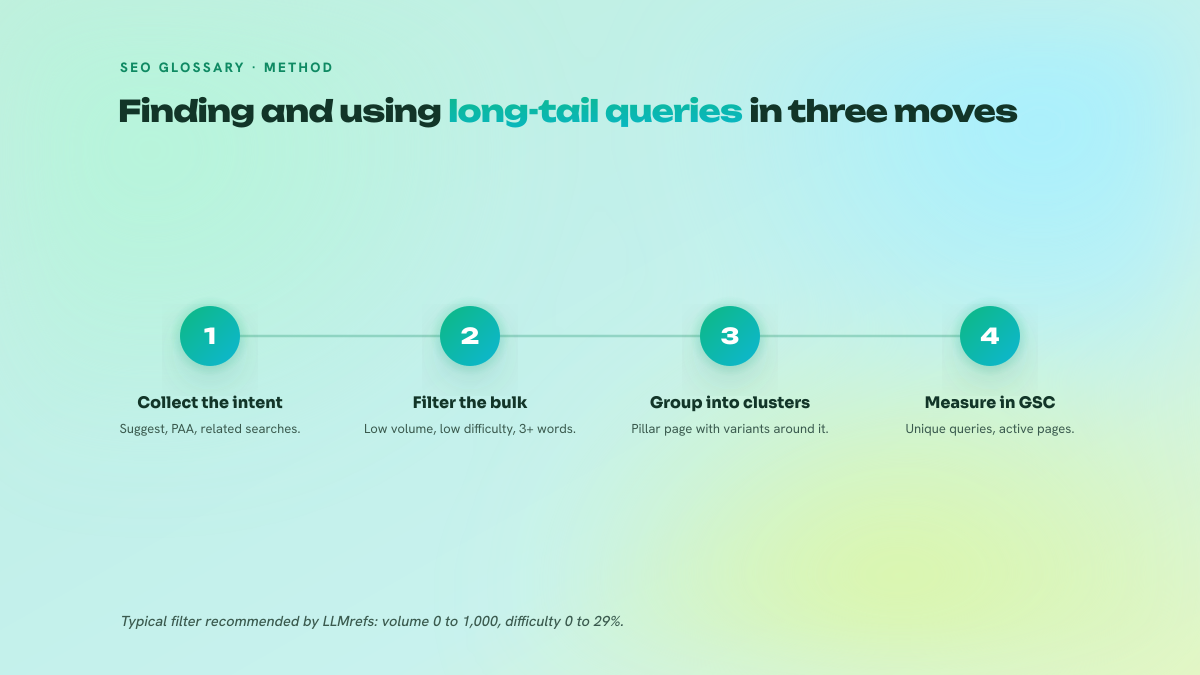
The long tail in SEO: how it works in 2026
Operationally, isolating the tail is a filtering exercise. The working recipe most practitioners converge on, described in LLMrefs' August 2025 long-tail research guide, is to filter a keyword database on search volume between 0 and 1,000, keyword difficulty under 30%, and three words or more, then read the results for intent rather than trusting the filter blindly. The word-count filter is a coarse first pass, the intent read is the actual work.
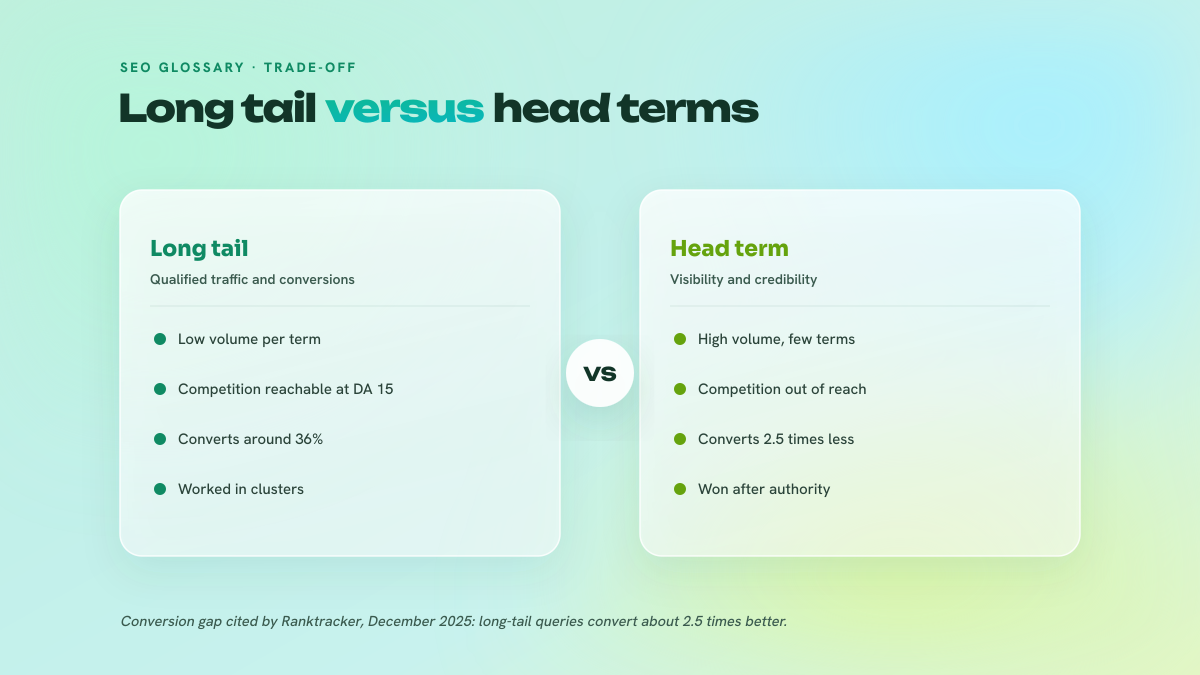
Why bother, given the volume is tiny per term? Because the tail converts. Ranktracker's 2025 data reports long-tail queries accounting for 70 to 92% of all search traffic in aggregate and converting at around 36%, roughly 2.5 times higher than head terms. Yotpo's 2026 guide repeats the same 2.5 times conversion gap. The head term flatters your impressions dashboard, the tail pays the invoices.
The part that changed, and the part legacy playbooks ignore, is what the SERP now does with informational long-tail. AI Overviews have gone from occasional to structural. NuTech Digital's April 2026 analysis, covering February 2025 to February 2026, found AI Overviews triggering on nearly 48% of tracked queries, a 58% year-on-year increase, and the queries that trigger them skew longer and more specific, which is to say long-tail. BrightEdge data from May 2025, cited in BestDigitalCompany's 2026 update summary, put the organic click-through decline on AI-impacted SERPs at up to 30%, hitting informational and featured-snippet-style queries hardest.
The senior read: chasing pure informational long-tail for raw clicks is a declining trade. The value has migrated to two ends. Transactional and commercial long-tail still earns the click because the user needs to leave the SERP to buy or sign up. And informational long-tail is now worth targeting when the goal is to be the cited source inside the AI answer, which is a question of topical authority more than of any single page. If your only long-tail play is thin informational pages built for clicks, the SERP is quietly taking that revenue away from you.
E-commerce and distribution: Amazon, Netflix, the infinite shelf
Anderson built his case on retail and media, and the examples still explain the mechanism better than any SEO diagram. Amazon does not need a physical shelf, so it can list millions of books and products that a bricks-and-mortar store would never stock. Customer reviews and star ratings then act as the discovery engine, surfacing niche items to the handful of buyers who want them. Netflix did the same for catalogue film and television, Spotify for niche playlists. The blockbuster still sells, but the aggregate of the obscure long tail rivals or beats it.
Anderson attributed this to three forces: democratised production, democratised distribution, and the tools that connect supply with demand. Anyone can publish a book, the marginal cost of stocking it digitally is near zero, and search plus recommendations match it to its readers. The economics of scarcity that governed traditional media stop applying once distribution is effectively free.
The reason this belongs in an SEO glossary is that content obeys exactly the same physics. Your site is an infinite shelf. A page answering a question five hundred people ask a year costs almost nothing to keep online and, unlike a blockbuster head-term page, faces almost no competition. The long-tail versus blockbuster choice in retail maps directly onto the head-term versus tail-content choice in SEO. The difference in 2026 is that the « connect supply and demand » layer, once owned by Amazon's recommendation engine and Google's ten blue links, is increasingly an AI answer layer, and being on the infinite shelf is no longer enough if you are not also cited.
Where the long tail sits in a netlinking operation
For link building specifically, the long tail reframes what you point links at. You do not build backlinks to every long-tail page, that is neither affordable nor natural. You build authority into the hub, the pillar, and let internal links distribute equity down into the tail. This is the topic-cluster model, and the 2025 to 2026 data backs it hard. Whitehat-SEO's June 2026 guide, synthesising Search Engine Land's 2025 write-up of HireGrowth data, reports that content organised into clusters generates around 30% more organic traffic and holds rankings roughly 2.5 times longer than standalone posts.
The AI-citation angle sharpens it further. The Yext AI Citation Study 2025 found that 86% of AI citations came from sites with at least five interconnected pages on a topic, with a typical winning structure of one pillar plus around eight cluster articles. LinkWhisper's May 2026 topical-authority guide makes the mechanical point: internal linking with descriptive anchor text lets a single well-supported cluster rank for dozens of long-tail searches rather than one primary term. So the external links you buy or earn work hardest when they land on the hub of a real pillar and cluster structure, not scattered across orphan tail pages.
Running Nautilinks's network of owned French media, what we see confirms this: a client page acquires a contextual link on a topically aligned site, and the pages that move are not only the linked URL but the long-tail children it links to internally. That is why we treat link acquisition as something you dose over several months rather than dump in a batch, and why a single well-placed contextual article on a relevant owned media often outperforms a stack of low-relevance links. If the objective is AI visibility on long-tail questions, the lever is being cited across the answer engines, which again rewards the cluster, not the isolated page.
What we see go wrong
The first mistake is the one already named: defining the tail by word count and building a keyword list that mixes low-competition gold with high-competition four-word head terms nobody flagged. Read intent, not length.
The second is scaled thin content. The temptation is obvious: the tail is huge, so generate ten thousand near-identical pages and catch the traffic. Google's June to July 2025 core update, which finished rolling out on 17 July 2025, was explicitly characterised by trackers such as ROI Revolution as surfacing « hidden gems and golden nuggets » from lesser-known sites, and its corollary was that large brands could no longer coast on authority to rank for long-tail. The March 2026 spam update, documented by Space & Story as running 24 to 25 March 2026, targeted manipulative content and links in the same spirit. Templated tail pages built purely for traffic are exactly what these systems demote.
The third is chasing informational long-tail for clicks the SERP no longer hands out, covered above. If a query is fully answered in an AI Overview, ranking first can still mean a shrinking click. Pick tail queries where the click has a reason to happen.
The fourth is neglecting internal linking, which quietly wastes most long-tail potential. A tail page with no internal links pointing to it, and no descriptive links out to siblings, is an orphan that neither Google nor an AI crawler can situate in your topical map. The fix is not more external links, it is a coherent cluster of internally linked pages. The fifth, on the link side, is over-optimised exact-match anchors into tail pages, which reads as manipulation to the same spam systems now watching link patterns.
Beyond marketing: animals, slang, and the long tail elsewhere
Search intent for « long tail » is not purely commercial, and a complete glossary entry should acknowledge it, if only so you understand the SERP you are competing in. Outside business and SEO, « long tail » is first a literal description in zoology. Plenty of animals are named for it, and the long-tailed tit is the textbook example: a tiny European songbird whose tail is longer than its body, which is exactly why it turns up in image results and explainer videos for the phrase.
For readers who land here from that angle, here is the visual reference:
In slang and idiom, « longtail » travels widely. In Thailand a longtail is the long, narrow boat with an exposed propeller shaft. In statistics it names a distribution with a long tail of rare events, the mathematical parent of Anderson's business usage. In insurance, « long-tail » risk means claims that surface years after the policy period. The through-line across all of these is the same shape: a small, persistent, far-reaching extension beyond the obvious bulk. For an SEO, the takeaway from this mixed intent is practical: « long tail » as a keyword is itself a head term with tangled meanings, a neat illustration of why raw volume without intent analysis will mislead you.
Nautilinks operates an owned network of editorial media. In-house written articles, transparency disclosures respected, anchor mix calibrated.
Frequently asked questions
Is the « three words or more » rule still a useful definition of long-tail in 2026?
It is a rough first filter, not a definition. Word count correlates with specificity but does not equal it. A two-word query like « SEO Toulouse » is long-tail by volume, intent and conversion, while a high-volume four-word phrase is not. Use the word-count filter as a coarse pass in Semrush or a similar tool, then classify by search volume and intent depth. Reading intent is where the actual selection happens, and it is the step most keyword lists skip.
Should I still target informational long-tail keywords when AI Overviews answer them?
Selectively. NuTech Digital's data shows AI Overviews on nearly 48% of tracked queries and BrightEdge reported click declines up to 30% on AI-impacted SERPs. If a query is fully resolved in the answer box, ranking first buys a shrinking click. Keep informational tail when the goal is to be the cited source inside the answer, and prioritise commercial or transactional tail where the user must leave the SERP to act. Do not measure that content on clicks alone.
What does « long tail » mean in business, and does it still apply to content?
Chris Anderson's 2004 Wired concept, expanded in his 2006 book, describes markets where countless low-demand products collectively outsell the few blockbusters, once shelf space and distribution stop being scarce. Amazon and Netflix are the canonical cases. Content obeys the same economics: your site is an infinite shelf, and a low-competition tail page costs almost nothing to keep live while facing little competition. The 2026 twist is that being on the shelf is not enough if you are not also cited in AI answers.
How many backlinks does a long-tail page actually need?
Usually none of its own. You point external links at the pillar or hub and let internal links with descriptive anchors carry authority into the tail. The Yext AI Citation Study 2025 found 86% of AI citations came from sites with at least five interconnected pages on a topic. Spending link budget on orphan tail pages is inefficient, and exact-match anchors pointed straight into them read as manipulation to the spam systems Google has been tightening through 2026.
Which animal is the long-tailed tit, and why does it appear for « long tail »?
It is a small European songbird whose tail is longer than its body, which is why image and video results for « long tail » surface it. It has nothing to do with SEO, but it illustrates a real point: « long tail » is itself a head term with tangled meanings across zoology, statistics, insurance and business. That mixed intent is a clean reminder that raw search volume for a phrase tells you nothing useful without intent analysis.
Test your knowledge
Quiz: Long tail
1/3Why is the « three words or more » heuristic an unreliable definition of a long-tail keyword?