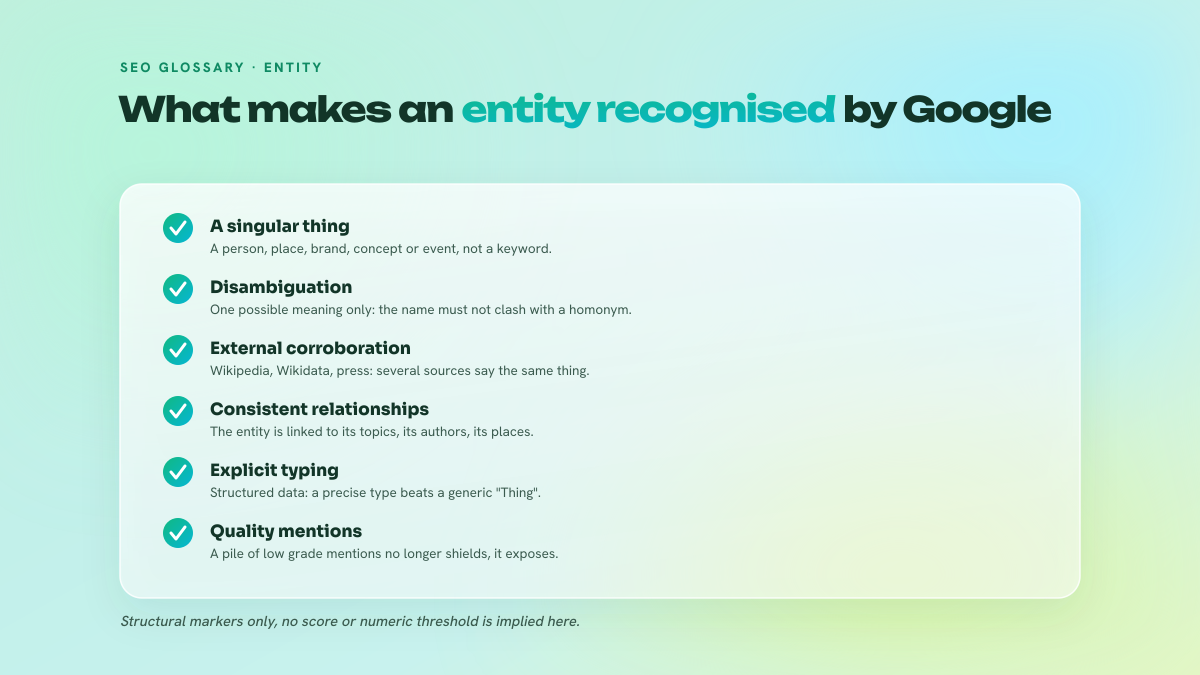
- →An entity is a disambiguated node Google can name, type and connect, not a keyword. Your page can rank in the blue links and still be ignored by the AI layer if the underlying brand is not a trusted entity.
- →Google's June 2025 Knowledge Graph cleanup deleted over 3 billion entities in a week (Search Engine Land, June 2025). Mention volume without clear disambiguation is now a liability, not a signal.
- →Brand web mentions correlate roughly 3× more strongly with AI Overview visibility than backlinks (DigitalApplied meta-analysis of 54 studies, 2026). Entity authority is outrunning raw link volume as a citation predictor.
- →Only 38% of AI Overview citations pull from the top 10 organic results, down from 76% a year earlier (Ahrefs 863k-SERP study, updated March 2026). Ranking no longer guarantees a citation.
- →Freshness is now a systematic factor: AI-cited content averages 25.7% fresher than the competing top-10 (DigitalApplied, 2026). Entity work without a re-publishing cadence decays.
- →Word count barely predicts citation (0.04 correlation, Ahrefs 2026). Structure, answer-first blocks and entity clarity beat length every time.
Beyond the strings-to-things slogan
When you optimise for Entity SEO in 2026 you are not chasing a keyword ranking, you are trying to become a disambiguated node that Google can resolve with confidence and reuse across classic search, AI Overviews and AI Mode. An entity is a thing the search engine can name, type and connect to other things: a brand, a person, a product, a place, a concept. The textbook line is «from strings to things», the phrasing Google has used since the Knowledge Graph launched in 2012. The operational reality is blunter: the same page can sit in the ten blue links and never get pulled into an AI answer, because the brand behind it is not a trusted entity in the graph.
That gap between ranking and being cited is the whole reason entity work stopped being a nice-to-have. In an entity-based model, Google does not just match the query string to the words on your page, it maps the query to a concept, resolves which real-world things you are talking about, and checks whether your site is a credible source about those things. From what we see in audits, the sites that win AI citations are rarely the ones with the fattest keyword density, they are the ones whose core entity is unambiguous everywhere it appears.
Here is a short, beginner-friendly explainer that frames the idea visually before we get into the mechanics:
People sometimes ask where entity SEO fits among «the four types of SEO», the on-page, off-page, technical and local buckets. The honest answer is that it is not a fifth type, it is a layer that runs underneath all four. On-page becomes entity clarity, off-page becomes corroboration of your entity across the web, technical becomes structured data that names the entity, and local becomes a LocalBusiness node with consistent NAP signals. Treat it as a lens, not a silo.
How Google resolves entities in 2026
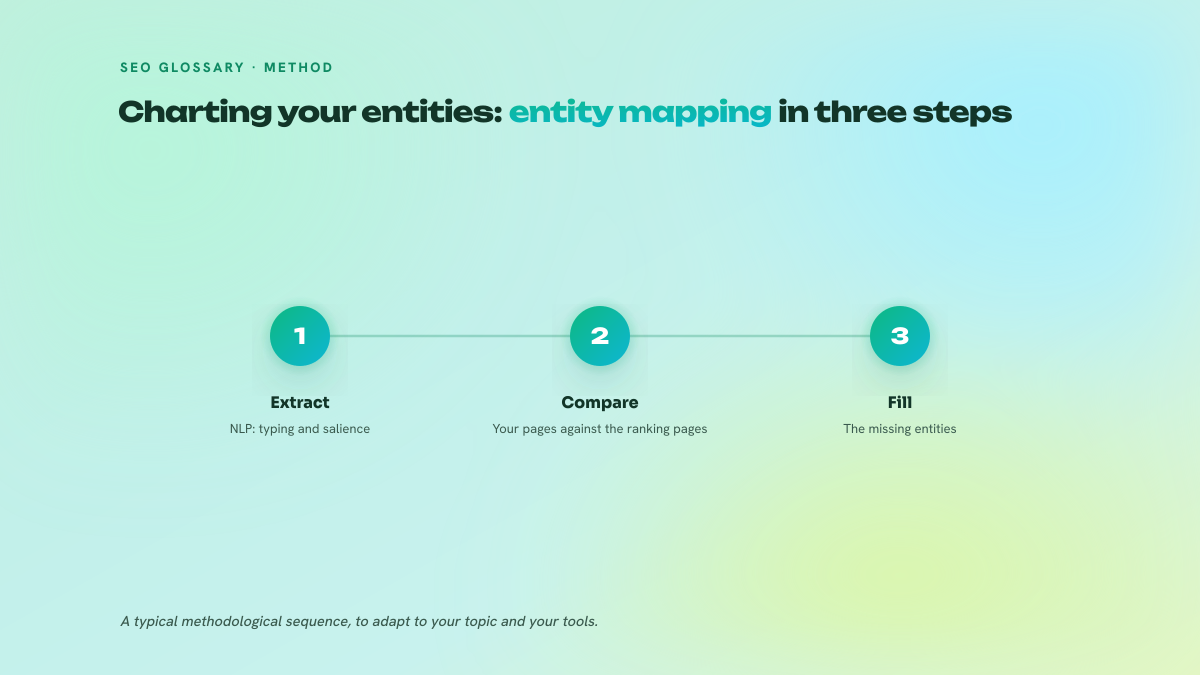
The Knowledge Graph is the database behind all of this: an official Google figure put it at 5 billion entities and 500 billion facts back in 2020, and third-party estimates now sit around 54 billion entities and 1.6 trillion facts by 2024 to 2025 (Ahrefs, 2026). Natural language processing models, from RankBrain through BERT to MUM, read a page and detect which entities it mentions, then entity resolution decides which canonical node each mention points to. Confidence scores gate whether a node is trusted enough to surface in a Knowledge Panel or feed an AI Overview.
The single most important event for entity practitioners in the last year was the Knowledge Graph cleanup of June 2025. Google contracted the graph by 6.26% in one week, deleting over 3 billion entities, the largest drop in a decade (Search Engine Land, June 2025). Event entities were hit hardest, with roughly 77% of them purged, many created during COVID, and low-quality or ambiguously typed «Thing» entities were cut by about 15.27%, close to 8 billion nodes. The stated aim was quality over quantity, better data for LLMs and AI search.
The takeaway is not academic. After the cleanup, Kalicube tracked person-entity confidence scores climbing from 70.16% to 76.78%, which tells you Google pruned the low-confidence profiles rather than the well-corroborated ones. Between May 2020 and March 2024 the number of person-type entities grew 22×, with the biggest 2024 growth in roles that map cleanly to E-E-A-T such as researchers, writers and journalists, while company entities grew only 5×. Read together, these numbers say one thing to anyone building authority: a thinly corroborated brand mention is now more likely to be ignored or purged than rewarded. Volume without disambiguation is a liability.
Entity linking and semantic relationships
Entity linking is the process of tying a mention in your content to a specific, canonical entity, so the machine knows your «Paris» is the capital and not the person, and your product is the product and not a generic noun. Inside your own content you do this with three levers: consistent naming, structured data that declares the entity, and internal links that connect related concepts into a coherent web. The sameAs property in schema markup, pointing at Wikidata, Wikipedia or an official profile, is the cleanest way to say «this node is that node» in a language Google trusts.
This video walks through connecting entities across content, which is exactly the relationship-building work that separates a keyword page from an entity hub:
There is a real distinction people gloss over: co-occurrence versus semantic relatedness. Two entities appearing near each other a lot is co-occurrence, which is weak evidence. Semantic relatedness is a modelled relationship, the graph actually understanding that a subject and an object are connected in a specific way. Good internal linking pushes you toward the second: link a concept to its own dedicated page with a natural anchor, and you are telling the engine these nodes belong together. This is why building genuine depth of coverage on a single subject outperforms scattering one article each across twenty unrelated topics. The internal link graph is a map of relationships, and Google reads it as one.
Off your own domain, entity linking happens through corroboration. Every time an independent, credible source names your brand next to the concepts you want to own, it reinforces the relationship in the graph. This is where mentions and links start to blur: the modern signal is less «a hyperlink with anchor text» and more «a trusted publication associating your entity with a topic». That reframing matters for how you spend a netlinking budget.
Where entities meet a netlinking operation
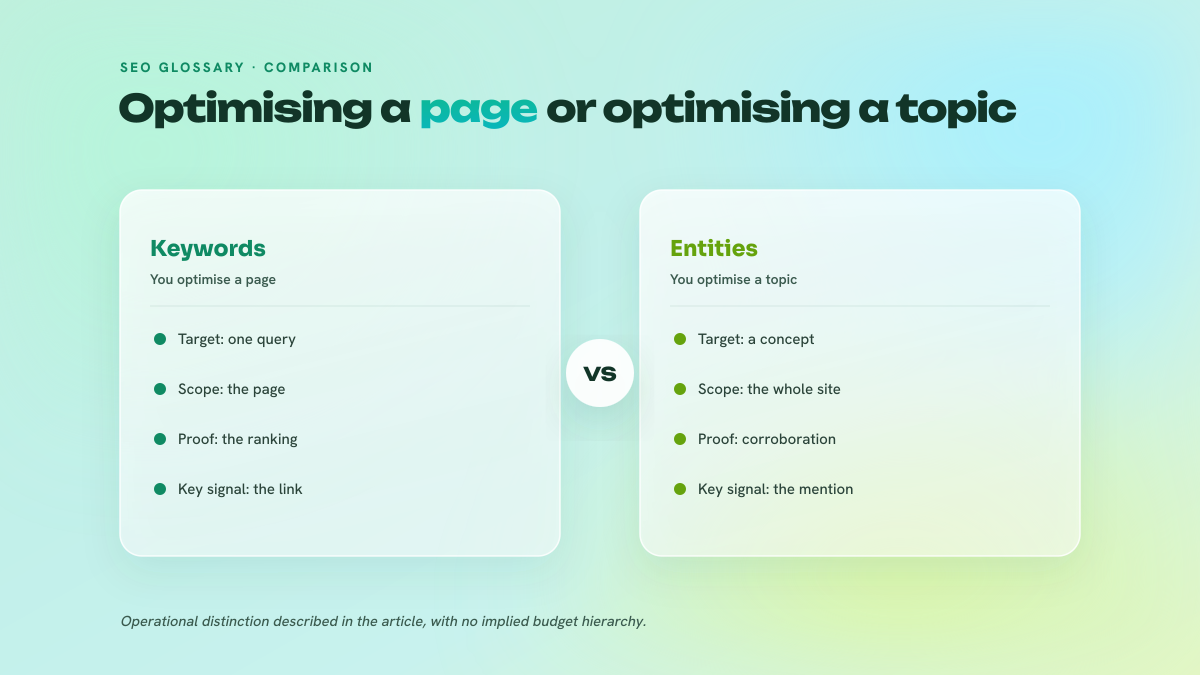
If you run link acquisition, the entity shift changes what you are actually buying. The old model treated a backlink as a vote for a URL. The entity model treats an editorial placement as a corroboration event for a brand and its topical relationships. The data backs the reweighting: a DigitalApplied meta-analysis of 54 AI citation studies in 2026 found brand web mentions correlate roughly 3× more strongly with AI Overview visibility than backlinks, and a separate entity-SEO synthesis reported a correlation coefficient of 0.664 for brand mentions against 0.218 for backlinks. Backlinks still work, but as a component of entity authority, not as a standalone lever.
The AI layer makes this concrete. An Ahrefs study of 863,000 SERPs, updated 2 March 2026, found only 38% of AI Overview citations pull from the top 10 organic results, down from 76% a year earlier. Ranking first is no longer a guarantee of being cited, entity authority and freshness now decide which of the eligible pages the model actually quotes. So a campaign that only chases blue-link position for a single URL is optimising for a shrinking prize. The better brief is: place your entity, in context, on relevant editorial pages that a model would trust, with anchors and surrounding copy that reinforce the topical relationship.
This is where an owned editorial network behaves differently from a marketplace. At Nautilinks we operate our media in-house, which means a placement is a real editorial page on a real topical site, written by our own team, not a slot rented from an anonymous inventory. For entity work that matters, because corroboration from a coherent, on-topic publication carries more resolving weight than a link dropped on a thematically random domain. If you want to calibrate a campaign around your core entity over the long run rather than buy one-off links, that is the axis to brief on. The same logic applies when you extend into AI search: a coordinated fan-out of entity mentions across trusted media is how you show up in the citation layer, not just the ten blue links.
Entity-first content strategy that moves the needle
Entity-first content means organising your site around concepts and their relationships, not around a keyword list. In practice that is a hub-and-cluster structure: a central page that fully describes your core entity, surrounded by supporting pages that cover related entities and link back with natural anchors. If you have never mapped this out, start from your grouping of pages around one theme and check that every relationship a reader would expect is actually expressed as a link.
These tactics are covered well in this practical walkthrough, worth watching before you rebuild an architecture:
Two 2026 findings should reset your priorities. First, word count is effectively noise: an Ahrefs study of 174,048 pages and 1.6 million cited URLs found a correlation of 0.04 between length and AI Overview citations. Padding a page to 3,000 words buys you nothing. Second, structure and freshness do the heavy lifting. AI-cited content averages 25.7% fresher than the competing top-10 (DigitalApplied, 2026), and answer-first FAQ blocks in the 40 to 60 word range are cited roughly 3× more often than non-FAQ sections on the same sites. So the working playbook is: declare your entity with schema, answer real questions concisely near the top, keep the page updated, and connect it into the cluster.
Schema is the least glamorous and most reliable part. Organization, Person, Product and LocalBusiness types, with sameAs pointing at authoritative profiles, are how you hand Google an unambiguous entity declaration instead of making it guess. Common failure we see: a beautifully written page with zero structured data, so the engine has to infer the entity from prose and often gets the type wrong. Fix the markup first, it is cheap and it removes ambiguity at the source. When you commission editorial to support an entity, a contextual article that names your brand alongside its topic on a relevant site does double duty: it corroborates the entity off-domain and gives the AI layer a fresh, on-topic source to cite. Legacy assumption to drop: that «becoming an entity» is a one-time Wikidata submission. It is a maintained state, corroborated continuously, or the graph forgets you.
Nautilinks operates an owned network of editorial media. In-house written articles, transparency disclosures respected, anchor mix calibrated.
Frequently asked questions
What actually is an entity in SEO, in one sentence?
An entity is any thing Google can name, type and disambiguate as a node in its Knowledge Graph: a brand, person, product, place or concept, connected to other entities by modelled relationships. The point of entity SEO is to make your brand and topics resolve to clear, trusted nodes so the engine, and the AI layer on top of it, can reuse you with confidence rather than guessing from raw keywords.
Is entity SEO a separate discipline from the classic four types of SEO?
No. On-page, off-page, technical and local SEO still exist, but entity SEO runs underneath all four as a lens. On-page becomes entity clarity, off-page becomes corroboration of your entity across trusted sources, technical becomes schema that declares the entity, and local becomes a consistent LocalBusiness node. Treating it as a fifth silo is a mistake, it is the connective layer that makes the other four legible to a machine.
Do backlinks still matter for entity SEO, or is it all brand mentions now?
Backlinks still work, but their weight has shifted. A 2026 DigitalApplied meta-analysis of 54 studies found brand web mentions correlate about 3× more strongly with AI Overview visibility than backlinks (0.664 versus 0.218 in one synthesis). Read that as: a link inside a trusted editorial context that names and corroborates your entity is worth far more than a bare link on a thematically random domain. Buy corroboration, not just URLs.
Why does my page rank well but never appear in AI Overviews?
Because ranking and citation have split. An Ahrefs 863k-SERP study updated March 2026 found only 38% of AI Overview citations come from the top 10 organic results, down from 76% a year earlier. Entity authority and freshness now decide which eligible page gets quoted. If your brand is a weak or ambiguous entity, or the page is stale, the model skips you even when you rank.
How do I actually become an entity in the Knowledge Graph?
Declare yourself unambiguously with Organization or Person schema plus sameAs links to Wikidata, Wikipedia and official profiles, then get corroborated by credible independent sources naming you next to your core topics. Consistency of brand signals across the web is what raises your confidence score. After the June 2025 cleanup that purged over 3 billion low-confidence entities, thin or contradictory signals get you pruned, not promoted.
Does content length help entity SEO?
Barely. An Ahrefs 2026 study of 174,048 pages found a 0.04 correlation between word count and AI Overview citations, effectively zero. What moves the needle is structure and recency: answer-first blocks of 40 to 60 words are cited around 3× more than non-FAQ sections, and cited content averages 25.7% fresher than the top-10. Spend your effort on clear entity declaration and a re-publishing cadence, not on padding.
Test your knowledge
Quiz: Entity SEO
1/3During the June 2025 Knowledge Graph cleanup, roughly how many entities did Google delete in a single week?