- →A pillar is a link-graph role, not a content format: elect the URL first, then engineer its internal links toward the 40-44 range that Zyppy's 2024 study of 23 million internal links associates with roughly 4× more organic traffic.
- →Since Google folded the Helpful Content system into the core algorithm in March 2024, evaluation is site-wide and increasingly cluster-level: a pillar without 10 to 15 supporting articles is a long article, not an architecture.
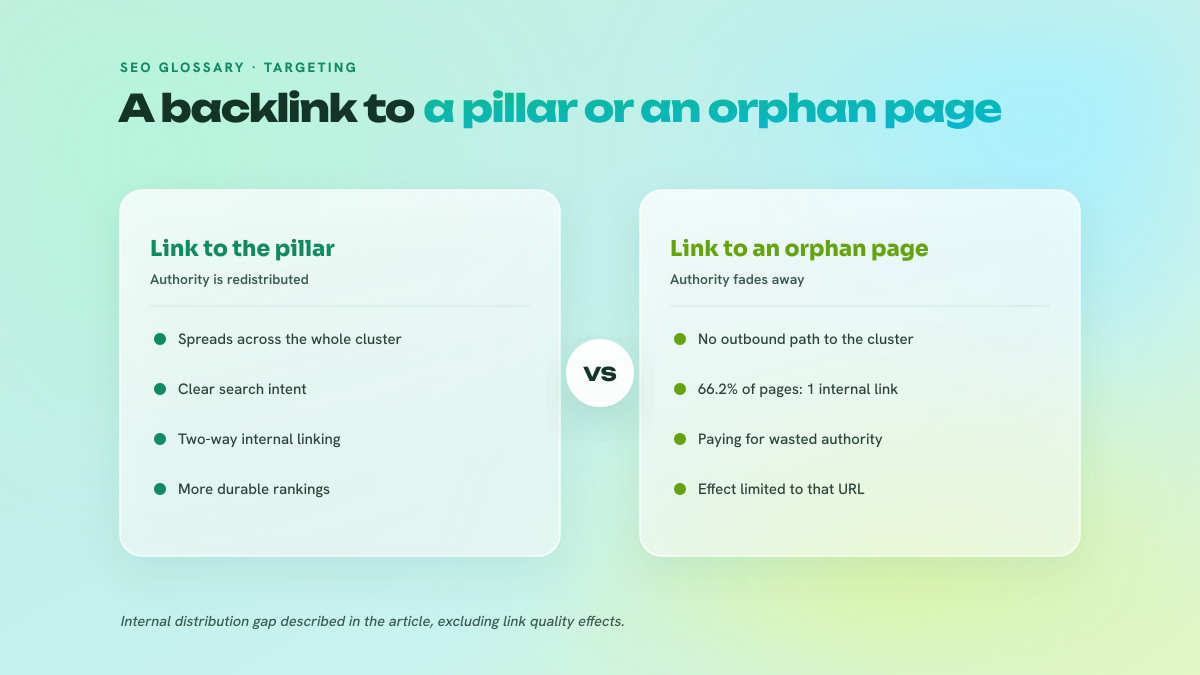
- →Point earned and paid backlinks at pillars rather than scattering them across posts: with 66.2% of web pages holding a single internal link (Ahrefs, 2024), most external equity dies exactly where it lands.
- →The most common failure is scope, not length: a pillar broader than what your cluster can actually support dilutes the site-level focus signals surfaced in the May 2024 Google API leak instead of building authority.
- →Refresh pillars on a fixed cadence: post-update analyses from late 2025 show Google reevaluating whole clusters at once, so a stale hub drags down every article attached to it.
- →Clustered content is not a nice-to-have: per the HireGrowth 2025 analysis cited in Search Engine Land's topic cluster guide, it drives about 30% more organic traffic and holds rankings 2.5× longer than standalone pieces.

What a pillar page really is (and what it isn't)
Strip away the content-marketing packaging and a pillar page is a structural decision: one URL elected to consolidate an entire topic, absorb the largest share of internal links in its section of the site, and compete on the head or mid-tail query that individual articles cannot win alone. What makes it a pillar is not its word count or its table of contents. It is its position in the site's link graph. The pillar sits at the center of a topic cluster: it links out to every supporting article covering a subtopic, and every one of those articles links back up to it, usually with varied, descriptive anchors.
This distinguishes it from two formats it gets confused with. A landing page exists to convert a single offer; it hoards attention and deliberately limits exits, which is the exact opposite of what a pillar does. An ultimate guide is a format, a long comprehensive document, and it only becomes a pillar when a cluster actually exists around it. From what we see in audits, most self-declared pillar pages are ultimate guides with zero supporting articles: long, expensive, and structurally identical to any other blog post. The guide is the furniture. The pillar is the room.
The operational test is simple. Crawl the site and look at the URL's inbound internal links, its outbound contextual links, and whether the pages it links to link back. If the answer to all three is thin, you do not have a pillar, whatever the H1 says. Content teams tend to evaluate pillars by reading them. SEO teams should evaluate them by graphing them.
How pillar pages actually work in 2026
The reason pillar architecture matters more now than in 2019 is that Google's evaluation unit has visibly moved up a level. In March 2024, the Helpful Content system was folded into the core algorithm as a continuous, site-wide signal, and Google stated the accompanying core update reduced low-quality, unoriginal content in results by about 45%. Site-wide scoring means an individual strong page can be dragged down by the shallow sprawl around it, and conversely that a coherent cluster lifts every URL inside it.
The May 2024 Google API documentation leak gave this a vocabulary: attributes like siteFocusScore and siteRadius describe how tightly a site's content holds to its core topics and how far individual pages drift from that center. You should treat leaked attribute names with caution, but they align with what post-update data shows. Analyses of the December 2025 core update converge on the observation that Google now frequently reevaluates entire content clusters rather than isolated URLs. And the numbers on clustering are consistent: per the HireGrowth 2025 analysis cited in Search Engine Land's topic cluster guide (December 2025), content organized into clusters drives roughly 30% more organic traffic and holds its rankings 2.5× longer than standalone pieces.
Measurement is where most teams stay vague, and they shouldn't, because the key metric is countable: internal links pointing at the pillar. Zyppy's 2024 study of 23 million internal links across roughly 1,800 websites found that pages receiving 40 to 44 internal links generated about 4× more organic traffic than pages receiving fewer than 5, with diminishing returns beyond that band. That gives you an engineering target, not a vibe. A pillar sitting at 6 inbound internal links is underpowered regardless of how good the copy is. This is also the mechanism behind topical authority: the authority is not conferred by declaring a topic, it is accumulated by the density and coherence of the linking around it.
Where pillars fit in a netlinking operation
Here is the part the top-ranking guides on this term barely touch: the pillar is the natural landing zone for your external link budget. Ahrefs found in 2024 that 66.2% of web pages have exactly one internal link pointing to them. On a site like that, a backlink aimed at a random blog post is equity poured into a dead end: it lands, it has nowhere to flow, and it lifts one URL on one query. The same backlink aimed at a pillar irrigates the ten or fifteen articles wired into it. Link equity is a budget, and pillars are how you get compound interest on it instead of simple interest.
This changes how you brief link placements. The reflex of pointing every acquired link at the homepage or the money page is a 2015 habit; the homepage rarely needs it and the money page rarely deserves it editorially. A sponsored placement reads naturally when it cites a substantial informational resource, which is exactly what a pillar is, and you can brief a sponsored article so the contextual link lands on the pillar rather than on a page no publisher would plausibly reference. Across the French editorial media we operate in-house at Nautilinks, the client pages that appreciate steadily over quarters are pillar-shaped hubs; conversion pages linked directly tend to plateau once the anchor looks commercial.
Pillar targeting also disciplines your source selection. Because the pillar aims at a competitive head term, the links pointing at it should come from media whose own topical footprint overlaps the cluster, not from whatever inventory is cheapest this month. Working from a catalogue where every medium's metrics and theme are public makes that matching a filtering exercise instead of a negotiation, and it keeps the anchor profile of the pillar diverse, which matters: Zyppy's same 2024 dataset showed anchor variety correlating positively with search clicks.
The mistakes we keep seeing in audits
The first and most expensive mistake is scope. A pillar on «digital marketing» for a site that can realistically produce twelve supporting articles is not ambitious, it is undersupplied: the cluster cannot cover the topic's subtopics, the pillar competes against sites that can, and the off-topic sprawl needed to fake coverage widens the site's radius and dilutes its focus. Scope the pillar to the topic you can genuinely saturate. A narrower pillar that owns its territory outranks a broad one that rents it.
The second is the orphan pillar: a beautiful hub linked from the navigation and from nothing else. Navigation links are the weakest internal links you own; contextual, in-paragraph links from cluster articles are what move the needle, and they are precisely the ones content teams forget to add retroactively when new articles ship. Every new cluster article should link up to the pillar on publication day, not during the annual audit.
The third is cannibalization between the pillar and its own cluster. If a supporting article targets the same intent as the pillar's head query, they split signals and Google picks one inconsistently. The discipline is vertical: the pillar owns the head term, each cluster article owns one subtopic intent, and the internal anchors reflect that division instead of repeating the head keyword everywhere.
The fourth is set-and-forget. Post-update analyses published after the December 2025 core update describe cluster-level reevaluation: when the hub goes stale, the decay propagates to the articles attached to it. A pillar is an asset with a maintenance schedule, the same way a media property is. Treating it as a one-time launch is how a 2023 pillar quietly becomes the anchor dragging a 2026 cluster down.
Running a pillar in practice
The working sequence is unglamorous. Pick the topic by supply, not by search volume: if you cannot name 10 to 15 concrete subtopics worth a full article each, the topic is either too narrow to need a pillar or too broad for your production capacity. Map the subtopics against what already exists on the site; promoting an aging article with existing backlinks to pillar status usually beats launching a fresh URL, because you inherit its age and its equity instead of starting at zero.
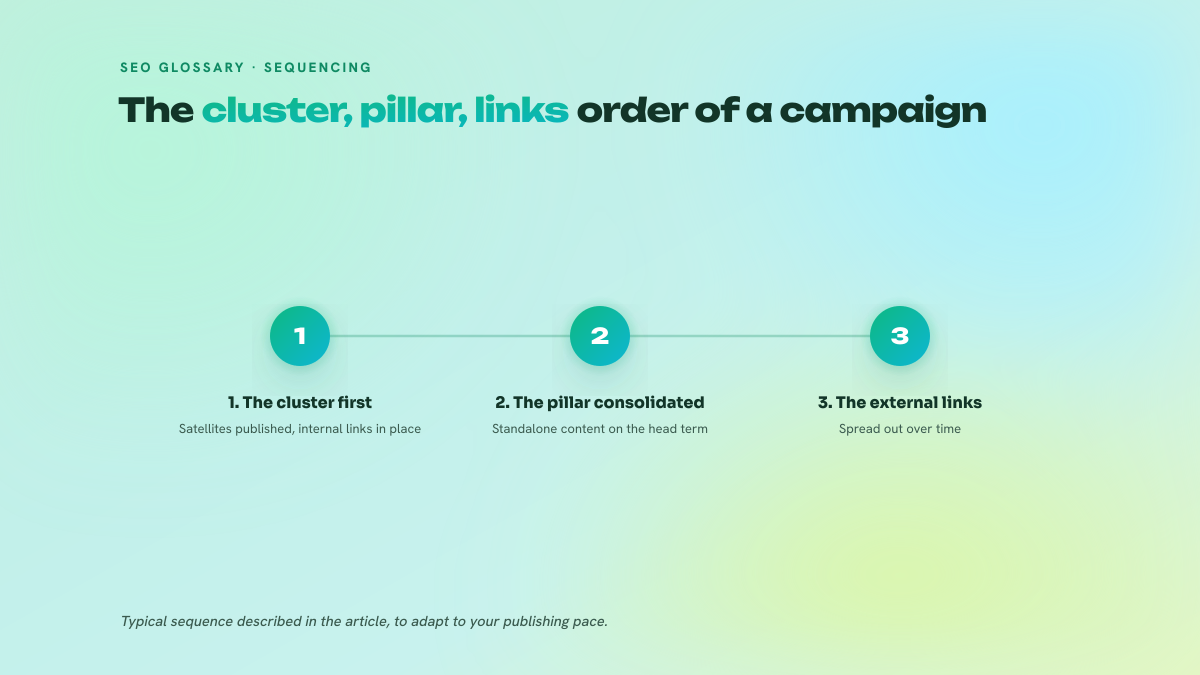
Then engineer the links before writing another word of content. Crawl the site, count inbound internal links to the designated pillar, and wire contextual links from every relevant existing article until you are moving toward the 40-44 band, with varied descriptive anchors rather than forty copies of the head keyword. Only then does the external layer make sense: route the next quarters of link acquisition toward the pillar, at a velocity consistent with the site's history, and let the internal structure distribute what lands. If you would rather not orchestrate the pacing, the media matching and the anchor plan yourself, that is the kind of multi-month calibration a team that manages campaigns end to end exists to run.
Finally, measure at cluster level. Individual keyword positions on the pillar are noisy; the honest KPIs are aggregate organic traffic across the pillar plus its cluster, the share of cluster URLs ranking in the top 20 for their subtopic query, and the pillar's inbound internal and external link counts over time. When those three trend together, the architecture is doing its job. When the pillar climbs while the cluster stagnates, you have built a strong article, not a strong topic, and the difference is exactly what this term exists to name.
Nautilinks operates an owned network of editorial media. In-house written articles, transparency disclosures respected, anchor mix calibrated.
Frequently asked questions
What's the practical difference between a pillar page and a landing page?
Direction of flow. A landing page concentrates attention on one conversion and deliberately limits exits; a pillar page distributes attention outward to a cluster of supporting articles and ranks on informational head terms. They also earn links differently: publishers will naturally reference a substantial pillar, almost never a commercial landing page. Pointing your netlinking budget at a landing page buys anchors that look paid; pointing it at a pillar buys references that look editorial.
Are pillar pages still worth building now that AI Overviews compress informational SERPs?
More than before, not less. AI answer engines cite sources that cover a topic comprehensively, and a 2026 Whitehat analysis aggregating 2024-2026 data reports topic clusters earning 3.2× more AI citations than flat site structures. The pillar-plus-cluster shape is also the architecture Google's post-2024 site-wide evaluation rewards. What has died is the standalone 4,000-word guide with no cluster around it, which was always the weakest version of the idea.
How long should a pillar page be?
It is the wrong variable to optimize. Length is downstream of scope: cover every subtopic at summary depth with a link to the full cluster article, and the length lands where the topic requires. The better-evidenced lever is inbound internal links: Zyppy's 2024 study of 23 million internal links found pages in the 40-44 inbound range earning about 4× the organic traffic of pages under 5, a far stronger predictor than word count.
Can I promote an existing blog post to pillar status instead of creating a new URL?
Usually you should. An aged URL with existing backlinks starts the job with equity a fresh URL lacks. The promotion is structural work: broaden the scope to cover the full topic, rewrite the intro for the head intent, add summary sections linking down to each cluster article, then rewire contextual internal links from the cluster back up to it. Keep the URL if at all possible; if you must change it, a 301 and updated internal links are non-negotiable.
Should acquired backlinks point at the pillar or at the cluster articles?
Majority to the pillar, minority to cluster articles. The pillar redistributes equity through its internal links, so a link landing there lifts the whole cluster; with 66.2% of pages having a single internal link (Ahrefs, 2024), links landing on ordinary posts mostly stop there. Keep 20 to 30% of placements on cluster articles anyway: it diversifies your target profile, lifts specific mid-tail queries directly, and looks more natural to anyone reading the link graph.
How many pillar pages does a site actually need?
As many topics as it can genuinely saturate, which is fewer than most content calendars assume. Each pillar needs 10 to 15 credible supporting articles to function, so the count is bounded by production capacity, not by keyword research. For a mid-authority site, three to six well-supplied pillars beat a dozen undersupplied ones: post-2024 site-wide evaluation punishes broad shallow coverage, and every half-built cluster widens your topical radius without deepening anything.
Test your knowledge
Quiz: Pillar page
1/3According to Zyppy's 2024 study of 23 million internal links, which inbound internal-link range correlated with roughly 4× more organic traffic than pages receiving fewer than 5?