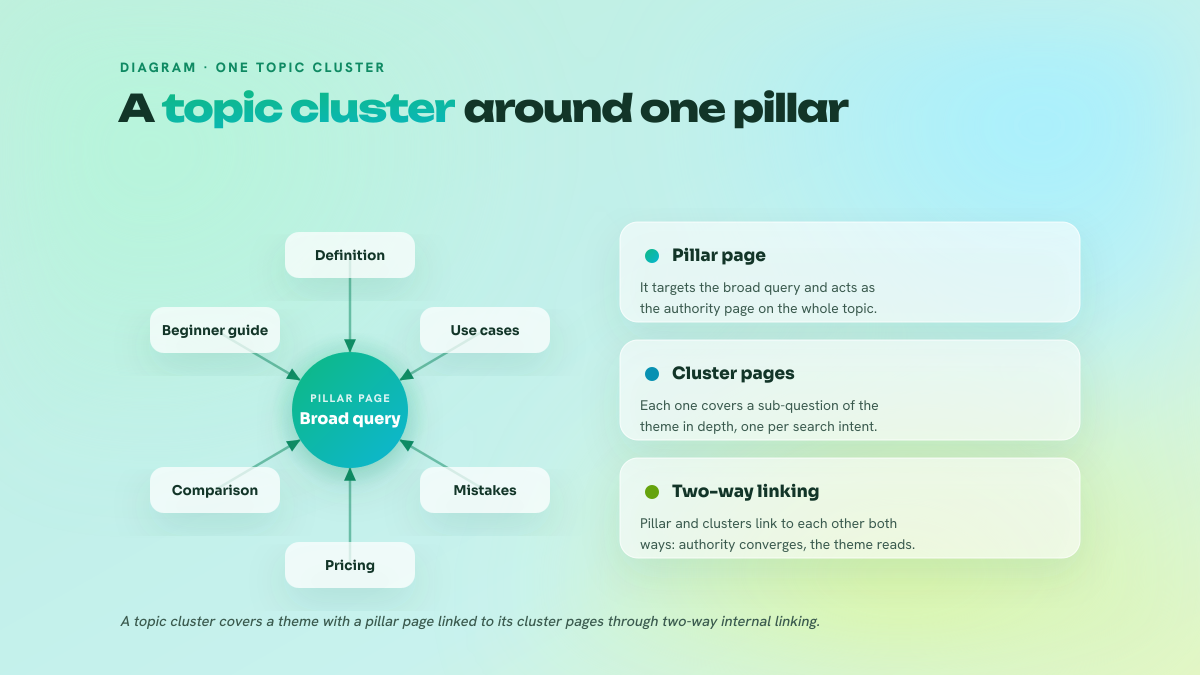
- →A cluster exists in the internal link graph, not in the CMS taxonomy: if the pillar and its subtopic pages do not link both ways, you have a category, not a cluster.
- →The Yext AI Citation Study 2025 (6.8M citations) found 86% of AI citations came from sites with at least five interconnected pages on the topic, and the average winning architecture was one pillar plus eight cluster pages.
- →Ranking in Google's top 10 no longer guarantees AI citation: DigitalApplied's 2026 meta-analysis of 54 studies puts the share of AI Overview citations coming from top-10 pages at 38%, down from 76% in mid-2025.
- →Measure the cluster, not the page: share of cluster keywords in the top 10, cluster-level impressions in Search Console, and whether two pages compete for the same intent.
- →Backlinks pointed only at the pillar waste half the cluster. Point some acquisition at the two or three subtopic pages that already sit at positions 6 to 15.
- →Vendor-published cluster uplift figures (30% more traffic, 2.5x longer rankings) are directional at best. Use them to justify the architecture, never to forecast a client's numbers.
A cluster is an architecture, not a content calendar
Most teams that say they run topic clusters are running a tag. They publish fifteen articles around one theme, drop them in the same category, name the longest one a pillar, and consider the job done. Google sees fifteen pages that happen to share vocabulary. What turns a pile of content into a cluster is the internal link graph: one page positioned as the entry point for the subject, every subtopic page linking up to it with a descriptive anchor, and the pillar linking back down to each of them. Remove those links and the cluster stops existing, whatever the CMS taxonomy claims.
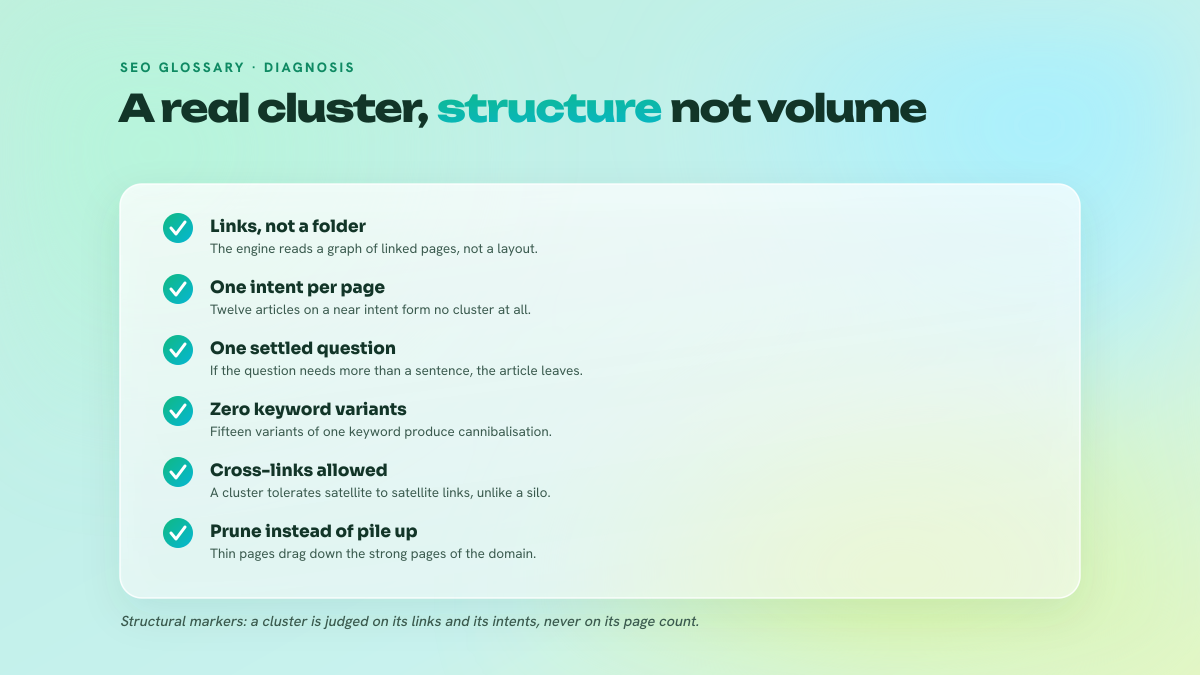
The second thing that separates a real cluster from a content calendar is intent segmentation. A cluster is not fifteen ways of saying the same thing, it is one topic sliced by the different questions a reader asks at different points, from definitional to comparative to transactional. If two pages in your cluster serve the same intent, you do not have two cluster pages, you have a cannibalization problem that will cost you the topic.
Third, a cluster is a maintenance object. A standalone article can be published and forgotten. A cluster degrades: you add a sixteenth page, forget to link it from the pillar, and it sits orphaned; you prune a thin page and leave three inbound internal links pointing at a 404. The competitors ranking for this term almost all skip this part, which is why so many published clusters look correct in a spreadsheet and broken in a crawl.
How Google reads a cluster in 2026
Google has never confirmed a « topic cluster » ranking factor and never will, because that is not the level at which the system operates. What it does evaluate, and has been evaluating more heavily since the June 2025 core update, is whether a domain covers a subject completely enough that its pages satisfy the query without the user going elsewhere. Search Engine Land's coverage of that update, and the industry post-mortems that followed, converged on the same reading: sites with structured topical coverage recovered, sites carrying thin or off-topic pages across the domain were dragged down by their own weakest content. The 2026 core updates (27 March to 8 April, then 21 May to 2 June) continued in the same direction, with topical coverage quality reported as a primary differentiator in recovery analyses.
The practical consequence is that the unit of evaluation moved up a level. Ten years ago you optimised a page for a keyword. Now the question is whether the set of pages around a subject is coherent, non-redundant, and complete, which is exactly what the authority a domain accumulates on a subject describes. A single excellent page on a topic the rest of your site never touches is a harder sell than the same page sitting inside eight supporting ones.
AI Overviews sharpened this. Semrush's 2025 study of more than 10 million keywords tracked AI Overview prevalence rising from 6.49% of queries in January 2025 to a peak of 24.61% in July, settling at 15.69% in November. More interesting for content strategy is the intent shift the same study measured: informational queries fell from 91.3% of AI-Overview-triggering queries in January to 57.1% by October 2025, meaning commercial and transactional queries started getting AI answers too. And the selection mechanism no longer mirrors the blue links. DigitalApplied's 2026 meta-analysis of 54 AI citation studies found that only 38% of AI Overview citations now come from pages ranking in Google's top 10, down from 76% in mid-2025. Being cited is becoming a separate game from ranking, and coverage breadth is one of the things that qualifies you for it, which is the same logic behind a query fan-out placement plan built around the cluster rather than a single page hoping for a citation.
Pillar, cluster pages, and the links that hold them
The pillar page is the one that has to survive the most scrutiny. It covers the whole topic at a level of depth that answers the broad query on its own, and it hands off to the subtopic pages for anything that deserves its own treatment. It is not a table of contents with 300 words of glue, and it is not a 6000-word monolith that makes every cluster page redundant. If you want the full spec of what that page owes the reader, we treat it separately in the entry on pillar pages.
This short explainer covers the structural definition cleanly if you want a second framing before the numbers:
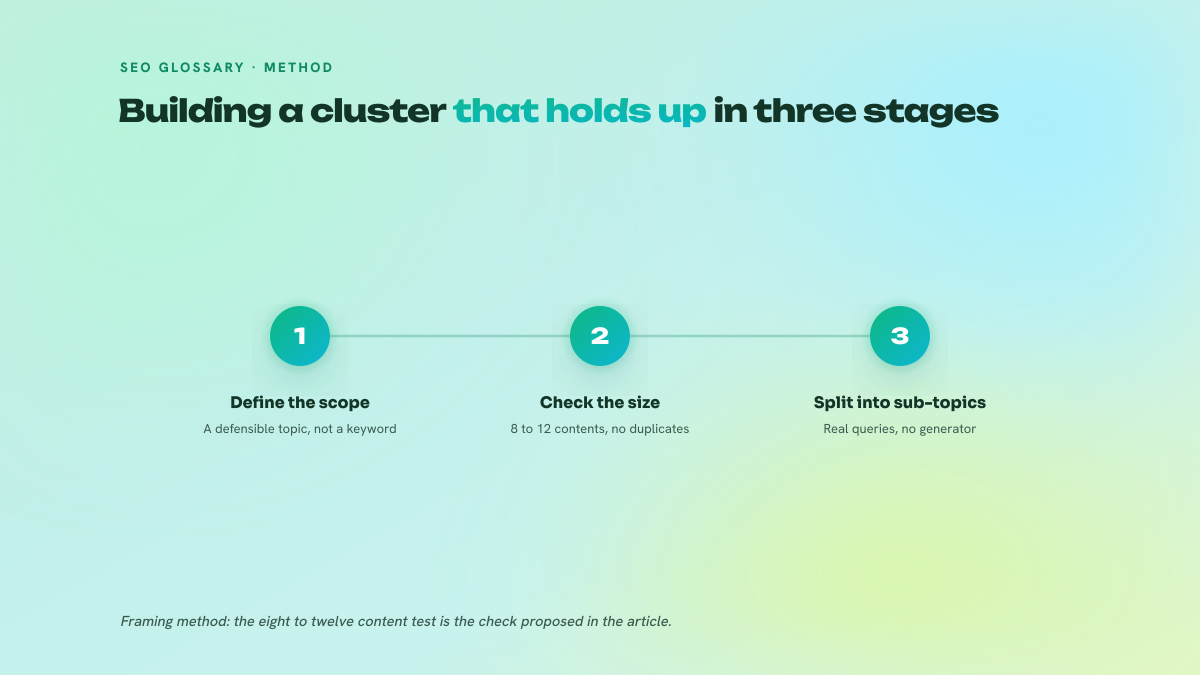
On sizing, the most useful recent dataset is the Yext AI Citation Study 2025, which analysed 6.8 million AI citations across ChatGPT, Gemini and Perplexity between July and August 2025. Three findings are worth internalising. First, 86% of AI citations came from sites with at least five interconnected pages on the topic, which sets a practical floor: below five linked pages, you are not a cluster to a machine reader. Second, sites with topic clusters earned 3.2 times more AI citations than single-page competitors. Third, the average winning architecture was one pillar plus eight cluster pages, and bi-directional internal linking increased citation probability by 2.7 times. That last number is the one most teams leave on the table, because linking up from the child to the parent is easy and linking back down from the parent to every child requires actually editing the pillar every time you publish.
And this second video walks through the pillar-to-cluster relationship if you prefer it laid out visually:
Anchor text inside the cluster deserves the same discipline you apply to external links. Exact-match repetition across twelve internal links is a footprint that helps nobody: vary the phrasing, keep it descriptive, and let the anchor describe the destination page rather than the query you want to win.
Where clusters change a netlinking operation
The default reflex when a cluster is built is to point every acquired backlink at the pillar and let internal links distribute the equity. That is half right. The pillar does need external authority, because it is the page competing for the head term. But the pages that actually convert a link into a ranking gain are usually the subtopic pages sitting at positions 6 to 15, where a handful of referring domains moves them into the top 5 and, incidentally, pushes the whole cluster's average up. Auditing where the cluster is stuck before deciding where to point acquisition is a ten-minute job that changes the allocation entirely, and it is exactly the audit a campaign calibrated over several months should run before the first link goes out.
Cluster logic also changes what a good source looks like. A link from a media that already publishes on the subject reinforces the topical signal you are building internally, which is why placing an editorial article on a site that already covers the theme outperforms a generic high-authority placement on an unrelated domain. At Nautilinks we run our own French editorial media, and the filter we apply before proposing a placement is thematic proximity to the cluster, not the raw metric of the source. If you want to run that check yourself, the catalogue is filterable by theme before you buy anything, with no account required.
The last operational point is timing. A cluster published over three months and linked in one weekend produces a spike in internal link volume that looks exactly like what it is. Spreading external acquisition across the same window as publication, so the link profile grows with the cluster rather than after it, is the kind of thing that matters when you are sequencing acquisition over several months instead of in one burst.
Measuring cluster authority, and when to refresh
Measuring a cluster page by page is how you miss what the cluster is doing. The metric that actually tracks progress is the share of the cluster's target keywords sitting in the top 10, computed across the whole set and read as a trend. A cluster where the pillar is at position 3 and eight children are at position 40 is not working. A cluster where nothing ranks first but the median position moved from 28 to 14 across two months is working, and will keep working.
This walkthrough covers the build process end to end and is a reasonable sanity check against your own workflow:
Alongside that, three things are worth instrumenting. Cluster-level impressions in Search Console, filtered by URL prefix or a regex on the cluster's paths, which tells you whether Google is testing the cluster on more queries over time. Internal link count per page from a crawl, which surfaces the orphan you forgot. And cannibalization, meaning any query where two of your cluster pages alternate in the ranking, which is the signal to merge or re-intent one of them. On the AI side, tracking whether your pages appear as citations is now a distinct measurement, and the HubSpot State of AEO 2026 report (data from December 2025 to March 2026) found that pages carrying outbound links, statistics, author bios and a visible last-updated date are cited more often across AI Overviews, ChatGPT, Gemini and Perplexity. Those are cheap to add to an existing cluster.
On refresh cadence, be sceptical of the numbers circulating. Vendor-published figures like 30% more organic traffic and 2.5 times longer ranking duration for clustered content (a HireGrowth 2025 analysis, widely recycled in trade content since) are directionally plausible and methodologically opaque. Use them to justify the architecture internally, never to forecast a client's outcome. The honest version is simpler: a cluster that is audited quarterly for orphans, dead internal links, intent overlap and factual staleness holds its positions, and one that is not decays at the speed of the next core update.
What we see go wrong
The most common failure is choosing a core topic the site has no business owning. A cluster is a bet that you can be the most complete resource on a subject, and if your domain has no authority signal in that field and no external links pointing to it, ten pages will not manufacture one. Pick a topic adjacent to something you already rank for, and expand outward.
The second is padding. Once the plan says one pillar plus eight children, teams write the eight even when only five subtopics justify a page, and the remaining three are 600 words of restated pillar content. Since the 2023 Helpful Content Update and the consolidation Google has continued through 2025 and 2026, thin pages do not merely fail to rank, they drag the cluster down. Five strong pages beat nine where four are filler, every time. The corollary is that pruning is a cluster tactic: cut the filler, fold its useful paragraphs into a surviving page, and 301 the URL.
The third is treating the cluster as finished at publication. Internal links rot, the pillar stops being updated when child pages are added, and the gaps a competitor has since filled go unnoticed for a year. Put a recurring task on the calendar, crawl the cluster, and fix what the crawl surfaces. It is unglamorous and it is the single highest-return hour in the whole exercise.
The fourth, and the one that costs the most budget, is building the cluster and then buying links as if the cluster did not exist: every backlink to the homepage, none to the pages that are three positions away from converting.
Nautilinks operates an owned network of editorial media. In-house written articles, transparency disclosures respected, anchor mix calibrated.
Frequently asked questions
How many pages does a cluster need before it produces a measurable effect?
Five interconnected pages on the topic is the practical floor. The Yext AI Citation Study 2025 found 86% of AI citations came from sites with at least five linked pages on the subject, and the average winning architecture was one pillar plus eight cluster pages. Below five, machine readers treat the pages as isolated. Above ten, returns depend entirely on whether the extra pages serve distinct intents or just restate the pillar.
Is a topic cluster just a rebranded semantic silo?
No, and the difference is directional. A silo isolates: it restricts internal links to stay inside the theme and deliberately cuts cross-links between sections. A cluster is bi-directional and open, with the pillar linking down to every child and children linking up and sometimes sideways. Silos were an answer to a PageRank-sculpting era. Clusters answer a topical-coverage era. Running both logics at once usually produces orphaned pages.
Should backlinks go to the pillar or to the cluster pages?
Both, weighted by where the cluster is stuck. The pillar competes for the head term and needs external authority. But the fastest measurable gain usually comes from pointing a few referring domains at the two or three subtopic pages already sitting at positions 6 to 15. Audit the cluster's current positions before allocating budget, and re-check every couple of months, because the bottleneck moves.
Does a cluster still help if my pages do not rank in the top 10?
Increasingly yes, for AI citation. DigitalApplied's 2026 meta-analysis of 54 AI citation studies put the share of AI Overview citations coming from Google top-10 pages at 38%, down from 76% in mid-2025. Coverage breadth and internal interconnection qualify a domain for citation independently of blue-link position. That does not replace ranking, it means the two now need separate measurement.
How do I decide whether to merge two cluster pages or keep them separate?
Run the query set through Search Console and look for alternation: if the same query returns page A one week and page B the next, Google cannot separate them and neither can your reader. Merge, keep the stronger URL, 301 the other, and repoint the internal links. If each page owns a distinct intent and holds distinct queries, leave them and tighten the anchors between them instead.
How often should a cluster be audited?
Quarterly is enough for most, and the audit is mechanical: crawl the cluster, list pages with zero inbound internal links, list internal links returning 404 or 301, check for intent overlap, and flag pages whose facts or dates have aged out. Adding a visible last-updated date and author information is worth doing at the same pass, given the HubSpot State of AEO 2026 finding that those signals correlate with AI citation.
Test your knowledge
Quiz: Topic cluster
1/3According to the Yext AI Citation Study 2025 (6.8M citations), what share of AI citations came from sites with at least five interconnected pages on the topic?