- →Since Google integrated the Helpful Content system into core ranking in March 2024, a coverage hole in one cluster degrades quality signals site-wide: close the gap before pointing links at the cluster.
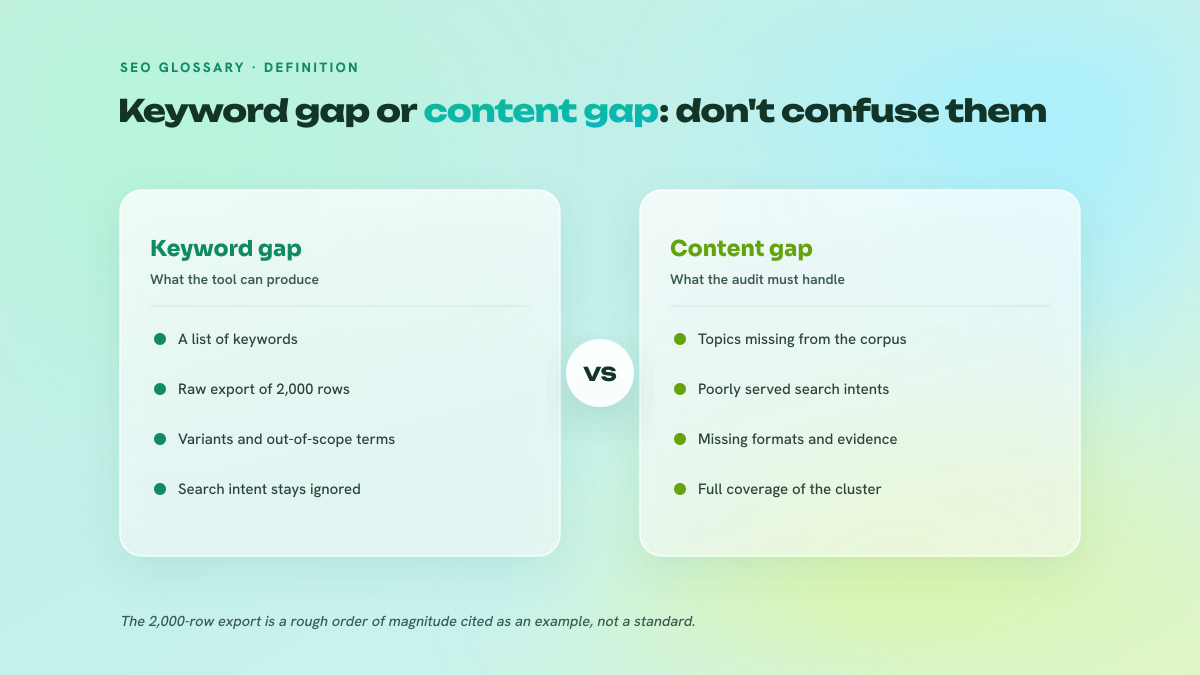
- →Keyword gap is the symptom, content gap is the diagnosis: the missing piece is often a format, a dataset or first-hand evidence, not a new URL.
- →Gaps now live in the AI layer too: AI Overviews doubled their query footprint between January and March 2025 (Semrush-based data, 6.49% to 13.14%), and pages absent from the sub-questions they synthesize are invisible there.
- →Prioritize gap candidates by cluster adjacency and commercial path, not search volume: a low-volume query from your buying committee is worth more than a high-volume query with no path to revenue.
- →Filling gaps with derivative summaries is the exact behavior Google targeted: the company reported a 45% reduction in low-quality, unoriginal content in results after the Helpful Content integration.
- →Rerun the analysis quarterly, aligned on core update cadence: coverage is relative to competitors, and the bar moved with every 2024 and 2025 core update.
What a content gap really is, beyond the keyword diff
Strip away the tool marketing and a content gap is a coverage failure: a question your audience asks that your domain does not answer, answers in the wrong format, or answers less convincingly than the pages already ranking. The industry shorthand, exporting a keyword diff between your domain and three competitors, captures only the narrowest version of this. The export tells you which queries competitors rank for and you do not. It says nothing about whether those queries matter for your market, whether the missing piece is a page or a paragraph, or whether the real gap is evidence rather than existence.
The distinction with keyword gap matters operationally. A keyword gap is a symptom you read in a spreadsheet. A content gap is the diagnosis: a missing subtopic, a missing format (the comparison table where you only have prose, the calculator where you only have theory), or a missing layer of first-hand experience. Since Google folded the Helpful Content system into its core ranking algorithm in March 2024, that diagnosis carries domain-level consequences: helpfulness became a continuous, site-wide signal rather than a periodic penalty sweep. Google reported a 45% reduction in low-quality, unoriginal content in its results following that integration, which tells you precisely what happens to gaps filled with derivative summaries.
For a two-minute grounding on the concept before we go deeper, this short explainer does the job:
This is why we read content gaps at cluster level, as an input to the topical authority a domain projects rather than as a standalone metric. One uncovered subtopic rarely costs you one ranking; it weakens the perceived expertise of everything around it. The 2026 strategy literature converges on the same observation we make in audits: sites with deep, complete coverage of a subject outperform sites with scattered pages, because the 2025 and 2026 core updates reward topical completeness over isolated keyword wins.
How Google evaluates missing coverage in 2026
The update cadence since 2024 rewrote the cost of a gap. Google shipped four core updates in 2024 (March, August, November, December) and at least three in 2025, including June 30 and December 11. Industry analyses of the March 2025 core update noted expanded detection of first-hand expertise, and post-mortems of the December 2025 update described a sharper line between genuinely helpful pages and thin or structurally manipulative ones. Read together, the direction is consistent: Google is not ranking your page against a query, it is ranking your domain against a subject. A cluster with a fifth of its subtopics uncovered projects incomplete expertise, and that projection follows every URL in the cluster.
The second shift is where gaps now live. A Semrush-based analysis put AI Overviews on 6.49% of queries in January 2025 and 13.14% in March 2025, a doubling in three months. When they appear, they absorb clicks: an April 2025 study measured average CTR 34.5% lower on results carrying an AI Overview, and the February 2026 follow-up from the same source measured the loss at 58%. SparkToro's 2024 zero-click research already put nearly 60% of searches ending without any click to an external site. The head term you were told to chase is increasingly answered above position one.
The compensating channel is real but small. Adobe analytics data showed AI-driven referral traffic in the US growing more than tenfold between July 2024 and February 2025; between September 2024 and February 2025, generative-AI referrals rose 123%, moving from 0.54% to 1.24% of organic traffic share. The operational consequence: in 2026 a content gap includes the sub-questions an AI assistant synthesizes when it answers, not just the queries in a rank tracker. Understanding how an assistant fans a question out into sub-queries belongs in the same coverage exercise, because the page that answers the sub-question is the page that gets cited.
Where the gap sits in a netlinking operation
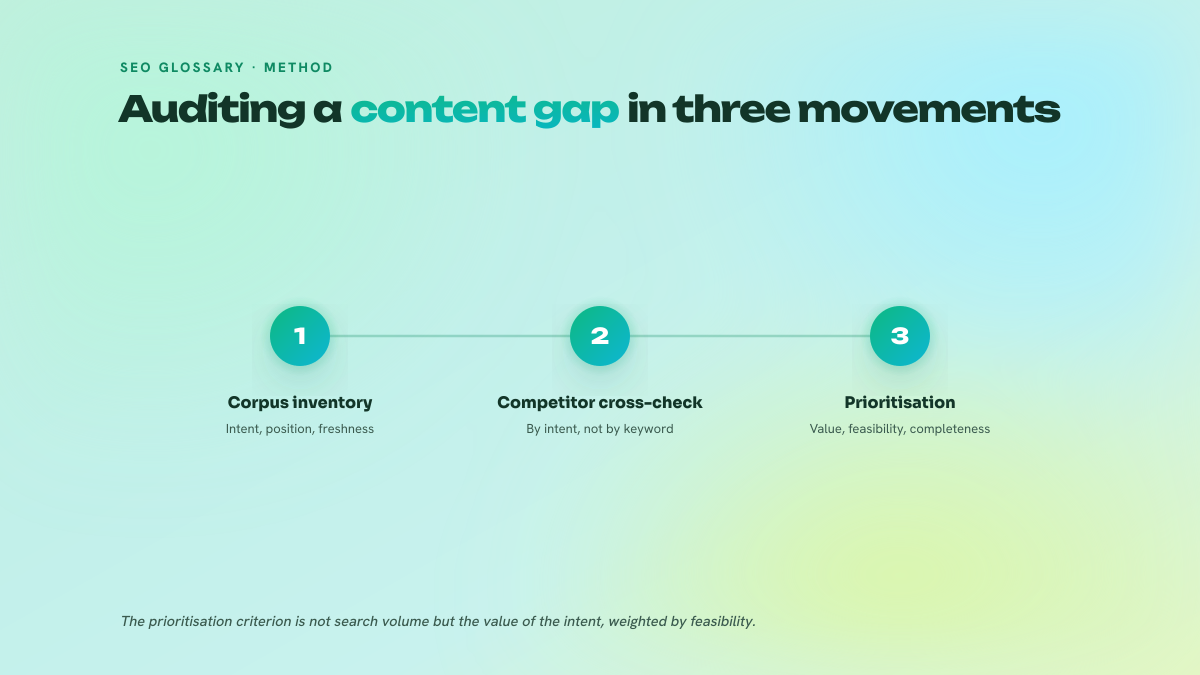
Gap analysis is usually filed under content strategy. In a netlinking operation it decides budget allocation. Links pointed at a page inside a thin cluster underperform: the page has no internal reinforcement, the domain projects no expertise on the subject, and post-2024 quality signals cap what external authority can compensate. From what we see in audits, the sequence that works is coverage first, links second: close the load-bearing gaps in a cluster, then calibrate a link campaign around the pages that already carry topical weight. The inverse order burns budget on URLs Google has already classified as peripheral.
The publisher side is the half almost nobody audits. A placement lives on someone else's domain and inherits that domain's coverage logic. An article that fills a real gap on the host site earns internal links, stays indexed and passes value for years; the two-hundredth piece on an exhausted topic gets orphaned within months. On the owned media we operate at Nautilinks, placements are planned against each site's coverage map for exactly this reason: a sponsored article written to fill a real hole in the host's cluster is a more durable asset than one dropped wherever there was editorial space. That is not courtesy toward the publisher, it is link durability.
Running a gap analysis that holds up
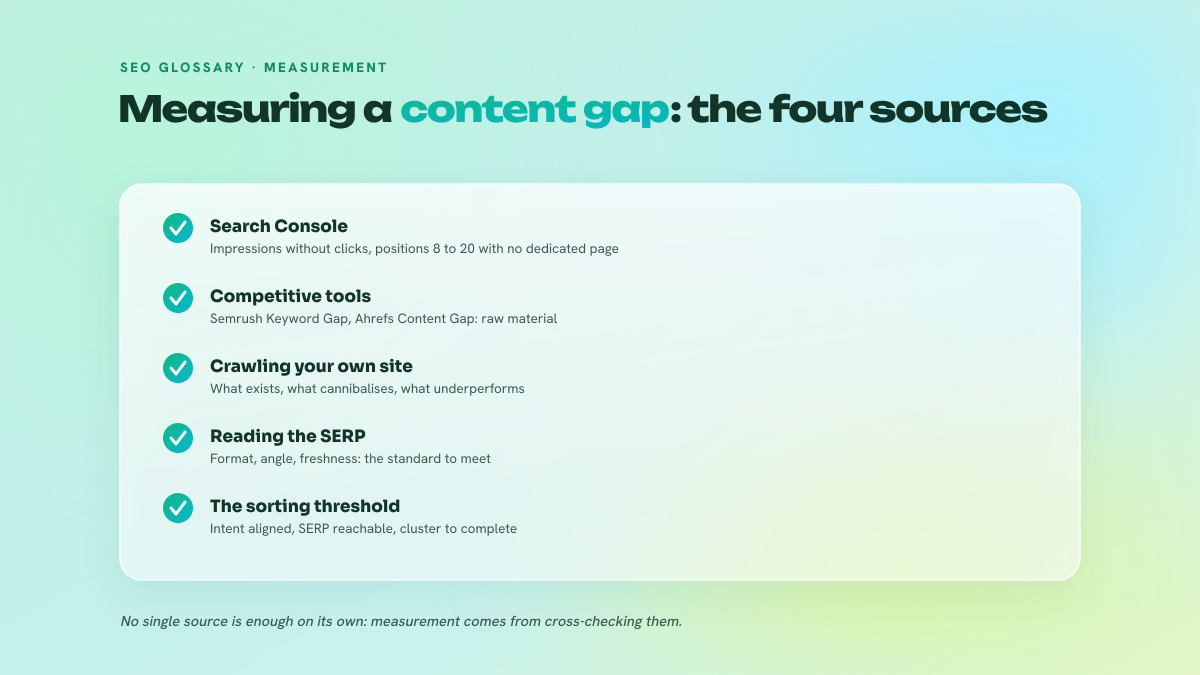
Start from Search Console, not from a competitor export. Filter for queries with impressions but no dedicated URL: Google is already telling you it considers your domain relevant for demands you never addressed head-on. Queries stuck between positions 8 and 20 on a loosely related page are the same signal, adjacent coverage exists but a dedicated answer does not. This is the cheapest and most site-specific gap data available, it requires no paid tool, and Google Trends adds the directional layer: which of these uncovered demands is growing rather than fading.
Then read the SERPs manually before writing anything. A tool diff tells you a query exists; only the SERP tells you what search intent actually hides behind it and which format Google currently rewards. If the top results are comparison tables and you plan a 2,000-word essay, you have identified a gap and chosen the wrong way to close it. Format and intent mismatches kill more gap-filling content than missing keywords ever did.
For the tool-assisted pass, this walkthrough shows the mechanics on a live example:
Paid suites accelerate the competitor half: intersecting three or four domains in Ahrefs or Semrush surfaces candidates in minutes that manual review would take days to find. Treat the output as raw candidates, nothing more. Prioritize by cluster adjacency and commercial path, never by volume alone: a gap that extends a cluster you already own compounds with everything around it, while an isolated gap starts from zero authority. And keep a column for what you can add that the SERP does not already contain, data, tests, a defensible position. A candidate with nothing in that column should not become a brief.
Common mistakes we see in audits
The most expensive one: treating the keyword-diff export as a publishing plan. A team generates forty briefs from an intersection report, produces forty derivative articles, and lands squarely in the population the Helpful Content integration was built to demote. Post-March 2024, filling a gap with a summary of what already ranks does not close the gap; it adds a URL that dilutes the domain's quality signals while the original hole stays open.
Second: chasing competitor gaps that are not your gaps. A competitor covers a subtopic because it fits their market position, their audience or their product. If a query has no path to your commercial pages and no role in a cluster you need, its absence from your site is not a gap, it is focus. The diff is symmetric; your strategy is not.
Third: auditing only for missing URLs. Quality gaps (you cover it, they cover it with original data), format gaps (they rank a tool, you rank prose) and experience gaps (their author tested the product, yours paraphrased documentation) never show up in a keyword report, yet they are exactly what the March 2025 expansion of first-hand expertise detection targets. In most audits we run, upgrading ten existing pages outperforms shipping forty new ones.
Fourth: the one-shot analysis. Coverage is relative to a moving field, competitors publish, updates recalibrate, AI surfaces reshuffle what gets clicked. An analysis older than two quarters describes a market that no longer exists.
Tactical takeaways
Run the Search Console pass monthly; it costs an hour and it is your only gap source that reflects how Google actually reads your domain. Run the full competitive pass quarterly, aligned on core update cadence. Treat gap analysis as an editing exercise as much as a publishing one: a healthy backlog contains upgrades, merges and format conversions, not only new URLs. Score every candidate on three axes, cluster adjacency, commercial path, and your ability to add something the SERP lacks. Two out of three is a maybe. One out of three is a pass.
For a senior-level view on prioritization and workflow, this session is worth the time:
And keep one argument ready for the stakeholder who asks why coverage suddenly outranks link volume in your roadmap: with AI Overviews on a growing share of queries and CTR losses measured at 58% where they appear (February 2026 data), being the cited source of a sub-answer is worth more than a marginal position gain on a head term nobody clicks. Coverage is what gets you cited. Links accelerate pages that deserve it; they no longer substitute for the pages that are missing.
Nautilinks operates an owned network of editorial media. In-house written articles, transparency disclosures respected, anchor mix calibrated.
Frequently asked questions
Where exactly is the line between a keyword gap and a content gap?
A keyword gap is a data artifact: queries where competitors rank and you do not, readable in any suite's intersection report. A content gap is the underlying coverage failure, which may be a missing page, but just as often a missing format, missing original data or missing first-hand experience on a page you already have. Every keyword gap points at a possible content gap; plenty of content gaps, especially quality and format gaps, never appear in a keyword report at all.
Is the « five gaps » framework (knowledge, format, channel, quality) actually useful?
As a checklist, yes; as a doctrine, no. The taxonomy circulating in marketing blogs, knowledge, format, channel, quality, plus a fifth that varies by author, is mainly useful as a reminder that gaps are not just missing URLs. In practice we collapse it to three questions per candidate: does the page exist, does it match the format the SERP rewards, and does it contain something original. That covers every case the framework does, with less ceremony.
Can I run a credible gap analysis without paid tools?
Yes, and for a single site it is often the better starting point. Search Console queries with impressions but no dedicated URL, positions 8 to 20 on loosely related pages, plus manual SERP reading and Google Trends for direction, will surface the gaps that matter for your domain specifically. Paid intersection reports mostly accelerate the competitor half and multi-site work. What no tool replaces is reading the SERP to identify format and intent before writing.
Do content gaps affect visibility in AI Overviews and assistants?
Directly. AI Overviews synthesize answers from sub-questions, and the source cited for each sub-answer is a page that covers it explicitly. Semrush-based data showed AI Overviews doubling from 6.49% to 13.14% of queries between January and March 2025, and CTR studies measured losses of 34.5% (April 2025) then 58% (February 2026) where they appear. A cluster with uncovered sub-questions is invisible in that layer regardless of how well its main page ranks.
How often should the analysis be rerun?
Monthly for the Search Console pass, quarterly for the full competitive pass. Google shipped four core updates in 2024 and at least three in 2025, and each one recalibrated what complete, helpful coverage looks like. Competitors publish continuously and AI surfaces keep reshaping which queries return clicks at all. An analysis older than two quarters describes a market that has already moved; treating it as current is how teams end up filling last year's gaps.
Should I fill every gap the competitor diff exposes?
No. The diff is symmetric but your strategy is not: a competitor covers subtopics because they fit their product and audience. Filter candidates on cluster adjacency, commercial path and your capacity to add something original. A gap with no route to revenue and no role in a cluster you need is not a gap, it is noise, and post-Helpful Content, publishing derivative pages to close it actively costs you site-wide quality signals.
Test your knowledge
Quiz: Content Gap
1/3What changed in March 2024 that turned content gaps into a domain-level problem rather than a per-query one?