- →Topical authority is a site-level property, not a page-level one: since the Helpful Content system was folded into core ranking in March 2024, off-topic or thin sections drag the whole domain, not just themselves.
- →The 2024 Content Warehouse leak surfaced siteFocusScore, siteRadius and site2vecEmbeddingEncoded, which is the closest public evidence that topical concentration and deviation from the core topic are modelled explicitly.
- →A 2026 analysis of AI search citations found a quantitative topical authority metric correlated with being cited at r=0.41, while Domain Authority and backlink counts sat near r² ≈ 0.03: for AI visibility, depth of coverage now outweighs raw link volume.
- →Measure it with query coverage, not with a vendor score: the share of the sub-topic keyword set where you rank top 20, tracked as a curve over time, tells you more than any single authority number.
- →Links still matter, but their job changed: on-topic links from media that already publish on the subject reinforce the same signal your content builds, while scattered off-topic links add nothing to topical coherence.
- →The fastest way to lose it is topic sprawl: chasing adjacent trending subjects widens the site radius and dilutes the coherence you spent a year building.
What topical authority really is, beyond the definition
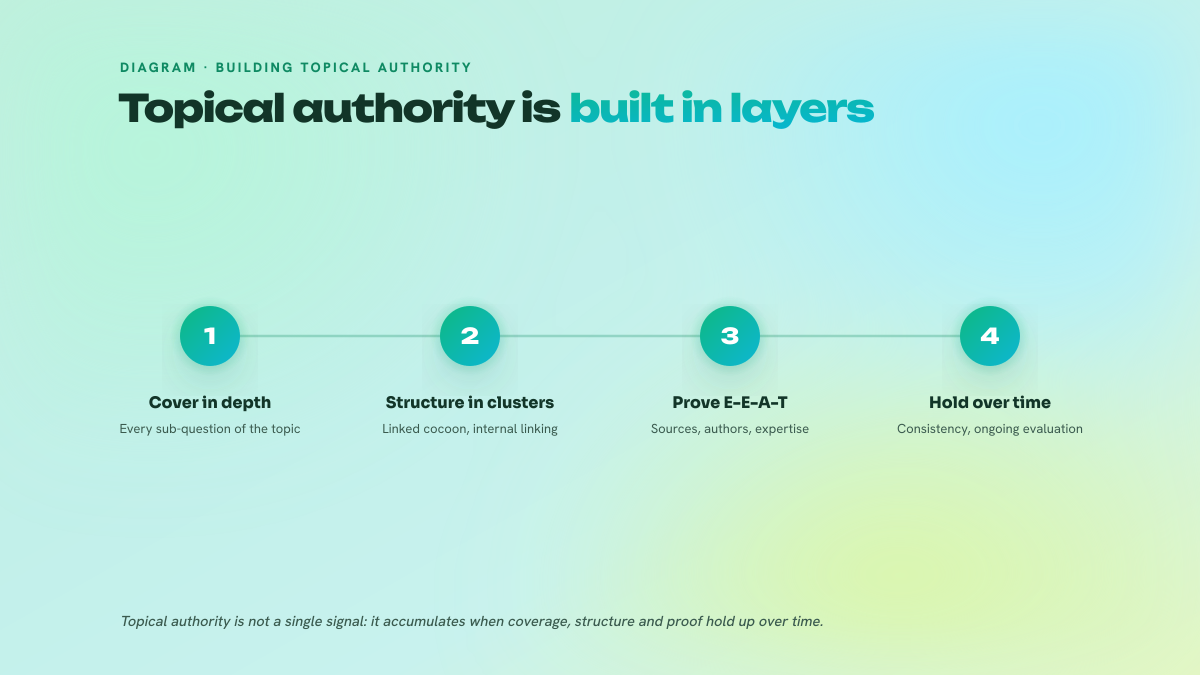
Topical authority is the probability, from Google's side, that your site is a competent source on a subject rather than a site that happened to publish one page about it. No dashboard exposes that probability. What exists instead is a bundle of site-level signals behaving exactly as if such a score were computed: breadth of coverage across the subject, depth on each sub-topic, an internal link structure that actually connects them, and the thematic consistency of the domains pointing at you.
The test we run in audits is blunt. Take the twenty most commercially useful queries in your topic and ask whether a reader landing on any one of your pages could get a serious answer to the other nineteen without leaving the site. If not, you have content about a topic, you do not have authority on it. That distinction matters because Google's evaluation moved from the page to the site: an isolated excellent article on a domain that covers eleven unrelated subjects is treated differently from the same article on a domain that covers nothing else.
Worth being precise on vocabulary, because the industry is sloppy here. Google does not use the phrase « topical authority » in its core ranking documentation. It does publish a system called topic authority, but that one is scoped to news-type queries, built to surface expert sources in specialised areas like health, politics and finance. Everything else the SEO industry calls topical authority is an inference from observed behaviour plus the leaked attribute names. That inference happens to be well supported, but a senior operator should know they are working with a model, not a published metric.
How Google actually models it in 2026
Three things happened between 2024 and late 2025 that turned topical authority from a content-marketing talking point into an operational constraint.
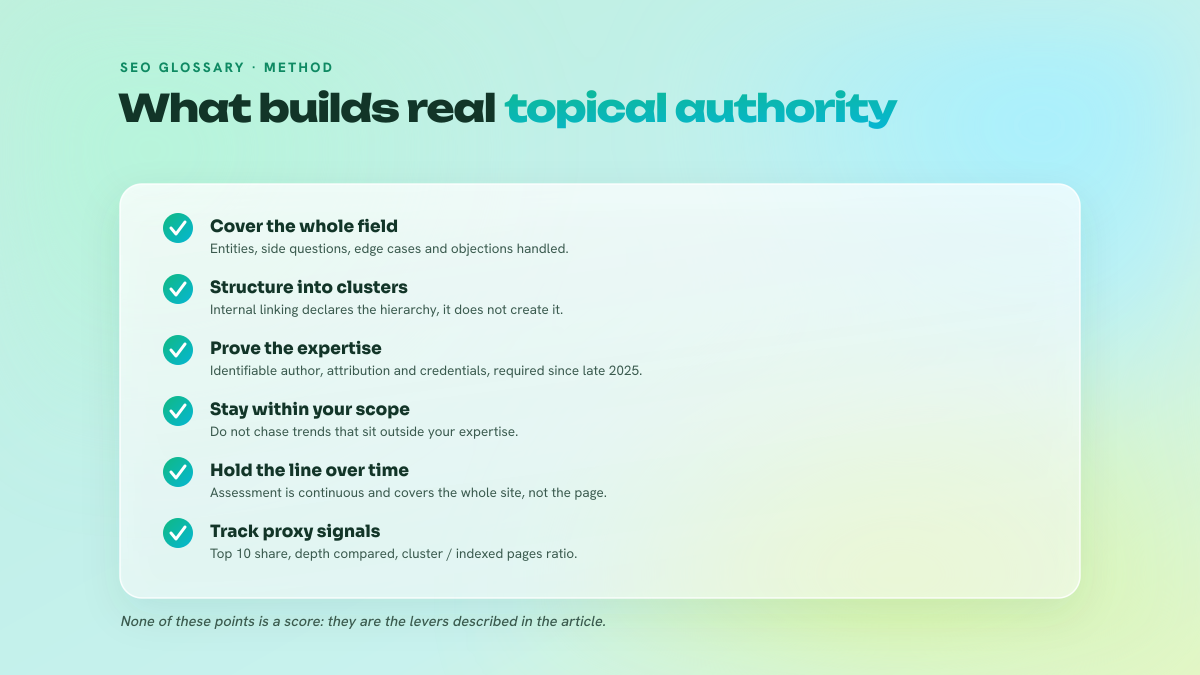
First, the Helpful Content system stopped being a separate filter and was folded into core ranking in March 2024. Since then it evaluates entire sites continuously, and a cluster of weak or off-topic pages can depress a whole domain. Google's own guidance after that change warned against chasing trends outside your area of expertise, which is the clearest institutional statement that topical focus functions as a protection signal rather than a growth trick.
Second, the March 2024 Google Content Warehouse documentation leak, noticed publicly in May 2024, described more than 14,000 ranking-related attributes. Three of them are the reason this term stopped being hand-waving: siteFocusScore, which measures the topical coherence of a site, siteRadius, which measures how far individual pages deviate from the site's main topics using embeddings, and site2vecEmbeddingEncoded, an embedding representation of the site's topics. The same corpus contained siteAuthority, a site-level authority score whose existence had been publicly denied. Nobody outside Google knows the weights, but the vocabulary confirms the shape: coherence and deviation are measured, at site level, in embedding space.
Third, the core updates kept pushing in that direction. The December 2024 core update was read across the industry as placing particular emphasis on topical relevance. The June 2025 core update was widely described as surfacing lesser-known sites with genuine depth. The December 2025 core update, rolled out on 11 December 2025, increased the weight of E-E-A-T signals across competitive queries well beyond the YMYL perimeter, and tightened requirements on author attribution and credentials, with anonymous content struggling on competitive terms.
The fourth force is AI search, and it is the one that changed the economics. BrightEdge data reported in 2026 shows AI Overviews triggering on 48% of Google searches by early 2026, up 58% between February 2025 and February 2026. A Seer Interactive study covering 3,119 informational queries and 25.1M organic impressions between June 2024 and September 2025 measured organic CTR on AI Overview queries dropping 61%, from 1.76% to 0.61%. Being ranked is no longer the same as being read. Being cited is. And a 2026 analysis of AI search citations found that a quantitative topical authority metric, defined as measurable depth and breadth of coverage on a subject, was the strongest predictor of citation at r=0.41, while Domain Authority and backlink counts each sat around r² ≈ 0.03. The same analysis found pages ranking between positions 6 and 10 on topically strong sites were cited 2.3 times more often than position-1 pages on topically weak ones.
Keep some perspective on the doom narrative though: an analysis of 40,000 US websites between February 2024 and November 2025 found organic search traffic down only 2.5% year over year, with organic results still capturing roughly 90% of Google clicks against about 10% for ads. The channel did not collapse. The selection criteria inside it got stricter.
Topical authority vs domain authority vs E-E-A-T
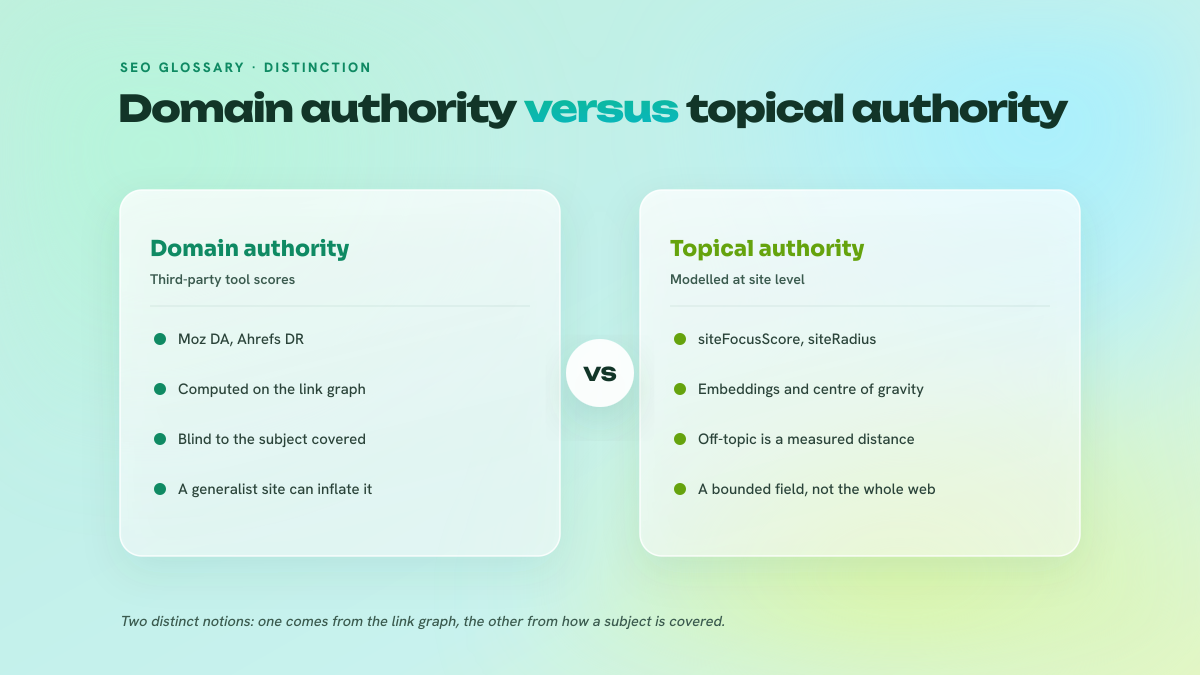
Domain authority, in the Moz or Ahrefs sense, is a vendor-computed prediction of ranking strength derived almost entirely from the link graph. It is topic-blind by construction: a DR 70 built on generalist press coverage says nothing about whether the site can rank on industrial thermal insulation. Topical authority is topic-scoped and content-driven first, link-reinforced second. The two are not competitors, they answer different questions. Domain authority answers « can this site rank at all », topical authority answers « can this site rank here ».
The operational consequence is that they fail in opposite directions. A high-DR generalist site launching a new vertical ranks quickly on easy queries and then stalls on the ones that pay, because it never built coverage. A focused specialist site with a modest link profile ranks slowly, then holds positions through core updates that flatten the generalist. In 2026, with E-E-A-T weighted more heavily since the December 2025 update, the second profile is the safer asset.
E-E-A-T is the evaluation framework, topical authority is one of its observable outputs. Experience and expertise are asserted through author attribution and demonstrated through coverage depth; authoritativeness is corroborated by who links to you and on what subject; trust is the aggregate. Treating E-E-A-T as an author-bio checkbox and topical authority as a content-volume target is the standard way to satisfy neither.
How you build it, and how you measure the build
Building starts from the query set, not from an article calendar. Map the full space of questions a buyer asks across the subject, group them by the job they do rather than by keyword string, and accept that a third of them will have negligible search volume. Those are frequently the ones that carry the semantic weight, because they are where a genuine practitioner has something to say and a content mill does not. The cluster architecture that comes out of this, a hub page holding the definitional and commercial ground with satellites treating each sub-question in full, is the standard shape for a reason: it mirrors how the internal link graph needs to look. If you are formalising that architecture, our entries on how clusters are organised around a central subject and on the hub page that anchors them go deeper on the mechanics.
This talk covers the relationship between coverage depth and E-E-A-T, which is the part most teams get backwards:
Measurement is where most teams get lazy and buy a vendor score. Do not. The honest metric is query coverage: define the sub-topic keyword set once, then track the share of it where the site ranks in the top 20, as a curve over months. A site gaining topical authority shows rising coverage before it shows rising average position, because Google starts admitting the site to more query sets before it promotes it inside them. Second metric: the ratio of impressions coming from queries you never explicitly targeted, straight out of Search Console. When that ratio climbs, the model has generalised your site to the topic. Third: citation share inside AI Overviews for your subject, sampled manually or through systematic tracking of the query fan-out around your topic, since that is now the visibility that converts to clicks.
A practical walkthrough of the build sequence:
Two mechanical points that are worth more than another thousand words of content. Internal linking must be built as you publish, not retrofitted in a quarterly audit: a new page with zero inbound internal links is invisible to the coherence calculation. And every page should resolve a distinct intent, because two pages competing on the same intent do not add coverage, they split it. Our note on reading intent before writing a brief is the shortest path out of that trap.
On mapping the space itself:
Where it meets a netlinking operation
Topical authority reframes what a good link is. If site-level coherence is modelled through embeddings, then a link from a domain whose own topical centre sits next to yours reinforces the same vector your content is building, while a link from a generalist high-DR site mostly moves a vendor metric. That is not a reason to refuse authority, it is a reason to stop treating DR as the sorting key. Sort by subject proximity first, filter by quality second.
This also changes what you buy. A single article placed inside a media that already publishes regularly on your subject does two jobs at once: it passes a contextual link and it associates your domain with a topic in a corpus Google already classified. That is the logic behind placing a sourced piece inside a media that already covers your field, and why filtering the catalogue by theme before looking at any metric is the right order of operations. If you would rather inspect the inventory yourself, the media catalogue is public and browsable without an account, prices included.
We run this constraint on our own side too: Nautilinks operates its own French editorial media, each built around a defined subject rather than as a generalist container, precisely because a media with a diffuse topic is worth less to the sites it links to. When a campaign needs a sequence of placements spread over months across a coherent subject perimeter rather than a one-off batch, that is the case for having the whole thematic sequence calibrated and executed for you. The lighter, self-serve version of the same discipline is pacing a link campaign over several months yourself, on your own schedule.
What we see go wrong
Topic sprawl is the dominant failure. A site builds real depth on one subject, then the marketing team adds a section on an adjacent trending topic because the volume looks attractive. In siteRadius terms, that widens the deviation and dilutes the coherence built over a year. If you genuinely need a second subject, a separate domain is usually the cheaper answer.
Second failure: volume mistaken for depth. Publishing sixty near-identical articles on variants of the same query produces internal cannibalisation and a thin-content footprint, which the Helpful Content signals now read at site level. Fifteen pages that each fully resolve a distinct question beat sixty that circle one.
Third: leaving gaps in the middle of the map. A cluster with a missing sub-topic is a hole a competitor fills, and the hole is usually where the commercial intent lives, because those queries are harder to write. Running a proper comparison of what competitors cover and you do not quarterly is cheap and consistently finds two or three of them.
Fourth, and increasingly expensive since December 2025: anonymous content. Unsigned articles with no credentials attached compete badly on the queries that matter now that author-level attribution carries more weight. Attaching a real, verifiable author to a body of work on one subject is the least glamorous and most reliable lever left.
Last one, quieter than the others: teams stop measuring at the ranking layer. If half your subject's queries now trigger an AI Overview and you only track positions, you will report a stable curve while your actual readership erodes. Track citation presence alongside position, or you are auditing a dashboard rather than a business.
Nautilinks operates an owned network of editorial media. In-house written articles, transparency disclosures respected, anchor mix calibrated.
Frequently asked questions
Is topical authority an actual metric inside Google's ranking systems?
Not under that name in core documentation. Google does run a published topic authority system, but it is scoped to news-type queries and expert sources in areas like health, politics and finance. What supports the wider concept is the March 2024 Content Warehouse leak, which exposed siteFocusScore, siteRadius and site2vecEmbeddingEncoded, attributes describing site-level topical coherence and deviation in embedding space. So the mechanism is modelled, the industry label is ours, not Google's.
How do I measure topical authority without buying a vendor score?
Define the full sub-topic keyword set once, then track the share of it where you rank in the top 20 as a monthly curve. Coverage rises before average position does, so it is the earlier signal. Add two Search Console reads: the proportion of impressions from queries you never targeted, which shows the model generalising your site to the topic, and the trend on long-tail query count. Then sample AI Overview citation presence on your core queries.
Can links alone build topical authority?
No, and the 2026 citation data makes that concrete: a quantitative topical authority metric predicted AI citation at r=0.41 while backlink counts and Domain Authority each sat near r² ≈ 0.03. Links reinforce a signal your content has to create first. What links do change is speed and corroboration, especially when they come from media whose own topical centre sits close to yours. A dense link profile on a shallow content base ranks briefly and then gets flattened by a core update.
How long does it take before topical authority shows in traffic?
In our audits the coverage curve starts moving after roughly ten to fifteen substantive pages on a well-defined sub-topic, with position gains following one to two months behind. Full cluster maturity on a competitive subject is a two to four quarter project, not a sprint. The two things that reliably slow it down are publishing without building internal links as you go, and letting two pages compete on the same intent.
Does topical authority still matter if AI Overviews are eating the clicks?
It matters more. AI Overviews triggered on 48% of Google searches by early 2026 per BrightEdge data, and a Seer Interactive study found organic CTR on those queries fell 61%, from 1.76% to 0.61%. But the same 2026 citation analysis found pages ranking 6th to 10th on topically strong sites were cited 2.3 times more often than position-1 pages on weak ones. Depth of coverage is what gets you into the answer.
Should a second subject live on the same domain or a separate one?
Separate, in most cases. Adding an unrelated section widens what the leak called siteRadius and dilutes coherence built over months, and since the Helpful Content system merged into core ranking in March 2024 the penalty is site-wide, not section-wide. The exception is a subject genuinely adjacent to your existing one, where the audience and the vocabulary overlap. If you struggle to write the sentence connecting the two, it is a second domain.
Test your knowledge
Quiz: Topical authority
1/3Which pair of attributes from the 2024 Google Content Warehouse leak most directly describes a site's topical concentration?