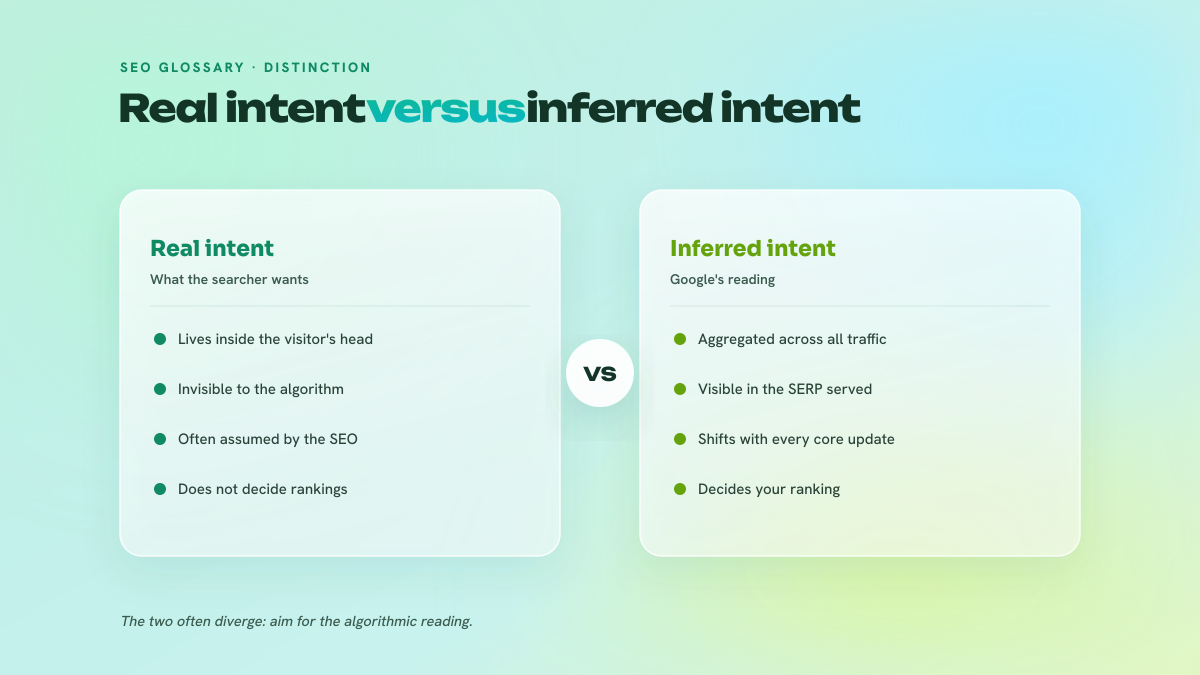
- →Intent is a gate, not a ranking bonus: a transactional page pointed at an informational query cannot rank no matter how many quality backlinks it carries.
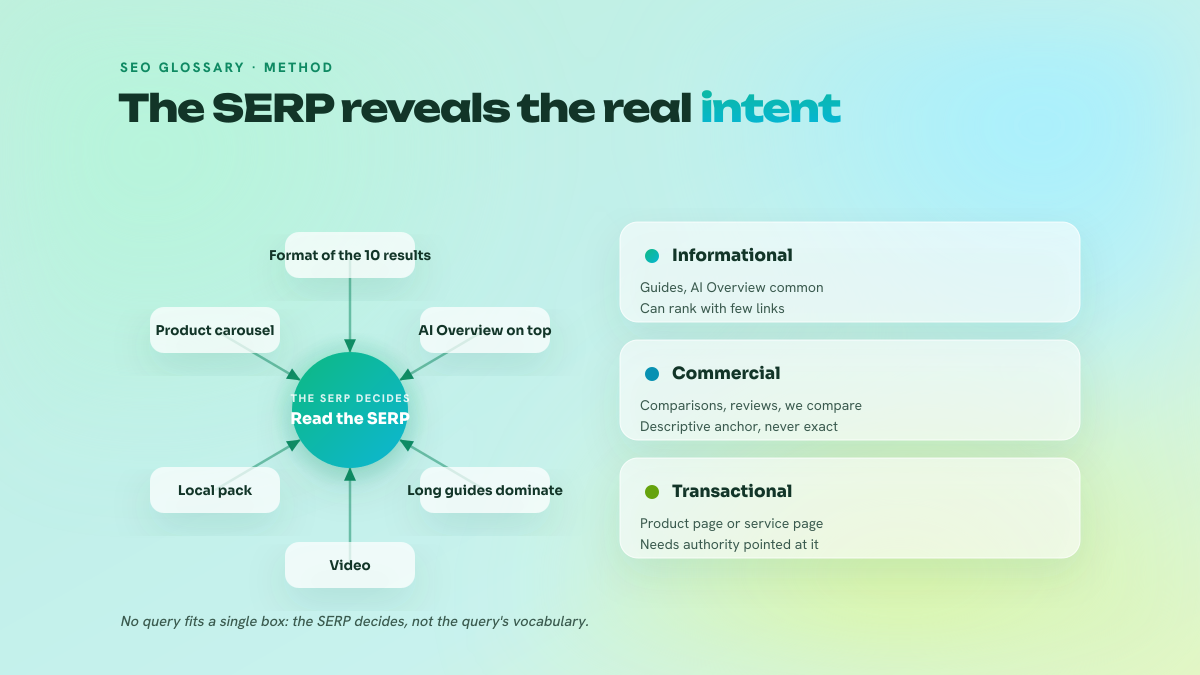
- →The SERP is the ground truth. Google already resolved the intent for every keyword; read the layout of the top 10 before you write a line or place a link.
- →AI Overviews concentrate on informational intent (roughly 80% of desktop AIOs in Semrush's Sept 2024 data), and Ahrefs measured a 58% drop in position-1 CTR on AIO keywords by December 2025. Informational pages now need a commercial or link-earning reason to exist beyond traffic.
- →The «three Cs» (content type, format, angle) matter more than keyword density: match the dominant format the SERP rewards, or you compete in the wrong contest.
- →Intent drifts. A query that was informational in 2023 can turn commercial after a core update, so re-audit alignment on your key URLs rather than treating intent as a one-time tag.
What search intent actually is
Every keyword carries a job the user wants done, and Google spends most of its ranking effort inferring that job before it ever weighs your links. That inference is search intent: the operational reason behind a query, not the words in it. Two searches with near-identical wording, «CRM» and «best CRM for agencies», ask for completely different pages, and the SERP proves it by serving a definition for one and a comparison table for the other.
The practical consequence for a working SEO is blunt: intent is a gate, not a bonus. You can point a strong URL, backed by clean editorial backlinks, at a query whose intent your page format does not satisfy, and it will still stall outside the top 20. Link equity amplifies a page that already fits the intent. It does not overturn a mismatch. This is the part tutorial blogs skip when they call intent «important for SEO» without saying what it gates.
The following overview reinforces why this sits upstream of everything else in a content workflow.
Google has made its position explicit in its update communications. The November 2024 core update was described as refining the algorithm to «better recognize search intent and context» while cutting the visibility of content «optimized solely for ranking», and the March 2025 core update was read across the industry as improving intent handling and local relevance. When Google keeps naming intent in successive core updates, treat it as the axis those updates actually turn on, not marketing copy.
The intent taxonomy and where it breaks
The classic model splits queries into four buckets: informational (the user wants to understand), navigational (they want a specific site), commercial (they are comparing before buying), and transactional (they are ready to act). Some frameworks add a «three Cs» layer on top: content type, content format, and content angle, which is the more useful lens because it maps intent to a page you can actually build. Most competitors stop at listing the four types. The gap worth exploiting is that the taxonomy leaks at the edges, and local intent is the clearest leak.
Local intent cuts across the four buckets: «plumber Lyon» is transactional and local at once, and the SERP it triggers (map pack, reviews, proximity signals) has almost nothing in common with a national transactional page. This tactical layer is covered here.
The second leak is generative intent. Since AI Overviews rolled out widely to US users in May 2024 and reached, per a DigitalApplied analysis of Ahrefs data in March 2026, 48% of queries (up from 34.5% in December 2025), a growing share of informational queries never reach a blue link at all. Semrush's zero-click study for 2025 put roughly 58.5% of US searches ending with no external click. So «informational intent» now splits into two operational sub-cases: queries Google fully satisfies in-SERP, where ranking first buys you almost nothing, and queries deep enough that the user still clicks through. Knowing which you are dealing with changes whether the page is worth writing for traffic or only as a link and authority asset. This is where a coherent reputation built across a whole subject starts to matter more than any single ranking URL.
Reading intent straight from the SERP
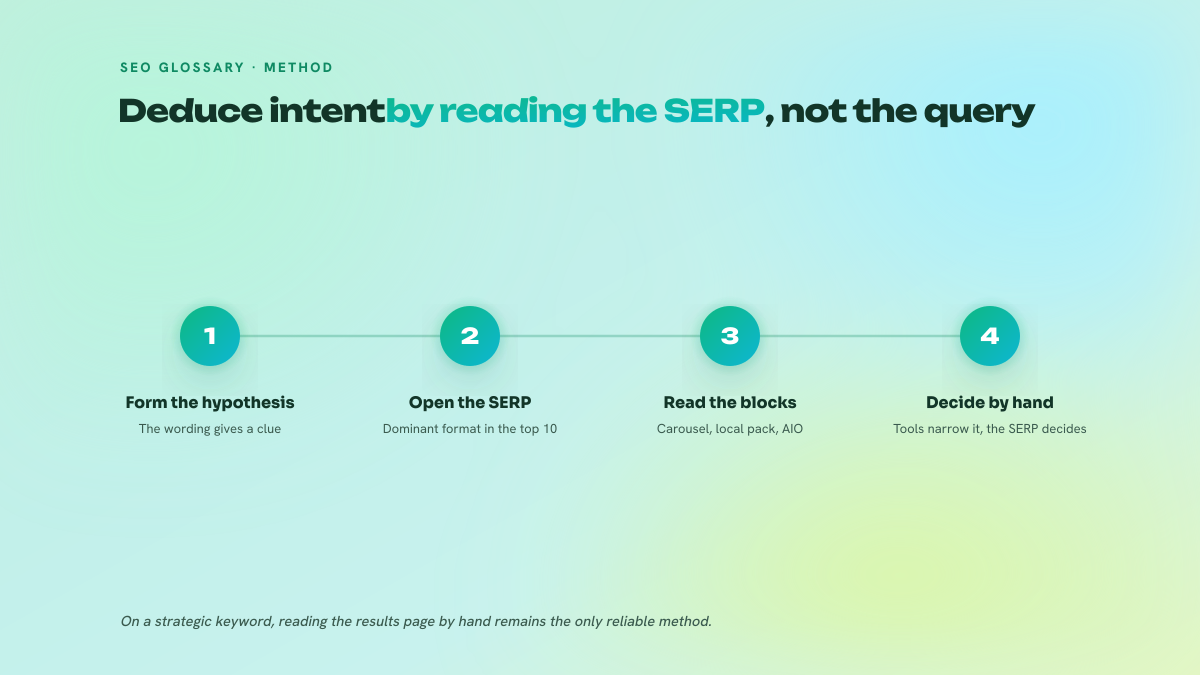
You do not guess intent. Google already resolved it for every keyword, and the resolution is sitting in the top 10 results. If the first page is dominated by listicles, that query is commercial and your product page will not rank there. If it is definitions and how-to guides, it is informational and your pricing page is in the wrong contest. Read the SERP before you write, before you brief a writer, and before you point a single link at the URL.
This method is worth internalising, and the walkthrough below covers the practical mechanics of analysing searcher intent from the results.
Beyond eyeballing the results, three signals sharpen the read. The query language itself: modifiers like «how», «what» and «guide» skew informational, «best», «vs» and «review» skew commercial, «buy», «price» and «near me» skew transactional. The SERP features: a shopping carousel or ads density flags commercial or transactional weight, while an AI Overview flags a query Google considers answerable, most often informational. Ahrefs measured 99.2% of its AIO sample as informational in the synthesis Search Engine Land published in January 2026, which is why a commercial page rarely triggers one. And the People Also Ask box, which exposes the adjacent sub-questions the audience actually carries, the raw material for spotting a question your existing pages never answer. Tools like Ahrefs and Semrush now tag intent automatically, but the tag is a starting hypothesis, not a verdict. When the tag and the live SERP disagree, the SERP wins.
Where intent decides a netlinking operation
Intent governs link allocation as much as it governs content. Link equity is a budget, and pointing it at a URL whose intent it cannot satisfy is spend with no return. Before a campaign, we sort target URLs by the intent contest they compete in: a commercial comparison page fighting for «best X» terms earns priority because it converts and can be lifted by authority, while a thin informational post that an AI Overview already answers rarely deserves the same link budget. When you decide to pick the host media by editorial topic yourself, intent alignment between the linking article and the target page is what makes the link read as a genuine recommendation rather than a placement.
The topical fit of the source matters for the same reason. A link from an article whose own intent and subject sit next to your target reinforces relevance, which is exactly why an editorial piece written around the reader's actual question outperforms a generic mention dropped into an unrelated post. Across the owned French media we operate in-house, the pieces that move rankings are the ones where the host article's intent and the linked page's intent belong to the same user journey, informational article feeding a commercial page one step down the funnel. Because dominant intent can drift mid-campaign, our default is a campaign spread over several months rather than a single push, checking the target SERPs again as it runs. For a client who would rather hand over the whole sequence, having it calibrated end to end on our side works the same way, just managed instead of self-directed. Intent is also why a cluster of pages covering one subject at every funnel stage distributes link equity more efficiently than a scatter of unrelated URLs.
What we see go wrong in audits
The recurring failure is the intent mismatch nobody re-checked. A page was mapped to a keyword two years ago, the query's dominant intent shifted after a core update, and the page kept its old format while the SERP moved on. From what we see in audits, this is the single most common reason a well-linked URL underperforms: the links are fine, the intent is stale. Google's own March 2025 recovery guidance pointed operators toward re-auditing content for intent alignment rather than technical tweaks, which matches our experience.
The second mistake is stacking multiple intents on one URL, an informational guide bolted onto a transactional page in the hope of ranking for both. It usually ranks for neither, because the format cannot satisfy two contests at once. Split them. The third is chasing informational traffic that no longer clicks. With Ahrefs measuring a 58% drop in position-1 CTR on AIO keywords by December 2025, an informational page justified purely by traffic is a weaker bet than it was in 2023. It can still earn its place as a link magnet or an authority signal, but plan it as that, not as a traffic play. The fourth, and the one that quietly caps a whole domain, is ignoring emerging generative intent: writing for the blue link when the query already resolves inside an AI Overview, instead of mapping how AI assistants decompose it into sub-queries first. Notably, Search Engine Land reported that on the rare branded queries where an AIO appears (4.79% of branded terms), CTR actually rose about 18.7%, a reminder that strong navigational intent behaves nothing like broad informational intent, and that the two demand different playbooks.
Nautilinks operates an owned network of editorial media. In-house written articles, transparency disclosures respected, anchor mix calibrated.
Frequently asked questions
How do I settle an ambiguous query where the intent tag and my instinct disagree?
Open the live SERP for that exact query and read the format of the top 10. Google has already resolved the intent, and the dominant page type (definition, listicle, product, map pack) is the answer. If your tool tags a keyword commercial but the results are all how-to guides, the SERP wins and the query is informational. The tag is a hypothesis; the live results are the verdict.
Are informational pages still worth writing now that AI Overviews absorb the click?
Sometimes, but the justification has changed. With Ahrefs measuring a 58% drop in position-1 CTR on AIO keywords by December 2025, a page defended only by expected traffic is weak. Informational content now earns its place mainly as a link-earning and authority asset, or when the query is deep enough that users still click through past the summary. Decide the role before you brief it, not after.
What is the difference between commercial and transactional intent in practice?
Commercial intent means the user is still comparing («best», «vs», «review»), so the SERP rewards listicles and comparison content. Transactional means they are ready to act («buy», «price», «near me»), so it rewards product, category or booking pages. The operational tell is the SERP: a shopping carousel or heavy ads density signals transactional weight, while comparison articles signal a commercial contest you win with editorial format, not a checkout page.
How does intent change how I allocate a link budget?
Sort target URLs by the intent contest they compete in and fund the ones that can actually rank and convert. A commercial comparison page fighting for «best X» terms earns priority because links lift it and it converts. A thin informational post already answered by an AI Overview rarely deserves the same spend. Then match the source article's own intent to the target so the link reads as a genuine recommendation.
How often should I re-audit intent on existing pages?
Treat intent as mutable and re-check it around every broad core update, plus at least once a year on your commercial URLs. The most common cause of a well-linked page underperforming, from what we see in audits, is that the query's dominant intent shifted while the page kept its old format. Google's March 2025 recovery guidance itself pointed operators toward re-aligning content with current intent rather than technical fixes.
Test your knowledge
Quiz: Search Intent
1/3According to Ahrefs' February 2026 study, by how much did AI Overviews reduce position-1 CTR on affected keywords by December 2025?