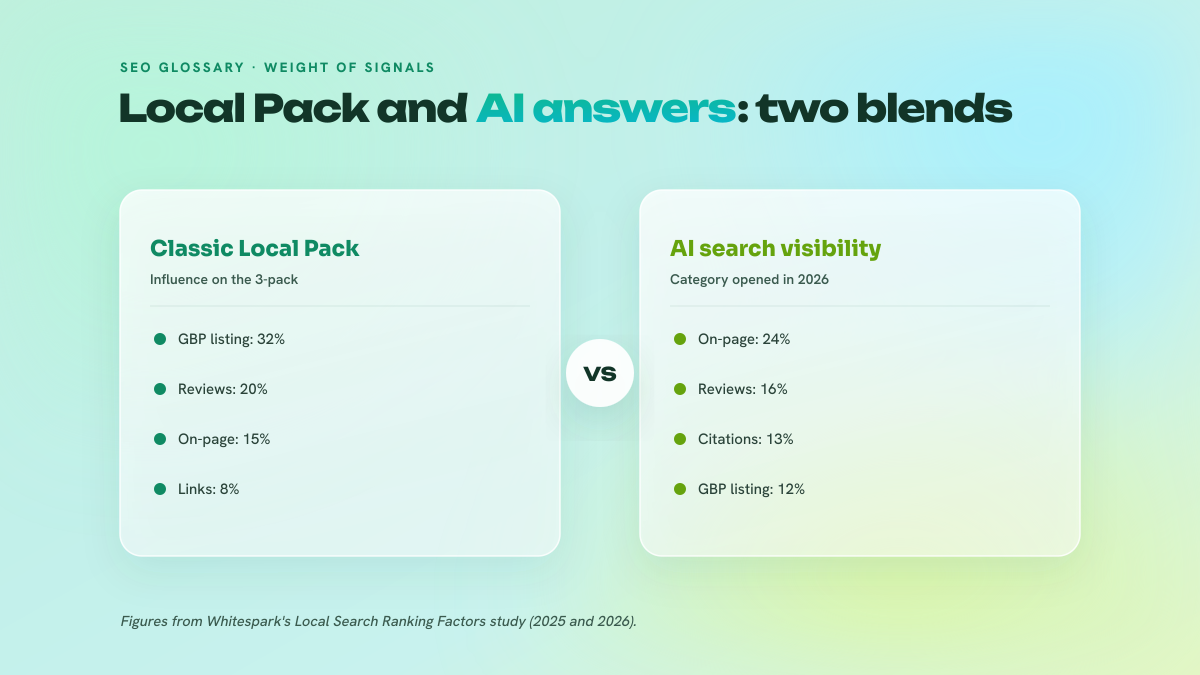
- →GBP signals account for 32% of Local Pack influence in Whitespark's 2026 ranking factors, the single largest bucket, ahead of reviews at 20% and on-page at 15%.
- →Review recency climbed from around rank 20 in 2023 to the single most important individual factor by 2025/2026: an old five-star average decays, a steady drip of fresh reviews wins.
- →The GBP Q&A API was shut down on 3 Nov 2025 and the public Q&A section began deprecation on 3 Dec 2025, replaced by Ask Maps and Gemini answers pulled from your profile, site and reviews.
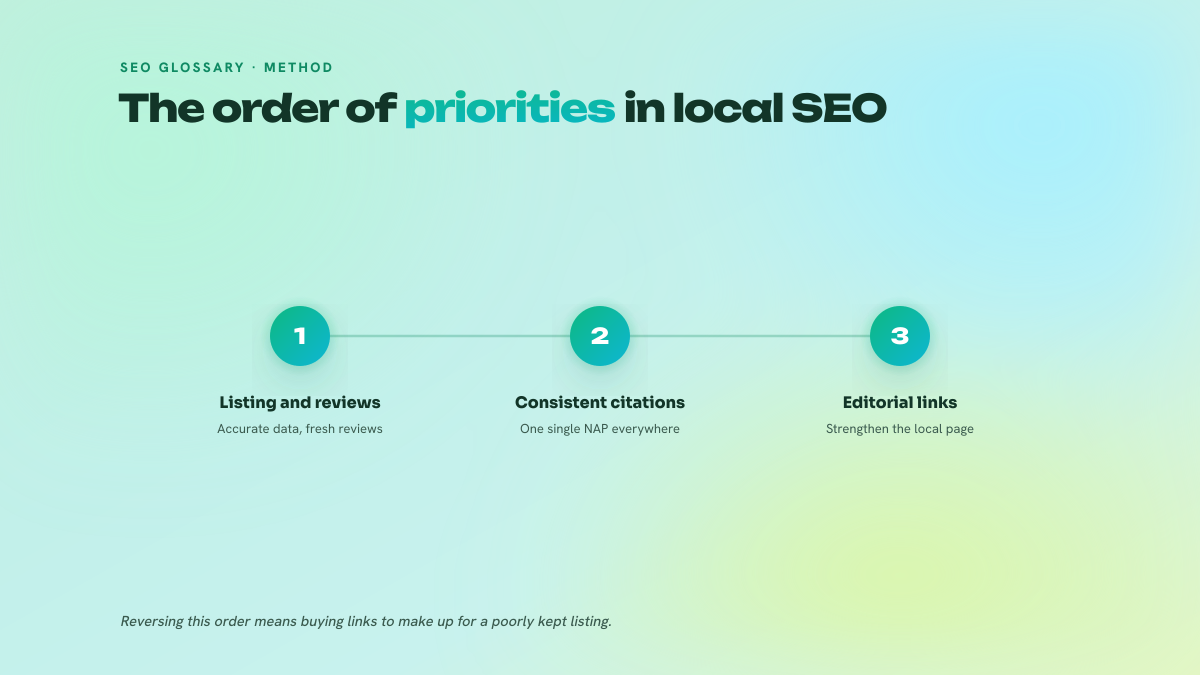
- →Links are only 8% of local pack weight (Whitespark 2026), so a strong backlink profile corroborates a well-built GBP, it does not compensate for a broken one.
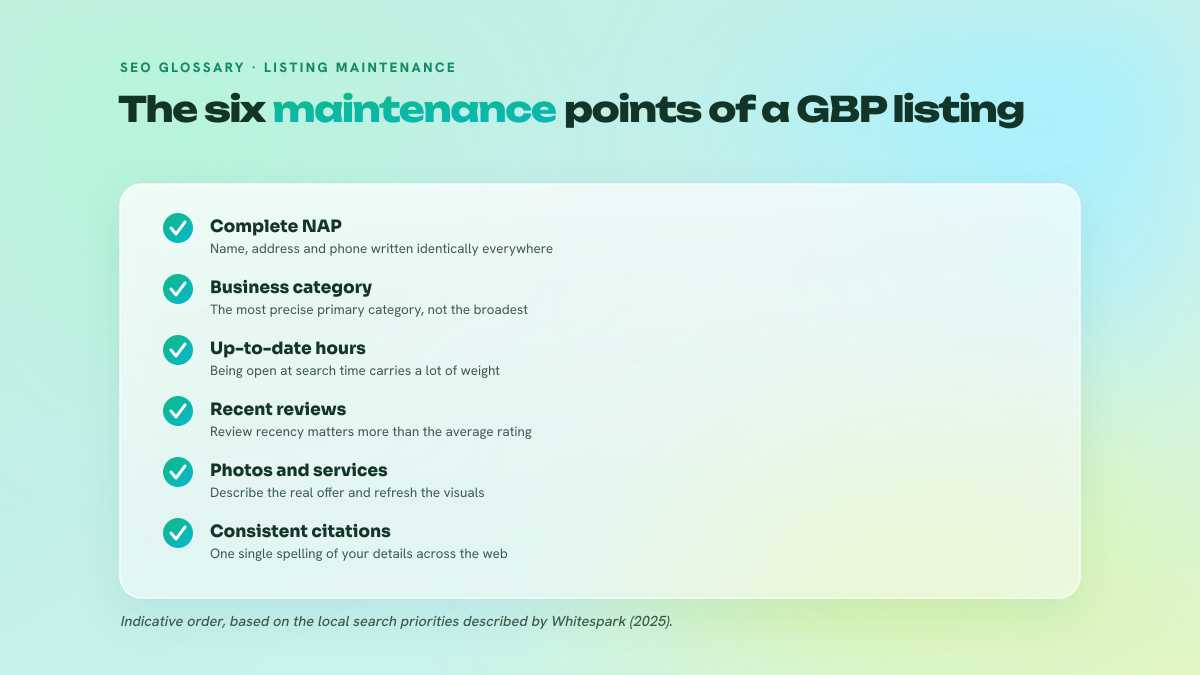
- →Being open at the moment of the search is now roughly the 5th most important local pack factor, and profiles with updated hours get 2x more visits (SearchLab 2026).
- →GBP now feeds AI local packs where 32% fewer businesses surface than in the classic 3-pack: concentration rewards the profiles with the deepest, freshest entity data.
More than a listing: the entity Google trusts
Strip away the marketing framing and a Google Business Profile is the entity record Google treats as the canonical source of a business's name, address, phone, category, hours and reviews. It is what decides whether a business appears in the local pack, on Maps, and increasingly inside AI-generated local answers. The listing you edit in the dashboard is just the editable surface of a knowledge-graph node that Google reconciles against your website, your local citations and third-party mentions.
That reconciliation is why the profile carries so much weight. In Whitespark's 2026 Local Search Ranking Factors, GBP signals represent 32% of Local Pack influence, the single largest category ahead of review signals at 20% and on-page at 15%. No other lever in local SEO concentrates that much of the ranking surface in one place. For a business that lives on local intent, the profile is not a nice-to-have citation, it is the primary asset.
The practical consequence: the profile is where relevance is declared and prominence is measured. The category you pick tells Google which queries you are eligible for. The reviews tell it whether searchers trust you. The completeness of the record, from a full description to accurate hours to fresh photos, tells it whether the entity is real and active. Everything else in a local strategy, including the network of local citations you build across directories, exists to corroborate what the profile asserts.
How GBP ranking actually works in 2026
Google still frames local ranking around relevance, distance and prominence, but the weighting of the signals underneath has shifted hard in the last two years. Review signals now behave as primary factors rather than tiebreakers, and inside that bucket recency is the story. Review recency jumped from around rank 20 in 2023 to the single most important individual factor by 2025/2026 (Whitespark 2026). A five-star average earned three years ago decays in the model: what matters is a steady, recent flow of genuine reviews and, just as much, your responses to them.
Freshness extends beyond reviews. Being open at the moment someone searches is now roughly the fifth most important Local Pack factor, and profiles with updated hours receive 2x more visits than those with missing or outdated hours (SearchLab 2026). Description length correlates too: SearchLab's 2026 compilation reports that profiles with a description of at least 750 characters get 2.5x more impressions than profiles with none. These are not vanity fields, they are ranking and conversion inputs.
The biggest structural change of the cycle is the death of GBP Q&A. Google discontinued the Q&A API on 3 Nov 2025, and the public-facing Q&A section began deprecation on 3 Dec 2025 with full removal rolling out over one to three months. It is being replaced by Ask Maps and Gemini-style AI Overviews that answer questions directly from your profile data, your website and your reviews. Whitespark's 2026 release also introduced a separate AI Search Visibility category, where the weighting is different again: on-page 24%, reviews 16%, citations 13%, links 13%, GBP 12%, behavioural 10%. The lesson is that the same profile feeds two ranking surfaces now, the classic pack and the AI answer, and they reward slightly different things.
Messaging has quietly become a signal as well. Google introduced WhatsApp integration into GBP messaging in 2025, and 2026 feature guides note that business messaging responsiveness has been treated as a ranking input since late 2025. SearchLab's 2026 data puts messaging growth at 45% per year and reports that businesses responding within five minutes convert three times better than slower responders. Activity, not just presence, is what the model reads.
Where GBP fits in a netlinking operation
Here is the stance a lot of link buyers get wrong: backlinks are a minor direct lever for the local pack. Links account for just 8% of Local Pack weight in Whitespark's 2026 factors, the same as citations. So a business that expects a netlinking campaign to force its way into the 3-pack, on its own, is spending against the wrong constraint. The profile has to be right first.
Where links do earn their keep is prominence and corroboration. Editorial mentions of a local business, with consistent name and address, reinforce the entity that the profile declares. This is exactly where owned editorial media beats a scattershot approach: at Nautilinks we operate a French network of media in-house, so a link and its surrounding context can be calibrated to match a business's real NAP and category rather than a keyword-stuffed anchor that looks manufactured. If you want to place a contextual link directly with the publisher that names the business the way its profile does, that consistency is worth more locally than raw Domain Rating.
The second, more forward-looking angle is AI visibility. As Ask Maps and AI Overviews start answering local queries from GBP data, coverage concentrates: 2026 commentary notes that 32% fewer businesses surface in AI local packs than in the traditional 3-pack. That is a scarcity signal. The profiles that win are the ones with the deepest entity footprint, reviews, reputable citations and mentions across independent sources that an AI model can cite. Building that footprint deliberately is what a campaign focused on getting cited by AI answers is for, and it leans on the same corroboration logic as classic prominence. You can see how an owned catalogue supports that in the media network we run ourselves, where every placement is transparent and traceable.
None of this replaces the on-profile work. It sits on top of a profile whose name, address and phone stay identical everywhere they appear. Inconsistent NAP across your site, your citations and your backlink mentions is the fastest way to dilute the entity Google is trying to trust.
What we see go wrong in audits
The recurring failure is category drift. Google changed category availability roughly 40 times in 2025, which means the primary category you chose eighteen months ago may no longer be the strongest match, or may have been split into a more specific one. Businesses that never re-audit their category quietly lose eligibility for queries they should own. This is an ongoing task, not a setup step.
The second is name stuffing. Adding a city or service keyword to the business name field to game relevance is still common and still a policy violation that gets profiles suspended. The August 2025 Spam Update tightened local enforcement, and Google's Trust and Safety reporting cited in multiple 2026 roundups notes 292 million policy-violating reviews blocked or removed in 2025, with SearchLab reporting more than 170 million fake reviews removed, a 38% year-on-year increase. The same enforcement machinery that hunts fake reviews watches for deceptive profile data. Review gating and buying reviews are not clever growth tactics in 2026, they are suspension risk.
The third is treating the profile as static. From what we see in audits, the profiles that underperform are rarely the ones missing a field, they are the ones frozen in time: no fresh reviews, no responses, stale photos, hours that go wrong on public holidays. Given that recency and open-when-searched now carry real weight, a frozen profile actively bleeds rank. Verification is the other quiet blocker: video verification is now the default for many new profiles, and a business stuck in verification limbo is invisible regardless of how good its links are.
Tactical takeaways for a working SEO
Run a category audit every quarter against the current list, and check whether a more specific primary category now exists. Treat reviews as a velocity metric, not a count: a system that nudges satisfied customers to leave a fresh review each week beats a one-time push to hit a round number, because recency is doing the ranking. Respond to every review, positive and negative, both for the trust signal and because responses are read as activity.
Fill the description to at least 750 characters with real, specific copy, keep hours accurate including holiday exceptions, and refresh photos on a cadence rather than at launch. Wire up messaging and actually answer it fast, since responsiveness is now a signal and a conversion multiplier. Then, and only then, layer prominence: consistent citations, and editorial links whose context names the business exactly as the profile does. If you are running a broader local play, calibrate the link acquisition over several months so the entity's authority grows at a believable pace alongside its review and content freshness. The profile is the anchor. Everything you buy off-site should corroborate it, never contradict it.
Nautilinks operates an owned network of editorial media. In-house written articles, transparency disclosures respected, anchor mix calibrated.
Frequently asked questions
Do backlinks help a business rank in the local pack?
Only marginally on their own. Links are about 8% of Local Pack weight in Whitespark's 2026 factors, tied with citations and well behind GBP signals at 32% and reviews at 20%. Backlinks corroborate prominence and reinforce the entity, especially when the mention names the business with consistent NAP, but they cannot compensate for a weak or wrongly categorised profile. Fix the profile first, then use links to strengthen prominence and, increasingly, AI visibility.
The GBP Q&A section disappeared. What replaces it and does it matter for SEO?
Google shut the Q&A API on 3 Nov 2025 and began removing the public Q&A on 3 Dec 2025. Answers are now surfaced by Ask Maps and Gemini AI Overviews, which pull from your profile, website and reviews. Operationally it means you can no longer seed Q&A manually, so the questions buyers ask must be answered in your description, services and review content, because that is now the corpus the AI reads.
How often should I re-check my primary category?
At least quarterly. Google changed category availability roughly 40 times in 2025, so new, more specific categories appear and old ones get split or merged. The primary category is the strongest relevance lever you control, and staying on an outdated one silently costs you eligibility for queries you should rank for. Treat it as a recurring audit, not a one-time setup decision.
Why does review recency matter more than my overall star rating now?
Because the model rewards signals of a currently active, currently trusted business. Whitespark's 2026 data shows review recency rose from around rank 20 in 2023 to the top individual factor by 2025/2026. A high average earned years ago decays in influence, while a steady flow of recent, genuine reviews plus your responses reads as ongoing relevance. Volume still helps, but freshness is what moved to the front.
Is GBP visibility changing with AI search?
Yes, and it concentrates. As Ask Maps and AI Overviews answer local queries from GBP data, 2026 commentary notes 32% fewer businesses surface in AI local packs than in the classic 3-pack. Whitespark also added a separate AI Search Visibility category where GBP is 12% and on-page is 24%. The profiles that win are those with the deepest, freshest entity data and independent corroboration an AI model can cite.
Can messaging actually affect rankings?
It appears to. 2026 feature guides report Google has treated business messaging responsiveness as a ranking input since late 2025, and Google added WhatsApp integration to GBP messaging in 2025. SearchLab's 2026 data puts messaging growth at 45% per year and finds businesses that respond within five minutes convert three times better than slower ones. So enabling messaging and answering fast is both a possible ranking lever and a clear conversion one.
Test your knowledge
Quiz: Google Business Profile
1/3In Whitespark's 2026 Local Search Ranking Factors, which category carries the largest share of Local Pack influence?