- →A ccTLD is the only geotargeting signal you cannot contradict later: Google retired the international targeting report in Search Console, so a gTLD geotargets through hreflang, links and content, while a country domain sets the market before any of that.
- →Google redirecting google.fr and google.co.uk to google.com (rollout complete August 2025) changed its own search interface, not how it treats your .fr. Several country-ranking gaps reported in mid-2025 were rank-tracker artifacts, not ranking losses.
- →The real cost of a ccTLD is not registration, it is running N separate link graphs. Below three years of authority, a subfolder on one strong gTLD almost always beats three anaemic country domains.
- →Some ccTLDs carry no geographic weight at all: Google documents a list it treats as generic because usage is overwhelmingly non-local, .co, .io and .tv among the familiar ones. Domain hacking gives you a foreign registry's rules with none of the local signal.
- →A .fr backlink is not intrinsically worth more than a .com one. What moves a local ranking is the referring page being about your market, in your language, and actually read there. The extension is a lazy proxy for that.
- →Buying an aged country domain for its history and repurposing it sits squarely in what the August 2025 spam update (26 August to 22 September 2025) was built to catch, alongside scaled content abuse and site-reputation abuse.
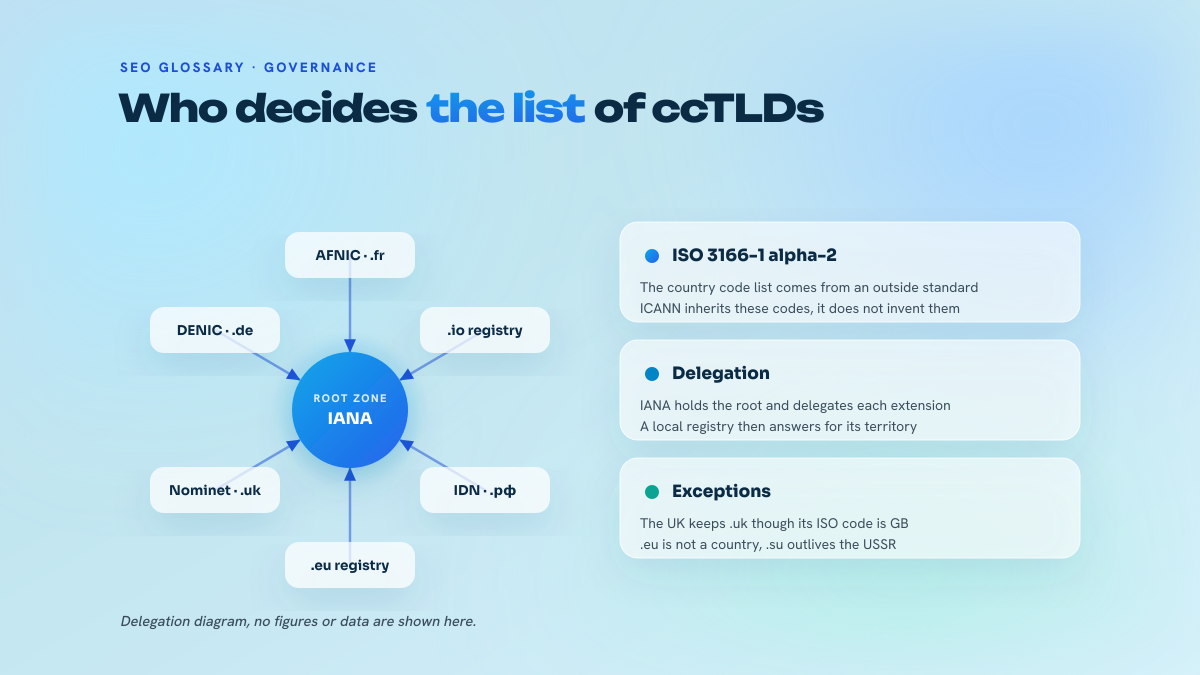
A two-letter code borrowed from a standard that was never about search
A ccTLD is a top-level domain whose label is pulled from the ISO 3166-1 alpha-2 list: .fr, .de, .it, .co.uk, .com.au. That list exists to name countries and territories for customs paperwork, banking and postal systems, and the domain name system simply borrowed it in the mid-1980s. The borrowing explains almost every oddity you run into later. The ISO code for the United Kingdom is GB, yet the extension is .uk, grandfathered from the pre-ISO era. The .eu extension is not a country at all. Tuvalu owns .tv and Montenegro owns .me, and neither registry sells much of anything to its own residents.
Governance matters more than the trivia, because it dictates what you can and cannot do with a country domain. IANA, operating under ICANN, maintains the root zone and delegates each two-letter string to a designated manager: AFNIC for .fr, DENIC for .de, Nominet for .uk. RFC 1591 still frames that delegation as a public trust rather than a commercial concession, which is why national registries answer to their own government's policy first and to ICANN barely at all. A gTLD registry signs a contract with ICANN and inherits its consensus policies, UDRP included. A ccTLD registry writes its own rules: who may register, what dispute procedure applies, whether whois data stays public. That asymmetry is the substantive difference between the two families, far more than anything a search engine does with them.
The volume is not marginal. Verisign's DNIB data for Q4 2025, released on 5 February 2026, counted 145.6 million ccTLD registrations, up 0.8 million over the quarter (+0.6%) and 4.8 million year over year (+3.4%), against a total domain base of 386.9 million. Country extensions are roughly a third of the namespace, and they are still expanding.
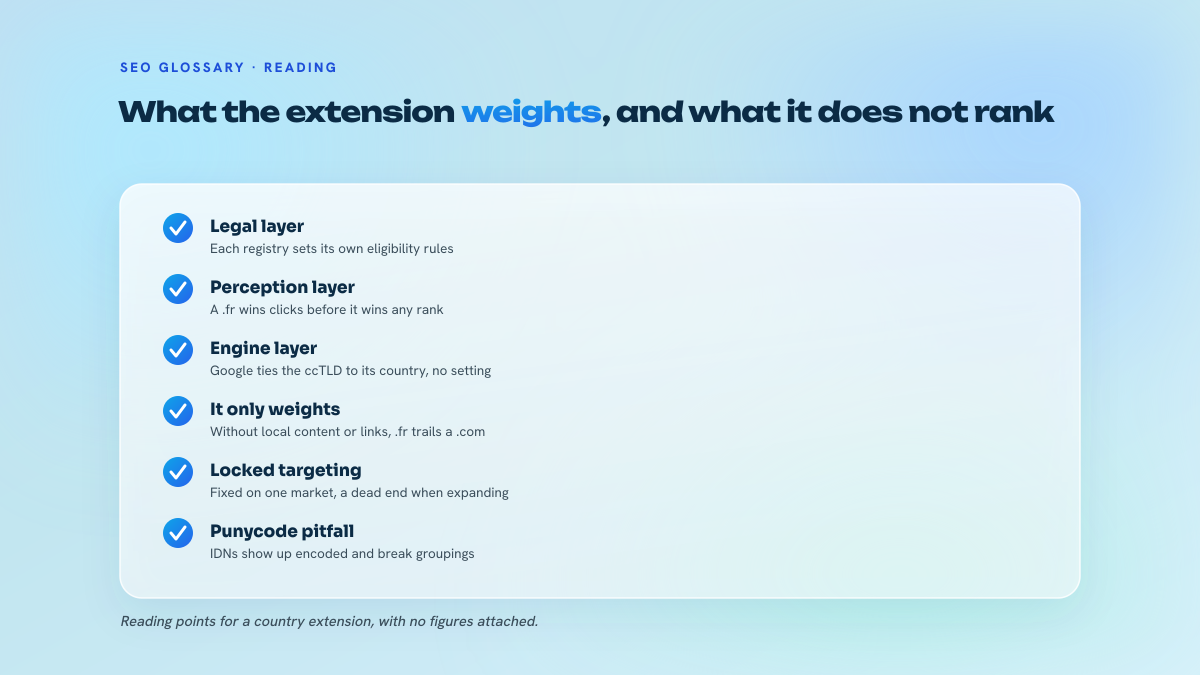
Google retired its own country domains, and the industry misread it
In April 2025 Google started redirecting its country-specific search domains, google.co.uk, google.fr, google.co.in and the rest, to google.com, with the rollout reported complete in August 2025. Google's own framing was narrow: the change affects what appears in the browser address bar, not how results are generated. Localization still runs on user location, language settings and the usual regional signals.
A depressing number of agency notes read that as « Google has stopped caring about country domains » and started floating migrations off .de and .fr. Two entirely different objects share a name in that sentence: Google's own search interface, and your site's extension. Retiring the first says nothing whatsoever about the second, and nobody has produced evidence since that legitimate country domains lost their geographic weight.
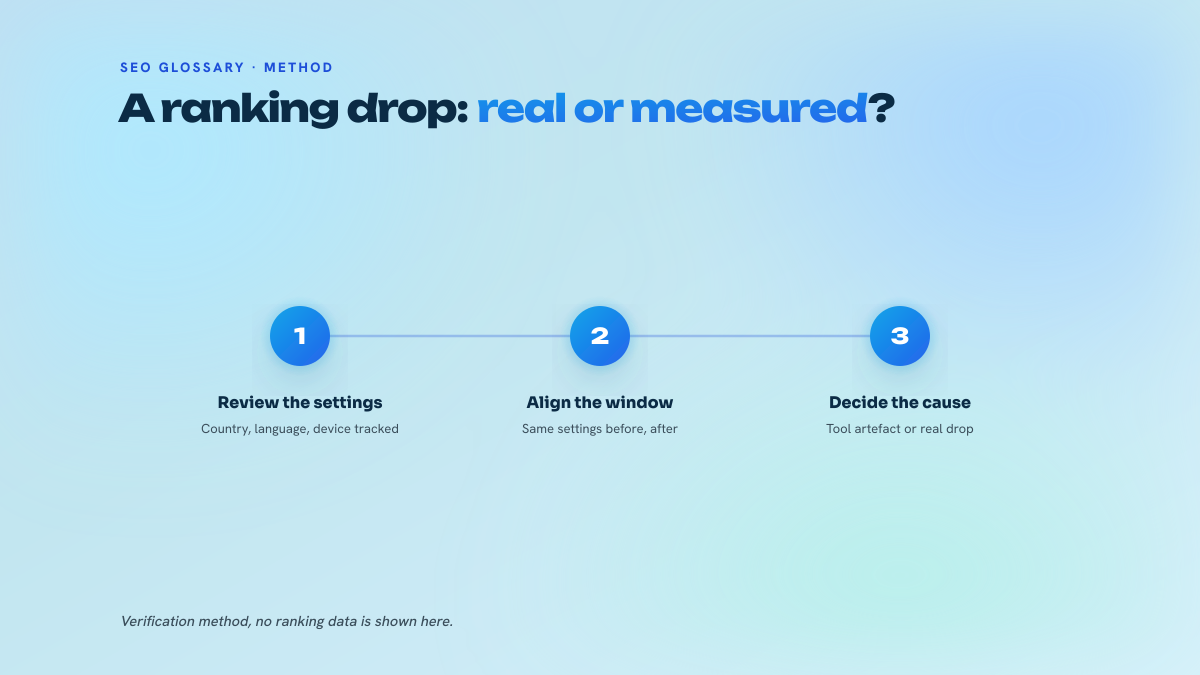
The genuine consequence was measurement. Rank trackers that queried country-specific Google domains had to switch to country and location parameters on google.com, and some of the country-level ranking gaps people panicked about in mid-2025 were tracking changes rather than ranking changes. If you keep historical projects in Semrush or anywhere else, check that location, language and device settings survived that transition before you read a trend line as a decline.
What the extension actually buys you is a country assignment you cannot contradict downstream. Google retired the international targeting report in Search Console some years back, so a generic domain now geotargets through language and region annotations, local links, currency, address data and content language. A ccTLD declares the market before any of those are read. It is also the least reversible choice on the list: you cannot unset it, you cannot serve two markets from one country domain with a straight face, and the day the business expands you either live with the mismatch or run a migration.
Stance, plainly: the extension is a complementary signal, never a guarantee. A .fr serving English copy, dollar prices and an American link profile ranks in France about as well as a .com doing the same thing, which is to say poorly.
ccTLD, gTLD or subfolder: the arbitration nobody wants to make twice
The taxonomy is quick. Generic top-level domains (gTLD) are .com, .net, .org and the several hundred newer strings; sponsored ones (sTLD) like .gov, .edu or .museum are restricted to a defined community; country extensions sit apart with their national registries. Every comparison table on the first page of Google stops there, which is why every one of them is useless. The arbitration that costs money is not ccTLD against gTLD, it is one domain against several.
Each country domain you register is a separate link graph, a separate authority to accrue, a separate crawl budget, a separate deployment and a separate legal entity to keep the registration valid. Link equity does not cross a domain boundary the way it flows through a folder tree, so three country domains split the same acquisition budget three ways and each one starts at zero. We have watched more international projects die from that split than from any algorithmic penalty.
The rule we apply when a client asks: take the country domain when the country is the business. Regulated sectors where a local legal entity is mandatory, trust-driven commerce where a .com reads as foreign, markets where the local extension carries genuine consumer preference. Everything else, and especially anything under three years old, belongs in a subfolder on one gTLD, where every link earned anywhere lifts the whole property. If the market later proves itself, migrating a folder to a country domain is a known operation with a known cost. Fragmenting first and consolidating later is neither. Whichever way you go, the market-by-market link plan is the part that decides the outcome, and it is worth calibrating that plan per country with people who actually operate the publishers rather than buying the same package everywhere.
One trap deserves its own warning. Google documents a set of country extensions it treats as generic because their usage is overwhelmingly non-local, with .co, .io and .tv among the familiar entries. Domain hacking gave us those: Tuvalu's .tv sold to broadcasters, Montenegro's .me sold to personal brands, and the whole startup fondness for .io. If your extension sits on that list you inherit a foreign registry's rules, its pricing decisions and its political risk, and you get no geographic signal in exchange. That is the worst of both families.
What a country domain changes in a link campaign
Very little, on the link side, and that surprises people. A .fr backlink is not mechanically stronger than a .com one for French rankings. What correlates with local performance is that the referring page treats your market, in the local language, with a local readership behind it. The extension is a proxy for those properties, and a sloppy one: plenty of the strongest French publishers sit on generic domains, and plenty of .fr domains are parked, syndicated or recycled through a link farm. Selecting by extension alone is how you end up paying local rates for links nobody in the country reads.
The tooling has finally caught up with that critique. Ahrefs added page-type and page-category filters to its backlink reports in its January 2026 updates, which lets you separate links coming from articles, listicles, tool pages or a given topical business category instead of counting country domains in aggregate. That filtering is the actual prospecting work: format and topical fit first, extension as a tie-breaker.
We run our own French editorial media in-house, all on French domains, and the extension is the least interesting fact about them. What buyers check on the media list we publish openly is the topic, the traffic and whether the article will sit somewhere a reader plausibly lands. Someone looking to place a link on a French publisher without going through an intermediary is buying editorial relevance in a market, and the country domain is a consequence of operating there, not the product.
Where the extension does raise your risk profile is the shortcut version. The August 2025 spam update, launched 26 August 2025 and completed 22 September 2025, ran globally and across languages, and industry reporting tied its enforcement to scaled content abuse, expired-domain abuse and site-reputation abuse. Acquiring an aged country domain for its accumulated history and repointing it at unrelated content is precisely the pattern that update was built to catch, and a strong national extension makes the recycled property more attractive to the buyer without making it any safer.
The second surface is newer. Google expanded AI Mode on 7 January 2026 to more than 35 new languages and over 40 new countries and territories, taking availability past 200 countries and territories. A country domain does not get you quoted in a generated answer. First-hand market information, local data nobody else publishes and regionally relevant editorial coverage plausibly do, and those are the same assets that earn the conventional local rankings. Treat it as one investment serving two retrieval surfaces rather than two separate programmes.
The failures we keep finding in audits
Defensive registrations counted as international presence. A company owns nine country extensions, redirects all of them to the .com, and reports an international footprint to its board. Those redirects contribute nothing to ranking, and statistically one of the nine will lapse at renewal and reappear six months later pointing at something embarrassing.
Eligibility discovered after the strategy deck. National registries impose their own local presence conditions: .fr requires a presence in the European Union, European Economic Area or Switzerland, .de expects an administrative contact with a German address, .com.au demands an Australian business number. Teams solve it by registering through a local partner's identity and discover two years later that the domain is legally somebody else's asset.
Half-wired language and region annotations between country domains. Missing return tags on one side of a pair are enough for the cluster to be ignored, and the symptom looks exactly like a ranking problem: the German domain surfacing in French results, the French one nowhere. Validate the reciprocity across every pair before touching anything else.
Treating the extension as a substitute for local entity signals. A .fr with no verified business profile, no local citations and no address markup competes for a local pack it has no evidence of belonging to. The domain says where you claim to be; the entity graph says whether anybody believes it.
And the expensive one: migrating a working subfolder architecture to three country domains mid-campaign, to capture a signal that was already being delivered by content and links, and spending the following eighteen months rebuilding three weak link profiles out of one that worked. If you cannot fund a distinct acquisition programme per market, you cannot fund a ccTLD strategy. Register the domains defensively, park them properly, and keep the equity where it compounds.
Nautilinks operates an owned network of editorial media. In-house written articles, transparency disclosures respected, anchor mix calibrated.
Frequently asked questions
Now that google.fr redirects to google.com, is there any point keeping a .fr?
Yes, the two things are unrelated. Google redirected its own search interface, with the rollout completed in August 2025, and stated the change affects the browser address bar rather than how results are generated. Localization still runs on user location, language and regional signals, and your extension is one of those signals. What genuinely changed is measurement: rank trackers moved to location parameters on google.com, so audit your historical tracking settings before reading any mid-2025 drop as a real loss.
Do backlinks from a country's extension carry more weight for local rankings?
Not by extension alone. What correlates with local performance is the referring page covering your market, in the local language, with a readership actually in that country. A .fr placement on a syndicated page nobody reads is worth less than a topically relevant link from a generic domain aimed at the same audience. Filter prospects by page type and topical category, which Ahrefs exposed in its January 2026 backlink report updates, and treat the extension as a tie-breaker rather than a selection criterion.
When does a country extension stop working as a geographic signal?
When Google classifies it as generic. It publishes a list of country extensions treated as gTLDs because real-world usage is overwhelmingly international, with .co, .io and .tv among the familiar entries. Domain hacking put most of them there. If your extension sits on that list you get no country assignment, while still inheriting a foreign registry's eligibility rules, pricing decisions and political exposure. Check the list before assuming a two-letter string buys you local relevance.
Country domains or subfolders for a three-market rollout?
Subfolders on one generic domain, unless a market legally or commercially requires a national domain. The cost of country extensions is not registration, it is running three separate link graphs on one budget, each starting from zero. Link equity does not cross domain boundaries the way it flows through a folder tree. If a market later proves itself, migrating a folder to its own extension is a bounded operation. Fragmenting first and consolidating afterwards is not.
Is buying an aged country domain a legitimate shortcut to local authority?
It is the riskiest thing you can do with one. The August 2025 spam update, which ran from 26 August to 22 September 2025 across all languages, was tied by industry reporting to expired-domain abuse, scaled content abuse and site-reputation abuse. A strong national extension makes a recycled property look more attractive without making it safer. If the historical topic genuinely continues, the operation is defensible; if the domain is a vessel for unrelated content, it is exactly the target pattern.
How do country domains fit into visibility inside AI answers?
The extension itself buys nothing there. Google expanded AI Mode on 7 January 2026 to more than 35 new languages and over 40 new countries and territories, passing 200 in total, so local market coverage now feeds two retrieval surfaces at once. What plausibly earns a citation is first-hand market information, data nobody else publishes locally, and regionally relevant editorial coverage. Those are the same assets that earn conventional local rankings, so fund one programme, not two.
Test your knowledge
Quiz: ccTLD
1/3Where do the two-letter labels used by ccTLDs come from, and who delegates them?