- →Netlinking refers to acquiring inbound links pointing to your site, from other relevant sites recognised in their topic area.
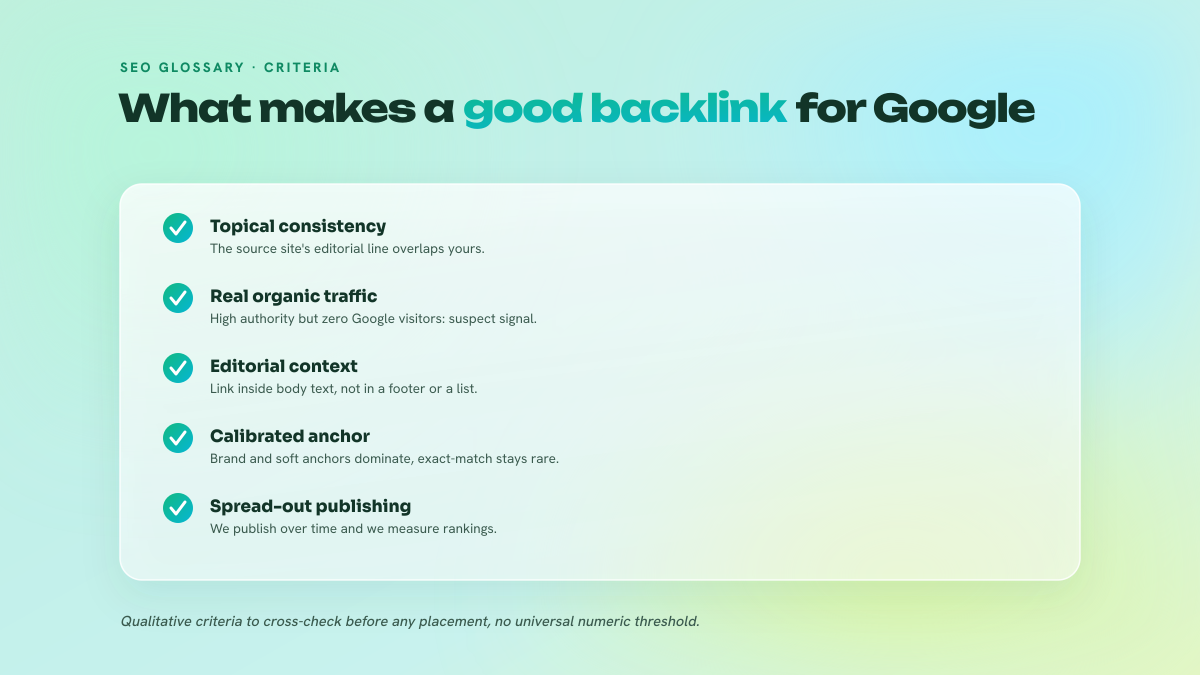
- →A good backlink is judged on four criteria: topical fit of the source site, real organic traffic, editorial context and naturalness of the anchor.
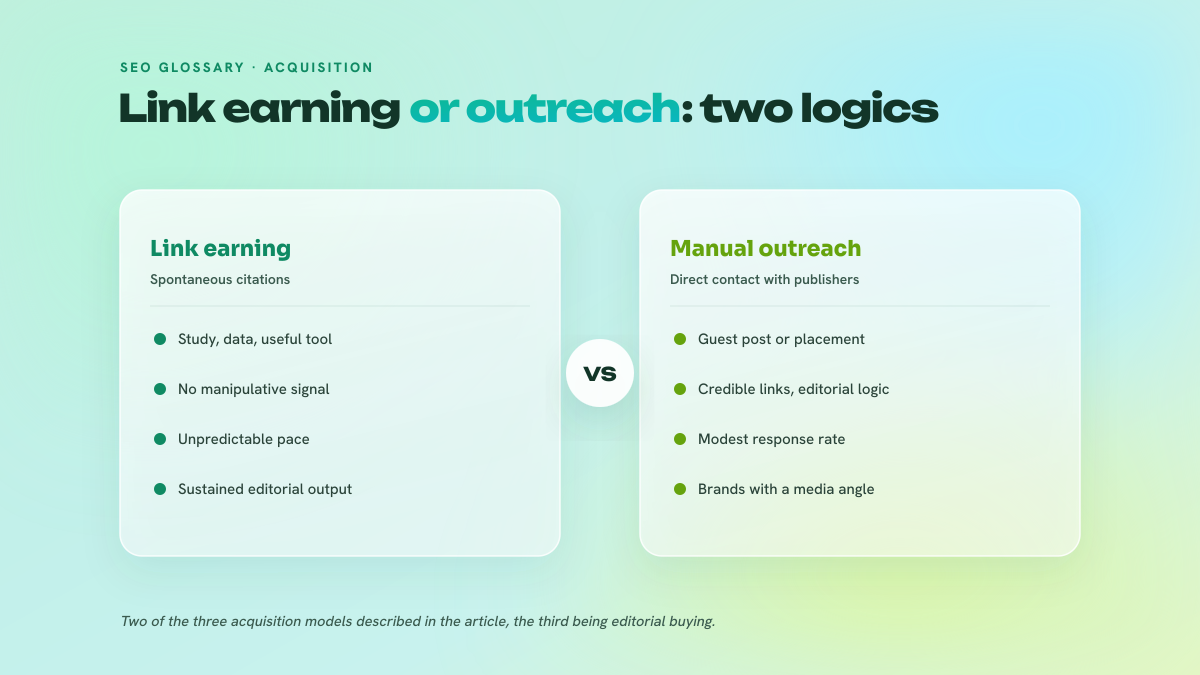
- →Three main acquisition models: organic (natural link earning), manual outreach, and editorial purchase on an owned network or marketplace.
- →Manipulative practices (low-cost PBNs, link farms, anchor over-optimisation) are regularly devalued by Google and expose the site to penalties.
Definition of netlinking
Netlinking, also called link building in English, refers to the set of activities aimed at obtaining inbound links from other websites. These links, called backlinks, signal to Google that a site is cited, recommended or used as a source by other actors on the web. The more a site receives links from sources that are relevant and recognised in its topic area, the more authority it gains in the eyes of search engines.
This logic has been at the heart of Google's mechanics since day one. The original PageRank, the engine's historical algorithm, rests precisely on this idea: a page's value is calculated in part from the implicit votes that inbound links represent. The hundreds of updates that followed have refined the calculation but never challenged the principle.
Role in organic search
In a complete SEO strategy, netlinking plays three distinct roles. First, it signals a site's authority on its topic. When multiple credible sources in a domain point to your pages, Google reads those signals as the mark of recognised expertise. That mechanism is what allows a young but well-recommended site to outperform an older but isolated one.
Netlinking also passes link juice, that is, ranking equity, from source pages to target pages. A page that receives a link from a URL that itself ranks well inherits part of its authority. The transmission isn't linear but it remains measurable, and that's what makes a backlink from an established media outlet more valuable than a link from an obscure blog.
Finally, netlinking brings direct referral traffic. Readers who click on a link from an editorial article arrive qualified on your site. That traffic, sometimes low in volume, often converts better than pure organic traffic because the reader arrives with a reading context that primes the encounter with your content.
What makes a good backlink
Not all links are equal. The most discriminating criterion remains the topical fit of the source site. A link from a site whose editorial line overlaps with yours carries more signal than a link from an unrelated site, even one with a higher authority score. The logic ties to the simple principle Google tries to reproduce: the editorial relevance of a recommendation.
Real organic traffic of the linking site weighs almost as much. A site with a high Domain Rating but zero Google visitors is statistically suspicious. Conversely, a smaller site with an active, qualified audience transmits a more authentic signal. Tools like Ahrefs or Semrush make it possible to cross those two dimensions and decide with full information.
The editorial context of the link inside the article that carries it also matters. A link in the body of a text that serves a topic, naturally integrated into an explanatory sentence, is worth far more than an isolated link in a "useful links" section or a footer. That difference has been encoded in the algorithm for a long time and remains one of the simplest levers to distinguish a serious placement from a surface rental.
On the quality of an editorial placement, see how we buy backlinks directly from the publisher. To structure real long-term acquisition, see the method of a netlinking campaign. If you're comparing market models, see the different types of netlinking agency.
Acquisition methods
Three main acquisition models coexist. Organic link earning, first. You publish remarkable content, an original study, exclusive data, a useful tool, and other sites cite it spontaneously. That route produces the strongest links in Google's eyes because no manipulative signal taints them. It also requires sustained editorial investment and the acquisition pace stays unpredictable.
Manual outreach, next. You identify relevant sites, contact the author or the editor, propose guest content or suggest a contextual placement. The relational work is demanding, response rates are modest, but the resulting links remain credible because they fit an editorial logic. The approach suits brands with a naturally newsworthy angle and the time to cultivate relationships.
Editorial purchase, finally. You pay a site to publish an article that mentions your brand, or to insert a link into an existing article. That model, long polemical, has matured significantly in recent years. With appropriate transparency disclosure and contextually justified placement, it moves away from spam and closer to a recognised editorial advertorial. The quality of the operator makes all the difference.
Anchors and link profile
The anchor of a link is the clickable text that carries it. It plays an essential role in the value of a backlink, and also in the risks it brings. Anchors fall into several families. Brand anchors simply reuse the name of the site or company, like Nautilinks or nautilinks.co. They always pass under the radar and represent the bulk of a natural profile.
Soft or descriptive anchors describe the linked content through phrasing, for instance "our method for calibrating a campaign". They give context to the link without overloading the commercial signal. Exact-match anchors, at the opposite end, reuse the targeted commercial query verbatim, like "buy backlinks". Powerful but visible, they trigger over-optimisation signals quickly when they dominate the profile.
A healthy profile combines those families in proportions that mirror a site's organic growth. A solid majority of brand anchors, a third of soft and descriptive, and a marginal share of exact-match. That ratio adjusts based on the site's maturity and the existing profile, but the principle holds: diversity rather than concentration.
Auditing the link profile
Before launching a netlinking operation, auditing the existing profile is essential. It reveals imbalances, areas to compensate, and any suspicious footprints left by past operations. The audit runs through Ahrefs, Majestic or Semrush, ideally cross-referencing several sources because each tool has its own coverage of the web.
Three indicators are worth monitoring. The distribution of anchors helps spot potential over-optimisation. The diversity of referring domains tells you whether links come from enough distinct sources. The average quality of linking sites, measured by their organic traffic, flags toxic links or risky domains that may call for a disavow request.
Common mistakes to avoid
The first mistake is focusing on volume. Buying fifty links a month on low-quality sites produces less effect than five carefully placed editorial links on established media. The algorithm weights quality, and links without an audience often end up being ignored.
The second mistake is overdosing exact-match anchors hoping for a quick effect. The pattern is detectable and triggers, at best, stagnation, at worst, an algorithmic penalty that's hard to correct. Calibrating the anchor mix is surgical work, not instinct.
The third mistake, more insidious, is concentrating the entire operation on the homepage or on a single commercial page. A healthy link profile points to several pages of a site, in a topical-cluster logic. A balanced distribution of links across pillar, secondary and long-tail pages signals to Google an authority lift across the whole domain, not just one isolated URL.
Nautilinks operates an owned network of editorial media. In-house written articles, transparency disclosures respected, anchor mix calibrated.
Frequently asked questions
Is netlinking still effective in 2026?
Yes. Google's algorithms have evolved but links remain a major authority signal. What has changed is the sophistication of the detectors. Effective netlinking today demands rigour on the quality of source sites, the editorial context and anchor diversity. Mass and automated practices no longer work.
How many backlinks do you need to rank well?
No universal answer. The number depends on the competitiveness of the query, the age of the site and the existing profile. For a young site in a low-competition niche, a handful of editorial links is enough to get the engine running. For a mature site in a competitive environment, the pace ramps up. Topical consistency weighs more than raw volume.
Is buying backlinks penalised by Google?
The market for paid editorial links is legal and structured. What Google sanctions is obvious manipulation: link farms, low-cost PBNs, anchor over-optimisation. An editorial placement inside an article that serves a topic, with appropriate transparency disclosure, does not fall into that category. The nuance makes all the difference.
What is the difference between netlinking and link building?
Netlinking is the most common French word for the activity of acquiring inbound links. Link building is the English equivalent. In practice they describe the same thing. English speakers also use link earning or backlink building depending on the acquisition method.
Which tools should I use to monitor my link profile?
Ahrefs, Majestic and Semrush are the three market references for analysing a backlink profile. Google Search Console gives a more partial but free overview. For a full audit, cross-reference at least two tools, since indexing differs from one crawler to the next.
Test your knowledge
Quiz: Netlinking
1/3A site gains 50 new referring domains in a month, but its organic traffic stays flat. What's the most likely explanation a senior SEO would investigate first?