- →A backlink is a hyperlink placed on another site that points to yours. It's one of the heaviest authority signals in Google's algorithm.
- →Not all backlinks are equal. The topical fit of the source site, its real organic traffic and the editorial context of the link matter more than sheer volume.
- →Three main acquisition routes coexist: organic link earning, manual outreach, editorial purchase on an owned network or marketplace.
- →A healthy backlink profile combines source diversity, calibrated anchor mix, time spread and topical consistency.
Definition of a backlink
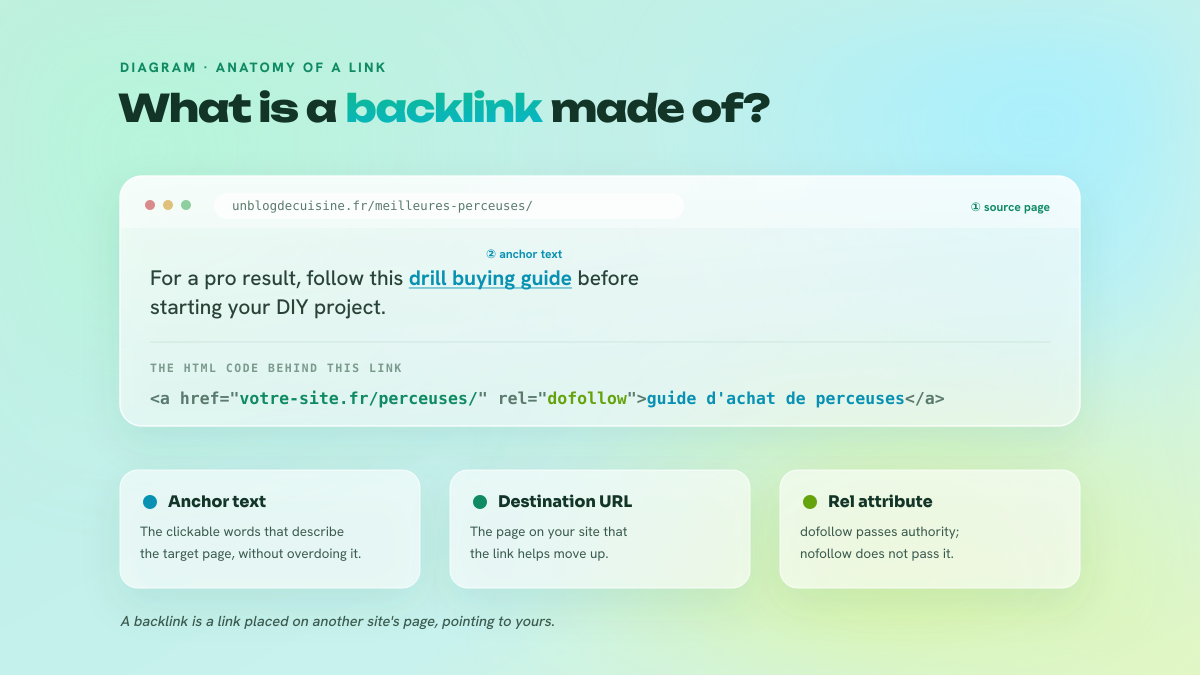
A backlink is a hyperlink placed on an external site that points to a page on your own. The word comes from the English back, what comes back to, and link. In French, you also hear lien entrant or lien retour, strictly equivalent designations.
The role of the backlink in organic search has been central since Google arrived in 1998. The PageRank algorithm, the engine's founder, rests precisely on the idea that a site cited by other relevant sites acquires a form of digital authority. That citation logic, modelled on academic usage, has never been challenged in principle, even though its implementation has changed considerably.
The different types of backlinks
Not all backlinks are alike, and the difference lies as much in their HTML attribute as in their context of appearance. On the attribute side, the standard dofollow link, with no specific rel, passes PageRank and is the SEO reference format. The nofollow link tells Google not to pass authority. The rel=sponsored applies to commercial placements. The rel=ugc covers user-generated content.
On the context side, several types stand out. The editorial link inserted in the body of an article that talks about a subject carries the highest value. The link in an author section or in a signature stays editorial but is less valued. The link in a footer, a blogroll or a useful-links section transmits much less signal. The link from a comment or a forum carries little but can diversify a profile risk-free if obtained naturally.
You also hear of niche edit to describe inserting a link into an already-published article, and of guest post or advertorial for the publication of a new article that contains the link. Both formats have their merits: the niche edit benefits from the source article's existing ranking, the advertorial allows better control of the angle.
What makes a good backlink
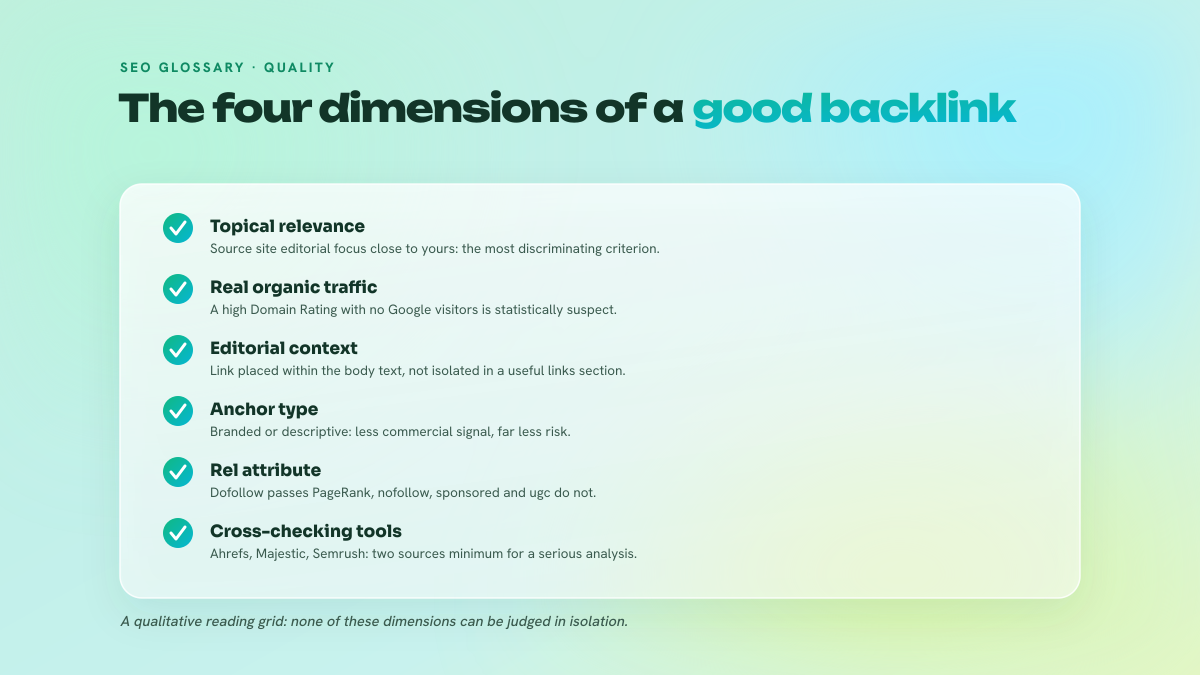
Backlink quality is measured along four complementary dimensions. The first is the topical fit of the source site. A link from a site whose editorial line overlaps with yours carries far more signal than a link from an unrelated site, even one with a higher authority score. That topical relevance is the most discriminating criterion.
The second dimension is the real organic traffic of the linking site. A site with a high Domain Rating but zero Google visitors is statistically suspicious. Conversely, a smaller site with an active, qualified audience transmits a more authentic signal. Tools like Ahrefs, Semrush and Majestic let you cross those dimensions.
The third dimension is the editorial context of the link inside the article. A link in the body of a text that serves a topic, naturally integrated into an explanatory sentence, is worth far more than an isolated link in a useful-links section. That difference has been encoded in the algorithm for a long time.
The fourth dimension is the link's anchor. A brand or descriptive anchor carries less commercial signal than an exact-match anchor, but is also far less risky from an algorithmic standpoint. A healthy profile combines those families in natural proportions.
How to obtain backlinks
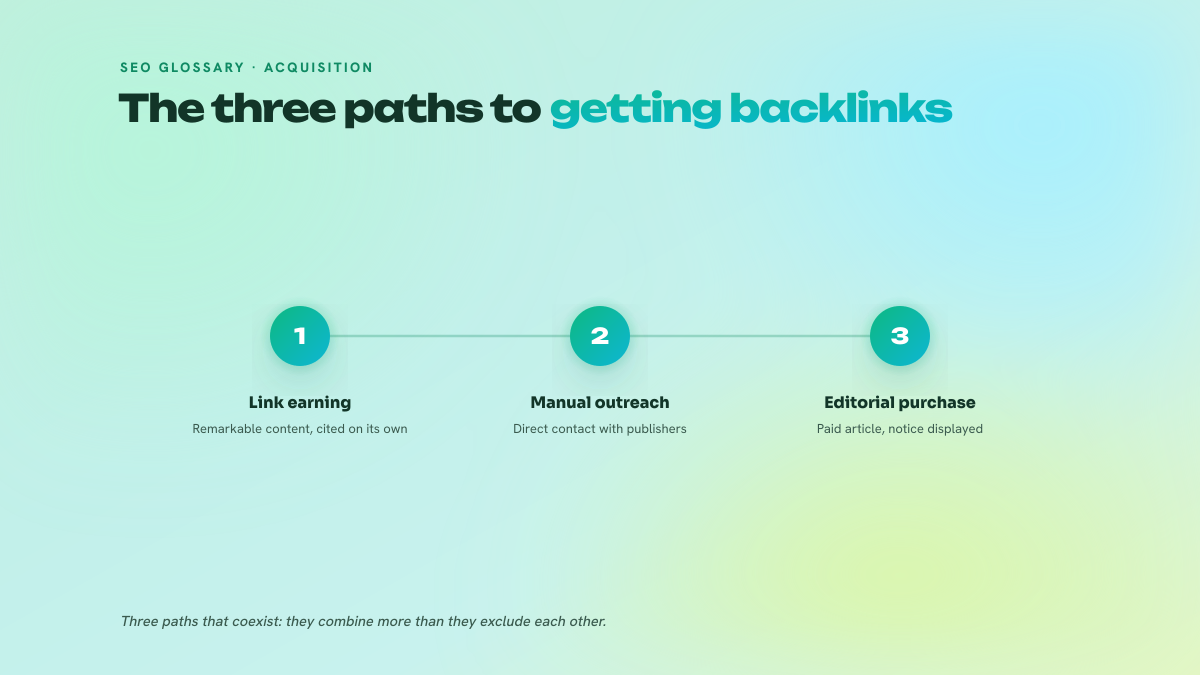
Three main routes coexist on the market. Organic link earning, first, consists in publishing content so remarkable that other sites cite it spontaneously. Original study, exclusive data, useful tool, argued position. That route produces the strongest links in Google's eyes, but demands a heavy investment in editorial production and an unpredictable pace.
Manual outreach, next, rests on identifying relevant sites and contacting their authors or editors to propose guest content or suggest a placement. The relational work is long, response rates are modest, but the resulting links remain credible because they fit an editorial logic.
Editorial purchase, finally, has matured significantly in recent years. You can buy a backlink directly from the publisher on a site that mentions your brand, or insert a link into an existing article. With appropriate transparency disclosure and contextually justified placement, that model moves away from spam and closer to a recognised advertorial. The quality of the operator makes all the difference, which is why some teams prefer a self-serve netlinking platform where each placement is vetted before going live.
Analysing your backlink profile
Regular analysis of the inbound link profile is essential. Three reference tools dominate the market: Ahrefs, Majestic and Semrush. Each maintains its own crawler and exposes a different slice of the web. For serious analysis, cross-checking at least two sources is advised.
Several indicators are worth tracking. The total number of distinct referring domains, which signals source diversity. The breakdown of anchors, which reveals any over-optimisation. The average quality of linking sites, measured by their organic traffic. The time distribution of new links, which should look like a natural curve rather than purchase spikes.
That analysis lets you spot imbalances before they become problems. A profile dominated by commercial exact-match anchors, for example, signals penalty risk. A profile dependent on a single network operator creates a visible footprint. The fix runs through active diversification.
Common mistakes to avoid
Focusing on volume remains the most common mistake. Buying fifty backlinks a month on low-quality sites produces less effect than five carefully placed editorial links on established media. The algorithm weights quality, and links without an audience eventually get ignored or devalued.
Exact-match anchor over-optimisation is the classic beginner trap. The pattern is easy to detect and triggers, at best, stagnation, at worst, an algorithmic penalty that's hard to correct. The default mix combines brand, descriptive, naked URL and exact-match in marginal proportion.
Concentrating the entire operation on the homepage or on a single commercial page dilutes the effect. A healthy link profile points to several pages of a site, in a topical-cluster logic. A balanced distribution signals to Google an authority lift across the whole domain, not just one isolated URL.
Nautilinks operates an owned network of editorial media. In-house written articles, transparency disclosures respected, anchor mix calibrated.
Frequently asked questions
What is the difference between backlink, inbound link and incoming link?
Essentially nothing. Backlink is the most-used English term. Inbound link is a direct equivalent. Incoming link is a rarer variant. All three describe the same thing: a hyperlink placed on another site that points to yours.
How many backlinks do you need to rank?
No universal number. A young site in a low-competition niche can reach the first page with a dozen relevant editorial backlinks. A mature site in a highly competitive environment may need several hundreds. Topical consistency outweighs raw volume.
Do all backlinks pass SEO juice?
No. Links carrying the rel=nofollow attribute tell Google not to pass authority. Links with rel=sponsored signal a commercial placement. Links with rel=ugc cover user-generated content. Dofollow links (without a specific attribute) normally pass PageRank, but Google confirmed in 2019 that all links, even nofollow, are now treated as algorithmic hints.
Is buying backlinks penalisable?
The market for paid editorial links is legal and structured. What Google sanctions is obvious manipulation: link farms, low-cost PBNs, exact-match anchor over-optimisation. An editorial placement inside an article that serves a topic, with appropriate transparency disclosure, does not fall into that category.
How can I tell if a backlink is good before buying it?
Four checks at minimum: real organic traffic of the site (Ahrefs, Semrush), topical fit with your activity, editorial context of the link inside the article that carries it, the inbound link profile of the source site. If any one of those dimensions is weak, the link will produce little positive effect.
Test your knowledge
Quiz: Backlink
1/3Two sites link to yours: Site A is a high-authority generalist with no topical overlap, Site B is a smaller niche site directly relevant to your vertical. Which link is likely to carry more weight today?