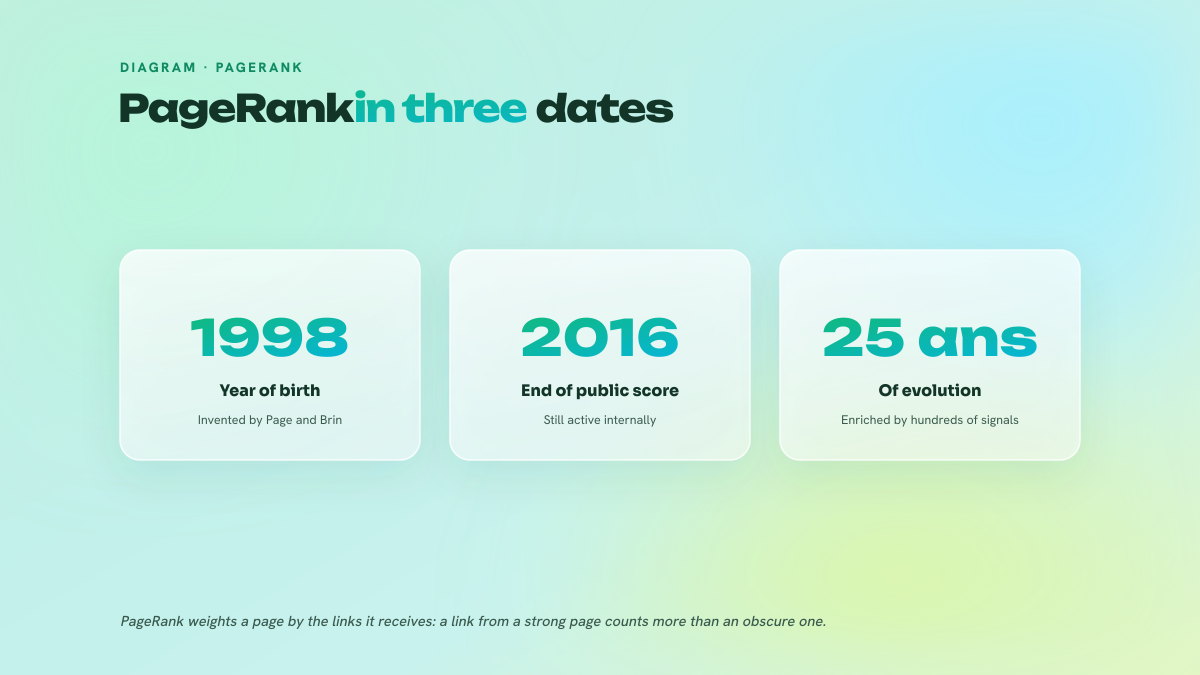
- →PageRank is the historical algorithm invented by Larry Page and Sergey Brin in 1998, the foundation of Google. It calculates the value of a web page from the links pointing to it.
- →The central idea: a link from an important page is worth more than a link from an obscure one. Value propagates from page to page through a recursive formula.
- →Google has evolved the algorithm for 25 years, enriching it with hundreds of other signals. Pure PageRank is no longer publicly visible since 2016 but remains active internally.
- →For an SEO in 2026, understanding PageRank stays useful for structuring internal linking, choosing which pages to prioritise and calibrating a netlinking campaign.
Definition of PageRank
PageRank is an algorithm invented in 1998 by Larry Page and Sergey Brin, then PhD students at Stanford. It serves as the foundation of Google, the search engine they launched the same year. The idea fits in one sentence: the value of a web page can be estimated by looking at the number and quality of the links that point to it.
That intuition was revolutionary. Before Google, search engines ranked pages mostly from their textual content. AltaVista, Yahoo, Lycos compared the query keywords to the words present in the page. PageRank added a new dimension: a page's reputation, measured by the implicit votes that inbound links represent.
How it works
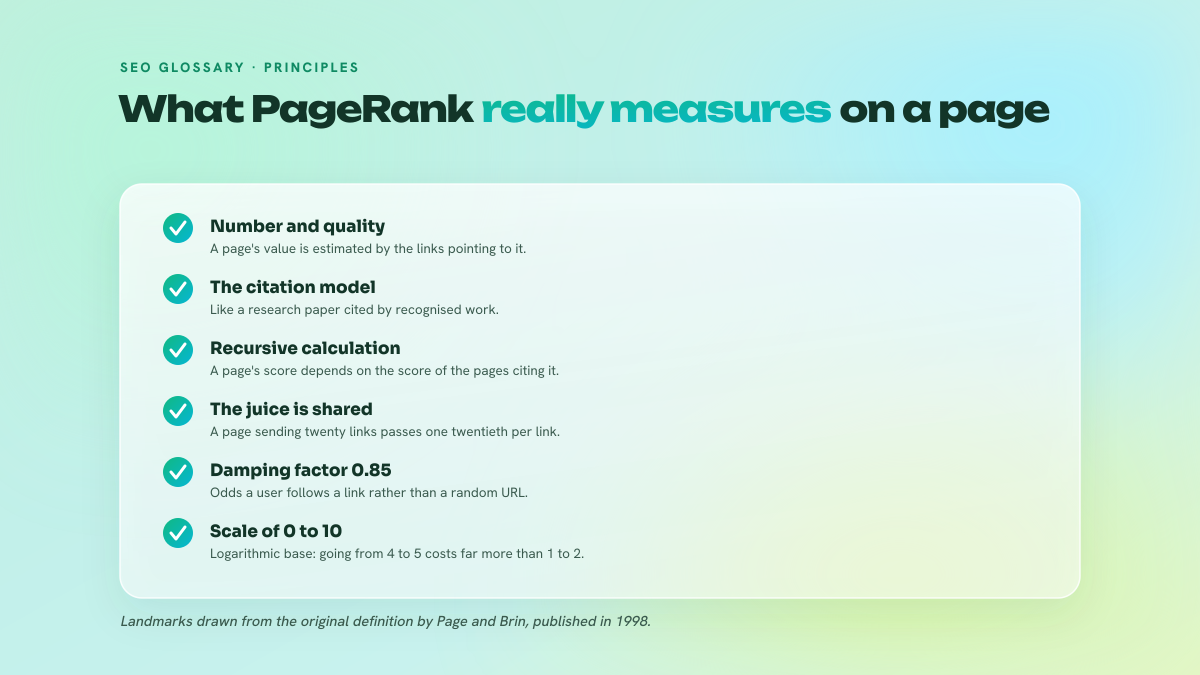
The principle mirrors that of an academic citation. A scientific paper frequently cited by other important papers gains authority in its field. In the same way, a web page that receives links from other already-recognised pages sees its score climb.
The mechanic is recursive. The PageRank of a page A depends on the PageRank of the pages B, C, D that point to it. But the PageRank of B itself depends on the pages that point to B, and so on. To solve that multi-variable equation, the algorithm proceeds through successive iterations, recomputing scores until they converge to a stable value.
Another important subtlety: the PageRank of a page is distributed among all the pages it links to. If a very powerful page emits twenty links, each link transmits one twentieth of its juice. That property explains why it is better to receive a link from a page that emits few than from one that emits hundreds.
The original formula
The formula published by Page and Brin in their 1998 paper uses a damping factor of 0.85, which models the probability that an internet user clicks on a link rather than typing a new URL at random. That factor prevents the calculation from diverging and reflects a behavioural reality: users do not chain links indefinitely.
The algorithm walks the entire page graph, propagates PageRank step by step, and generally converges after about thirty iterations. On the original Google scale, scores ranged from 0 to 10 on a logarithmic basis. Moving from PageRank 4 to 5 took far more effort than moving from 1 to 2.
That formula has been published and widely studied since. It remains a study object in graph theory and has applications well beyond the web: social-network analysis, product recommendation, ranking of scientific articles.
Evolution since 2000
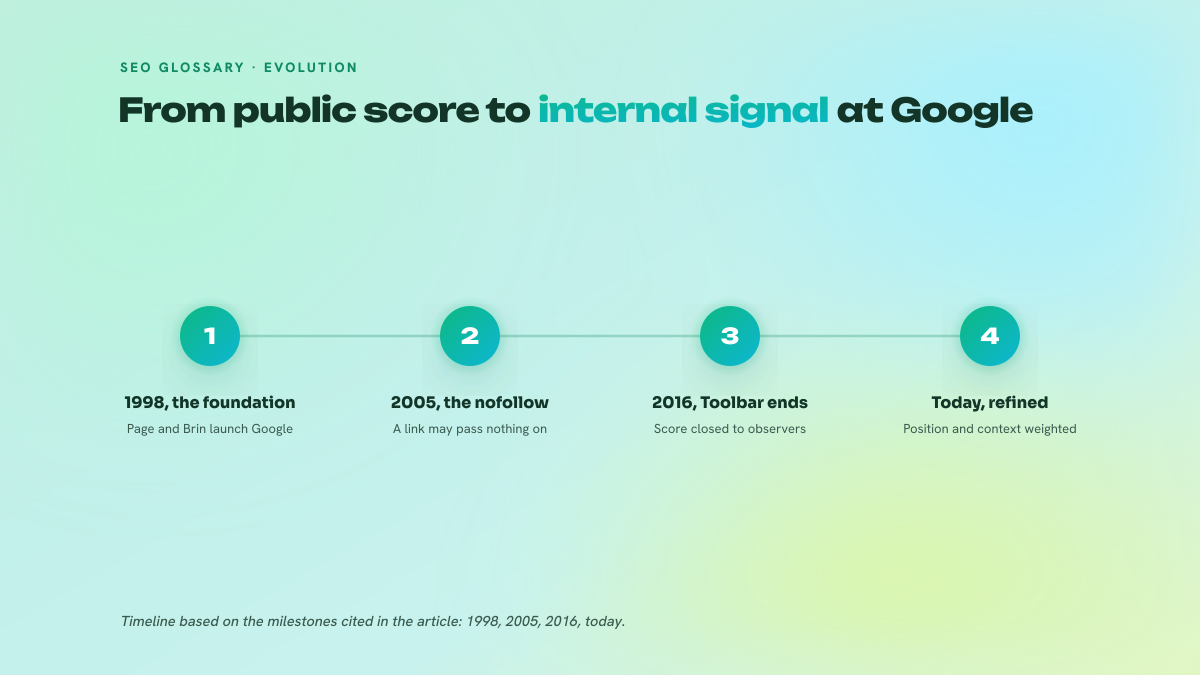
Google has continually enriched its algorithm since the original PageRank. Hundreds of signals have been added, some major: content quality, user experience, behavioural signals, search intent, mobile-friendliness, speed, HTTPS security. Each major algorithm update (Penguin, Panda, BERT, Helpful Content) has reshuffled the weightings.
PageRank itself has been refined. More recent versions weight links based on their quality, their position on the page, their semantic context. A link in the body of a relevant article no longer carries the same weight as a link in a generic footer. The nofollow tag, introduced in 2005, allowed sites to indicate that a link should not pass PageRank.
In 2016, Google definitively removed the PageRank Toolbar, the public score visible in the Google bar of browsers. That removal did not signal the disappearance of the algorithm, only its closure to outside observers. Google explained that the public score encouraged manipulation behaviour and no longer offered a useful reading at scale.
PageRank in 2026
Twenty-five years after its creation, PageRank remains active at the core of Google's algorithm. John Mueller and several Google engineers have repeatedly confirmed that links and their authority propagation still rank among the heaviest signals. What has changed is the environment.
Today, PageRank coexists with hundreds of other signals. A page can rank well on a query without an exceptional PageRank, if its content matches search intent perfectly and offers an exemplary user experience. Conversely, a high PageRank alone is no longer enough to compensate for poor content or a slow page.
Algorithmic detectors are also more sophisticated. Google identifies manipulative link profiles, link farms and low-cost PBNs. PageRank earned through these routes is devalued, sometimes penalised. That evolution favours editorial, contextual and therefore more natural link acquisition.
Practical implications for SEO
For an SEO or an advertiser in 2026, several concrete implications flow from PageRank. First, internal linking remains an under-used lever. PageRank flows between your pages through internal links: structuring that linking as a topical cluster, channelling juice toward priority pages, is optimising a signal that was already valued back in 1998.
Second, quality trumps quantity in a netlinking strategy. Receiving a link from a page recognised in its topic is worth far more than ten links from pages without an audience, which is the rationale behind buying a backlink on a high-authority media rather than spreading budget across dozens of weaker placements. Source selection should beat volume.
Third, the transparency of anchors matters. PageRank is sensitive to link context: coherent anchors, position in the body of the article, relevant editorial environment. Links that look like natural placements pass through better than those that scream their commercial nature, which is why teams that publish on media that genuinely pass authority tend to invest in the editorial fit before negotiating the placement itself.
Nautilinks operates an owned network of editorial media. In-house written articles, transparency disclosures respected, anchor mix calibrated.
Frequently asked questions
Is PageRank still used by Google?
Yes, internally. Google has confirmed several times that PageRank remains one of the signals used in its ranking algorithm, even though it is no longer publicly exposed since the PageRank Toolbar was retired in 2016. The modern version is probably very different from the original formula, enriched with hundreds of variables and continually refined.
How can I know a page's PageRank today?
Officially, no way. Google has communicated no public equivalent since 2016. SEOs use proxies like Moz's Page Authority, Ahrefs' URL Rating or Majestic's Citation Flow, which draw on the same principle but rely on indexes specific to each tool.
How do I boost my internal PageRank?
Internal PageRank is managed through site internal linking. Pages linked from the homepage and the most-visited pages receive more juice. A topical-cluster logic, which groups pages by topic and makes them link to one another, optimises the flow of PageRank toward priority pages.
Is buying a link from a high-PageRank site really worth more?
In principle yes, PageRank remains a major signal. In practice, you should reason in terms of overall quality: real organic traffic of the site, topical fit, editorial context of the link. A link from a high-PageRank site that's off-topic carries less weight than a link from a moderate-PageRank site that aligns perfectly with your niche.
Are PageRank and Domain Authority the same?
No, they are two different metrics. PageRank is Google's proprietary algorithm, computed at page level. Domain Authority is a Moz score, computed at domain level, from an independent crawler. Both measure authority but not exactly the same thing, and the correlation between them is imperfect.
Test your knowledge
Quiz: PageRank
1/3Why does a single link from a highly-ranked page typically outweigh dozens of links from obscure pages?