- →Penguin has not existed as a named update since 2016. Its logic sits inside core ranking and runs in real time, which means there is no rollout to wait for and no recovery date to plan around.
- →Devaluation and penalty are two different mechanisms with two different remedies. Neutralized link equity needs new links, a manual action needs cleanup plus reconsideration, and confusing the two wastes months.
- →Anchor distribution remains the loudest signal. A 2026 Bluetree Digital audit of 200+ B2B SaaS sites found excessive exact match commercial anchors as the primary flag on 82 % of penalized profiles.
- →The disavow file is a manual action tool in 2026, not routine hygiene. Uploading it after every spam update treats a symptom Google already handled on its own side.
- →Links still correlate with rankings: Ahrefs measured that across one million keywords in January 2025. The filter kills manipulative patterns, not link acquisition as a discipline.
- →The only durable defence is a link profile that survives being read by a human: real editorial context, varied sources, anchors written for the sentence rather than for the target page.
What Penguin actually is now
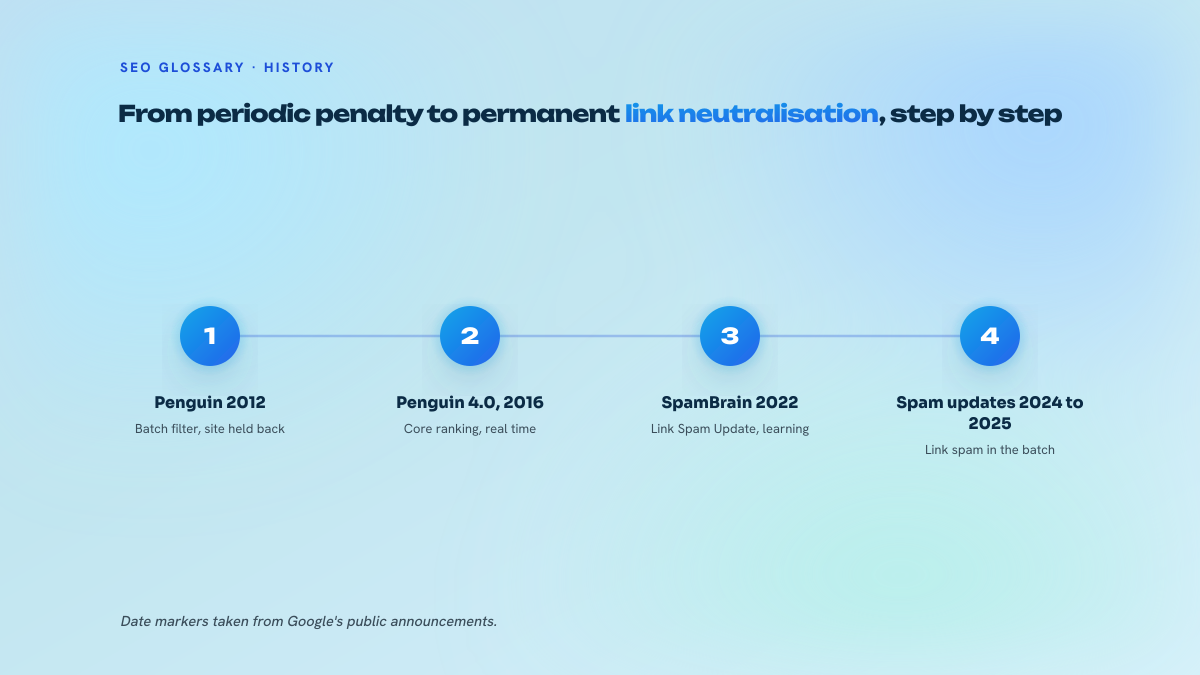
Penguin launched in 2012 as a discrete filter that ran on a schedule, hit a set of sites, and left them stranded until the next refresh. Sites cleaned their profiles and then waited for the next refresh before anything moved. That version of Penguin is dead. With Penguin 4.0 in 2016 Google folded the link spam logic into its core ranking systems, made it continuous, and stopped announcing it. Wikipedia's own entry on the update records the same transition, and every serious 2026 breakdown of Google's update landscape now treats Penguin as a historical component rather than a live product name.
The practical consequence is that the word Penguin has become shorthand for a behaviour, not a system. When a consultant says a profile got hit by Penguin in 2026, what they mean is that a chunk of the site's backlinks stopped transmitting value. There is no message in Search Console, no dated rollout to align a graph against, and no reconsideration request to file. The link is still there, still crawled, still rendered on the page. It simply counts for nothing.
That shift also changed the blast radius. Pre-2016 Penguin was largely site-level: bad links dragged the whole domain down. The post-2016 behaviour is closer to selective muting. Google's stated intention was to devalue spam links instead of demoting the sites receiving them, which removed most of the collateral damage from negative SEO and, incidentally, removed most of the leverage from the cleanup industry that had grown around the 2012 version.
How devaluation works in 2026
The operative machinery today is SpamBrain, the machine learning spam detection system Google introduced publicly and then wired into link handling with the December 2022 Link Spam Update. That update is the real ancestor of current behaviour, not any late Penguin iteration: it explicitly used SpamBrain to neutralize unnatural links and to propagate the effect to sites that had been sending them repeatedly. Everything since has been an extension of that logic through the spam update cycle: June 2024, December 2024, then the August 2025 Spam Update which started rolling out on 26 August 2025 and covered scaled content abuse, site reputation abuse and link spam together in one global pass.
Reading that sequence matters more than memorizing it. Google now bundles link spam with content abuse in the same enforcement wave, which means a site can lose visibility to a spam update for reasons that have nothing to do with its backlinks, and vice versa. Attribution is genuinely hard. The usual diagnostic sequence in audit is to check whether losses cluster by page type or by referring domain: a content problem tends to hit templates and query families, a link problem tends to hit the specific URLs that were the destination of a purchased campaign, and leaves the rest of the site untouched.
The second thing worth internalizing is that devaluation is silent by design. Search Console reports the link, Ahrefs and Semrush both count it, and none of that reflects whether Google is passing anything through it. Third party tools measure the existence of a link, never its transmission. This is why the only honest measurement of a campaign is the destination page's own trajectory: impressions, ranked query count, and position distribution on the queries the page was built for, measured against a symmetric window before and after. If a batch of thirty links produced no movement on any of those over three months while a comparable batch on a different page did, you have your answer without needing a Penguin announcement.
Where it bites in a netlinking operation
Devaluation is a budget problem before it is an algorithmic one. Editorial.link's 2026 survey of 518 SEO professionals put the benchmark price of a quality link at $508.95, and BuzzStream's 2025 analysis of more than 26,000 guest post sites found an average direct guest post link cost of around $365. At those levels, a campaign whose links get quietly neutralized is not a ranking setback, it is five figures of spend that produced a graph and nothing else. Anyone building a serious budget should be pricing survival, not volume, which is why what a link actually costs before you commit to a campaign deserves more scrutiny than the DR filter people usually stop at.
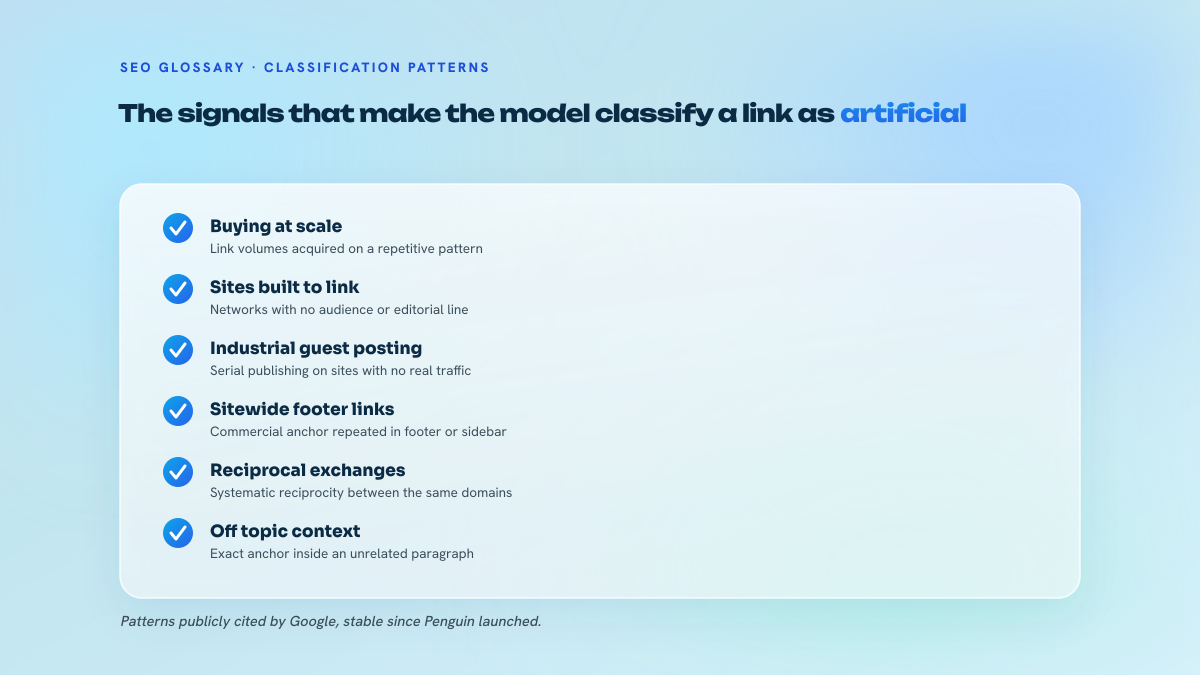
The signal that gets profiles into trouble is overwhelmingly anchor distribution. A 2026 audit dataset published by Bluetree Digital, covering more than 200 B2B SaaS sites, reported that 68 % of sites with unexplained ranking plateaus showed identifiable unnatural link patterns, and that 82 % of penalized profiles carried excessive commercial exact match anchors as the primary flag. That figure lines up with what we see in audit: the anchor sheet is where a bought campaign confesses. Nobody writing an editorial article naturally links four times to the same page with the same three commercial words.
Source pattern is the second axis. Footprint clusters, recycled expired domains pointing at one client, sitewide footer placements and networks where every host runs the same template all reduce to the same underlying tell: the links were produced by one operator with one goal. This is where operating owned media is a structurally different position from renting placements. Across the French editorial media we run in-house, the constraint we live with is that each site has to justify its own audience independently of who buys a link on it, and the same discipline is what makes a catalogue you can inspect host by host before ordering a more defensible purchase than a black box marketplace inventory.
Note what has not changed: links still work. Ahrefs' January 2025 analysis across one million keywords found that the number of backlinks and referring domains still correlates positively with top 20 rankings. The filter kills manipulative patterns, not link acquisition. Consultants who read every spam update as evidence that netlinking is over have been wrong for a decade running.
What we see go wrong
The most common error is misdiagnosis in the direction of links. A site loses a large share of its traffic, the owner remembers a campaign from eight months ago, and the whole recovery effort points at the backlink profile while the actual cause was a broad core update reshuffling the whole query set. Core updates and spam updates often run within weeks of each other, as they did around December 2024, which makes the calendar useless as evidence on its own. Before touching a single link, check whether the drop is uniform across the site or concentrated on the pages that received links, and whether competitors moved in the same direction.
The second error is the reflex disavow. Since Penguin 4.0 and SpamBrain, bad links are far more likely to be quietly discounted than to suppress a site, and Google's own guidance through the August 2025 cycle has been to reserve the disavow file for confirmed manual actions or for documented paid and PBN schemes that genuinely cannot be removed. Uploading a file scraped from a tool's toxicity score after every spam update accomplishes nothing except occasionally disavowing links that were working. Toxicity scores are vendor inventions, not Google signals, and treating them as such has cost more sites than it has saved.
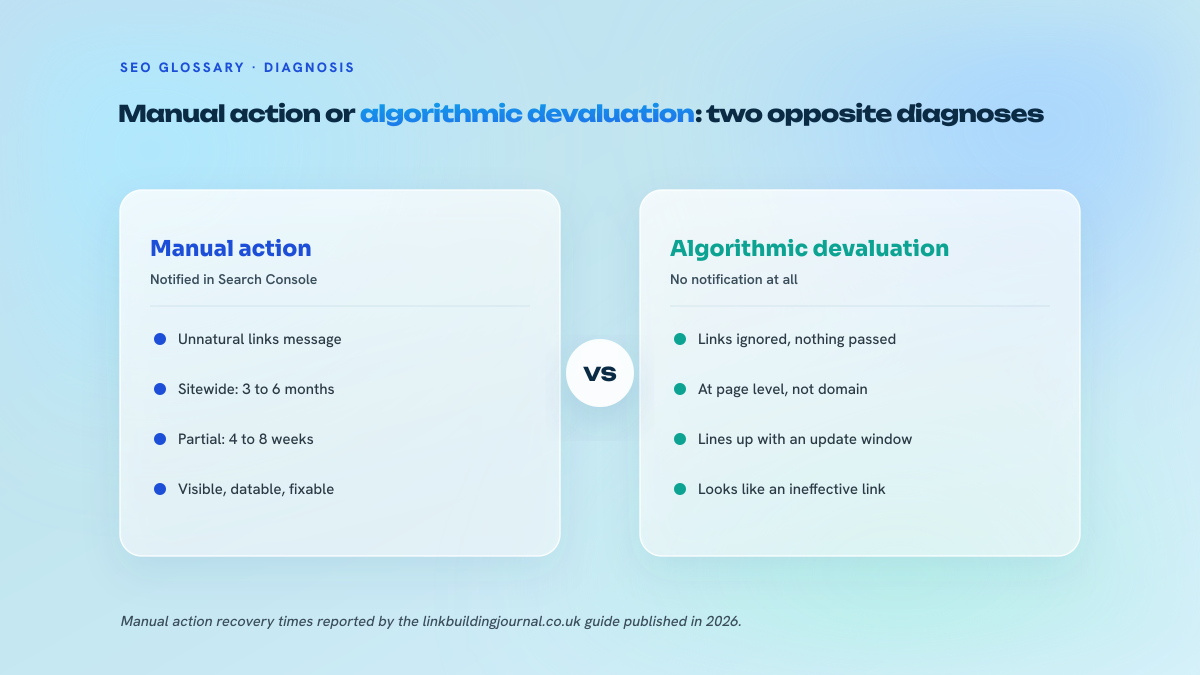
The third error is impatience on real manual actions. Where an unnatural links manual action genuinely exists, recovery timelines published in 2026 recovery guidance are measured in months: roughly 3 to 6 months for full recovery from a site wide unnatural links action after cleanup and reconsideration, and around 4 to 8 weeks for a partial action with thorough remediation. Filing a reconsideration request with half the removals documented restarts that clock rather than shortening it.
The fourth error is the one nobody talks about: continuing to buy from the same source after a devaluation event. If a batch of links produced no movement, the correct inference is that the source pattern is recognized. Buying more from the same pattern is buying the same neutralized outcome twice.
Operating under a permanent Penguin
Treat link spam filtering as an ambient condition, not an event. That reframing changes three concrete habits. First, measure at the destination page level with a fixed protocol, because a permanent real time filter gives you no other feedback channel. Second, keep anchor distribution honest at acquisition time rather than trying to correct it later: a profile dominated by brand, URL and descriptive phrasing with commercial anchors as a minority is not a compliance exercise, it is simply what real editorial linking looks like.
Third, pace acquisition against the site's own history rather than against a target number. A domain that sat at two referring domains a month for a year and then takes forty in three weeks is describing a purchase, whatever the quality of the hosts. This is the part of the 2012 Penguin intuition that survived intact, even though the mechanism underneath it has been rebuilt twice.
The uncomfortable senior take: most profiles that get devalued were not unlucky, they were legible. Someone could open the anchor sheet, sort by frequency, and see the campaign. Build so that test fails, and the algorithm question mostly stops being interesting.
Nautilinks operates an owned network of editorial media. In-house written articles, transparency disclosures respected, anchor mix calibrated.
Frequently asked questions
Can a site still get a Penguin penalty in 2026?
Not in the 2012 sense. There is no named Penguin filter issuing algorithmic penalties any more. What exists is continuous devaluation inside core ranking, plus manual actions for unnatural links issued by human reviewers, which do appear in Search Console. If you have no manual action message, you are dealing with devaluation, and the remedy is acquiring links that count rather than removing links that do not.
Does devaluation ever suppress a site, or only neutralize the link?
Google's stated behaviour since the December 2022 Link Spam Update is to neutralize the offending link, and to propagate consequences to sites that repeatedly send unnatural links. For a receiving site, the practical effect is usually loss of the equity you paid for rather than a site-wide demotion. Egregious, sustained patterns can still attract a manual action, which is a different and heavier mechanism.
Should I disavow after a spam update?
Not reflexively. Current guidance through the August 2025 spam cycle reserves disavow for confirmed manual actions and for documented paid or PBN schemes you cannot get removed. Since Penguin 4.0 and SpamBrain, unnatural links are more likely to be silently discounted than to hurt you. Disavowing on the basis of a third party toxicity score risks removing links that were passing value.
What anchor ratio is actually defensible?
There is no published threshold, and anyone quoting one is inventing it. What the audit data supports is direction: Bluetree Digital's 2026 dataset of 200+ B2B SaaS sites found excessive exact match commercial anchors as the primary flag on 82 % of penalized profiles. Operationally, keep commercial exact match as a clear minority of the profile and let brand, URL and descriptive phrasing carry the bulk.
How do I distinguish a link devaluation from a core update loss?
Look at the shape of the loss, not the date. Link devaluation concentrates on the specific URLs a campaign targeted and leaves the rest of the site roughly intact. A core update reshuffles whole query families across page types, and usually moves competitors in visible ways at the same time. Since spam and core updates often run weeks apart, calendar alignment alone proves nothing.
How long does recovery take after an unnatural links manual action?
2026 recovery guidance puts full recovery from a site wide unnatural links action at roughly 3 to 6 months after cleanup and a successful reconsideration request, and partial actions at around 4 to 8 weeks with thorough remediation. The main cause of overrun is filing a reconsideration with incomplete documentation, which restarts the review rather than shortening it.
Test your knowledge
Quiz: Penguin algorithm
1/3What changed structurally with Penguin 4.0 in September 2016?