- →Exact match is the most literal relevance signal you can send and the most machine-scrutinised: the 2024 Google API leak exposed «IsAnchorBayesSpam» and «anchorMismatchDemotion» as dedicated anchor classifiers.
- →Keep external exact match to a thin slice: 2025-2026 guides converge on 1 to 5 percent (W3era, May 2026) up to under 10 percent (SegmentSEO, Jan 2026), never double digits on money keywords.
- →SpamBrain now devalues the manipulative portion of a profile without a sitewide penalty (BlueTree, March 2026), so a bad exact match batch gets quietly zeroed rather than announced.
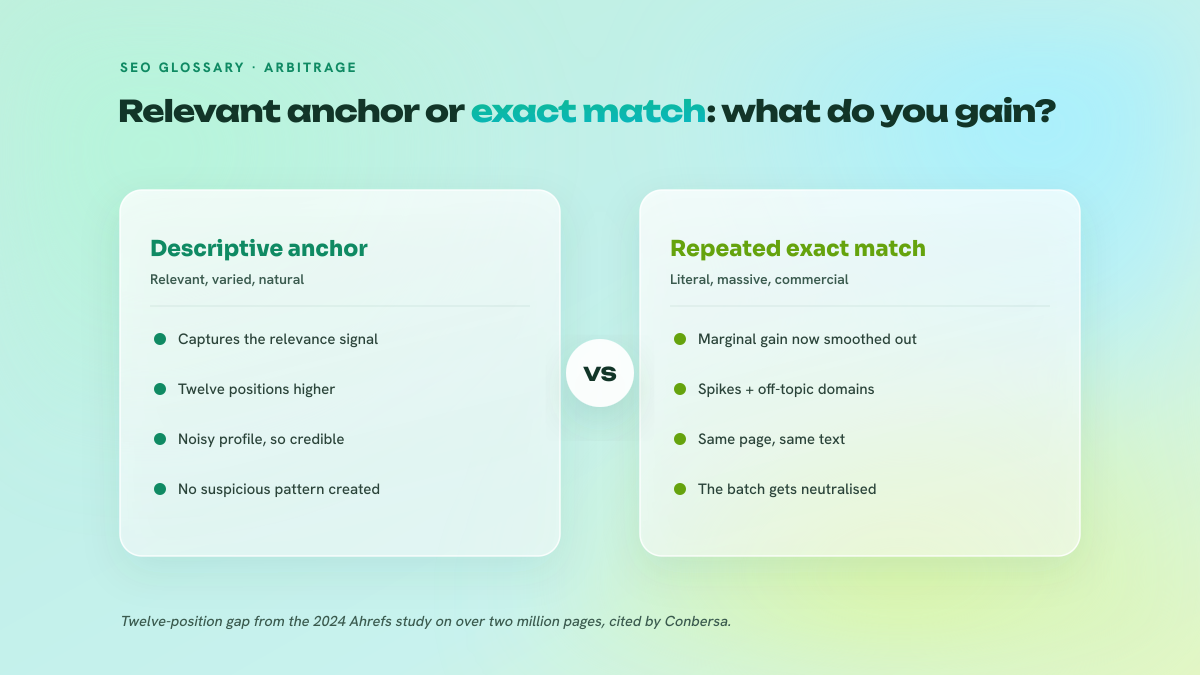
- →The reward is real but shrinking: Ahrefs' 2024 study of over two million pages found keyword-relevant anchors ranked twelve positions higher, yet The Frank Agency (Jan 2026) reports exact match is «no longer significantly more effective» than alternatives.
- →Internal links are the safe home for exact match: Zyppy's 23-million-link study (Feb 2026) tied sparing internal exact match to more organic traffic.
- →Audit distribution before building, lead external acquisition with branded and partial match, and reserve exact match for high-authority, topically-matched placements.
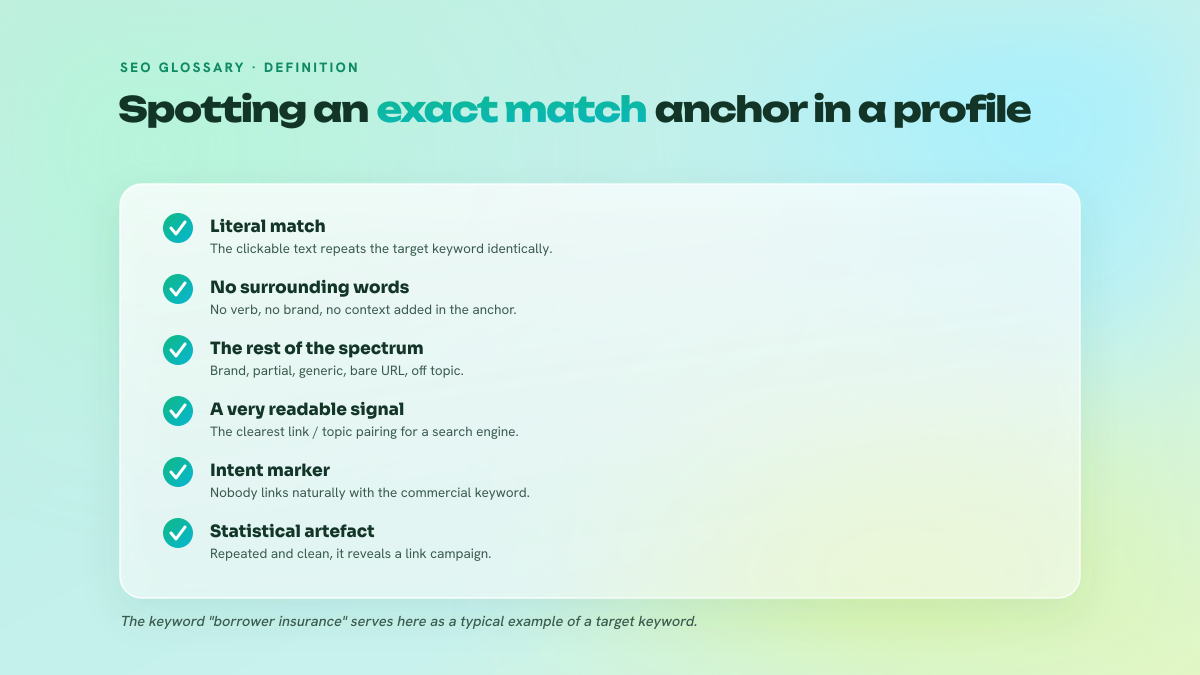
Exact match anchor: the signal Google reads most literally
An exact match anchor is a link whose visible text is the precise keyword you want the destination page to rank for. Point a link at a page about running shoes with the anchor «running shoes», and you have handed the search engine a word-for-word relevance label. That is the entire appeal, and the entire problem. The anchor is the one part of a backlink you control down to the character, so it became the most gamed signal in link building, and Google has spent well over a decade learning to distrust it whenever it looks engineered.
The historical context explains the current caution. In the early PageRank era, anchor text was close to a direct ranking dial: repeat «best payday loans» across a few hundred forum links and you moved. The 2012 Penguin update was built specifically to punish that pattern, and every spam iteration since has tightened the screws. So when a peer asks whether exact match still «works», the honest answer is that it works exactly the way a loud signal works: it is read clearly, and it is scrutinised clearly. Nothing about that is neutral.
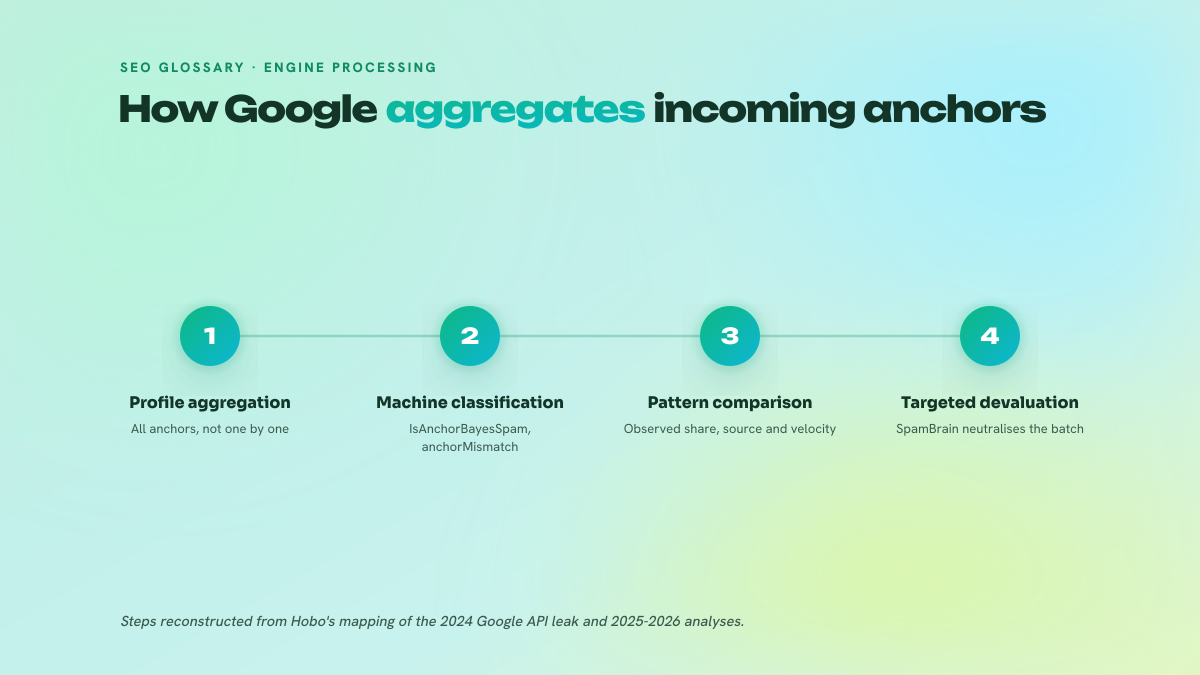
How Google actually evaluates exact match in 2026
The 2024 Google API leak gave the field its clearest look yet at how anchors are machine-classified. In Hobo's January 9, 2026 mapping of the leaked attributes, two flags stand out: «IsAnchorBayesSpam» and «anchorMismatchDemotion», internal classifiers that evaluate inbound anchor patterns for link-spam schemes and demote anchors that do not match the topic of the destination. Read plainly, that confirms what practitioners long assumed: exact and partial match ratios are not read by a human, they are scored by a system that models what a natural profile should look like and flags the deviations.
The enforcement got more surgical, not blunter. BlueTree's March 15, 2026 analysis of Google's backlink policy ties the December 2024 and October 2025 spam updates to SpamBrain's ability to devalue the manipulative portion of a link profile without dropping a sitewide penalty. In practice that means a batch of exact match anchors from unrelated domains can be quietly zeroed out while the rest of your profile keeps working. Sterling Sky's case study on the August 2025 spam update (26 August to 22 September) found precisely this: the pages that lost rankings were the ones carrying exact match commercial anchors from spammy domains, while pages on the same site without that pattern gained. Search Engine Land's spam update explainer (May 11, 2026) frames the trigger the same way: sudden spikes of exact match anchors from unrelated sites.
The June 2026 spam update continued the same line. A June 28, 2026 analysis of that update describes keyword stuffing in anchors, forcing the exact target keyword into anchor and body text, as a specifically targeted violation alongside scaled content abuse. The direction of travel is unambiguous: every spam update of the last two years has reinforced, not relaxed, the machine's suspicion of engineered anchors. Measurement, then, is about distribution and source quality together, never the raw count of exact match links. If you are running campaigns at scale, this is exactly where pacing acquisition over several months beats a single burst: the same anchors spread across time and calibrated sources read very differently from the same anchors dumped in one window, which is also the core logic behind how fast a profile grows.
Anchor types and the ratios that actually matter
Exact match only means anything relative to the rest of your anchor mix, so you need the full taxonomy. Branded anchors use your name («Nautilinks»), naked URLs use the raw address, generic anchors are the «click here» and «read more» filler, partial match wraps the keyword in a longer natural phrase («the best running shoes for trail»), and exact match is the bare keyword. A real profile is dominated by branded and partial, with exact match as a thin slice.
This short breakdown visualises how the anchor types stack up and what ratios look healthy:
The numbers back the hierarchy. Conbersa's February 28, 2026 summary cites an Ahrefs 2024 study of more than two million pages showing that pages with keyword-relevant anchors ranked on average twelve positions higher than those with generic or random anchors, which is the reward side nobody should ignore. The same piece summarises Semrush research on what a healthy distribution looks like: roughly 40 to 50 percent branded, 20 to 30 percent partial match, 10 to 15 percent generic, and only 5 to 10 percent exact match. A Rhino Rank study across 19,840 keywords similarly found exact match anchors carried more ranking impact than generic «click here» anchors, while warning in the same breath that an above-normal exact match ratio is itself the manipulation signal. Both things are true at once, and holding that tension is the whole game.
Risks, over-optimisation and the threshold that flips reward into penalty
The stance to hold is simple: exact match is the strongest anchor you can build and the one most likely to sink you, and the deciding variable is ratio, not any single link. The «safe» range has converged over the last year. W3era's May 7, 2026 guide puts external exact match at only 1 to 5 percent of the profile; SegmentSEO's January 7, 2026 guidance lands at under 5 to 10 percent. Nobody credible in 2026 is arguing for double-digit exact match on money keywords.
The case walk-through below shows exact match overuse dragging real rankings down:
The reason the threshold matters is that Google's spam policies explicitly name «links with optimised anchor text in articles, guest posts, or press releases» as link spam, so every exact match anchor you place in bought or guest content is sitting on a listed violation the moment the ratio tips. This is where sourcing discipline pays for itself: sourcing links straight from calibrated publishers lets you control both the anchor and the surrounding topical context, instead of accepting whatever a marketplace hands you. Nautilinks operates its own media in-house precisely so the anchor and the editorial context are decided together, not bolted on afterwards. The common failure we see in audits is a client who bought «forty guest posts» and let the vendor use the target keyword as anchor on every single one: forty exact match anchors on unrelated blogs is the textbook «IsAnchorBayesSpam» pattern, and it ages badly.
Internal links and the tactical playbook
Internal linking is where exact match is safest and most under-used, because you own every anchor and there is no third-party spam risk. Zyppy's February 23, 2026 study of 23 million internal links found that pages with at least one internal exact match anchor pulled significantly more organic traffic than pages with none, and that naked URL internal anchors did no harm while sparing exact match delivered the bigger lift. The lesson is not «stuff exact match internally», it is that a deliberate, descriptive internal anchor on the right page is a clean signal you fully control.
This clip covers the safe way to use exact match on internal links:
Tactically: audit before you build, using Ahrefs, Semrush or Sistrix to pull your current anchor distribution and flag any money page already over the single-digit exact match line. Lead external acquisition with branded and partial match, reserve exact match for a handful of high-authority, topically-matched placements, and keep the anchor descriptive rather than crammed, which is Google's own documented guidance: descriptive, concise, relevant, and «resist the urge to cram every keyword». The Frank Agency's January 5, 2026 trend report even argues exact match backlinks are «no longer significantly more effective» than non-exact alternatives, which is the real 2026 shift: the marginal ranking gain has shrunk while the risk has not, so the smart money treats exact match as seasoning. A well-placed link sitting inside relevant editorial copy with a partial-match anchor almost always beats a bare keyword drop, and if you want that placement done as real editorial rather than a footprint, have the article written around the link instead of the link stapled into it.
Nautilinks operates an owned network of editorial media. In-house written articles, transparency disclosures respected, anchor mix calibrated.
Frequently asked questions
Is exact match anchor text still worth using in 2026?
Yes, but as seasoning, not a staple. Ahrefs' 2024 study still shows keyword-relevant anchors ranking higher, yet The Frank Agency's January 2026 report finds the marginal gain over partial match has shrunk while penalty risk has not. Use it on a handful of high-authority, topically-relevant links and keep the overall ratio in the low single digits. The pro move in 2026 is to treat exact match as a scarce resource, not a default anchor.
What actually counts as a good anchor?
One that reads naturally in the sentence and describes the destination without cramming the keyword. Google's own guidance is descriptive, concise, relevant. In practice branded and partial-match anchors do the heavy lifting: they pass topical context, look organic to the spam classifiers, and carry most of a healthy profile (Semrush puts branded at 40 to 50 percent). A good anchor tells a reader where the link goes, not just which keyword you want to rank for.
Can bad anchor text actually hurt my rankings?
Yes, directly. Sterling Sky's case study on the August 2025 spam update found the pages losing rankings were the ones carrying exact match commercial anchors from spammy domains. The leaked «anchorMismatchDemotion» flag also demotes anchors that do not match the destination topic. Over-optimised exact match from unrelated or low-quality domains is one of the clearest ways to trigger a devaluation of that portion of your profile, even without a full manual penalty.
What is the difference between an exact match anchor and an exact match domain?
They are unrelated despite the shared phrase. An exact match anchor is link text that equals your target keyword. An exact match domain (EMD) is a domain name that equals the keyword, like bestrunningshoes.com. EMDs had their own Google devaluation update back in 2012 and are a domain-selection topic, not an anchor one. People conflate them because both were early keyword-in-X manipulation tactics that Google later took the value out of.
What is a safe exact match ratio for external links?
The 2025-2026 consensus sits in low single digits. W3era's May 2026 guide recommends 1 to 5 percent of external anchors as exact match; SegmentSEO caps it under 5 to 10 percent. Semrush's «healthy» model allows up to about 10 percent. Treat anything into the teens on commercial keywords as a red flag, and remember the ratio across the whole profile matters far more than any single link.
Test your knowledge
Quiz: Exact Match Anchor
1/3According to the Semrush research cited in 2026, what share of a healthy backlink profile should be exact match anchors?