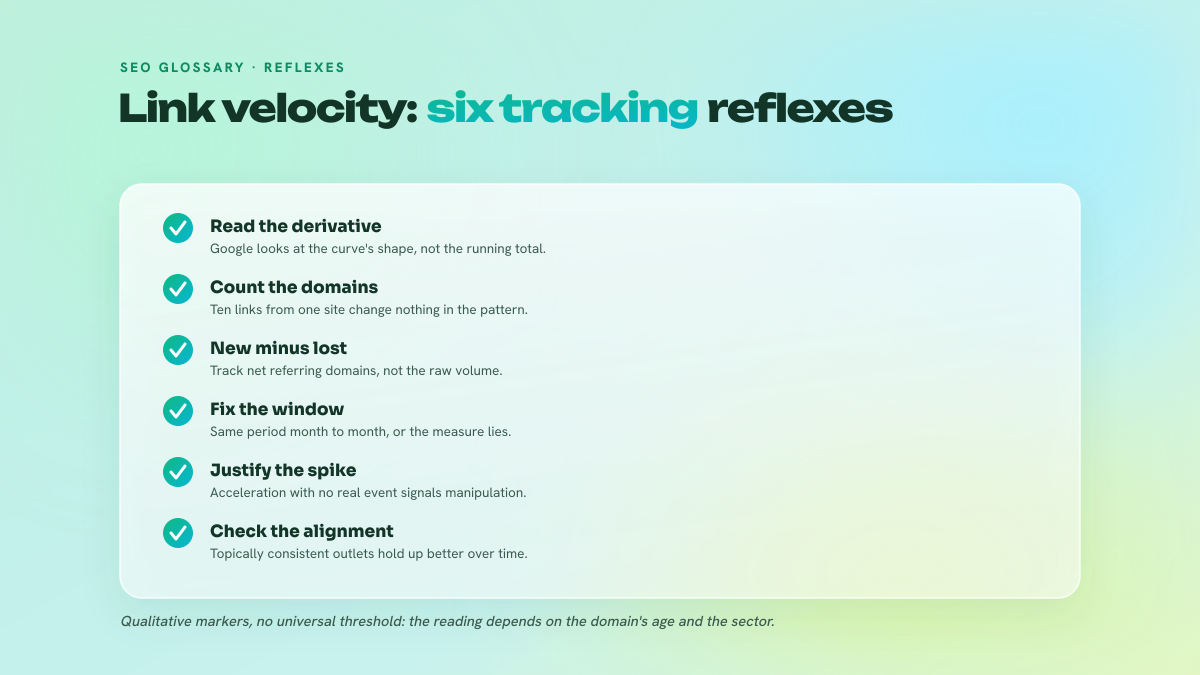
- →Velocity is the derivative of your backlink graph, not a links-per-month number. SpamBrain flags the shape of the curve, not the absolute count.
- →The 2024 SpamBrain update added explicit pattern detection for « unnatural link velocity », and its first-stage filter usually neutralizes flagged links rather than triggering a manual penalty (KeySERP, June 2026).
- →Natural growth for a site publishing consistently sits around 5 to 15% monthly, and spikes above 50% monthly can trigger manual review (Ranktracker aggregating SEMrush 2024).
- →There is no universal « too many per month » figure. Orbink's 2025 benchmark on 412 sites confirms risk is governed by ratio and pattern per niche, not raw volume.
- →A young domain and an established one carry different budgets: first ten referring domains land in 3 to 6 months with active promotion, 12 to 18 without (Ahrefs 2024).
- →The expensive mistake is not building too fast, it is building fast from irrelevant, footprint-heavy sources. That is what turns velocity into a flag.
Velocity is a derivative, not a count
The mistake most people make with link velocity is treating it as a number of links per month. It is not a count, it is the shape of a curve: the rate at which your referring-domain graph changes over time. Google never publishes it and never will, because it is not a metric you optimize toward, it is a pattern its spam systems observe. A site that goes from ten new referring domains a month to five hundred, then back to zero, has one velocity signature. A site that adds fifteen a month for two years has another. The absolute figure barely matters on its own. What matters is the acceleration, the abruptness, and the quality of the sources feeding the spike.
This distinction is the whole game in 2026. Backlinks.pk, in its January 20, 2026 guide, put it plainly: Google « no longer punishes websites for building backlinks quickly, instead it evaluates whether your backlink growth pattern aligns with genuine online behavior ». That single sentence retires a decade of « build no more than X links per week » advice. The question a spam system asks is not how many, it is does this curve look like something that happens naturally to a site of this age, in this niche, with this topical footprint.
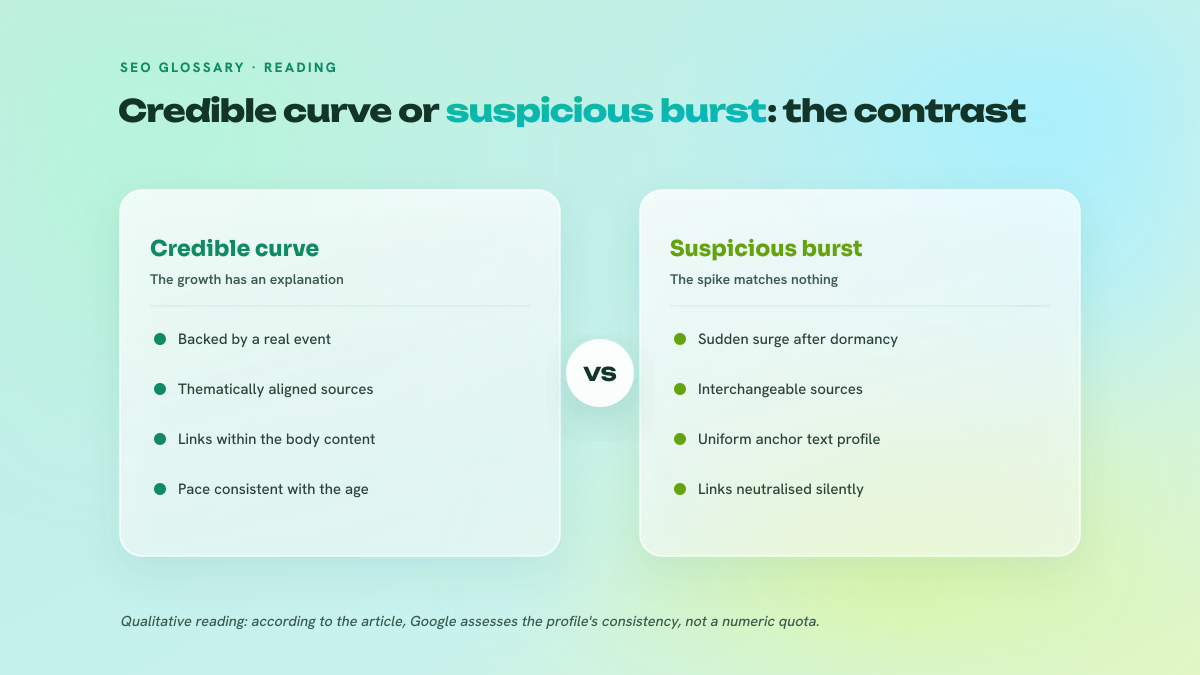
From what we see in audits, the sites that get into trouble are rarely the ones that built a lot. They are the ones that built a lot suddenly, from a cluster of unrelated domains, with the same exact-match anchor repeated. The curve told the story before the links were even weighed on quality. If you want to understand why anchor patterns compound this risk, our note on how to spread anchor text so it reads as organic is the companion piece to this one.
How Google actually treats it in 2026
SpamBrain is the piece of machinery that made velocity a live signal rather than a retrospective one. BlueTree's March 15, 2026 backlink policy analysis notes that by the August 2025 spam update, SpamBrain could flag suspicious link patterns in real time, and that manipulative links are now selectively devalued rather than always causing a sitewide penalty. In practice, the system tends to neutralize the contaminated portion of a profile and leave the rest standing. KeySERP's June 16, 2026 compliance guide describes the same mechanism from the inside: the 2024 SpamBrain update added pattern detection for « unnatural link velocity », such as sites acquiring hundreds of backlinks in a few days after months of dormancy, and its first-stage filter usually neutralizes those links with no benefit passed and no manual action taken. Escalation to a real penalty is reserved for the worst, most persistent cases.
The mechanics matter because they change how you should think about risk. When flagged links are simply zeroed out, the downside of an aggressive spike is rarely a catastrophe, it is wasted budget: you paid for links that pass nothing. The genuinely dangerous scenario is when velocity combines with the other network-level tells. SerpHaus, on May 4, 2026, reported that both the August 2025 spam update and the March 2026 spam update leaned heavily on SpamBrain to detect network patterns such as hosting fingerprints, theme similarity and interlinking, and singled out bursty acquisition, « building 500 links in a month when you have been building ten a month », as a manipulation pattern. Velocity is the trigger that makes the system look closer, then the footprint decides the verdict.
There is a local-search coda worth flagging. Sterling Sky's February 28, 2026 analysis of the August 2025 spam update found that local and SMB sites carrying toxic link networks and over-optimized anchors, exact-match anchors tied to keywords that were already sliding, were hit hardest. Velocity did not act alone there either, but it was one of the signals the analysis recommended monitoring to stay clear of future algorithmic penalties.
Measuring the curve: tools and reading
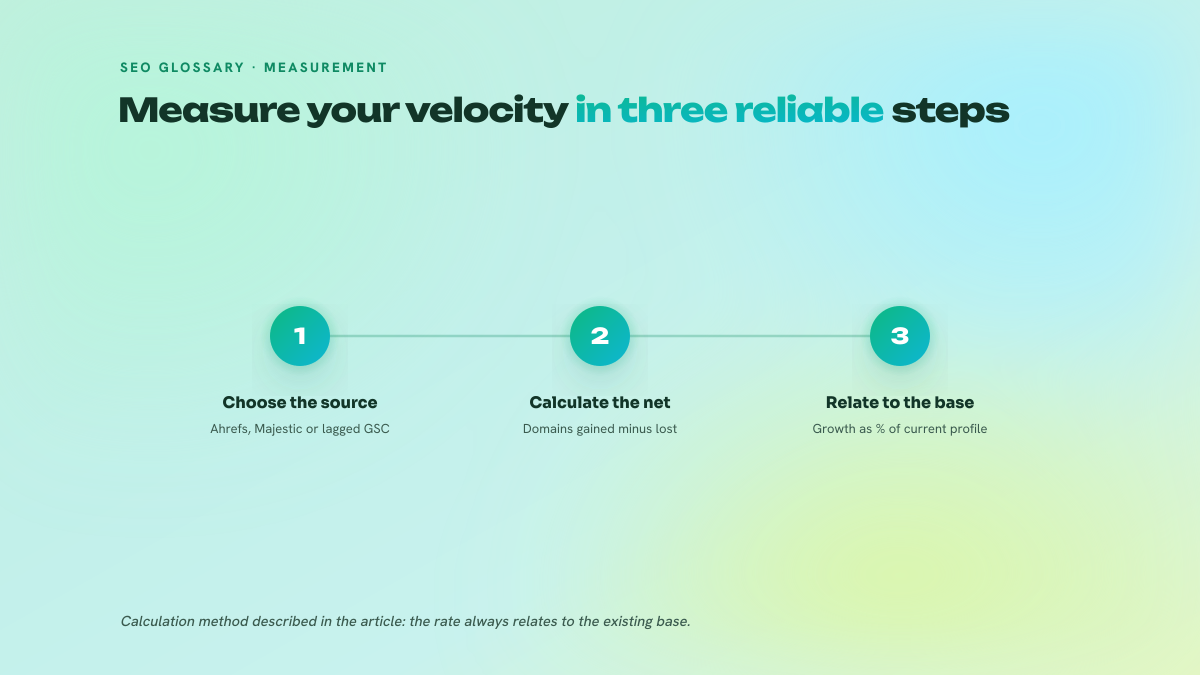
You cannot read velocity from a single snapshot. You need the referring-domains timeline, and the standard toolset gives it to you: Ahrefs and Semrush both plot new versus lost referring domains month over month, Majestic exposes a dedicated link velocity view, and LinkResearchTools builds trend curves designed specifically to spot anomalies. The number you actually track is the delta of referring domains, not raw backlinks, because a single domain dropping fifty sitewide footer links inflates the backlink count without changing the graph in any meaningful way.
The webinar below is a solid deep dive on how fast you can realistically build and how to read the resulting curve.
What counts as a normal curve is niche-dependent, but there are anchor figures worth carrying in your head. Ranktracker's December 19, 2025 backlink statistics roundup reports that healthy sites publishing consistently see natural backlink growth of roughly 5 to 15% monthly, and that spikes above 50% monthly can trigger manual reviews, citing SEMrush 2024 data. ContentLadder's July 25, 2025 guide translates that into a concrete benchmark: a page sitting at 100 referring domains gaining 5 to 15 new backlinks a month, roughly 0.17 to 0.5 a day, reads as a typical natural range. For content that actually earns links, the timing skews hard to the front: Ranktracker cites Moz 2024 showing about 73% of a viral page's backlinks arrive within the first three weeks, after which growth settles below 2% monthly past 90 days. That front-loaded spike is natural precisely because the content event that caused it is real.
Read the graph, not the total. A steady upward slope with occasional bumps tied to real publications or a PR pickup is the shape you want. A flat line broken by a single vertical wall, then flatness again, is the shape that gets a profile neutralized. When you plan acquisition, the honest move is to pace a campaign across several months instead of front-loading the whole order, so the curve never has to explain itself.
Where velocity decides a netlinking campaign
Velocity is where a netlinking operation either looks like editorial activity or like a purchase order. This is the one place a link network's structure genuinely changes your risk. When you buy from a marketplace that resells the same media to hundreds of clients, your links land alongside everyone else's on the same domains, in the same weeks, with the same acquisition rhythm: that is a shared velocity footprint you do not control. When we place links from the media we operate in-house at Stringer, the pacing is a lever we set deliberately, publication by publication, because the sites are ours and the editorial calendar is real. That is an operational difference, not a sales point: owned inventory lets you smooth the curve, rented inventory does not.
The niche multiplier is real and under-discussed. Orbink's Link Velocity Benchmark 2025, published May 15, 2026 on original research across 412 sites in iGaming, crypto, finance, CBD, adult and health, concluded that Google's link quality systems model natural acquisition per niche, age, authority and topical footprint, and do not evaluate raw velocity in isolation. The same study found that sites which maintained or increased aggressive acquisition after being suppressed took an average of 6.1 months to recover visibility, and 18% saw no measurable recovery inside the 12-month window. The lesson is not « go slow everywhere », it is « calibrate the curve to what your vertical and your domain age can plausibly attract ». A finance site three years deep can absorb a rhythm that would flag a two-month-old CBD domain overnight.
Age is the other axis. Ranktracker cites Ahrefs 2024 showing that new sites with active promotion typically earn their first ten referring domains within 3 to 6 months, stretching to 12 to 18 months without promotion. So a young domain that shows fifty referring domains in its first month is not just aggressive, it is describing a history that did not happen. When you plan links for a fresh site, the constraint is not your budget, it is credibility of the timeline. This is also why the type of link matters as much as the pace: a link placed inside relevant editorial copy reads as earned in a way a footer or sidebar link never will, and earned links carry a naturally forgiving velocity profile.
What we see go wrong in audits
The recurring failure is optimizing for the wrong variable. People throttle their monthly count to a fixed number they read on a blog, then feel safe, while every one of those links comes from the same three PBN-adjacent domains with the same anchor. That profile is far riskier than a larger, varied, well-paced one. Velocity is not a speed limit you obey, it is a pattern you make coherent.
The second mistake is confusing a devaluation for a penalty and reaching for the disavow tool at the first ranking dip. Given that SpamBrain's default response is to neutralize flagged links rather than penalize the domain, most « velocity penalties » people diagnose are actually links quietly passing nothing. Disavowing aggressively at that point can remove signal you were still benefiting from. The 2026 posture is to fix the acquisition pattern going forward, not to panic-disavow the past.
The third is treating AI-generated guest-post placement as a velocity-safe channel. BlueTree notes the October 2025 spam update extended enforcement to AI-generated guest-post farms publishing thin, machine-generated content purely to embed paid links. Spinning up fifty thin posts to smooth your curve does not smooth it, it hands the system a theme-similarity and content-quality signal on top of the velocity one. If you are choosing where to place links, browse the catalogue of media you can inspect before ordering and check that each source is a real, individually reachable site, then set the rhythm through a self-serve platform where you schedule placements over time rather than dumping an order in a single week. Coherent curve, relevant sources, honest pacing: that is the whole discipline, and it has not changed in substance, only in how fast the machine now reads it.
Nautilinks operates an owned network of editorial media. In-house written articles, transparency disclosures respected, anchor mix calibrated.
Frequently asked questions
Is there a safe number of backlinks to build per month?
No, and any fixed figure is a trap. Orbink's 2025 benchmark on 412 sites confirmed Google models natural acquisition per niche, age and authority, not a universal quota. A three-year-old finance domain can absorb a pace that would flag a new CBD site. Track the shape of your referring-domain curve relative to your domain's age and vertical, not an absolute count someone published as a rule of thumb.
What actually happens when velocity gets flagged?
In most cases the flagged links are neutralized, not penalized. Per KeySERP's June 2026 guide, SpamBrain's first-stage filter zeroes out suspicious links so they pass no value, usually with no manual action. Escalation to a real penalty is reserved for the worst, most persistent patterns. So the common downside of a spike is wasted budget on links that do nothing, not a sitewide collapse, unless velocity combines with heavy footprint signals.
Does a big spike from viral content look unnatural?
No, because the event behind it is real. Ranktracker, citing Moz 2024, notes roughly 73% of a viral page's backlinks arrive within the first three weeks, then growth drops below 2% monthly after 90 days. That front-loaded curve is exactly what genuine link earning looks like. The spikes that get flagged are the ones with no corresponding content event and sourced from unrelated, low-quality domains.
Should I disavow links after a velocity-related ranking drop?
Usually not as a first move. Because SpamBrain tends to neutralize rather than penalize, most drops people attribute to velocity are links quietly passing nothing, not an active penalty. Aggressive disavowing can strip signal you still benefit from. Diagnose first: check whether rankings actually correlate with an algorithmic spam wave, fix the acquisition pattern going forward, and reserve disavow for genuinely toxic, confirmed-manipulative sources.
How is velocity different for a brand-new domain?
A young domain has a much tighter credibility budget. Ahrefs 2024 data cited by Ranktracker shows new sites with active promotion earn their first ten referring domains in 3 to 6 months, 12 to 18 without promotion. Fifty referring domains in month one does not just look fast, it describes a history that never happened. For fresh sites the constraint is timeline plausibility, so pace deliberately and lean on relevant, editorial placements.
Which tools show velocity best?
Ahrefs and Semrush both plot new versus lost referring domains month over month, Majestic has a dedicated link velocity view, and LinkResearchTools builds trend curves specifically for spotting anomalies. Track referring-domain deltas, not raw backlink counts, since one domain dropping many sitewide links distorts the total without changing the graph. Read the slope and the abruptness of any jump, not the cumulative number.
Test your knowledge
Quiz: Link velocity
1/3What does SpamBrain most commonly do when it flags an unnatural link velocity pattern?