- →Diversification is not a tactic, it is the statistical fingerprint of uncoordinated linking. When you build links deliberately, you have to reconstruct that fingerprint on purpose.
- →Google evaluates anchors jointly with source quality and velocity: Sterling Sky's analysis of the August 2025 spam update showed drops concentrated on pages receiving exact-match anchors from spammy domains, not on exact-match anchors per se.
- →The 13% average exact-match share that Ahrefs measured on position #1 pages (cited by EMGI, April 2026) is a ceiling observation from winners, not a target ratio to engineer toward.
- →Internal links play by opposite rules: the Zyppy and Ahrefs 2024 study of 23 billion internal links found exact-match internal anchors correlated with 5x more organic traffic. Do not export external diversification dogma to your own site.
- →Plan the anchor mix per target page before ordering placements. Retro-fixing an over-optimized profile took an average of 60 days after remediation according to a 2025 link spam study cited by EditorialGE in March 2026.
- →The March 2026 spam update deliberately skipped link spam, and industry coverage expects a dedicated link-focused update later in 2026. This is the wrong year to carry a coordinated anchor footprint.
What Anchor Diversification Really Is
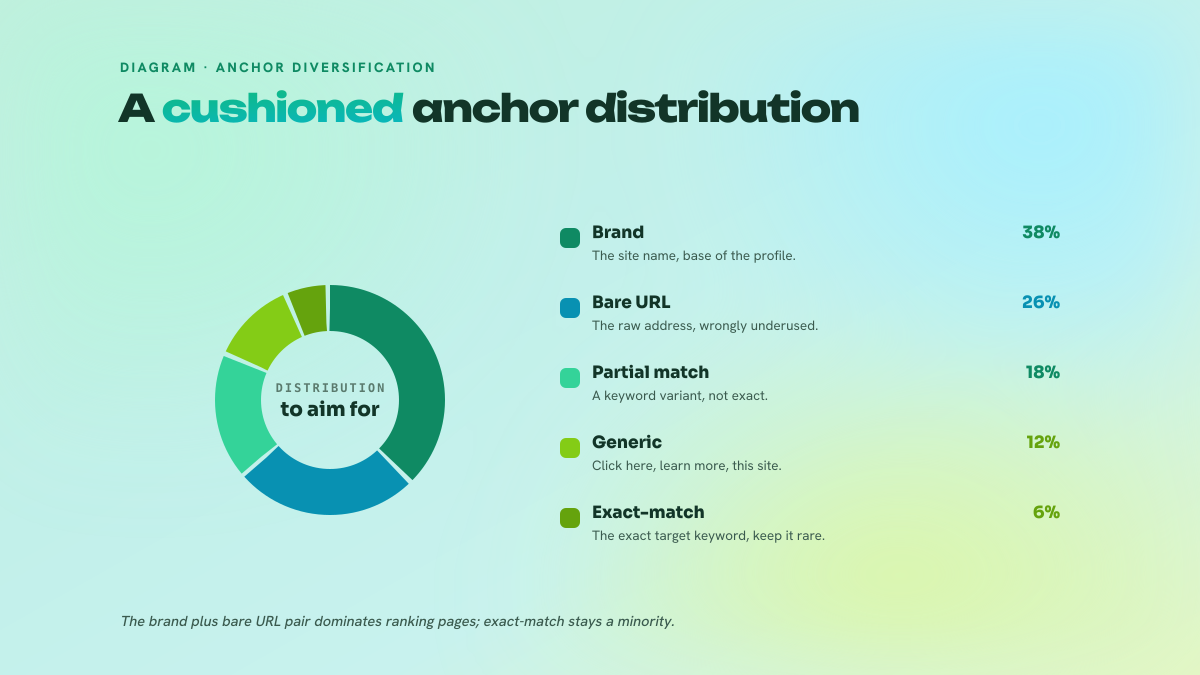
Anchor diversification is usually taught as a ratio recipe: so many percent branded, so many naked URLs, a thin slice of exact match. That framing gets the causality backwards. A natural backlink profile is diverse because nobody who links to you spontaneously coordinates their wording. A journalist cites your brand name, a forum user pastes the raw URL, a blogger writes whatever descriptive phrase fits their sentence, an aggregator uses your page title. Diversity is not something those linkers decided to produce. It is the statistical fingerprint of acquisition happening without a central planner.
The moment you build links deliberately, that fingerprint disappears unless you reconstruct it. Every placement you order is a decision point where nothing external forces variety, and the commercially tempting choice is always the same: the money keyword, pointed at the money page. Repeat that across thirty placements and you have manufactured the exact pattern Google's spam systems are trained to isolate. Anchor diversification, operationally defined, is the discipline of managing the distribution of anchor texts across a profile so that no single commercial phrase concentrates enough to look coordinated.
The working taxonomy has held stable for years: branded anchors, naked URLs, generic phrases like « read the analysis », partial-match variants, long natural sentences that happen to contain the topic, and exact-match commercial anchors. What has changed is which axis matters. The bucket percentages matter far less than the joint distribution: which anchors, from which quality of source, at which pace. A profile can be 20% exact match and clean, or 8% exact match and radioactive, depending entirely on where those anchors sit.
How Google Reads Anchor Patterns in 2026
Google has never published an anchor ratio, and anyone selling you one is extrapolating. What Google has published is spam policy, and what it has shipped is enforcement. The August 2025 spam update, announced by Google Search Central on August 26, 2025 and rolled out over 27 days, explicitly targeted link schemes, and coverage of the update flagged over-optimised anchor text pointing repeatedly at the same pages as one of the risky patterns.
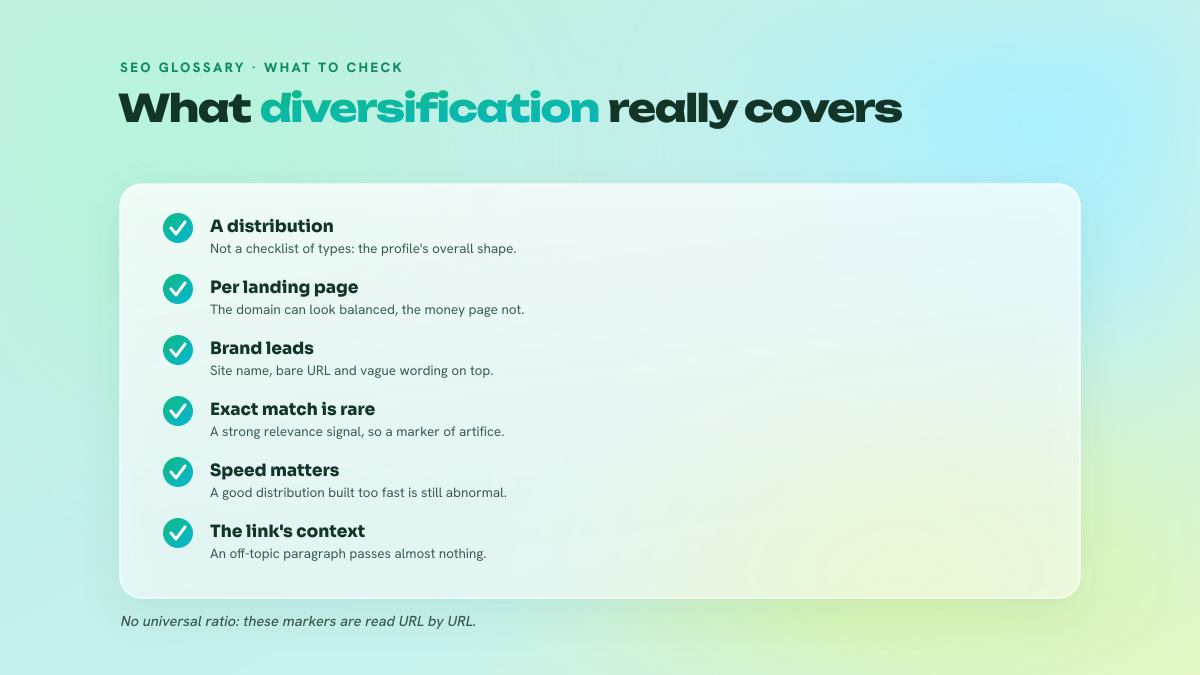
The most instructive data point came from Sterling Sky's analysis of that update on local sites: the pages that dropped were specifically those whose backlinks carried exact-match anchors from spammy domains, while other pages on the same sites held or improved. The same pattern had already surfaced around the August 2024 core update. Two consecutive years, same mechanic. Read that carefully, because it contains the whole model: the evaluation is page-level, and it is conditional. Exact-match anchors were not the trigger alone. Exact-match anchors from junk sources were.
Velocity is the third variable in the joint distribution. Search Engine Land's explainer on spam updates, updated May 11, 2026, describes spam systems flagging profiles that gain thousands of backlinks from unrelated domains within a month, especially when those links carry exact-match anchors. Anchor concentration and the velocity of your link graph are not two separate risk factors, they are one signal read together: a burst of identical commercial anchors is the signature of a campaign, and a campaign is what the systems exist to find.
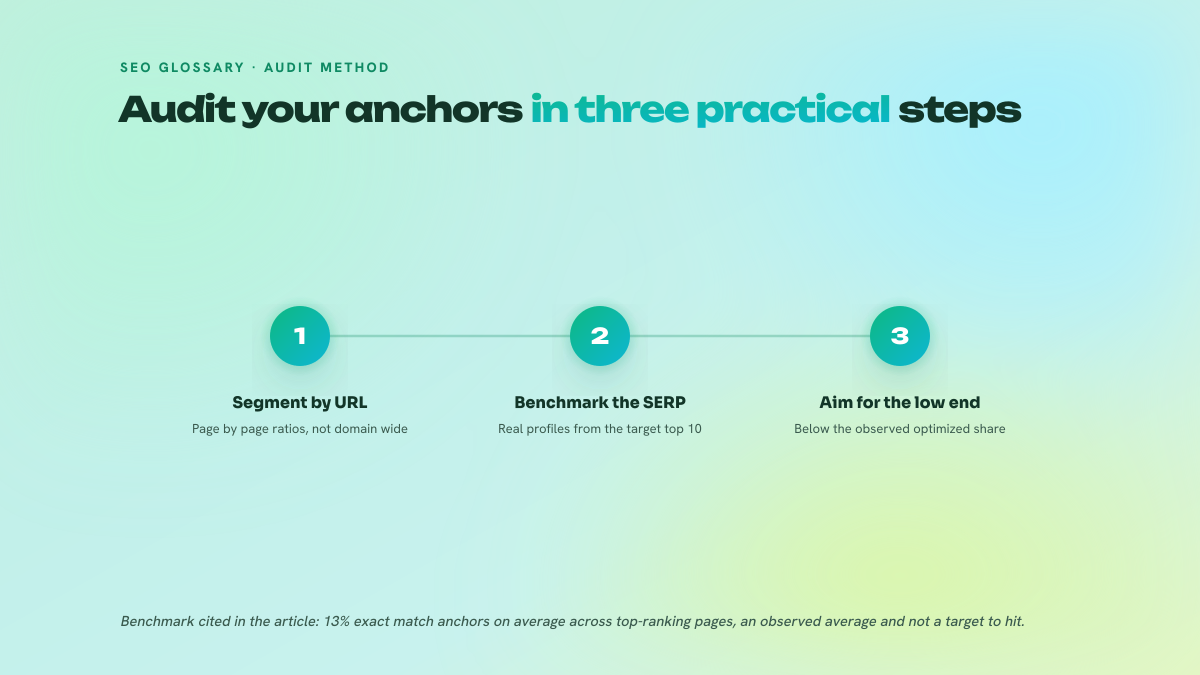
On the quantitative side, the most cited reference this year is Ahrefs' analysis of top-ranking pages, relayed by EMGI in April 2026: sites holding position #1 show on average 13% exact-match anchor text, the rest being branded, partial and miscellaneous variants. Treat that number as a ceiling observation, not a target. It describes what winners look like after the fact, across every niche and authority level mixed together. It does not say that engineering your profile to 13% makes you safe, and EMGI itself stresses that quality, context and relevance weigh more than the ratio. Finally, note the calendar: the March 2026 spam update completed in under 20 hours and deliberately did not focus on link spam, and industry coverage expects a dedicated link-spam update later in 2026. If your profile carries a coordinated anchor footprint, you are not betting against past enforcement, you are betting against announced enforcement.
Where It Sits in a Netlinking Operation
In a serious operation, the anchor plan is decided before the first placement is ordered, not reverse-engineered after. The unit of planning is the target page: for each money page, you define the one or two exact-match phrases you will allow yourself across the whole campaign, the partial variants that will carry most of the semantic load, and the branded and descriptive anchors that fill the rest. Then you enforce it procedurally, because when you buy placements you control the anchor 100%, and total control is precisely the danger. Nothing pushes back against the money keyword except your own discipline.
This is also where the structure of your supply chain matters. When you are picking placements from a catalogue where every medium is public, you set the anchor order by order, and the burden of keeping the campaign-level distribution coherent is on you. On an owned network like the French media Nautilinks operates, the article and its anchor are written in-house, which lets the operator calibrate the anchor mix across the entire campaign rather than hoping thirty independent orders average out to something natural. Neither model absolves you of the plan; one of them just makes the plan enforceable in one place.
The senior trick that most ratio-focused guides miss: relevance does not have to live in the anchor. A contextual link sits inside a paragraph, and that paragraph carries topical signal on its own. A branded or generic anchor wrapped in two sentences that discuss exactly what the target page covers transmits relevance without adding a gram of exact-match exposure. This is why editorial placements beat sidebar and footer links structurally, and why the write-up around the link deserves as much attention as the anchor itself. It is also why anchor discipline gets easier, not harder, when you pace a campaign over several months: spreading placements in time lets the soft anchors accumulate context while the rare exact-match anchors stay rare.
Common Mistakes We See in Audits
The first mistake is cargo-cult ratios: copying a 40/30/20/10 template from a blog post and applying it to every client regardless of niche. Anchor distributions differ by vertical because linking cultures differ by vertical. The only benchmark that means anything is the anchor profile of the pages actually ranking in your SERP, measured page by page, not the domain-wide aggregate.
The second is trying to fix over-optimization by volume: ordering a batch of branded and naked-URL links to dilute the exact-match share. Arithmetically it works. Behaviorally it stacks a velocity anomaly on top of an anchor anomaly, and as the Search Engine Land explainer makes clear, those two signals are read together. Dilution has to happen at the pace of a normal campaign, which is why remediation is measured in months: the 2025 link spam study cited by EditorialGE in March 2026 put average recovery at 60 days after cleanup, and that is the average, not the guarantee.
The third is exporting external dogma to internal linking. The Zyppy and Ahrefs 2024 study of 23 billion internal links found that pages receiving exact-match internal anchors saw 5x more organic traffic than pages linked with generic phrases like « click here », and Zyppy's data, quoted by Carnegie in January 2026, showed that the number of anchor variations correlates more strongly with performance than raw internal link counts. Your own site is not a spam vector against itself. Diversify internal anchors for coverage of phrasings, not out of fear.
The fourth is ignoring the source dimension entirely. Thirteen percent exact match from strong, topically adjacent pages and 13% from expired-domain blogs and directory farms are not the same profile, whatever the ratio tool says. Sterling Sky's August 2025 finding was precisely this interaction. And the fifth, specific to anyone operating at scale: repeating the same commercial anchor across many placements in a short window is a coordination footprint even when each individual source is decent. Uniqueness of phrasing per placement is cheap insurance, and it is one of the reasons a sponsored article written specifically for the hosting medium ages better than a syndicated template.
A Working SEO's Tactical Playbook
Start with measurement. Export anchors from Ahrefs and Search Console, bucket them, and compute the distribution per target page, because that is the level at which enforcement has been observed. Flag any money page where a single commercial phrase exceeds the share you see on ranking competitors, and weight the flag by source quality: exact match from real pages is exposure, exact match from junk is a liability to prune.
Then pilot forward, not backward. The cheapest fix for a skewed profile is the anchor mix of the next six months of placements, not a disavow spree over the last three years. Reserve disavows for the clearly toxic tail. Write every future anchor as a prose phrase that would survive in the sentence without the link, cap exact match per target page rather than per domain, and log every placement's anchor in the campaign sheet so concentration is visible before it exists. Finally, re-run the distribution after every named spam update. Industry coverage already expects a link-focused one later in 2026; the operators who will not notice it are the ones whose anchor profile already looks like nobody planned it.
Nautilinks operates an owned network of editorial media. In-house written articles, transparency disclosures respected, anchor mix calibrated.
Frequently asked questions
Is there a safe exact-match anchor percentage I can aim for?
No published one, and treating any number as a target misreads the data. The most cited figure, Ahrefs' 13% average exact match on position #1 pages (via EMGI, April 2026), describes winners after the fact across all niches. Enforcement observed in the August 2025 spam update was conditional: exact-match anchors from spammy domains, at the page level. Benchmark the pages ranking in your specific SERP and stay under what they show, weighted by source quality.
Should I diversify internal anchor text the way I diversify backlinks?
Not for the same reason. The Zyppy and Ahrefs 2024 study of 23 billion internal links found exact-match internal anchors correlated with 5x more traffic than generic phrases, and anchor variation count mattered more than link volume. Internally, vary phrasings to cover more query formulations, not to avoid a penalty. Your own site linking to itself descriptively is expected behavior, not a scheme.
How do I fix an over-optimized anchor profile without making it worse?
Change the mix going forward instead of flooding the profile with dilution links, because velocity spikes and anchor patterns are evaluated together per Search Engine Land's spam update explainer (May 2026). Shift the next months of placements to branded, partial and descriptive anchors, prune the exact-match links sitting on genuinely spammy domains, and budget patience: a 2025 link spam study cited by EditorialGE put average recovery at 60 days after remediation.
Do branded anchors waste the semantic value of a placement?
Only if the anchor is the sole carrier of relevance, which is a planning failure. A contextual link inherits topical signal from the paragraph around it, so a branded anchor inside two sentences that discuss the target page's exact subject transmits relevance with zero exact-match exposure. In practice we put the semantic work into the surrounding copy and spend the rare exact-match budget only where the SERP demands it.
Does anchor diversification still matter if a chunk of my links are nofollow?
Yes, because the pattern is profile-wide. Google treats nofollow as a hint, and a natural profile contains a meaningful share of nofollow, UGC and syndicated links with unglamorous anchors. A profile where every followed link carries a commercial anchor while the nofollow tail looks organic is itself a detectable asymmetry. Plan the anchor mix across everything you acquire, not just the dofollow placements you paid for.
Test your knowledge
Quiz: Anchor Diversification
1/3According to Ahrefs data relayed by EMGI in April 2026, what average share of exact-match anchors do position #1 pages show?