- →A contextual link is defined by its semantic neighborhood, not by the HTML container it sits in: an in-content link inside a grafted, off-topic paragraph fails the same test as a footer link.
- →Since the March 2024 core update and its spam policies (Google Search Central), contextually empty in-content links are an enforcement surface, not a neutral asset that simply passes less value.
- →Judge a placement by the host page before the host domain: indexed, ranking for something on the topic, receiving organic clicks. A strong domain metric on a dead page buys you nothing.
- →On anchors, partial match is the professional default (41.7% of 518 surveyed SEOs, editorial.link, March to May 2025), and Ahrefs data shows exact match adds risk without measurable ranking gain.
- →The paragraph around the link is part of the deliverable. If it was not written for the reader, the link fails the exact test it was bought to pass.
What a contextual link really is
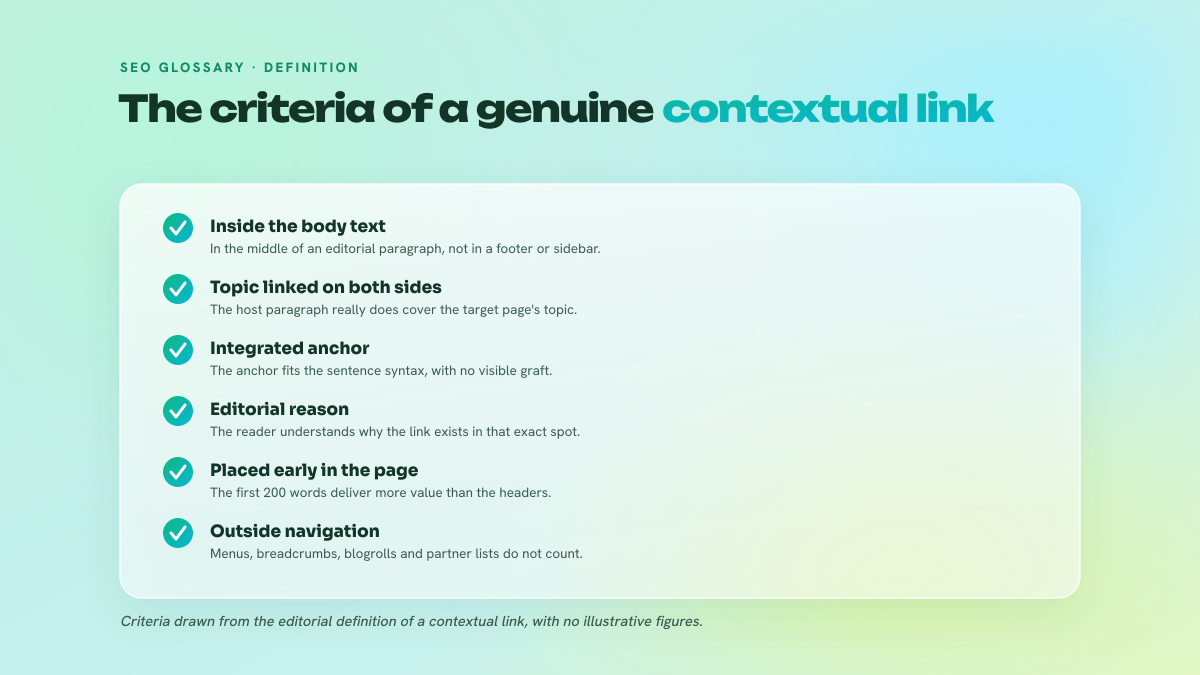
Strip away the vendor copy and a contextual link is a link that lives inside the argument of a page: placed in the body content, surrounded by prose that genuinely treats the same subject, pointing to a target that extends what the paragraph just said. The opposite is the template link: footer, sidebar, blogroll, author box, partner widget. The distinction sounds cosmetic. It never was: search engines have long weighted links differently based on their position in the document and the probability that a user would actually click them. A link buried in a footer next to forty others transfers a fraction of what the same link transfers from the third paragraph of a relevant article.
What has changed over time is the resolution of the analysis. Google no longer relies on positional heuristics alone: passage-level indexing and modern language models let it evaluate the semantic neighborhood of a link, meaning the sentence, the paragraph and the section around it, and how they relate to the target page. A contextual link is therefore not defined by where it sits in the DOM but by whether the surrounding text and the destination form a coherent semantic unit. You can place a link in the middle of an article and still fail the test if the paragraph was bolted on for the sole purpose of hosting it. Every auditor has seen these grafts: a recipe post that suddenly detours through payday loans for exactly one paragraph, then resumes as if nothing happened.
In practice this collapses the old typology of backlinks (contextual versus directory versus profile versus forum) into a single operational question: does the linking page have a legitimate editorial reason to send its reader to the target at that precise point of the text? If yes, the link accrues value whether it was earned, negotiated or paid. If no, it is noise at best and a spam signal at worst.
How Google actually reads context in 2026
The direction of travel has been explicit since the March 2024 core update: link evaluation moved further away from volume and closer to topical coherence. That update folded the Helpful Content system into core ranking and shipped spam policies targeting scaled content abuse, site reputation abuse and expired domain abuse (Google Search Central, March 2024), three tactics that historically produced links which were technically in-content yet contextually empty. Enforcement did not soften afterwards: the December 2025 core update, rolled out on 11 December as the third major core update of that year, recalibrated how content authenticity and genuine usefulness are weighed, which mechanically raises the bar for the pages your links live on.
This short walkthrough covers why in-content placement carries the weight it does, and pairs well with what follows:
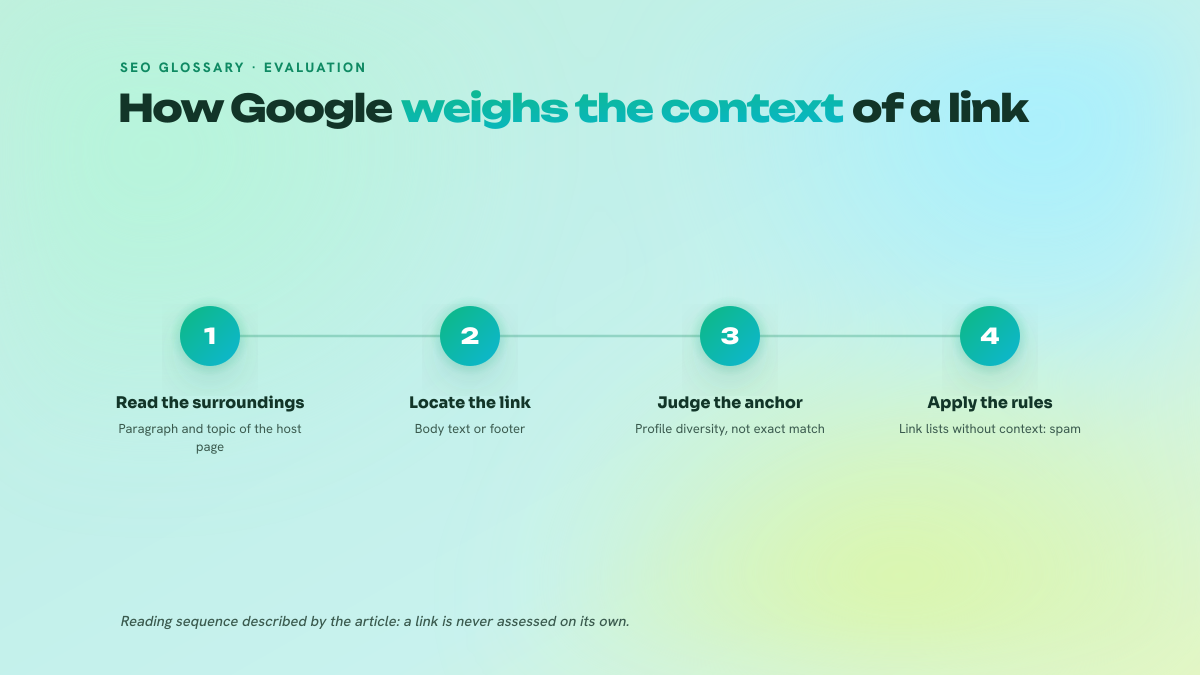
Mechanically, the evaluation runs on at least three layers. The anchor text itself, which is the weakest and most gamed layer. The passage around the link, where language models assess whether the anchor, the co-occurring entities and the claim being made actually belong together. And the page-to-page relation: does the linking document and the target document share a topical field, or is a gardening blog vouching for a crypto exchange? None of this requires believing in a secret « context score ». It only requires taking Google's own documentation and patents seriously, then observing what survives core updates and what does not.
The measurement side is more accessible than most people assume. Ahrefs and Semrush both expose the text surrounding each backlink in their link reports, which turns context auditing into a sampling exercise rather than guesswork. Pull the surrounding text of your fifty most recent links: if you cannot tell from the excerpt what the host article is about, neither can the reader, and you should assume the evaluation layer draws the same conclusion.
Where contextual links fit in a netlinking operation
Contextual placements are the core inventory of paid netlinking in 2026. They come in two forms. The sponsored article, written for the occasion, gives you full control of the semantic environment: topic, angle, entities, anchor, position in the text. The insertion into an existing indexed page, the so-called niche edit, trades that control for the accumulated signals of an aged URL that may already rank and receive clicks. Both work. The choice is a portfolio decision, not a doctrine: fresh articles for control and topical precision, insertions when the host page's existing equity genuinely matches your target.
Where operations diverge is sourcing. On a marketplace aggregating thousands of third-party publishers, the paragraph around your link is written by whoever the webmaster pays per insertion, and you discover the context after publication. On an owned network the editorial chain is internal end to end. That is the model we run at Nautilinks, our own French media where placements are written in-house under the same editorial rules as the rest of each site, and where you can pick placements from a catalogue where every metric is public before committing a euro. The point is not that owned is virtuous and marketplaces are evil: it is that context quality is exactly the variable you cannot verify upfront on anonymous inventory, and it is the variable that now carries the ranking weight.
The same logic applies to the format decision. When the concept you need to associate with your money page requires development, commissioning an article written by the publisher's own editorial team produces a semantic unit built around your link rather than a link squeezed into someone else's argument. That difference is invisible in a backlink count and decisive in a core update.
Building contextual links that survive core updates
Start with the host page, not the host domain. A placement is worth considering when the page is indexed, ranks for at least something in your topical field, and receives organic clicks. Domain-level metrics are a shortcut for prioritizing, never a purchase criterion: a DR 70 domain will happily sell you a link on a page Google deindexed eight months ago. Page-level checks take two minutes per candidate in any backlink tool and eliminate the majority of bad buys before price even enters the discussion.
For a practical view of the building side, this tutorial is a reasonable companion to this section:
Then anchor discipline. A survey of 518 SEO professionals conducted between March and May 2025 (editorial.link) found partial-match anchors are the default choice for 41.7% of practitioners, ahead of exact match at 25.1% and branded at 20.5%. That professional consensus matches the data: Ahrefs research has repeatedly found exact-match anchors no more effective at improving rankings than non-exact variants, which makes exact match a risk you take for a gain you cannot measure. The operational answer is a deliberately varied anchor profile where the surrounding sentence, not the anchor, carries the semantic load.
Finally, pacing. Contextual quality does not immunize a profile against acquisition patterns: twenty perfect placements landing in ten days on a site that earned nothing for a year is a pattern before it is a portfolio. This is where the pace at which links accumulate becomes a planning constraint, and why we consider it saner to calibrate a campaign over several months than to spend the same budget in a single burst. One caveat a senior buyer states plainly rather than hiding: Google's spam policies prohibit buying or selling links that pass PageRank (Google Search Central). The paid-link market operates anyway, at scale, across every competitive vertical. Risk management in that reality is editorial legitimacy: placements a human editor could defend, on pages a human reader actually visits.
The mistakes we keep seeing in audits
The grafted paragraph is the most common failure. An aged article gets a new paragraph appended whose only function is to host a link, with a topical jump any reader notices in one second. It was cheap, it was fast, and it is precisely the pattern the scaled content abuse policy describes: pages that link out without contextual justification. In audit, these are the links we recommend clients stop paying for first.
Second, buying on domain metrics alone. We regularly see link profiles where a third of the paid placements sit on pages with zero organic traffic and no rankings. The invoice said DR 60. The reality was a page nobody, including Google, ever visits. Nothing contextual can happen on a page with no context of its own.
Third, anchor over-optimization, which remains the most self-inflicted penalty vector: Semrush data compiled in a 2025 link-building statistics review (AllOutSEO) found anchor over-optimization present in 19% of penalty cases. The irony is that the exact-match anchor that triggers the scrutiny does not even outperform, per the Ahrefs findings above.
Last, treating internal linking as a separate, lesser discipline. The same evaluation layers apply inside your own site, and internal contextual links are the only ones you control completely and pay nothing for. An internal link placed in the body of a relevant paragraph, with a varied natural anchor, moves equity toward money pages with none of the risk profile of the paid variety. Any netlinking operation that spends five figures externally while its own money pages sit three orphan clicks from the homepage has its priorities inverted.
Nautilinks operates an owned network of editorial media. In-house written articles, transparency disclosures respected, anchor mix calibrated.
Frequently asked questions
Is the contextual link officially a ranking factor, or is that industry folklore?
Google publishes no factor list, so « official » is the wrong bar. What is documented: Google's spam policies treat pages that merely link out without contextual explanation as spam, and its guidelines insist on relevance and natural anchors. Combined with passage-level understanding, the defensible claim is that link value is conditioned by context, which is what practitioners mean by the term.
Sponsored article or insertion into an existing page: which produces the better contextual link?
Neither, categorically. A commissioned article gives you full control of the semantic environment but starts with zero page equity. An insertion inherits an aged URL's rankings and traffic but you inherit its context too, good or bad. Decide per target: if the existing page genuinely covers your topic and ranks, insert; if you need a precise semantic frame built around the link, commission.
How do I audit the context quality of an existing backlink profile without reading every page?
Sample it. Ahrefs and Semrush expose the text surrounding each backlink in their reports. Export the surrounding text of your last 50 to 100 links and read only the excerpts: if you cannot infer the host article's topic from the excerpt, flag it. Cross-check flagged links against the host page's own rankings and traffic. Two hours of sampling gives a reliable picture of a profile built over years.
Does the position of a contextual link within the article body still matter in 2026?
Yes, but less than relevance. The positional logic still holds: a link in the opening sections of the main content, where readers actually are, is worth more than one in the final paragraph nobody reaches. But a perfectly positioned link in an off-topic paragraph loses to a late link in a genuinely relevant one. Optimize relevance first, position second.
Given Google's paid-link policy, is buying contextual placements still rational?
The policy prohibits buying links that pass PageRank, and the market transacts at scale anyway in every competitive vertical. The rational frame is risk management, not abstinence: placements with editorial legitimacy on pages with real readers are statistically indistinguishable from earned coverage, while grafted paragraphs and over-optimized anchors are enforcement surfaces. Price that risk into what you buy and from whom.
Test your knowledge
Quiz: Contextual link
1/3According to the editorial.link survey of 518 SEO professionals (March to May 2025), which anchor type is the most preferred for link building?