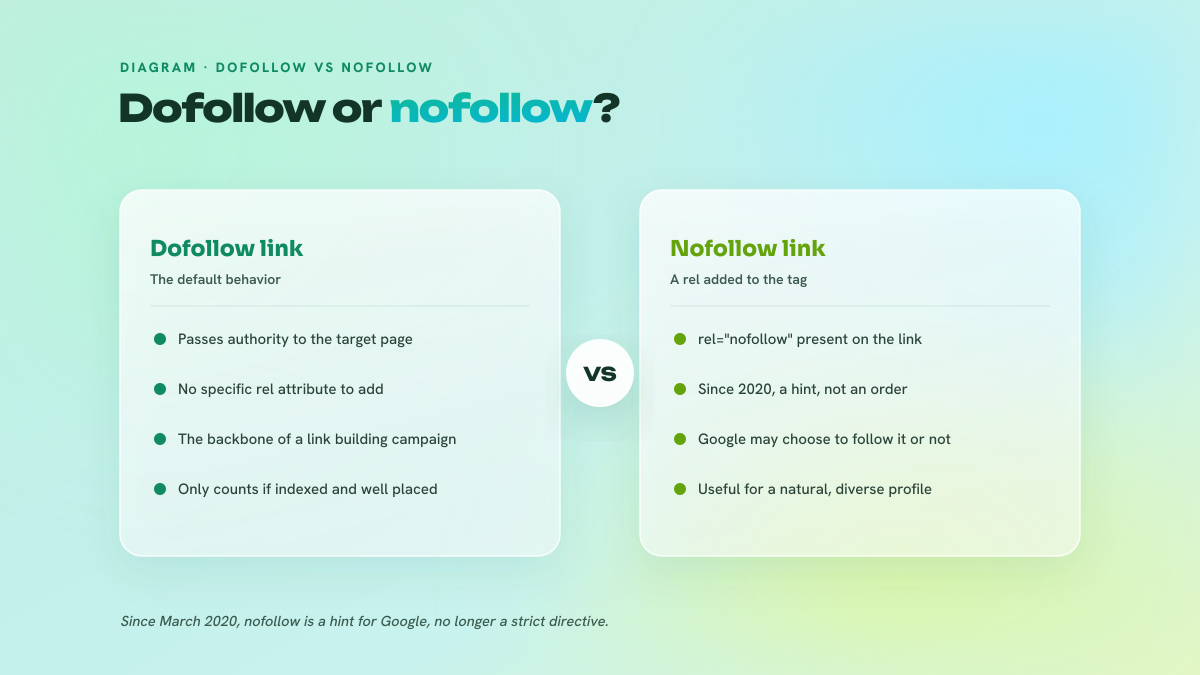
- →There is no rel=dofollow in the HTML spec or in Google documentation: dofollow means the absence of a qualifying attribute, and it grants eligibility to pass PageRank, never a guarantee.
- →Nofollow, sponsored and ugc are now hints, not directives. Google decides what to do with every link, followed or not.
- →For AI search visibility the qualifier barely matters: Semrush measured a 0.334 correlation for dofollow backlinks and 0.340 for nofollow in its September 2025 study of 1,000 domains.
- →A profile that is close to 100 % followed is a footprint, not an achievement: Searchlab's 2026 statistics compilation puts top-10 ranking sites at roughly 60 % dofollow / 40 % nofollow, with profiles above 80 % followed flagged as unnatural.
- →The risk on followed links is pattern-level, not per-link: exact-match anchors above 15 % of the profile correlate with a 3.2× higher penalty likelihood in the same 2026 dataset.
- →Verify followed status on the rendered DOM, not the raw source, and re-check paid placements quarterly: publishers change their link policies silently.
A default, not an attribute
The first thing to get straight is that dofollow does not exist as code. You will not find rel="dofollow" in the HTML specification, and Google Search Central documents exactly three link qualifiers: rel="nofollow", rel="sponsored" and rel="ugc". A link without any of these is simply a link, and following it is the crawler's default behavior. The industry invented the word dofollow because it needed a label for the thing it was buying and selling, and the label stuck because the price gap between a followed and a qualified link is real on every platform we track.
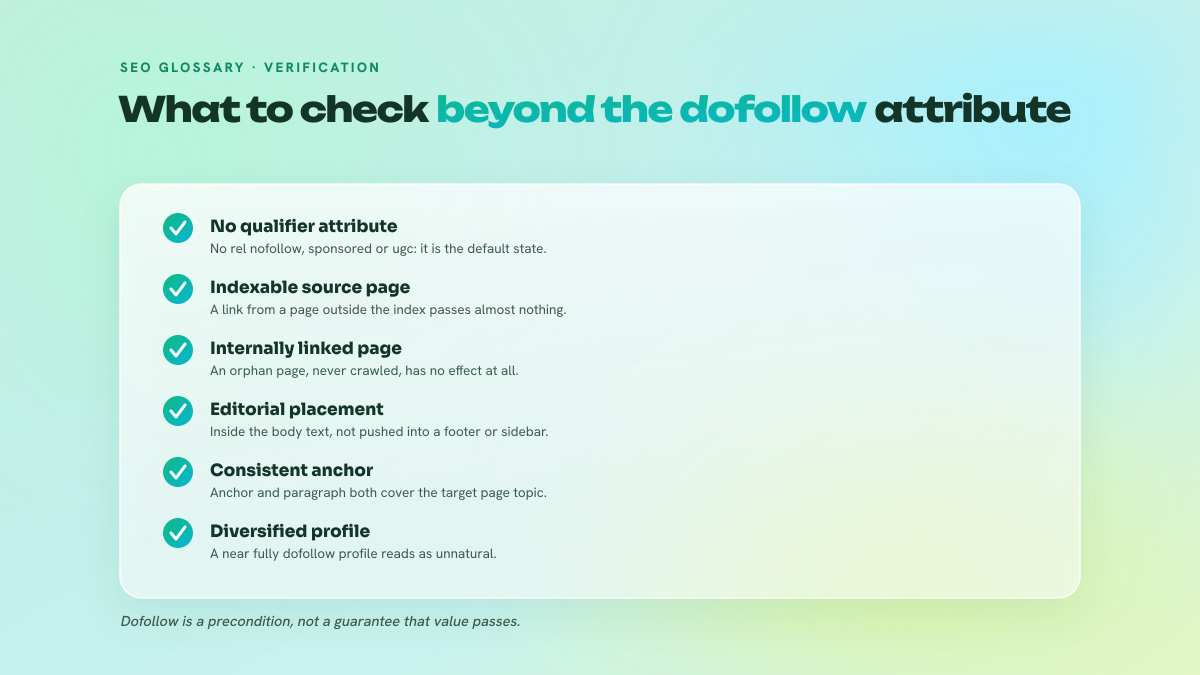
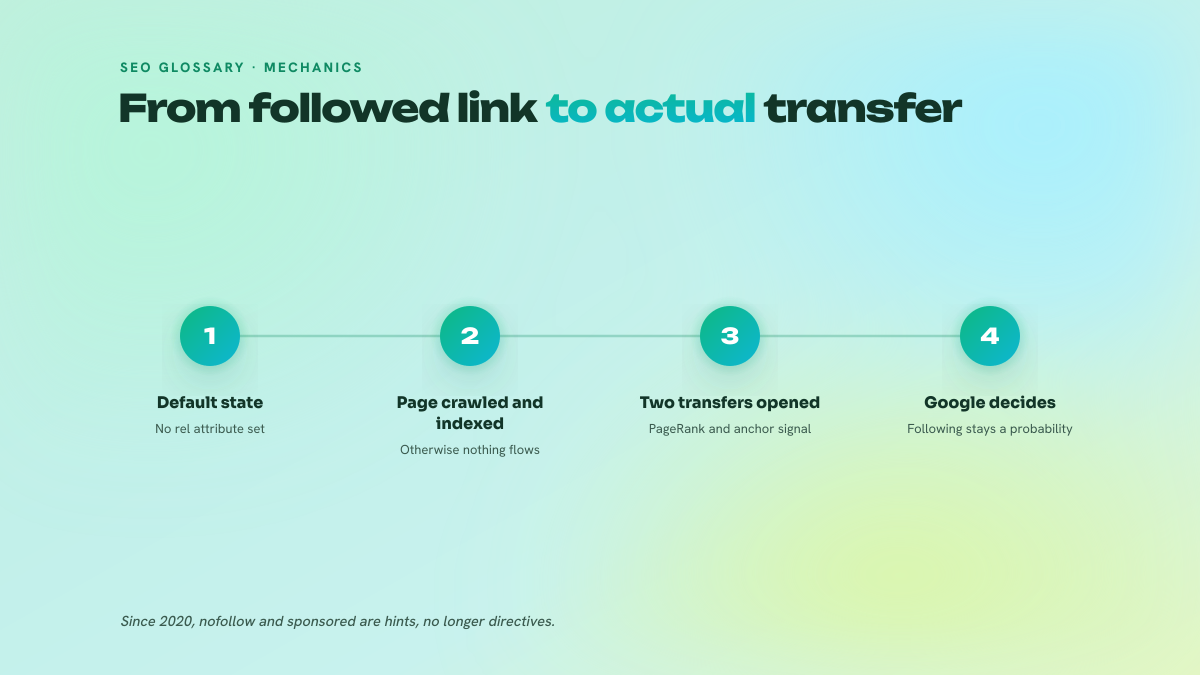
Operationally, a followed link means one thing: eligibility. The link is eligible to pass PageRank and anchor-text signals to its destination. Eligible, not guaranteed. Google devalues links it distrusts rather than counting them, and it does so silently. A followed placement on a page Google has algorithmically written off transmits nothing, while showing up green in every backlink tool you own. This is the gap that separates a link buyer who reads tool exports from one who reads the linking page itself: crawl status, indexation, whether the page receives any internal equity, whether it ranks for anything at all.
So the working definition a consultant should carry is not the dictionary line. It is this: dofollow is the default state in which a link is a candidate for passing authority, and everything that determines whether it actually does happens downstream, in systems you can only observe indirectly.
Dofollow vs nofollow, sponsored and ugc in 2026
The clean binary is gone. rel="nofollow", along with the sponsored and ugc attributes, is now treated as a hint rather than a directive. Per Google's own documentation, all three are treated as suggestions the ranking systems may or may not act on. The practical consequence cuts both ways: a nofollow link can be counted when Google judges it useful, and a followed link can be ignored when it does not. The qualifier tells Google what the publisher intended; it no longer dictates the outcome.
This short video lays out the core difference between the two states clearly, and is worth the four minutes even for practitioners:
The 2026 twist is AI search. Semrush's September 2025 correlation study across 1,000 domains found a Pearson correlation of 0.334 between dofollow backlinks and AI search visibility, and 0.340 for nofollow. Statistically identical. Whatever ChatGPT, Perplexity and Google's AI surfaces use to decide which brands to cite, the link qualifier is not the deciding variable: presence, context and the credibility of the citing source are. A strong mention on a major news site with a nofollow link contributes to AI visibility just as well as a followed one.
Where the qualifier still matters is classic PageRank. Followed links remain the primary vehicle for authority transfer in Google's link graph, and that is what moves rankings on competitive queries. The senior read: dofollow still decides how much a link moves your rankings, but it no longer decides whether a link is worth acquiring. Treating its nofollow counterpart as worthless is a 2015 reflex that discards Reddit, news coverage and every high-trust UGC platform for no defensible reason.
Where followed links sit in a netlinking operation
In a netlinking campaign, the followed in-content link is the unit of work. Everything else in the placement, the surrounding paragraph, the topical fit of the host page, the internal links feeding it, exists to make that one link worth what you paid for it. A followed link in a footer or an author bio is technically eligible to pass PageRank; a followed link inside a paragraph that argues for clicking it is what actually gets counted, from what we see in audits comparing placements that moved rankings against placements that did not.
For a deeper walkthrough of when each link type earns its place in a strategy, this analysis is solid:
Now the uncomfortable part. Google's policy says paid links should carry rel="sponsored". The market's reality is that bought editorial links overwhelmingly ship followed, because that is what the buyer is paying for. This tension is exactly what spam updates model. The August 2025 spam update rolled out from August 26 to September 22, 2025, and Search Engine Land's coverage of Google's spam updates makes a point every link buyer should internalize: when a spam update removes the benefit of manipulative links, that benefit is permanently gone, and cleaning up afterwards does not bring it back. Google announced another spam update on June 25, 2026, same enforcement scope. The risk on a followed paid link is not the individual placement; it is the pattern your whole profile draws: velocity spikes, anchor repetition, clusters of low-trust sources.
This is why the sourcing side matters as much as the attribute. On our own network, every placement is written in-house on media we operate, which means we control the two things Google's pattern detection actually reads: editorial context and host quality. If you are evaluating inventory, start by looking at a catalogue where the media list is public before you sign anything, because opacity on the host site is where most followed-link money gets wasted. And for placements that are openly commercial, the way a sponsored article is integrated editorially determines whether it reads as a citation or as an ad insert, to algorithms and readers alike.
The mistakes we keep seeing in audits
The most common one is the purity chase: a profile engineered toward 100 % followed links. Searchlab's 2026 link building statistics compilation, citing Semrush data, puts top-10 ranking sites at roughly 60 % dofollow and 40 % nofollow, and notes that sites in the 55 to 65 % followed band outperform near-exclusively-dofollow profiles. The same compilation, citing Ahrefs' 2025 link quality research, reports that profiles above 80 % followed read as unnatural and can attract manual review. A natural profile accumulates nofollow noise: directories, comments, UGC, syndication. Its absence is a signature of fabrication.
Second: exact-match anchors concentrated on followed links. The same 2026 dataset reports that profiles with more than 15 % exact-match anchors are 3.2 times more likely to take a Penguin-style hit than diversified ones. Practitioner behavior has already adjusted: editorial.link's 2025 survey of 518 SEOs found 41.7 % prefer partial-match anchors, against 25.1 % for exact-match and 20.5 % for branded. If your anchor plan for followed placements still opens with the money keyword, you are building the evidence file yourself; diversifying the anchor profile is not a nice-to-have, it is the counterweight that makes followed links safe to accumulate.
Third, the legacy assumption: PageRank sculpting. Nofollowing internal links to concentrate equity on money pages is an outdated tactic; blanket use of nofollow to conserve link juice no longer works. We still find sculpting patterns in audits of sites last seriously touched by an agency a decade ago. Strip them; they add noise and zero benefit.
Fourth: reading a followed link as a counted link. Tools report the attribute; they cannot report devaluation. A followed link from a deindexed page, an orphaned page, or a site flattened by a spam update is an entry in your CSV and nothing else.
How to check, and the thresholds that matter
For a single link: inspect the rendered DOM, not the page source. Right-click the link, inspect, read the rel on the <a> element. The distinction matters because JavaScript frameworks and consent-management layers routinely inject or rewrite rel at render time, and because a page-level <meta name="robots" content="nofollow"> or an X-Robots-Tag header nofollows every link on the page regardless of what each anchor carries. A placement can be clean at the anchor level and neutralized at the page level; only the rendered, header-inclusive view tells you.
At scale: crawl your target or your own profile with a crawler that flags link attributes, then cross-check against Ahrefs or Semrush exports, and manually verify a sample. Index data lags reality by weeks, and publishers change sitewide link policies without notice. Any paid placement should be re-verified at publication and then quarterly; a meaningful share of followed links quietly become nofollow when a publisher migrates CMS or panics after a manual action.
Thresholds worth managing against: keep the followed share of your profile in the 55 to 65 % band rather than maximizing it, watch the growth rate of followed links as closely as the stock, and cap exact-match anchors well below the 15 % line. None of this is achievable through one-off buying sprees; it is a pacing problem, which is why we treat it as campaign design. If your acquisition rhythm is currently whatever the monthly budget allows, it is worth seeing how calibrating acquisition over several months changes both the risk profile and the ranking curve. The sites that survive spam updates are rarely the ones with the most followed links; they are the ones whose link graph looks like something that could have happened naturally.
Nautilinks operates an owned network of editorial media. In-house written articles, transparency disclosures respected, anchor mix calibrated.
Frequently asked questions
Is there any point in adding rel=dofollow to a link?
No, and it can mark you as inexperienced. The attribute does not exist in the HTML spec, and Google documents only nofollow, sponsored and ugc as link qualifiers. An unqualified link is followed by default. Some CMS plugins insert rel=dofollow anyway; browsers and crawlers ignore unknown rel values, so it does no harm, but it signals template-driven link building to anyone auditing the page, including competitors filing spam reports.
Do nofollow links pass any value in 2026?
Sometimes, and for AI search, essentially as much as followed links. Google treats nofollow as a hint, meaning it can count a nofollow link when it judges the signal useful. Semrush's September 2025 study of 1,000 domains found nearly identical correlations with AI search visibility: 0.334 for dofollow backlinks, 0.340 for nofollow. For classic PageRank-driven rankings, followed links remain clearly stronger, but discarding quality nofollow opportunities is no longer defensible.
What share of dofollow links should a healthy profile have?
Around 55 to 65 % followed, based on Searchlab's 2026 statistics compilation citing Semrush data, which puts top-10 ranking sites at roughly a 60/40 dofollow-to-nofollow split. The same compilation reports that profiles above 80 % followed read as unnatural and can attract manual review. In practice you rarely need to engineer this: if you acquire links from genuinely diverse sources, the nofollow share accumulates on its own. If it does not, your acquisition mix is too narrow.
How do I verify a paid placement is genuinely followed?
Check three layers on the live, rendered page: the rel attribute on the anchor element in devtools, the meta robots tag in the head, and the X-Robots-Tag HTTP header. Any of the last two set to nofollow neutralizes a clean anchor. Then confirm the hosting page is indexed and internally linked, because a followed link from a page Google ignores passes nothing. Re-check quarterly: publishers change sitewide link policies silently, especially after CMS migrations or manual actions.
Can a followed link from a low-quality site actively hurt me?
One link, almost never: Google's default is to devalue distrusted links rather than penalize the target. The danger is the pattern. Spam updates, like the August 2025 rollout, model profile-level signals: velocity spikes, anchor repetition above roughly 15 % exact match, clusters of low-trust sources. And per Search Engine Land's coverage of Google's spam update process, ranking benefits removed by a spam update are permanently gone, even after cleanup.
Should a paid editorial link carry rel=sponsored instead of being followed?
Google's policy says yes; the market overwhelmingly ships paid editorial links followed, because authority transfer is what the buyer pays for. That gap is a risk decision, not a technical one. Since sponsored is a hint, Google may count a sponsored link anyway, but you cannot budget on it. Our operational position: the exposure sits in the profile pattern, so control what Google's detection actually reads, host quality, editorial integration and anchor diversity, rather than relying on the attribute alone.
Test your knowledge
Quiz: Dofollow
1/3What does the term dofollow actually correspond to at the HTML level?