- →Since Google’s 2019 change nofollow is a hint, not a directive: plan as if tagged links pass little or no equity, but never assume the tag shields a link scheme from spam enforcement.
- →Paid and affiliate links must carry rel=sponsored or rel=nofollow; Google’s 2025 link-spam enforcement treats missing tags as grounds for link-based devaluations (iMark Infotech, August 2025).
- →Internal nofollow is dead weight: SEOJuice’s audits of more than 12,000 sites between 2024 and 2026 found about 8% carrying purposeless internal nofollow, mostly legacy plugin defaults (April 2026).
- →A backlink profile with zero nofollow links reads as manufactured; attribute diversity is a byproduct of real acquisition, not a ratio to engineer.
- →There is no universal healthy follow ratio: benchmark your attribute mix against the profiles that outrank you on your target SERPs, not against folk wisdom.
- →When you commission links, make the attribute a contractual term settled before payment, not a surprise discovered in the crawl afterwards.
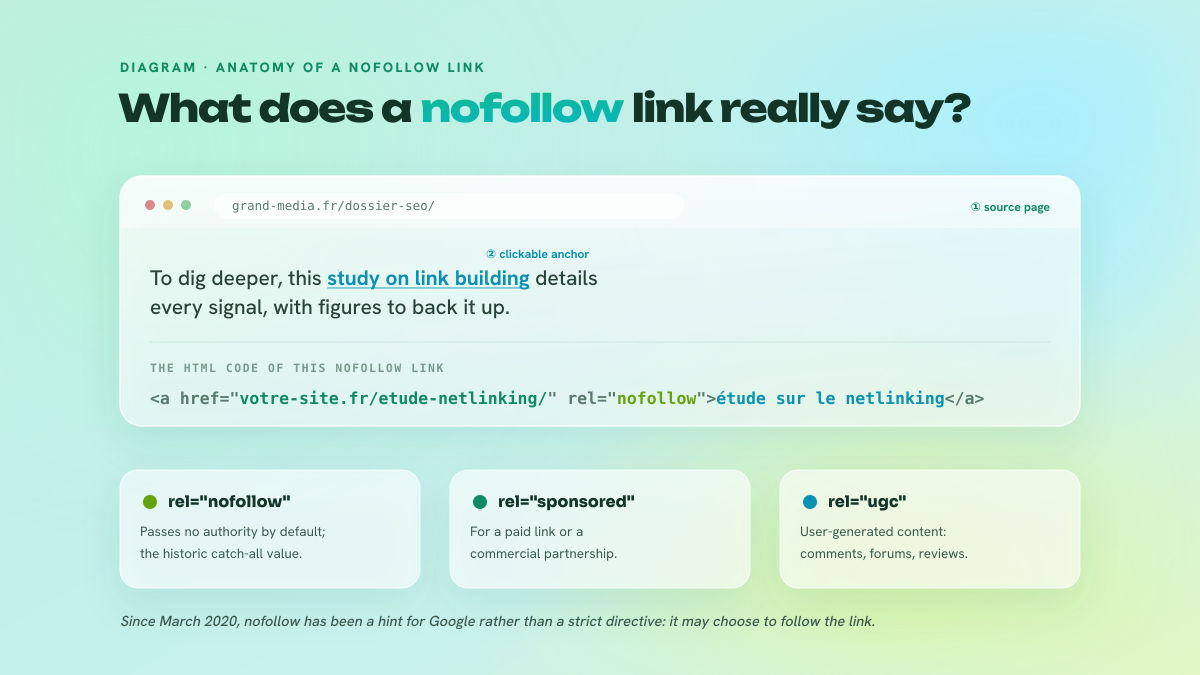
A hint, not a directive: what nofollow actually is
The rel=nofollow attribute is link-level markup telling search engines that the linking site does not vouch for the destination page. Google introduced it to kill the economics of comment spam, back when a blog comment section was the cheapest backlink source on the web. For years it behaved as a binary directive: a tagged link passed no PageRank, end of story. That era is over, and most of the confusion we still see around nofollow comes from professionals reasoning with the original model.
Google’s 2019 announcement rewired the mechanics. It split the signal into three values: rel=sponsored for paid and affiliate links, rel=ugc for user-generated content, and rel=nofollow as the generic non-endorsement marker. The same change turned all three from directives into hints for crawling and indexing: Google reserves the right to follow the link, index the target and count the link in its graph anyway. Google Search Central documentation still describes the attributes exactly this way, and recent practitioner syntheses, Safari Digital in May 2026 and Conductor in April 2026 among them, confirm the 2019 policy remains current.
Two chronic confusions are worth clearing early. Nofollow is link-level while noindex is page-level: tagging a link does nothing to keep the destination out of Google’s index, it only declines to endorse it. And « dofollow » is not an attribute that exists in any specification: a followed link is simply a link carrying no qualifying rel value. There is nothing you can add to a link to make it « dofollow ».
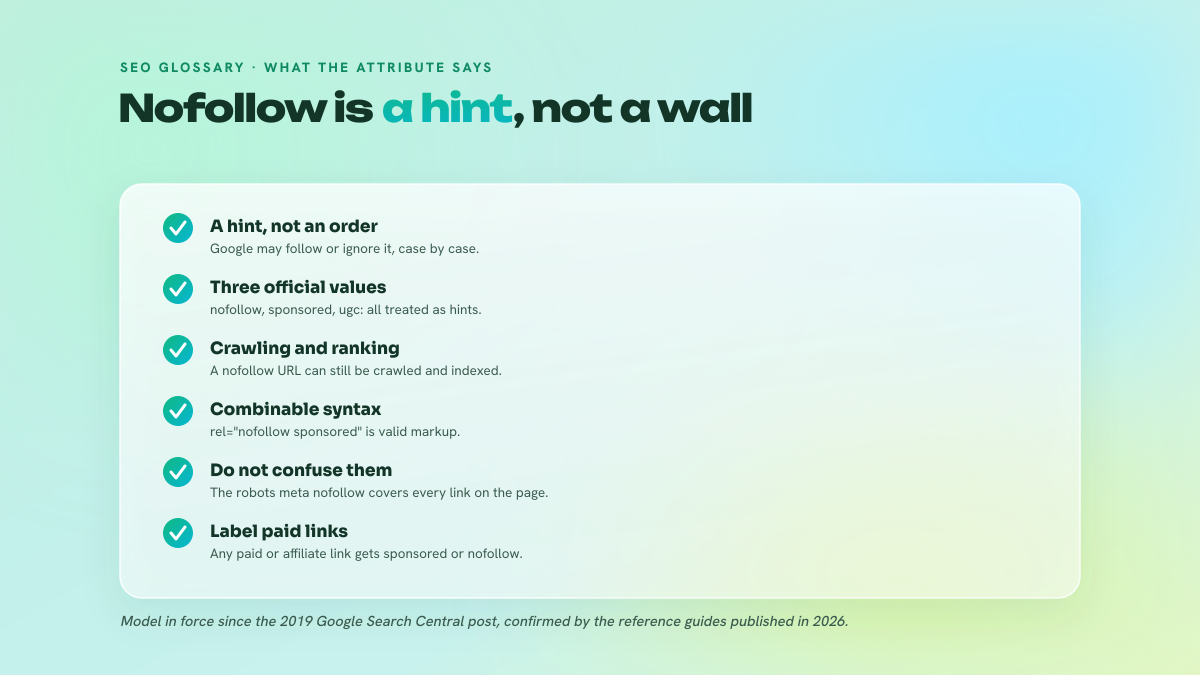
How Google actually processes the hint in 2026
The hint model deserves a precise reading, because optimists and pessimists both overstate it. Conductor’s academy documentation, updated April 29, 2026, phrases it plainly: Google can choose to ignore the nofollow attribute and use the link for ranking purposes. In practice, the operational assumption that has held since the 2019 change is asymmetric: plan as if a tagged link passes little or no equity, but never assume the tag makes a link invisible to the algorithm. A nofollow link from a page Google trusts is a lottery ticket you did not pay full price for; a followed link remains the asset you actually budget for.
The corollary cuts both ways. You cannot sculpt PageRank with nofollow, because Google decides what it follows. And you cannot use it as an immunity clause, because a link scheme wrapped in nofollow is still a link scheme. Google’s spam enforcement targets the pattern, not the markup: the March 2024 spam update went after manipulative link practices including AI-scaled schemes, as Opace’s 2026 review of Google’s link-building rules notes, and the same review points out that the March 2024 core update had already reduced the weight of raw link quantity in favor of quality and relevance.
On the choice between values, current guidance is stable: sponsored for anything paid, including affiliate links; ugc for comments and forum posts; nofollow when you simply do not want to vouch for a destination. The values can be combined in a single rel attribute. What matters is that paid links carry one of the two accepted values at all, a point the 2025 link-spam enforcement made considerably less theoretical.
Measurement is straightforward but lives outside Google’s own tooling. Search Console does not split your backlink profile by attribute. Ahrefs and Semrush both do: their link reports filter by link type, followed versus nofollow versus ugc and sponsored, as SE Ranking’s 2026 tool comparison documents. On-page, a crawler like Screaming Frog extracts rel values on every outbound link of your own site in one pass, and browser devtools settle any single-link dispute in five seconds.
Where nofollow fits in a netlinking operation
Start with the profile-level view. A backlink profile with zero nofollow links reads as manufactured, because real popularity is messy: forum threads, blog comments, social profiles, press mentions and aggregator pages all generate tagged links whether you like it or not. Attribute diversity is a byproduct of genuine acquisition, not a KPI to engineer. Chasing a target ratio of followed links misses the point; the useful benchmark is the profile shape of the pages that outrank you on the SERPs you care about.
Then the compliance view, which hardened recently. Google’s 2025 link-spam enforcement explicitly expects paid and affiliate links to carry rel=sponsored or rel=nofollow, and iMark Infotech’s August 2025 analysis of the update notes that failing to tag them can trigger link-based devaluations. The paid-link market largely ignores this, which is exactly why the attribute question should be settled before money changes hands, not discovered after. When you buy a placement directly from the publisher, the follow status of the link is part of the deal terms; through layers of intermediaries it often is not, and that opacity is where the bad surprises live.
Tagged links also play a pacing role. A campaign that produces only followed links from day one draws a cleaner, more artificial curve than the blend a genuinely popular site accumulates, which is one reason we watch the rhythm at which a domain acquires links as closely as the quality of each link. On the French media we operate in-house at Nautilinks, the attribute of every placement is explicit at order time: whether a sponsored article written by the media’s own editorial team carries a followed link is a decision the buyer makes with full information, not a default hidden in a marketplace’s fine print.
Common mistakes we keep seeing in audits
Internal nofollow is the most persistent zombie. PageRank sculpting, the idea of tagging internal links to steer equity toward money pages, is a dead tactic, and John Mueller has repeated for years that internal nofollow helps nothing and mostly confuses crawling. It still litters the web: SEOJuice’s audit data across more than 12,000 sites between 2024 and 2026 found about 8% carrying internal nofollow links that served no purpose, usually legacy CMS or plugin defaults nobody ever revisited (SEOJuice, April 2026). If a page should not be crawled or indexed, robots directives and information architecture do the job; nofollow does not.
Blanket external nofollow is the mirror error. Tagging every outbound link « for SEO safety » signals nothing except that your editorial process does not trust its own sources. Opace’s 2026 synthesis of Google’s guidance is unambiguous: use the attributes only where you have a specific reason to. Followed citations to authoritative sources are normal editorial behavior, and stripping them buys you nothing.
Third mistake: treating nofollow backlinks as worthless and filtering them out of prospection entirely. A tagged link on a page with real traffic sends visitors, puts your brand in front of journalists and buyers, and creates the co-citation context that later produces followed links. Under the hint model it may even count directly. Dismissing all of that because a dashboard shows « nofollow » in a column is bookkeeping, not strategy.
Last one: using nofollow as a disclosure fig leaf. Tagging a paid link satisfies Google’s webmaster guidelines, but it does not launder a placement that violates consumer-protection disclosure rules, and it does not protect a scheme whose footprint is visible at the pattern level. The attribute is a signal to crawlers, not an amnesty.
Tactical takeaways for a working SEO
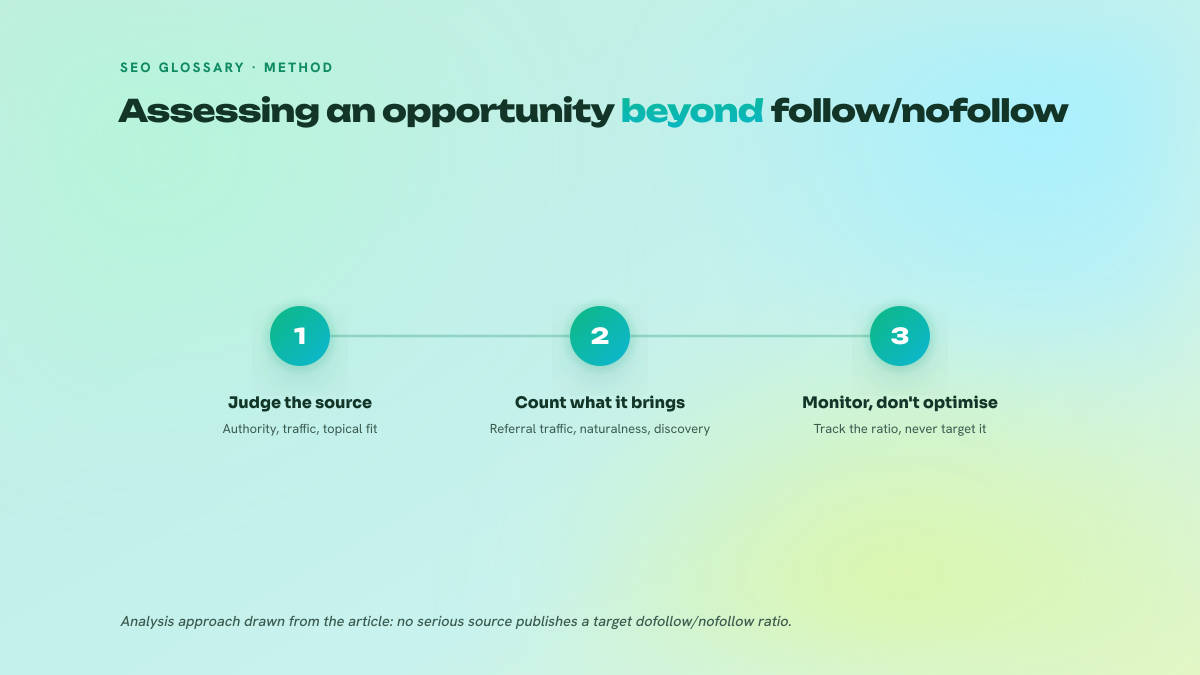
Operationally, nofollow management reduces to three routines. First, audit your own outbound layer once: crawl the site, extract rel values, delete the purposeless internal nofollow, and make sure paid or affiliate links carry sponsored. Second, read your backlink profile’s attribute mix against your SERP neighbors rather than against a folk-wisdom ratio; if every competitor ranking above you shows a natural blend and your profile is exclusively followed links from the same twenty referring domains, the attribute column is telling you something about credibility, not about nofollow. Third, when you commission links, make the attribute a contractual term.
None of this requires heavy tooling: a crawler, a backlink index and a spreadsheet cover it. What it does require is treating link attributes as part of campaign design rather than an afterthought. That is the difference between accumulating links and calibrating a netlinking campaign over the long run: the second one decides, placement by placement, what should be followed, what should be sponsored, and what a credible profile should look like six months out.
Nautilinks operates an owned network of editorial media. In-house written articles, transparency disclosures respected, anchor mix calibrated.
Frequently asked questions
Does a nofollow backlink pass PageRank now that it is only a hint?
Nobody outside Google can measure it per link, and Google will not tell you which hints it honors. The defensible operating assumption since the 2019 change: value a tagged link at little or no direct equity, while accepting that some fraction may be counted anyway. Conductor’s April 2026 documentation states Google can ignore the attribute and use the link for ranking. Budget for followed links; treat honored nofollow hints as upside you never paid for.
Should a paid placement carry rel=sponsored or rel=nofollow?
Both remain acceptable to Google, but sponsored is the precise value for anything involving payment, affiliate links included. What is no longer optional is tagging paid links at all: iMark Infotech’s August 2025 analysis of the link-spam update notes that untagged paid links can trigger link-based devaluations. Pick sponsored for new placements.
Can I combine several rel values on one link?
Yes, the rel attribute accepts space-separated values, so a link can carry both sponsored and nofollow. That combination is the pragmatic choice when you care about engines beyond Google, since not all crawlers parse sponsored and ugc the way Google does, while virtually every engine understands nofollow. It costs nothing, changes nothing for Google, and covers the long tail of other crawlers.
How do I check follow status at scale, on my site and in my backlink profile?
Three layers. For your own outbound links, a Screaming Frog crawl extracts rel values on every anchor in one pass. For your backlink profile, Ahrefs and Semrush both filter link reports by type, followed versus nofollow versus sponsored and ugc, as documented in SE Ranking’s 2026 comparison. For a single disputed link, inspect the element in devtools: if no qualifying rel value is present, the link is followed.
Is there any reason left to nofollow internal links, for example to cart or login pages?
Practically none. Internal nofollow does not sculpt PageRank, and it can degrade crawling since Google treats it as a hint about what not to explore on your own site. If a page has no search value, keep it out of the index with noindex or block it in robots.txt; if it wastes crawl budget, fix the architecture. SEOJuice’s 2024-2026 audit data found the internal nofollow it detected on about 8% of sites was almost always a forgotten plugin default, not a strategy.
Are nofollow links worth acquiring deliberately in a netlinking campaign?
Deliberately paying followed-link prices for nofollow placements, no. But excluding them from prospection is a mistake: a tagged link on a page with genuine traffic delivers referrals, brand exposure and the co-citation context that precedes followed links, and it keeps your attribute mix looking like a real site’s. The hint model adds a non-zero chance of direct value on top. Judge the page, its audience and its price; the attribute is one input, not a veto.
Test your knowledge
Quiz: Nofollow
1/3Since when has Google treated rel=nofollow as a hint rather than a directive for crawling and indexing?