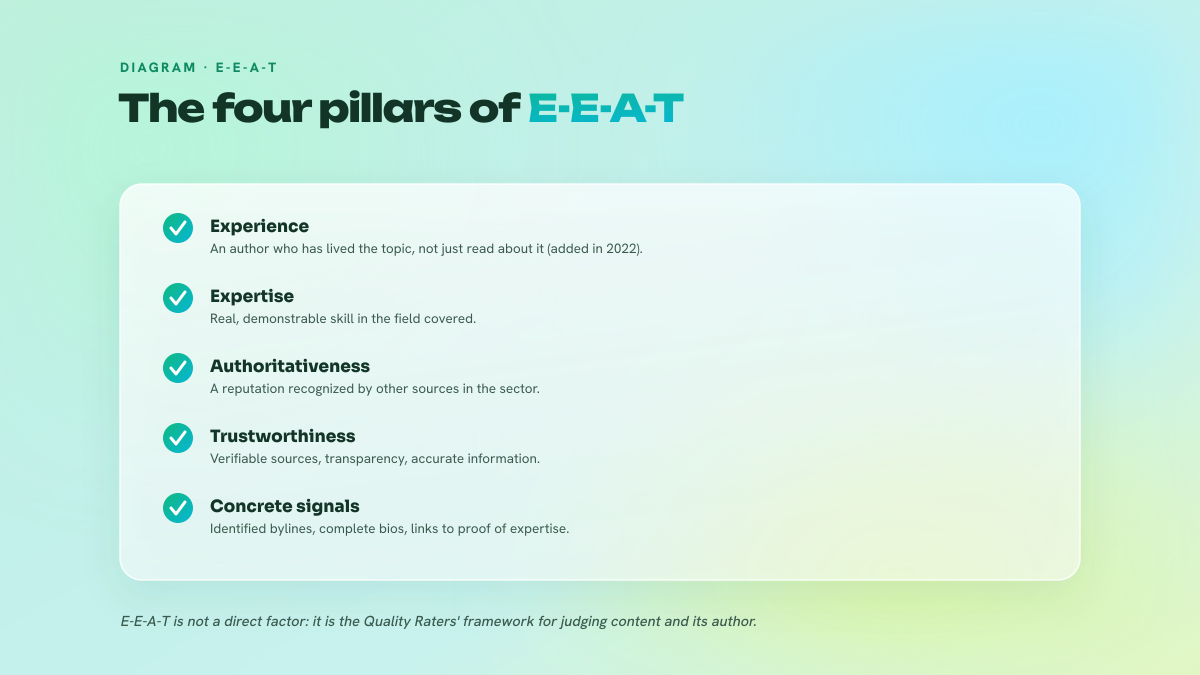
- →E-E-A-T is the acronym for Experience, Expertise, Authoritativeness, Trustworthiness. Four criteria Google uses to assess the quality of content and its author.
- →It is not a direct ranking factor but an assessment framework applied by Search Quality Raters and indirectly built into the algorithm.
- →The extra E (Experience) was added in 2022 to value content written by people who lived the topic directly, not just learned about it.
- →Optimising your E-E-A-T runs through identified author bylines, verifiable sources, full biographies, links to authors' external expertise.
Definition of E-E-A-T
E-E-A-T is the acronym for Experience, Expertise, Authoritativeness, Trustworthiness. It's the formal framework Google uses to assess the quality of content and the credibility of the entity that publishes it. It was defined in the Search Quality Rater Guidelines, the internal document distributed to the human evaluators who rate the quality of Google's results.
That framework is not a direct ranking factor in the technical sense. No E-E-A-T score circulates in the algorithm code. It's a conceptual framework that informs the design of the engine through the continual adjustments Google makes to align its results with human judgement. When Quality Raters note that a piece of content lacks expertise or authority, Google adjusts its algorithm to value the correlated signals more heavily.
The four letters explained
Experience, added in 2022, values content written by people who lived the topic directly. A product review by someone who actually used it weighs more than a review by someone who only read the spec sheet. A restaurant review by an actual customer is worth more than a compilation of external reviews.
Expertise concerns the level of technical knowledge on a topic. A medical article written by a recognised doctor carries more credit than an identical article signed by a non-specialist. That dimension is proven by content quality, but also by the author's displayed qualifications.
Authoritativeness measures the recognition of the author or site in their domain. A site widely cited by other actors in the sector, mentioned in specialised press, with authors speaking at conferences, accumulates authority. That dimension builds over time and is fed by editorial backlinks, and increasingly by an editorial mention as a source of expertise on niche media that AI engines cite back when answering related questions.
Trustworthiness covers overall reliability of the site and its author. Cited sources, transparency on conflicts of interest, full legal notices, HTTPS security, clear privacy policy, ability to correct acknowledged errors. Trust is earned through accumulated honest signals.
Role in Google's algorithm
The exact role of E-E-A-T in the algorithm remains a grey area. Google has confirmed that the framework informs the engine's design without being a direct signal. Concretely, Google engineers continually develop and adjust signals that aim to reproduce the human Quality Raters' E-E-A-T judgement.
Several major updates have correlated with the application of this framework. The 2018 Medic Update particularly hit health sites without strong E-A-T signals. The Helpful Content Updates since 2022 explicitly target content that lacks real experience or verifiable expertise. Each update marks a step in the algorithmic translation of those qualitative criteria.
The effect is cumulative and hard to measure point in time. A site with weak E-E-A-T can keep ranking for months before an update knocks it down. Conversely, strengthening your E-E-A-T has no immediate effect but protects against algorithmic shocks over time.
Observable concrete signals
Several observable signals correlate with E-E-A-T and that Google likely uses as proxies. Presence of an identified author byline on each article, with clickable biography. Author qualifications displayed (title, experience, training). Links to the author's external profiles (LinkedIn, personal site, other publications). Sources and verifiable citations in the body of the text.
At the site level, signals include a detailed About page with company history, full legal notices, a clear privacy policy, contact details, HTTPS, the absence of major technical errors. Verifiable user reviews and external press mentions add a layer of credibility.
At the content level, the analysis covers depth, originality, alignment with sector standards, absence of factual errors, regular updating. A health article that cites a scientific paper is worth more than an identical article without a source. A legal guide that references the texts of law weighs more than a generic guide.
YMYL and stricter requirements
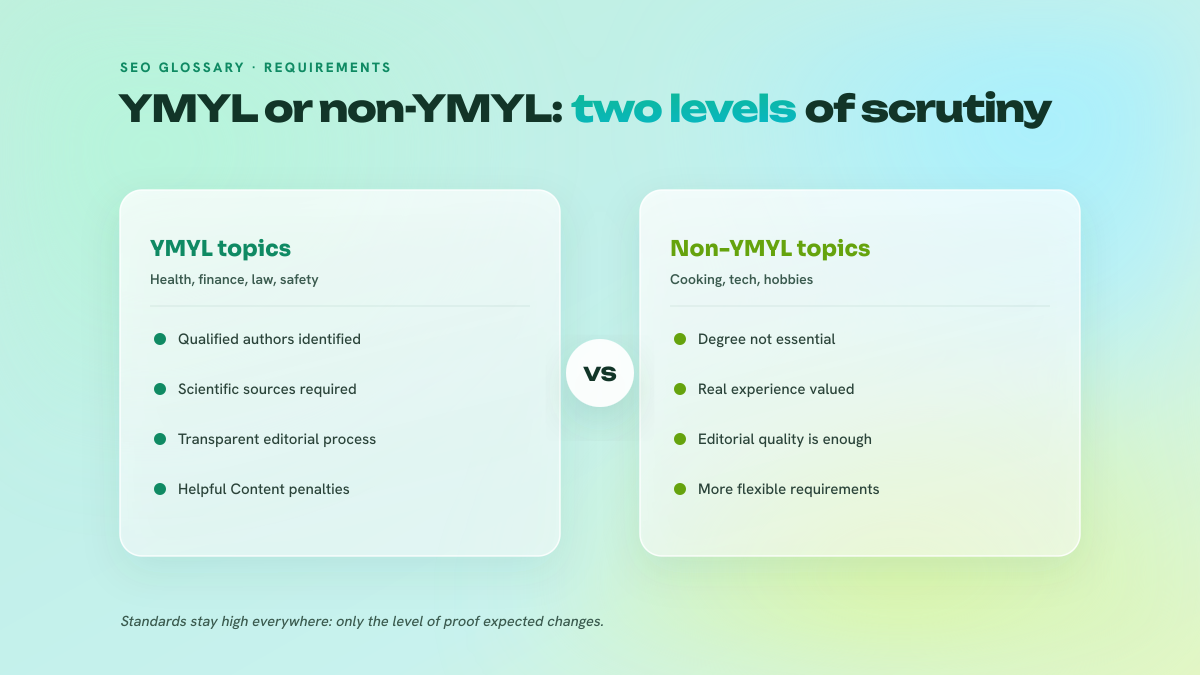
YMYL topics, for Your Money or Your Life, are subject to particularly high E-E-A-T standards. That category covers themes that can significantly affect readers' health, finances, safety or wellbeing. Health, medicine, law, personal finance, parenting and safety are the most typical domains.
For those topics, Google requires verifiable expertise signals. A health site without identified physician authors, without scientific sources, without transparency on editorial protocols, has little chance of ranking durably, regardless of its netlinking budget. Helpful Content Updates particularly penalise such situations.
For non-YMYL niches, requirements remain high but more flexible. A cooking site can rank without a credentialled chef author, provided recipes are tested and editorial quality holds. A tech site can do well with passionate authors instead of certified experts.
Optimising your E-E-A-T
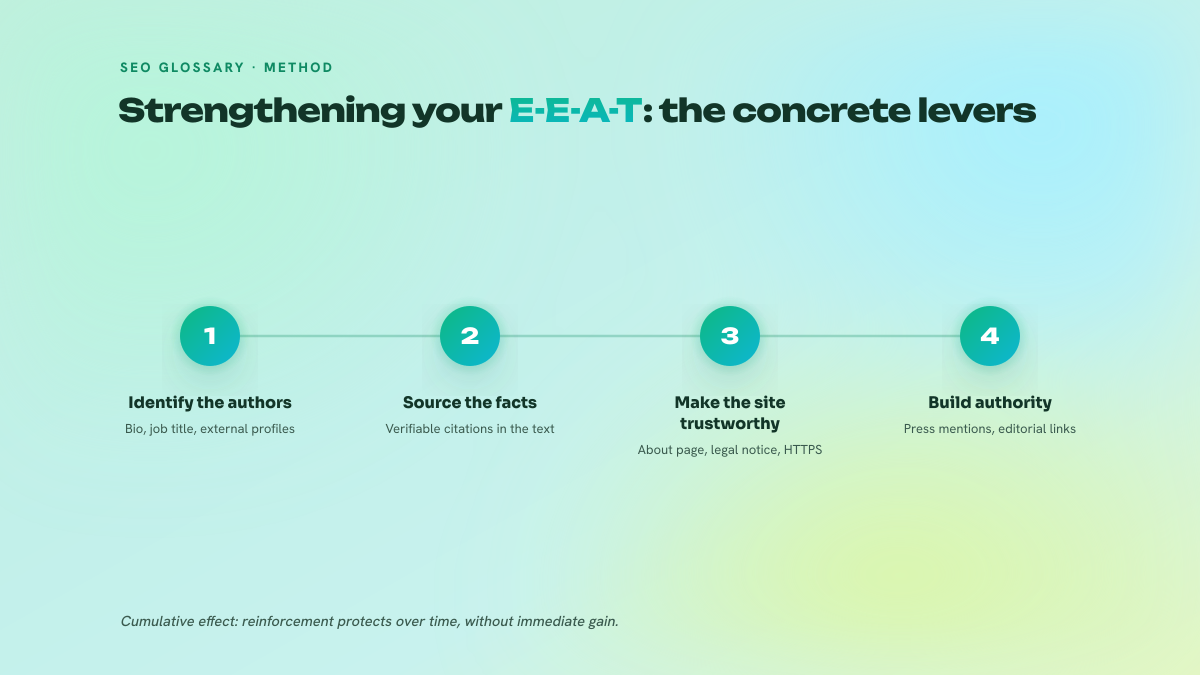
Five concrete levers help strengthen your E-E-A-T. First, clearly identify authors with full biography, qualifications and links to external profiles. That practice alone already produces an effect in niches where it's rare.
Second, systematically source factual claims. An article that cites its sources as outbound links to recognised references sends a rigour signal that Google values. That practice doesn't significantly raise production cost but immediately stands out.
Third, earn mentions and citations in other recognised sector media. That's the Authoritativeness dimension, built over time through digital PR, external speaking engagements, editorial partnerships, or a sponsored article signed by a named expert when the angle warrants a long-form treatment on a partner publication. Our digital PR service addresses this need.
Fourth, maintain a substantial and up-to-date About page. Company history, team, editorial methodology, values. That page is one of the first verification points for Quality Raters when they assess a site.
Fifth, solicit and display verifiable user reviews, ideally on external platforms (Trustpilot, Google Business). Those external reputation signals weigh more than unverifiable internal testimonials.
Nautilinks operates an owned network of editorial media. In-house written articles, transparency disclosures respected, anchor mix calibrated.
Frequently asked questions
Are E-A-T and E-E-A-T the same thing?
Not exactly. E-A-T (Expertise, Authoritativeness, Trustworthiness) is the original version, formalised by Google in 2014 in the Search Quality Rater Guidelines. In December 2022, Google added an extra E for Experience, creating today's E-E-A-T framework. The new E values content written by people who lived the topic directly, not just learned about it theoretically.
Is E-E-A-T a ranking factor?
Not directly. Google has confirmed several times that E-E-A-T is not an isolated ranking signal. It's a conceptual framework used by human Search Quality Raters to assess quality, and which then informs algorithms indirectly through the engine's continual adjustments. But no E-E-A-T metric exists in Google's code.
How does Google measure E-E-A-T concretely?
Google does not measure it directly. The algorithm relies on observable proxies: presence of an identifiable author byline, full biography with qualifications, links to the author's external profiles, citations and mentions in other media, overall editorial quality of the site, reputation signals. Those proxies produce a cumulative effect.
Does E-E-A-T concern all sites?
Officially yes, but the requirement varies by topic. So-called YMYL topics (Your Money or Your Life), health, finance, law, safety, are subject to much stricter standards. A cooking blog doesn't have the same requirements as a site giving medical advice. For the latter, E-E-A-T can make the difference between top 3 and page 5.
How do I strengthen E-E-A-T on an existing site?
Five main levers. Identify authors with detailed biographies and qualifications. Add verifiable sources to factual claims. Earn mentions and citations in other recognised media. Keep an in-depth About page with company history. Solicit and display verifiable user reviews.
Test your knowledge
Quiz: E-E-A-T
1/3A SaaS publishes a guide to a B2B tool written by an anonymous editorial team, citing only its own product pages. Which E-E-A-T pillar is most weakened?