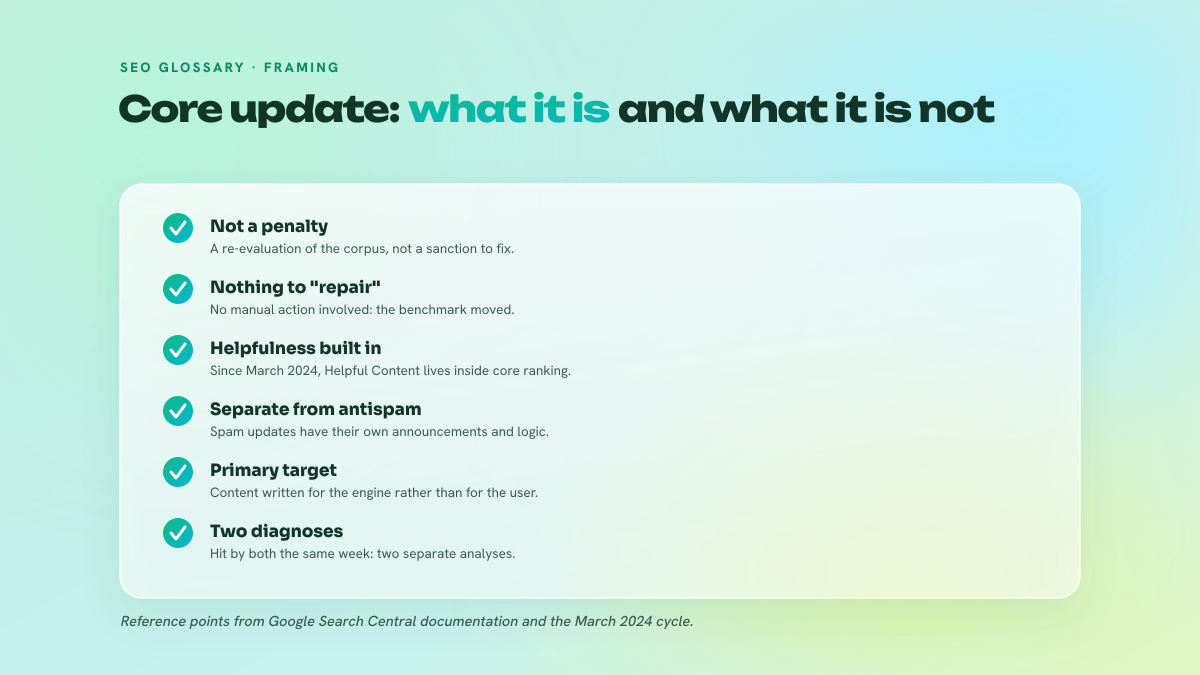
- →A core update is a re-scoring of the whole index, not a penalty: there is often nothing to « fix » on pages that drop, the yardstick moved.
- →Since March 2024 the Helpful Content system is folded into core updates, so content quality and link acquisition can no longer be audited as separate workstreams.
- →The March 2026 core update was the most volatile on record in SE Ranking’s dataset: 79.5% of top-3 URLs changed position and 24.1% of top-10 pages fell out of the top-100.
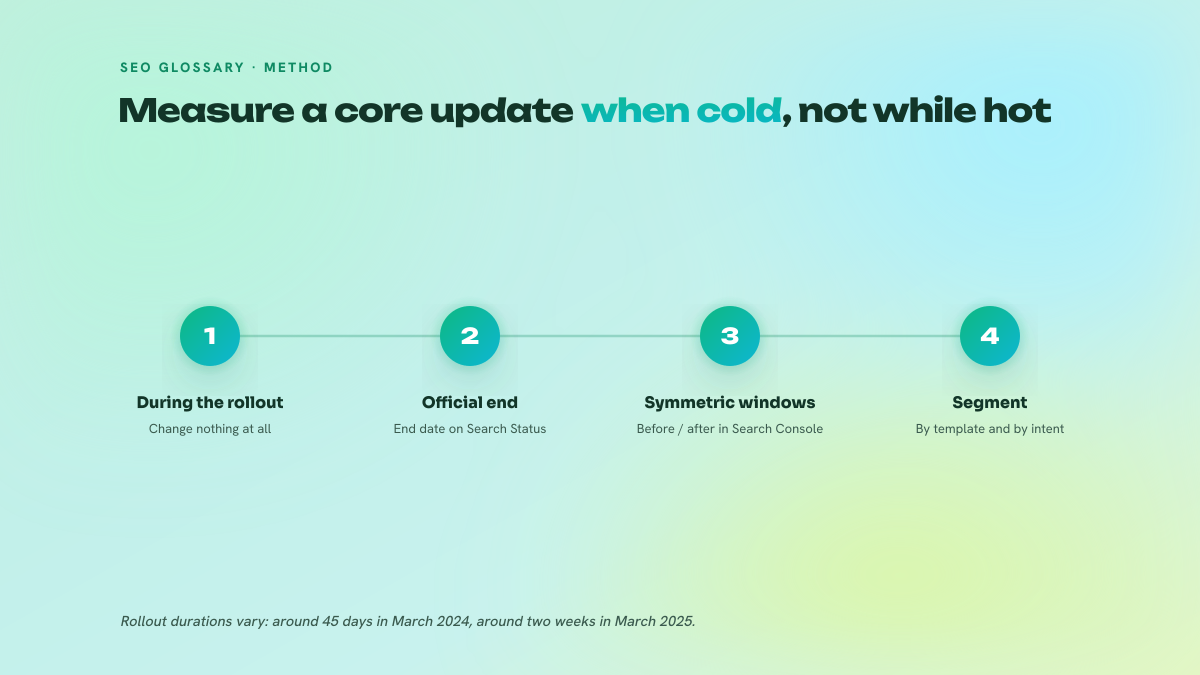
- →Never diagnose during a rollout. Wait for the completion date on Google’s Search Status Dashboard, then compare symmetric before/after windows in Search Console.
- →For link buyers, the operational question is publisher-side: aggregators and comparison sites keep losing visibility across recent core updates (SISTRIX, Amsive), while specialist and institutional sites gain. Buy placements on sites built to survive the next re-scoring, not the last one.
- →Recovery is measured in update cycles, not weeks: meaningful re-evaluation of a demoted site typically waits for the next core rollout.
What a core update really is, beyond the press release
The most useful mental model is a re-grading of the entire index. Google periodically retrains and re-weights the signals that feed its ranking systems, then re-scores every page against the new configuration. Your site didn’t trip a filter and nothing flagged you: the definition of « good enough for position 3 » changed, and your URL was re-ranked accordingly. That is why pages losing positions after a core update often have nothing specific to fix. That sounds evasive until you accept the premise: the update didn’t evaluate you, it re-evaluated everyone, and someone else now fits the intent better.
This distinction matters operationally because it dictates the diagnostic path. A manual action shows up in Search Console with a named violation. A spam update targets defined policy violations: scaled content abuse, expired domain abuse, site reputation abuse. A core update targets nothing; it redistributes. If your drop coincides with a confirmed core rollout and you have no manual action, you are not looking for a broken element, you are looking at a relative quality deficit against competitors who now score higher.
The watershed was March 2024. That update, announced on 5 March 2024 and rolled out over roughly 45 days until 19 April 2024, folded the former Helpful Content system into core ranking. There is no longer a separate helpfulness classifier that updates on its own schedule: every core update since carries those signals natively. Google stated a goal of reducing low-quality, unoriginal content in results by about 40%, and later communicated it had achieved roughly 45%. Whatever you think of the self-reported figure, the structural change is real: content quality assessment is now inseparable from the core re-scoring event.
How rollouts actually unfold in 2026
Cadence first. Google shipped four core updates in 2024 (March, August, November, December) and three in 2025, including a major one starting 13 March 2025 with a rollout of about two weeks (rollout histories compiled by RankMatrix and ROI Revolution). Rollouts run from several days to several weeks, and during that window rankings oscillate as the new scoring propagates across data centers and query classes. The start and completion dates are published on Google’s Search Status Dashboard, and those two dates are the only ones that matter for your analysis windows.
The magnitude has been escalating. The March 2026 core update, completed on 8 April 2026, was the most volatile core update on record in SE Ranking’s dataset: 79.5% of top-3 URLs changed positions and 24.1% of top-10 pages dropped out of the top-100 entirely. Semrush Sensor volatility peaked around 8.7 to 9.5 out of 10 over the same period. When a quarter of page-one results don’t just slip but vanish from the top-100, you are not watching a tuning pass, you are watching a re-scoring with new priorities.
This recent walkthrough of a 2026 rollout shows what that volatility looks like from inside the data:
Two consequences for how you monitor. First, mid-rollout positions are noise: a URL can lose fifteen spots on day 3 and recover on day 12 as the systems settle. Any conclusion drawn before the completion date is a conclusion drawn on a moving target. Second, third-party volatility trackers (Semrush Sensor, SE Ranking, similar sensors) are weather reports, not diagnoses. They tell you a storm is passing so you don’t misattribute turbulence; they say nothing about why your specific pages moved.
Reading the impact on your site without fooling yourself
The clean method is symmetric windows around the published dates: take an equal number of weeks before the rollout start and after the completion, exclude the rollout itself, and compare in Search Console. Segment three ways before concluding anything: branded versus non-branded queries, page templates (articles, category pages, tools), and query intent. Core update damage is rarely uniform; it typically concentrates on one template or one intent class, and that concentration is your actual diagnostic signal.
Here is a concrete look at detecting impact and deciding how to react:
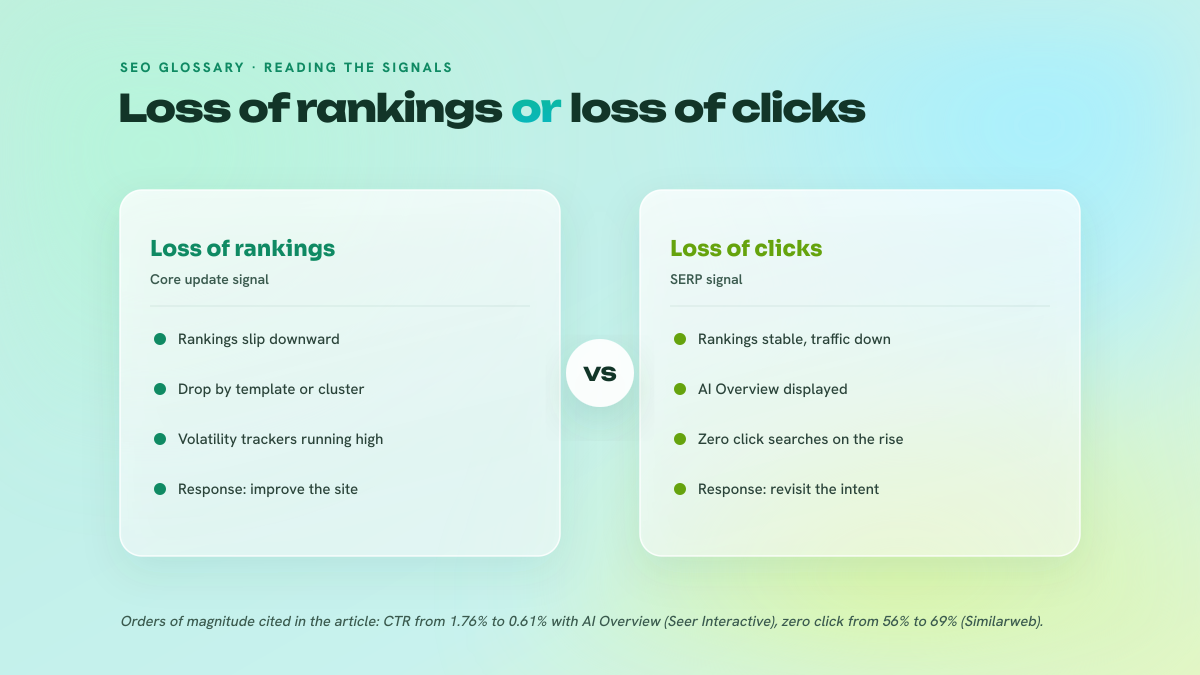
The confound nobody controls for in 2026 is SERP layout. Similarweb’s July 2025 report measured zero-click share of Google searches rising from 56% to 69% between May 2024 and May 2025, coinciding with the AI Overviews rollout, and its 2026 follow-up confirms about 68% of searches now end without a click. So a traffic drop with stable average positions is not a core update problem, it is a click-distribution problem: the answer box ate your CTR. Before you rewrite a single page, verify in Search Console whether positions moved or only clicks did. We see this misdiagnosis constantly in audits: teams launch a six-month content overhaul to recover clicks that no ranking improvement can bring back.
One habit that costs nothing and saves hours: annotate every confirmed rollout start and completion date in whatever dashboard your team actually looks at. Twelve months later, nobody remembers whether the dip in week 14 was the update, the site migration, or seasonality.
What core updates mean for a netlinking operation
A backlink is only worth what its host page will be worth after the next re-scoring. That is the single most underpriced idea in link buying. The spam policies introduced alongside March 2024 target exactly the inventory that dominates cheap link marketplaces: scaled content abuse, expired domain abuse, and site reputation abuse, the last one enforced from 5 May 2024 after a two-month grace period. A link from a domain that exists to sell links, stuffed with scaled AI content on a repurposed expired domain, sits in the blast radius of every core and spam rollout. When the host page gets demoted or deindexed, your link doesn’t get penalized, it simply stops existing as a signal.
The visibility data tells you which publishers survive. Across late-2024 through 2026 core updates, SISTRIX and Amsive analyses show aggregators, directories and comparison sites repeatedly losing visibility, while official and institutional sites, strong brands, and specialist niche sites gain. A German-market analysis of the March 2026 update found roughly four losers for every winner among 166 domains with confirmed visibility changes: 134 down, 32 up. In a re-scoring regime that harsh, publisher selection is not a nice-to-have filter on your link sourcing, it is the entire risk model.
This is the operational reason we run Nautilinks as an owned set of editorial media rather than reselling third-party inventory: when you control the publishing standards of the host site, you control its exposure to the next core update, and the placements you sold in January are still passing signal in December. If you are evaluating sources, browsing a transparent catalogue of owned editorial media tells you more about update resilience than any DR screenshot. And because demotions and recoveries happen on update cycles, not weeks, it pays to be calibrating a link acquisition campaign across several quarters rather than front-loading a burst that lands right before a rollout re-shuffles the board.
The mistakes we keep seeing in audits
Editing mid-rollout is the classic. A team sees the day-4 dip, rewrites twenty title tags, and by completion date the rankings have partially recovered on their own. Now they have two overlapping variables and no way to attribute anything for the next quarter. Freeze structural changes between the announced start and the confirmed completion.
Treating the update as a penalty comes next. Panic disavows after a core update are almost always destructive: no policy was violated, so you are removing link equity to cure a disease you don’t have. Disavow is a tool for manual actions and genuinely toxic profiles, not for relative demotions.
Third, the rewrite-everything reflex. Core update losses concentrate; blanket rewrites dilute your effort across pages that were never the problem. The higher-leverage move is usually pruning and consolidation: identify the template or content cluster that absorbed the loss, cut or merge the thin pages, deepen the few that map to real demand. From what we see in audits, sites that recover tend to have removed more content than they added.
Finally, calibrate expectations on recovery. The pattern documented since 2024 is consistent: demoted sites that did substantial cleanup mostly saw movement at the next core rollout, months later, not gradually the following week. Anyone selling you a four-week core update recovery plan is selling you the calendar.
Nautilinks operates an owned network of editorial media. In-house written articles, transparency disclosures respected, anchor mix calibrated.
Frequently asked questions
How do I tell a core update hit from a spam update hit?
Check three things in order. First, Search Console: a manual action names the violation, a spam or core update never will. Second, the dates: match your drop against the confirmed rollout windows on Google’s Search Status Dashboard, since core and spam updates sometimes overlap. Third, the pattern: spam update damage is usually brutal and site-wide, often with deindexation, because a policy classifier fired. Core update damage is relative and uneven, concentrated on templates or intent classes where competitors now score better.
Should I pause publishing or link acquisition during a rollout?
Keep publishing normally, freeze structural experiments. Ongoing editorial output at your usual cadence is not a variable Google punishes mid-rollout, and stopping it creates its own anomaly in your data. What you should avoid is shipping template changes, mass title rewrites, or migrations during the window, because you won’t be able to separate their effect from the update’s. Link acquisition on a steady, calibrated rhythm can continue; a sudden burst timed into a rollout just adds noise you’ll regret when attributing results.
My positions held but clicks collapsed after the update. What happened?
Almost certainly SERP layout, not the core update. Similarweb measured zero-click share rising from 56% to 69% between May 2024 and May 2025 as AI Overviews rolled out, and about 68% of searches ended without a click in early 2026. If Search Console shows stable average position with falling CTR, an AI Overview or richer SERP feature is intercepting the click above you. The response is snippet and citation strategy, not a content quality overhaul.
Does a core update evaluate my backlink profile?
Yes, in two ways. Directly, because link signals are part of the core systems being re-weighted. Indirectly, and this is the bigger effect in practice, because the pages hosting your links get re-scored too. A placement on an aggregator or a repurposed expired domain can silently lose most of its value when that host site is demoted, which SISTRIX and Amsive data show happening repeatedly to those site types across recent updates. Audit where your links live, not just how many you have.
How long does recovery actually take after a core update demotion?
Plan in update cycles. The pattern observed since March 2024 is consistent: sites that made substantial improvements mostly saw re-evaluation at a subsequent core update, which historically means a wait of two to five months given the recent cadence of three to four core updates per year. Minor fluctuations can happen between updates, but a genuine reversal of a core demotion between rollouts is the exception. Budget the cleanup accordingly and resist re-auditing every two weeks.
Test your knowledge
Quiz: Google Core Update
1/3What structural change did the March 2024 core update introduce?