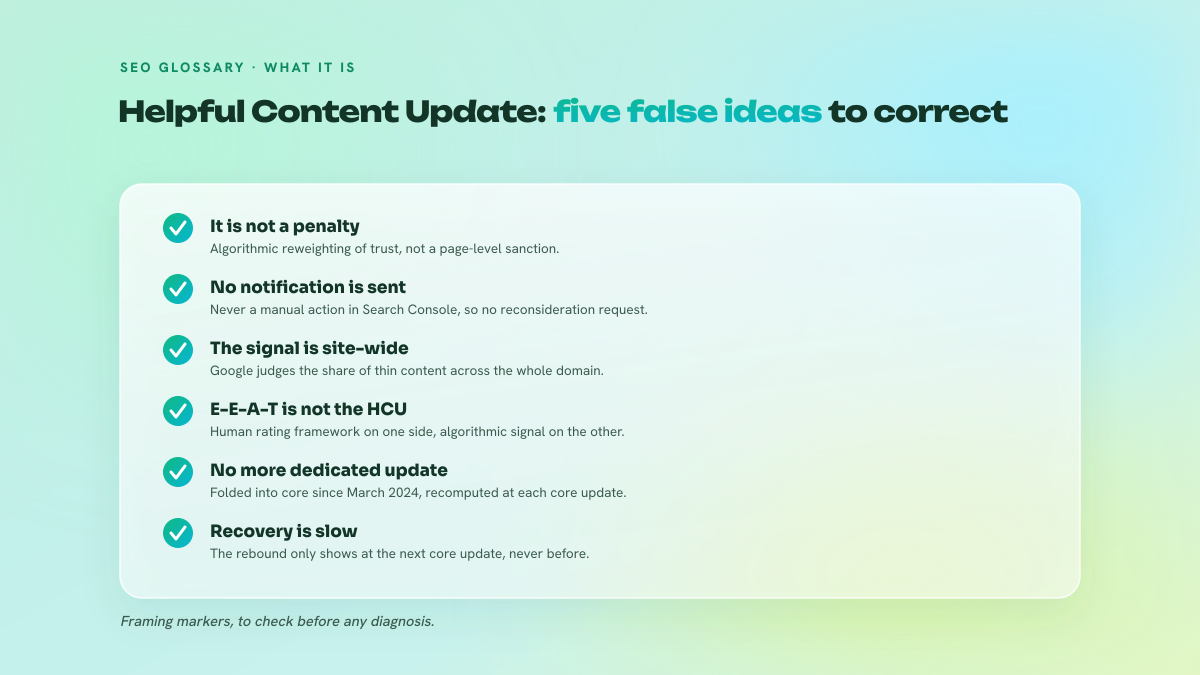
- →There is no separate Helpful Content Update to target since March 2024: helpfulness is recalibrated on each core update, so treat it as a permanent sitewide condition, not a one-off penalty.
- →The March 2024 core update was reported to cut low-quality, unoriginal results by roughly 40 to 45 percent, and its rollout ran 45 days (March 5 to April 19, 2024).
- →For link buyers the operational shift is simple: a link from a host that lost its helpfulness verdict loses value regardless of its DR, so vet the source's content, not just its metrics.
- →The three March 2024 spam policies (scaled content abuse, site reputation abuse, expired domain abuse) sit alongside the helpful content logic and are where AI-generated content and parasite tactics get flagged.
- →Recovery is tied to subsequent core updates and typically takes two to six months once content is genuinely improved, not days.
- →Affiliate and thin-content properties took the sharpest hits: 71 percent of affiliate sites were negatively impacted by the December 2025 core update per one analysis of 847 sites.
Beyond the classifier: a sitewide verdict
The first thing a working SEO needs to unlearn in 2026 is the idea that the Helpful Content Update is a live thing you can react to. It was, until early 2024, a separate machine-learning classifier that produced a sitewide signal. That standalone system is gone. Google's March 2024 core update absorbed the helpful content logic into the core algorithm, and there has been no isolated helpful content event since. Every core update now recalibrates helpfulness as one input among many, which is why the current framing is « part of core » rather than a named penalty.
That change is not cosmetic. When it was a bolt-on classifier, you could point to a rollout window and say « we got hit by HCU. » Now the verdict is baked into the same pass that reshuffles rankings on quality, relevance and reliability. The March 2024 rollout itself ran 45 days, from March 5 to April 19, and Google's own messaging framed it as expected to remove around 40 percent of low-quality, unoriginal content from search, with later analyses citing closer to a 45 percent reduction. Whatever the exact figure, the direction is unambiguous: search-engine-first content is being demoted continuously, not on a schedule you can plan around.
The other durable idea from the helpful content era is the sitewide nature of the judgement. This is the part most audits still underweight. A domain does not get scored page by page in isolation. A concentration of thin, templated or unoriginal pages can pull down URLs that are individually fine. In our own work we see this constantly: a media property with 400 solid articles and 200 scraped-feeling ones underperforms a cleaner site half its size. The helpful content logic rewards the average, not the best page.
How helpfulness is measured in 2026
Google does not publish a helpfulness score, and anyone selling you a single « HCU meter » is selling a proxy. What actually happens is that the core system evaluates content against the questions laid out in Search Central's guidance: who created the content, how it was created, why it exists, and whether a reader leaves satisfied or bounces back to the results to find a better answer. The people-first versus search-first distinction is the spine of it, and it is assessed at both page and site level.
Two mechanics matter operationally. First, the demotion is durable. Because helpfulness is folded into core, a site that improves its content does not recover on the next crawl. Recovery is tied to a subsequent core update running, which is why the realistic window is roughly two to six months after substantial improvement, not a fortnight. That cadence tracks the update schedule: the December 2025 core update completed on December 29 after 18 days, followed by a Discover-only quality update in February 2026, then the March 27 to April 8, 2026 core update, described by several trackers as the most volatile on record at that point. If your fix lands between updates, you wait.
Second, the scope keeps widening. The May 21 to June 2, 2026 core update overlapped with a major expansion of AI Overviews and, per update trackers, introduced a practical split between organic ranking and AI Overview citation share as separate KPIs. That is a real measurement problem: a page can hold its blue-link position while quietly losing its citation slot in the generated answer. If you only watch classic rankings, you miss half the helpfulness verdict now. This is exactly why we treat every core update since March 2024 as a recalibration of the same quality bar rather than a fresh, unrelated event.
Where it bites a netlinking operation
Here is the part most link-building content skips. The helpful content logic does not just decide whether your money site ranks. It decides how much authority the sites you link from can still pass. A domain that lost its helpfulness verdict is worth a fraction of its former self as a link source, even if the DR number your tool reports has not moved yet, because those metrics lag the actual traffic collapse by weeks.
This reframes source selection. The old reflex was to filter publishers by DR or Trust Flow and call it diligence. In 2026 the operational tell is the host's own trajectory: is its organic traffic stable across the last three core updates, or is it a stair-step decline? A link from a stable, genuinely useful editorial page carries weight; a link from a site being slowly demoted for unoriginal content is dead weight you paid for. When we source placements from publishers you can actually inspect, the helpfulness health of the host is the first screen, ahead of any authority metric.
The link tactics themselves also sit closer to the enforcement edge now. The three spam policies Google introduced in March 2024, scaled content abuse, site reputation abuse (the parasite-SEO pattern of low-quality third-party content on strong hosts) and expired domain abuse, run in parallel with the helpful content logic and are enforced through the parallel spam updates. Site-reputation enforcement began on May 5, 2024, and the August 26, 2025 spam update, completed in early September, again named scaled content, expired domain abuse and site reputation abuse as targets. A 2026 link-building risk guide notes that this same August 2025 update strengthened SpamBrain's detection of manipulative link patterns, and puts PBNs, undisclosed paid links and automated link building at « higher risk than ever » post-2024. The survey data agrees with the shift: Reporter Outreach's State of Link Building 2026, polling 500 professionals in Q1 2026, found digital PR has overtaken guest posting as the consensus top method and describes quality thresholds as stricter.
For a network operator this is not abstract. Nautilinks runs its own French media with in-house editorial rather than scaled generation, precisely because a link is only as durable as the host page's helpfulness verdict. That is an operational stance, not a slogan: if the source cannot survive a core update on its own content, the link it passes will not either.
What we see go wrong in audits
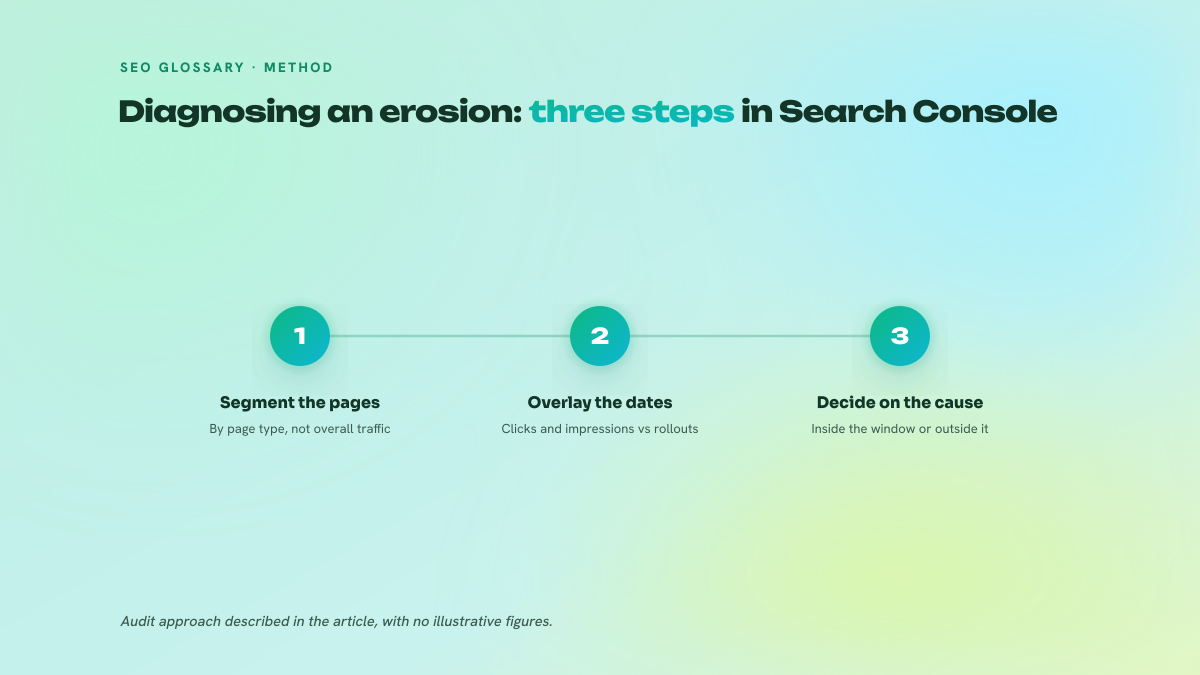
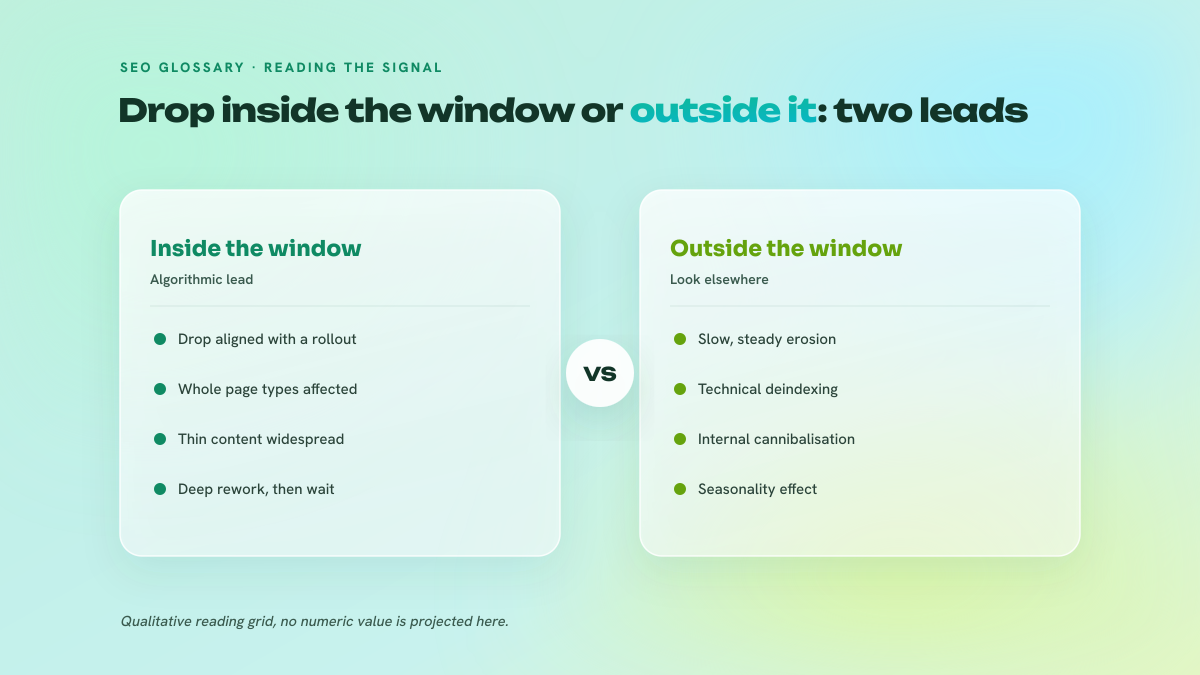
The most common error is treating a helpful content drop as a technical problem. Teams re-crawl, chase Core Web Vitals, tweak schema, and wonder why nothing recovers across two update cycles. The signal is about whether the content deserves to rank, and no amount of technical polish fixes unoriginal writing. Search Console is where you confirm the diagnosis: a broad, gradual decline in impressions and clicks that starts on a core update date, spread across the site rather than concentrated on a few URLs, is the fingerprint. A sharp drop on a handful of pages is usually something else.
The second mistake is misreading scaled AI content as a helpfulness win because it covers more keywords. It does the opposite. Publishing volume of thin, largely unoriginal pages is exactly what the scaled content abuse policy targets, and a 2026 SEO-statistics report summarising 2025 impact data put the average ranking drop for thin-content sites at 19 percent after the 2025 updates. Affiliate models fared worse still: an analysis of 847 sites after the December 2025 core update found 40 to 60 percent affected overall, with 71 percent of affiliate sites negatively impacted.
The third is source myopia on the netlinking side, already covered above but worth restating as an audit finding: buying links on hosts that are themselves losing their helpfulness verdict. We flag it every week. The DR looked fine, the traffic curve did not, and the placement passed nothing.
Recovery that actually moves the needle
Recovery is a content problem solved on Google's clock, not yours. Start with an honest inventory: separate the pages that answer a real question from a real perspective from the ones that exist to catch a keyword. The uncomfortable step is deletion or consolidation. Because the verdict is sitewide, thinning out or merging weak pages often helps the survivors more than editing them one by one. Improve what has genuine expertise behind it, remove what does not, and stop adding volume for its own sake.
Then accept the cadence. Substantial improvement does not surface until the next core update processes it, so the realistic window is two to six months. During that wait, keep publishing genuinely useful pieces rather than freezing the site, and monitor both classic rankings and AI Overview citation share, since after the May–June 2026 update those diverge. On the off-site side, do not try to link your way out of a helpfulness problem: manipulative acquisition raises spam risk without touching the underlying content verdict. Where links belong is on a site that already deserves to rank, and there the discipline is to pace acquisition across several core updates rather than spike it. The 74 percent of SEOs in the Reporter Outreach 2026 survey who believe backlinks influence AI search visibility are probably right, but only 19 percent have actually changed how they build links, which tells you the gap between belief and practice is still wide open.
Nautilinks operates an owned network of editorial media. In-house written articles, transparency disclosures respected, anchor mix calibrated.
Frequently asked questions
Is there still a Helpful Content Update I can target or recover from?
No. The last standalone helpful content event was superseded by the March 2024 core update, which folded the classifier into the core algorithm. Since then helpfulness is recalibrated on every core update rather than run as an isolated system. Practically, you stop chasing a single event and treat content quality as a permanent sitewide condition that any core update can reassess, up or down.
How long does recovery actually take?
Roughly two to six months, and it is gated by Google's update schedule, not your deploy date. Because helpfulness is part of core, improved content does not resurface on the next crawl; it needs a subsequent core update to process. If your fixes land between updates, you wait for the next one. The December 2025 update, for example, ran 18 days and completed December 29, so timing matters as much as the fix.
Does the helpful content logic affect the links I buy, not just my own site?
Yes, and this is the underrated angle. A link's value tracks the host page's own helpfulness verdict. A placement on a site being demoted for unoriginal content passes little authority even if its DR still looks healthy, because tool metrics lag the traffic collapse. Screen link sources by their organic trajectory across the last few core updates before you look at any authority score.
How do I confirm in Search Console that helpfulness is the cause?
Look for a broad, gradual decline in impressions and clicks that begins on a documented core update date and spreads across most of the site rather than a few URLs. That sitewide pattern is the fingerprint of a helpfulness demotion. A sudden drop confined to specific pages usually points to a technical issue, a manual action, or SERP-feature loss instead, so segment before you diagnose.
Where does scaled AI content sit relative to this?
On the wrong side. Publishing large volumes of largely unoriginal pages is exactly what the March 2024 scaled content abuse policy targets, and it runs alongside the helpful content logic. A 2026 SEO-statistics report put the average ranking drop for thin-content sites at 19 percent after the 2025 updates. AI assistance is not the problem; unoriginal, search-first output at volume is.
Test your knowledge
Quiz: Helpful Content Update
1/3What happened to the standalone Helpful Content system in 2024?