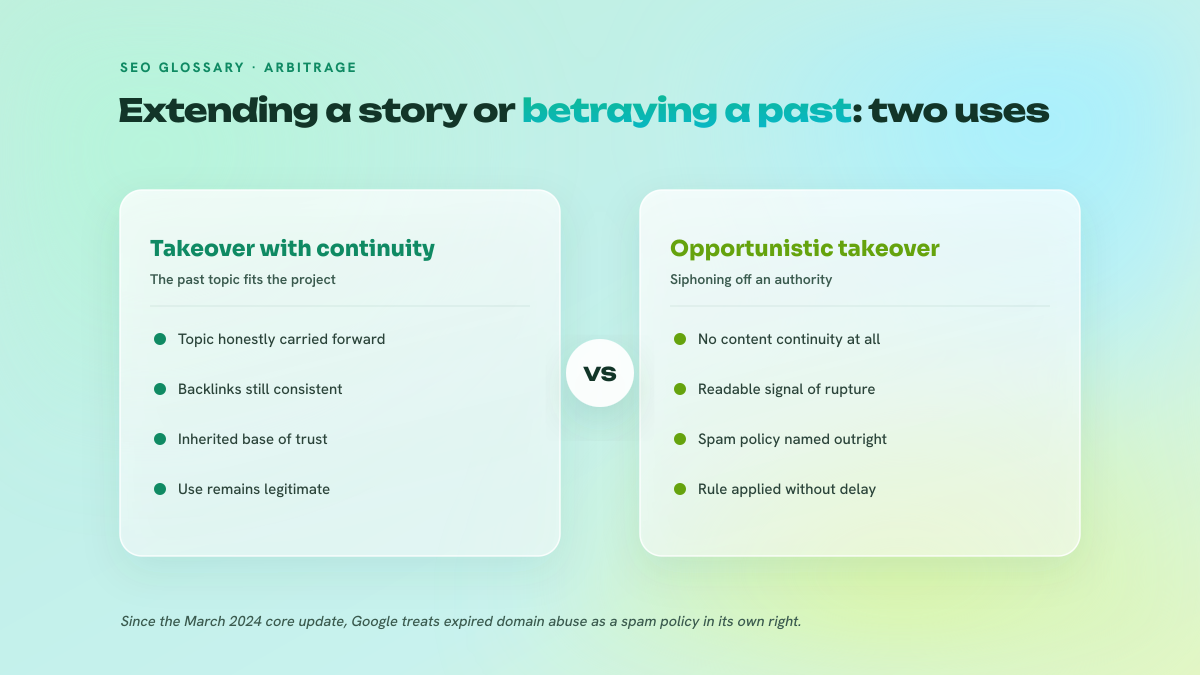
- →Since March 2024, «expired domain abuse» is a named Google spam policy, not slang: reuse that keeps topical continuity is fine, cross-niche flips get penalised (Google Search Central documentation, March 2024).
- →The history is both the asset and the liability. You inherit the backlink profile, the crawl history and any security flags: Google Safe Browsing 2024 data flagged 8.7% of recent drops for malicious content within 60 days of expiry.
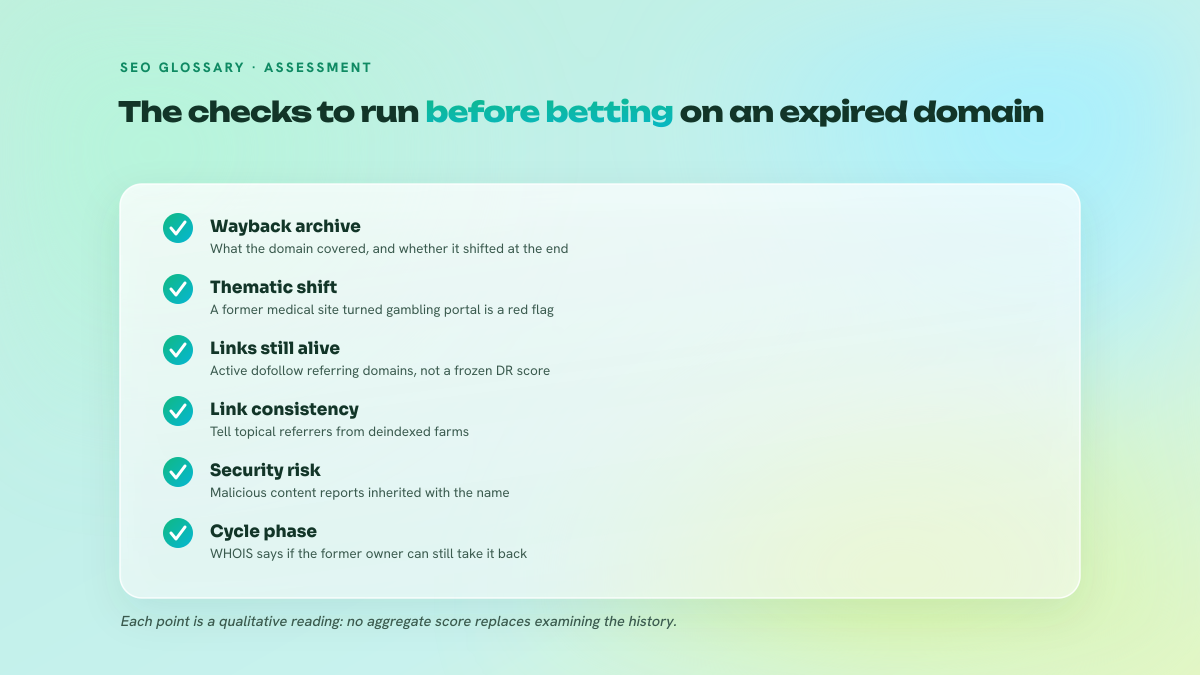
- →Never buy on DR or DA alone, both are inflatable in a weekend. Pull the referring domains one by one, check anchor distribution and confirm on archive.org that it was a real publication.
- →If your own domain lapses, move fast: a 2024 Moz study found 78% ranking recovery when renewed within 5 days versus 34% after 15 days, and a Semrush 2025 analysis measured 93% of organic traffic lost within 14 days.
- →The rulebook has been stable since 2024, the detection has not: the March 2026 spam update added no categories and completed in under 20 hours, but SpamBrain now spots inherit-the-backlinks sites and PBN footprints far better.
- →For most buyers, renting placements on media that were already rehabilitated with topical continuity beats acquiring and cleaning a raw drop yourself.
What an expired domain actually buys you
An expired domain is a name whose previous owner stopped paying, so it cycled back through the registry and became available again. That is the registrar definition. The SEO definition is different: you are not buying a name, you are buying a history. A backlink profile that took years to accumulate, a set of URLs Google already crawled and indexed, sometimes residual organic traffic, and a topical reputation that lives in Google link graph whether you want it or not. The name is the cheap part. The history is what you pay for, and it is also what you inherit as a liability.
The practical question in 2026 is no longer whether an aged backlink profile helps. It does, mechanically. The question is whether Google reads your reuse as continuity or as abuse, because since March 2024 that distinction is written into policy and enforced by an algorithm, not left to a human reviewer. That single shift reorganises everything a working SEO needs to know about the tactic, and it is why most evergreen guides on the subject are quietly out of date.
From the last unpaid invoice to the drop
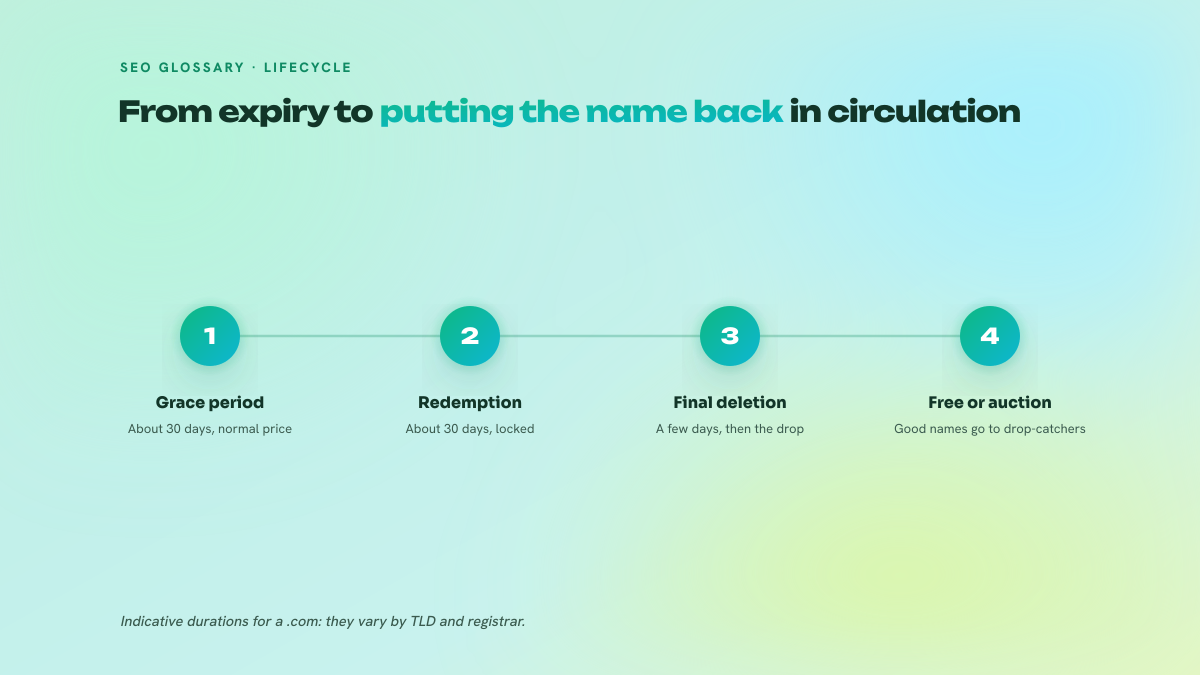
A domain does not go from expired to available overnight. It moves through a fixed sequence, and knowing where a candidate sits in that sequence tells you what you can actually do with it. First comes the grace period, roughly 30 to 45 days depending on the registrar, during which the original owner can still renew at the normal price and nothing has changed publicly. Then the redemption period, around 30 days, where the name is deactivated but the owner can recover it for a punitive fee. Then a short pending-delete window, five days for a .com, during which nobody can register it. Only after that does it drop and open for registration on a first-come basis, which is where drop-catch services and auctions fight over the valuable ones.
This matters operationally for two reasons. First, if it is your own domain that lapsed, your window to recover cleanly is narrow, and the data says how narrow: a 2024 Moz study found that domains renewed within five days of expiry recovered 78% of their rankings within two months, while renewals after fifteen days recovered only 34% in the same window. A Semrush analysis from 2025 put the bleed even more starkly, with sites that accidentally let a domain expire losing on average 93% of organic traffic within fourteen days. Second, if you are hunting someone else dropped name, the auction and drop-catch stage is where price meets competition, and the genuinely strong profiles rarely fall for a registration fee alone.
Why Google reclassified expired domains as spam
Here is the part a lot of guides still get wrong. Until 2024, «expired domain abuse» was industry slang. Since March 2024 it is a named Google spam policy. The March 2024 core update folded the Helpful Content system into core ranking and, at the same time, published three explicit spam policies: expired domain abuse, site reputation abuse, and scaled content abuse (Google Search Central documentation, March 2024). Google reported the update was designed to cut low-quality and unoriginal content by around 45%. Site reputation abuse got a grace period until 5 May 2024, while expired domain abuse and scaled content were enforced immediately.
The policy language is worth reading literally: the abuse is acquiring an expired domain and using it primarily to manipulate rankings by hosting low-value content that exploits the prior reputation. The operative word is primarily. Reusing an old cooking domain to publish more cooking content is not what the policy targets. Buying a former medical domain and redirecting it to a casino, the textbook cross-niche flip, is exactly what it targets.
Enforcement got sharper twice since. The August 2025 spam update, announced 26 August 2025 and rolling out until 22 September 2025, was read by multiple agency analyses as a direct pass at expired domain abuse and parasite SEO across all languages. Then the March 2026 spam update completed in under twenty hours, the fastest spam rollout on record per Google Search Status Dashboard, and introduced no new categories. What changed was SpamBrain, Google machine-learning spam system, getting better at spotting sites built on expired domains only to inherit backlinks, alongside classic PBN footprints. The rules have been stable since 2024. The detection has not stopped tightening.
The concrete lesson: topical continuity is now the difference between an asset and a penalty. This is the discipline behind how a serious owned network operates. Our own model at Nautilinks reuses expired domains, but each one is rebuilt inside its original theme and kept editorially coherent, which is the line the policy actually draws. If you want media that were repurposed with topical continuity rather than flipped, that is what a catalogue you can browse without an account lets you verify site by site.
Finding candidates without inheriting a liability
The sourcing tools have not changed much: ExpiredDomains.net remains the default aggregator for scanning drop lists across TLDs, registry drop lists feed the drop-catch services, and marketplace auctions surface the names other people already flagged as valuable. The skill was never in finding names. It is in filtering them fast enough that you only spend evaluation time on the few that survive a first pass.
This walkthrough covers the sourcing step and pairs well with the filtering logic below.
The filters that matter on a first sweep are blunt: a plausible number of referring domains from distinct IPs, a link profile that is not 90% one anchor, no obvious adult or gambling history unless that is your niche, and a name that reads like an editorial brand rather than an exact-match keyword string. Exact-match keyword domains with a suspiciously clean profile are usually either already burned or were built to be sold, not to rank. If you plan to host content and place links out, you are also choosing a name your future contributors and buyers will see, which is why publishing an article on a domain you control only works when the domain looks like a real publication.
Reading the backlink profile before you commit
Finding is cheap, evaluation is where the money and the risk both live. The single most useful habit is to treat every candidate as guilty until the backlink profile proves otherwise, because you are inheriting whatever the previous owners, plural, did with the name.
Pull the referring domains and actually look at them, do not trust an aggregate authority score. A Trust Flow or Domain Rating figure is trivial to inflate with a burst of low-quality links, and a domain that shows DR 40 built on three hundred spun-content footers is worthless. Check the anchor text distribution for commercial anchors in a language that does not match the domain history, a classic tell that the name already passed through a link farm. Check archive.org to confirm the site was a real publication and not a thin affiliate shell, and check whether the referring domains are still live or themselves dead. Roughly half of any old profile has rotted away by the time you look.
Risk signals deserve their own pass. Google Safe Browsing data from 2024 showed 8.7% of recently expired domains were flagged for malicious content within sixty days of expiry, which means a non-trivial share of drops carry a security history you would be inheriting. The demotix.com case, a former DA-80 camera and image domain turned into a guest-blog farm that lost all its organic traffic and rankings after the March 2024 core update, is the pattern to memorise: strong legacy metrics did not save a site whose reuse Google read as abuse.
The honest framing, and the one experienced buyers repeat, is that the large majority of expired domains are junk. The value sits in the small remainder where a real topical history, a clean profile, and a reuse plan that keeps the theme intact all line up. That is also why buying links on domains someone else has already vetted and rebuilt, rather than acquiring and rehabilitating a name yourself, is often the better use of a budget: you skip the archaeology and pay only for media that are already known quantities.
What we see go wrong, and the tactical read
The most common mistake is buying on authority score alone. DR and DA are inputs, not verdicts, and both are gameable in a weekend. The second is the cross-niche flip, still tempting because the metrics look great, still the single clearest trigger for expired domain abuse enforcement. The third is impatience on reuse: registering a strong drop and immediately pointing it as a 301 at a money site, or stuffing it with thin AI content to activate the backlinks. Both are exactly the footprint SpamBrain was refined to catch in 2025 and 2026.
The tactical read for 2026 is narrow and defensible. Expired domains still work as an SEO input, the backlink graph is real and aged links still carry weight, but the margin for manipulation has collapsed. Treat an expired domain as a publication you are reviving in its own field, not as a battery of link juice to drain. Keep the theme continuous, rebuild real content, and let the reuse look like what it is. If your goal is simply to acquire links rather than to run a network, the arithmetic usually favours renting placements on domains that have already been rehabilitated properly, and pacing that acquisition across months rather than a spike, which is what a campaign spread over several months instead of one burst is built for. When you do want the raw placement, a catalogue where each media lists its own metrics beats gambling on a drop whose history you cannot fully see. A single well-reviewed link slipped into an existing aged page on a domain with genuine topical continuity beats ten flipped drops every time.
Nautilinks operates an owned network of editorial media. In-house written articles, transparency disclosures respected, anchor mix calibrated.
Frequently asked questions
What actually happens to a domain once it expires?
It enters a fixed sequence. A grace period of roughly 30 to 45 days where the owner can renew at the normal price, then a redemption period of about 30 days with a punitive recovery fee, then a five-day pending-delete window for a .com where nobody can register it, then the drop. Only after the drop is it open on a first-come basis, which is when auctions and drop-catch services compete for the names worth having.
Can I recover my own domain after the grace period?
Usually yes during redemption, but it costs a redemption fee well above renewal, often in the €80 to €200 range. After pending-delete it drops and anyone can grab it, so recovery becomes a race. And recovery is not neutral for SEO: the Moz 2024 figures show rankings recover far better inside five days (78%) than after fifteen (34%), so speed is the whole game once a domain lapses.
Are expired domains still worth it for SEO in 2026?
As a link input, yes, aged referring domains still pass weight. As a manipulation shortcut, no. The 2024 to 2026 spam updates made cross-niche flips and thin-content reuse a reliable way to get demoted, with SpamBrain now detecting the pattern quickly. The tactic works only when you keep the domain in its original theme and rebuild genuine content, so the reuse reads as continuity rather than a reputation grab.
How soon can I register a domain after it drops?
The moment it clears pending-delete it is registrable, but for desirable .com names that moment is contested by automated drop-catch services firing within seconds. For those you use a backorder or auction service rather than a manual registration attempt, which is exactly why strong profiles rarely cost only the registration fee. For obscure names you can often just register them the normal way.
Is a high Domain Rating a reliable signal on an expired domain?
No. DR and Trust Flow are the easiest metrics to inflate, and a burst of low-quality links can manufacture a DR 40 on a name worth nothing. Treat the aggregate score as a first filter, then judge the domain on the actual referring domains, their anchor distribution, whether they are still live, and whether archive.org shows a real publication rather than a thin affiliate shell.
Test your knowledge
Quiz: Expired domains
1/3When did Google first codify «expired domain abuse» as an explicit, named spam policy?