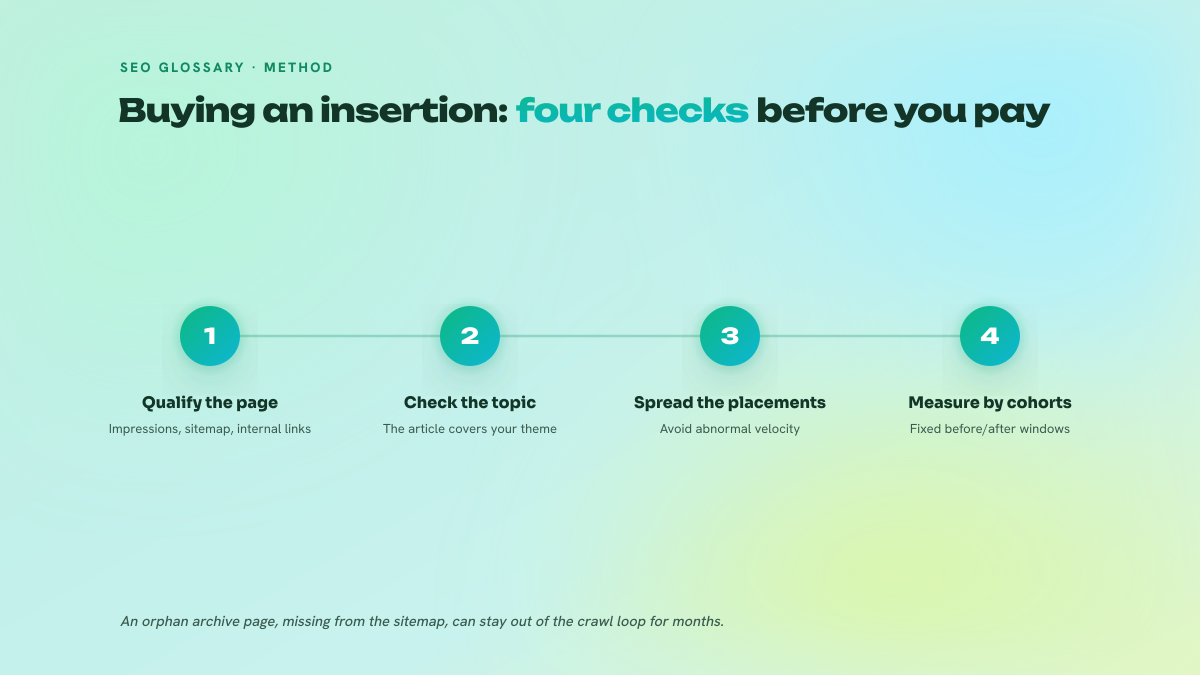
- →You are buying a page, not a domain. A DR70 host URL with four monthly visits and no ranking keywords is worth less than a DR35 page sitting top 5 on a query your buyer actually types.
- →The one signal an insertion cannot hide is the timestamp mismatch: a 2019 article whose outbound link set changed last Tuesday. Diffing crawls is cheap, so treat detection as a given and buy for topical logic instead.
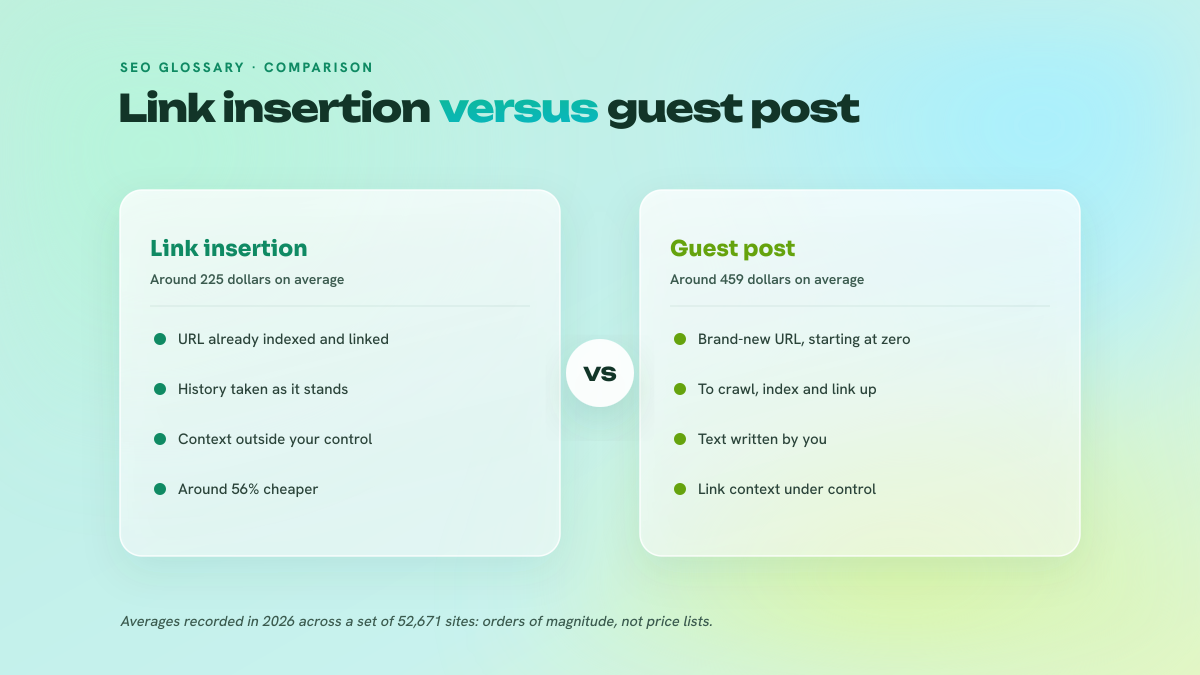
- →Pricing is the tactic's honest advantage: 2026 pricing studies built on a dataset of 52,671 sites put the average link insertion at about $225 against $459 for a guest post, roughly 56 % cheaper.
- →Speed, not power, is the real differentiator. The host page is already crawled on a regular cycle, so you skip the indexation wait rather than gaining extra weight.
- →Only about 9.4 % of practitioners name niche edits as their preferred tactic in the 2026 link-building statistics drawing on multiple surveys, behind digital PR at 48.6 % and guest posting at roughly 16 %. Treat insertions as a supporting move, never as the backbone of an acquisition plan.
- →Measure survival, not delivery. Check every paid insertion again at 90 and 180 days: editors clean up, sites get sold, and nobody sends you a notice when your link disappears.
What a niche edit actually buys
Strip the vendor vocabulary and the transaction is plain: you pay a publisher to reopen an article they put online two, four, sometimes eight years ago, and to drop your link into a sentence that already existed or into a sentence written around your link. Nothing new gets published. No new URL enters the index. The entire value proposition rests on the host page and what it already earned: its age, the backlinks pointing at it, the queries it ranks for, the crawl frequency it built up.
That is a genuinely different asset from an article you commission and publish from scratch. A new post starts at zero: no history, no traffic, no internal links beyond whatever the publisher's template hands it, and a wait of weeks before Google decides how often to come back. An insertion starts wherever the host page already stands. The flip side is symmetrical and much less discussed: you inherit the ceiling too. If that page has been sliding since a 2024 core update, your link sits on a decaying asset, and no broker will volunteer that information.
The terminology multiplied because the tactic sells better when it sounds editorial. Niche edit, curated link, authority link, contextual placement: they describe the same act, and we use them interchangeably with the more literal term for adding a link to an existing page. Be suspicious of any vendor whose deck spends more energy on the label than on the URL list. The label is not the product. The page is.
How Google reads insertions in 2026
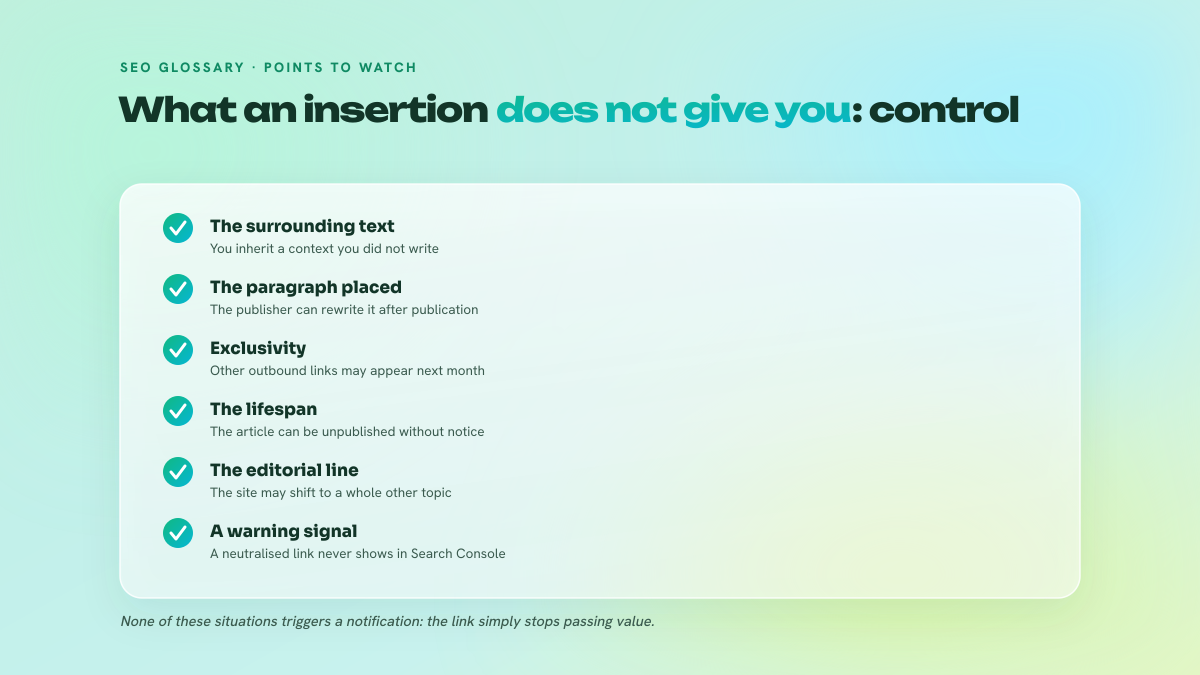
There is one signal an insertion structurally cannot hide: the timestamp mismatch. The article carries a publication date from years back, and its outbound link set changed last Tuesday. Comparing the link graph of a URL between two crawls is a trivial, cheap operation at Google's scale, and every insertion produces exactly that diff. Anyone selling you invisibility is selling you a story.
What matters is what happens after detection. The modern outcome is neutralisation rather than punishment: the link stops passing anything, silently, with no message in Search Console and no manual action to contest. Operationally that is the worst possible failure mode, because it is indistinguishable from ordinary competitive drift. A batch of insertions lifts a page from position 11 to position 6, the gain holds for a quarter, then evaporates, and the post-mortem concludes that the competition improved. It did not. The links were discounted.
The enforcement calendar backs this up. Search Engine Land reported that the August 2025 spam update rolled from 26 August to 22 September 2025, about 27 days, explicitly targeting thin content and link spam across all languages. Long rollouts of that shape are consistent with reprocessing large volumes of link data, which is precisely where scaled insertions live.
Practitioners are more optimistic than the evidence warrants. Editorial.link's survey of 518 link builders found that 51.7 % believe Google cannot effectively identify paid niche edits, while 91.9 % believe their direct competitors buy links. Our stance is that the first figure is wishful thinking built on a false binary. Google does not need to prove a link was paid. It needs enough confidence to discount it, and confidence is cheap when the same insertion paragraph shape, the same author account and the same CMS fingerprint repeat across a few hundred URLs. The pattern is what gets caught, never the individual placement.
The test we apply before buying anything is blunt: would a human editor keep this link if the money stopped tomorrow? If the paragraph makes topical sense, if the sentence would embarrass nobody, the placement is defensible. If the link only exists because someone was paid, the algorithm eventually reaches the same conclusion a reviewer would.
The real price, and what it hides
Insertions are cheaper than published articles, and that is their most honest selling point. The 2026 pricing studies, built on a dataset of 52,671 sites, put the average link insertion at roughly $225 against $459 for a guest post, about 56 % less across all DR tiers. A separate 2026 analysis of more than 3,000 backlinks lands higher, at $361.44 per insertion, while Editorial.link's 518-respondent survey reports an average acceptable cost per quality backlink of $508.95.
Those numbers do not contradict each other, and the gap is instructive. The $225 figure is what the catalogue asks across everything on the shelf. The $361 figure is closer to what buyers pay once they filter out the junk. The $508 figure is what they say they are willing to pay for something they consider good. The spread between catalogue price and paid price is the cost of filtering, and it is the only part of the budget that actually protects you.
By authority band, 2026 vendor data converges on $130 to $220 for DR 20-40, $220 to $400 for DR 40-60, $400 to $700 for DR 60-80, and $700 to $1,200 and up beyond DR 80. Ahrefs data across 450 niche-edit sites points the same way: sites at DR 50 or above charge around $600 per link on average, those below DR 49 stay under $400. If you want to compare that against what a placement costs when the media is operated in-house with the rate published up front, the arithmetic is worth doing before you sign a retainer.
Here is where the market prices the wrong variable. Every band above is indexed on the domain. Almost no vendor prices on the host page. Yet the host page is the entire asset: its own inbound links, its own rankings, its own crawl rate. A DR 70 domain selling you an insertion into a 2018 listicle that receives four visits a month, has not been recrawled since March and already carries eleven outbound commercial links is a worse buy at $600 than a DR 35 page ranking fifth on a query your customers type, at $180. Demand the exact URL before payment, not after. Check its ranking keywords, its last cached date and its existing outbound link count. Any seller who refuses to give the URL in advance is protecting a page that would not survive inspection.
Where niche edits fit in a campaign
The profession has already voted on this. In the 2026 link-building statistics synthesising several surveys, including Editorial.link's 518-expert dataset, digital PR is rated the number one tactic by 48.6 % of respondents, guest posting sits at roughly 16 %, and niche edits are the preferred tactic of about 9.4 %. That last number is not a verdict against the tactic. It is an accurate description of its role: a supporting move, valued for speed and for leveraging authority that already exists, not a backbone.
Speed is the measurable part. A 2026 guide synthesising six surveys of more than 1,500 professionals reports that 57.1 % see ranking movement within one to three months of link acquisition. Insertions compress that timeline for a structural reason, not a magical one: the host page is already on a regular crawl cycle, so the link is discovered in days rather than waiting for a fresh URL to earn attention. You are buying less waiting, not more weight. Anyone framing it as more weight is selling.
That makes insertions genuinely useful in three situations. Reinforcing a page already sitting at position 6 to 12, where a small push converts into visible traffic. Diversifying an anchor profile that has drifted too exact-match, since insertions let you write the surrounding sentence and therefore the anchor. Plugging a topical hole where the site has no coverage and no time to build any. They are a poor fit for launching authority on a site that has none, because a handful of inserted links into unrelated pages produces exactly the pattern spam systems are built to notice.
On the owned French editorial media we operate, we prefer commissioning a new article over inserting into an old one, for a reason that has nothing to do with ideology: when the article is written around the link, the topical logic is real rather than retrofitted, and the placement stops being something that has to be defended. When an insertion genuinely is the right call, the editorial context still has to be inspected first, which is why seeing the full media catalogue and its metrics without creating an account matters more than any promised DR.
One caveat on AI search. Surveys across 2025 and 2026 report that 73 to 74 % of SEO professionals believe backlinks influence visibility in AI answers. That is a belief figure, not a measurement, and it deserves to be labelled as such. Treat backlinks as a plausible input to generative visibility, not a proven lever, and do not let a vendor charge you a surcharge for a mechanism nobody has isolated.
What we see go wrong
Batch buying is the most common and the most expensive mistake. Fifty insertions in a single month through one broker do not produce fifty independent signals. They produce one signal repeated fifty times: same CMS, same author accounts, same insertion paragraph shape, often the same handful of IP ranges. A single relevant edit on a page that makes sense is close to risk-free. The same fifty edits bought together are a pattern with your domain's name on it.
Second failure: buying the domain and never looking at the page. This is the one that quietly wastes the most budget, because the invoice looks respectable and the placement produces nothing. Third: the paragraph nobody reads. A link glued to the end of an existing sentence, introduced with a limp connector, on a topic the host paragraph never discusses. It converts nothing, it survives no editorial review, and it fingerprints the entire batch.
Fourth, and the one almost nobody instruments: no survival monitoring. Insertions disappear. Editors tidy old articles, sites get sold, redesigns drop paragraphs, WordPress migrations mangle links. Check every paid placement again at 90 days and at 180 days, and put the survival rate in the same report as the acquisition cost. A link that vanished at month four cost you full price for four months of value. Teams running placements at volume need that discipline built into the process, which is one of the things that separates a campaign piloted with real reporting from a stack of invoices nobody reconciles.
Last, anchor greed. Because you control the sentence, the temptation is to write the perfect commercial anchor every time. Do it three times on the same target and you have manufactured an over-optimised profile faster than any other tactic allows. The freedom to write the anchor is the tactic's advantage and its most reliable trap.
Nautilinks operates an owned network of editorial media. In-house written articles, transparency disclosures respected, anchor mix calibrated.
Frequently asked questions
How do I tell an insertion into a real editorial page from one into a page built to look old?
Check the Wayback Machine for the URL, not the homepage. A genuine article shows captures spread over years with stable body text. A manufactured page either has no captures before last year or shows a body that changed wholesale at some point, which usually means an expired domain rebuilt with fake archives. Also compare the publication date against the site's internal archive pages: fabricated backdating rarely lines up with category listings and sitemaps.
Does the host page's outbound link count matter more than domain authority?
In practice yes, once you are past the obvious junk. A page already carrying ten commercial outbound links is a page the publisher sells repeatedly, which means both diluted equity and a visible pattern. We treat three or more existing paid-looking outbound links on the host URL as a decline, regardless of the domain's DR. Authority tells you what the domain was worth historically. The outbound profile tells you what the page is being used for now.
Should I disavow insertions bought years ago from a network that later got hit?
Usually not. Google's stated position is that it neutralises what it does not trust, and the discounting has already happened by the time you notice. Disavowing at scale removes links that may still be counting for you and gives back nothing measurable. The exception is a manual action naming unnatural links, where the file is part of the reconsideration process. Absent that, spend the effort on replacing the placements rather than filing them.
What survival rate should I expect on paid insertions?
Track it yourself rather than trusting a vendor figure, because it varies enormously by publisher type. What matters is instrumenting the check: a crawl of every placed URL at 90 and 180 days, comparing the link's presence, its rel attribute and its anchor. Silent conversion to nofollow is more common than outright removal and far easier to miss. Any broker unwilling to guarantee replacement on removal within twelve months is pricing a one-off, so budget accordingly.
Are insertions worth doing for visibility in AI answers?
Not as a dedicated line item. Surveys across 2025 and 2026 report 73 to 74 % of SEO professionals believing backlinks influence AI search visibility, but that is practitioner opinion, not an isolated measurement. Insertions on authoritative, topically coherent pages are defensible on classic search grounds alone, and whatever generative upside exists comes along for free. Paying a surcharge for a mechanism nobody has demonstrated is how vendors monetise uncertainty.
Test your knowledge
Quiz: Niche edit
1/3According to BuzzStream's 2026 pricing study across 52,671 sites, how does the average link insertion price compare with a guest post?