- →Digital PR is the only tactic that reliably produces tier-one editorial links plus the branded mentions Ahrefs' 2025 study found correlate roughly 3:1 stronger than backlinks with AI Overview visibility (0.664 vs 0.218).
- →Press releases are dead as a citation vehicle: Muck Rack's analysis of over one million AI-cited links attributes about 82% to earned editorial coverage and under 1% to releases.
- →You cannot target a URL or an anchor with earned coverage. Pair digital PR with controllable placements for anchor precision, or the money pages never move.
- →Budget reality per BuzzStream 2026: median retainer around $5,458 per month, most common cost-per-link band $300 to $500, and the share of teams paying $750+ per link more than tripled in a year.
- →Judge campaigns on a 3 to 6 month window and count unlinked mentions and AI citations alongside links: 66.2% of practitioners now track AI citations as a KPI, a metric that barely existed in 2025.
- →Relevance beats raw authority: a viral off-topic survey earns a traffic spike that never consolidates into rankings for the pages that pay the bills.
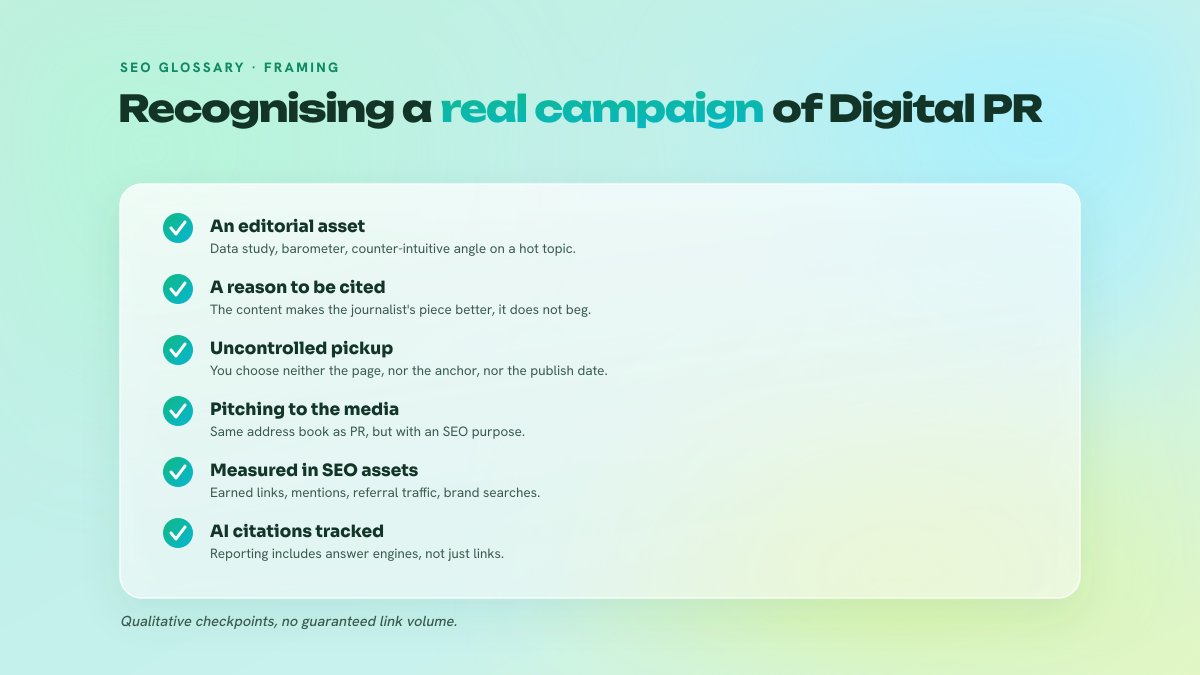
What digital PR actually is, beyond the agency deck
Digital PR is the discipline of giving journalists a reason to cover you: original research, a defensible expert take, a data set nobody else holds, timed to what their readers care about this week. The editorial coverage that follows carries links, brand mentions and citations you could never place by hand. That earned dimension is the entire point. Traditional press relations optimizes sentiment and clippings; digital PR optimizes search-facing outcomes: linked coverage on media that pass authority, unlinked mentions that feed brand signals, and increasingly, citations inside AI-generated answers.
For a quick visual grounding of the concept before we get into the operational detail, this walkthrough covers the fundamentals well.
The market has already voted on where this sits in the hierarchy. In Editorial.Link's 2025 survey of 518 SEOs, 48.6% named digital PR the most effective link building tactic, against 16% for guest posting and 12% for linkable assets. That gap is not fashion. It reflects where the hardest-to-replicate links now come from: anyone can order a placement, very few teams can get a national media to cover their study.
One number is worth pinning to the wall. Muck Rack's analysis of more than one million AI-cited links found that around 82% of citations in AI answers come from earned editorial coverage, while press releases account for under 1%. The wire release, historically the backbone of press relations, is functionally dead as a citation vehicle. What survives is the story a journalist chose to write.
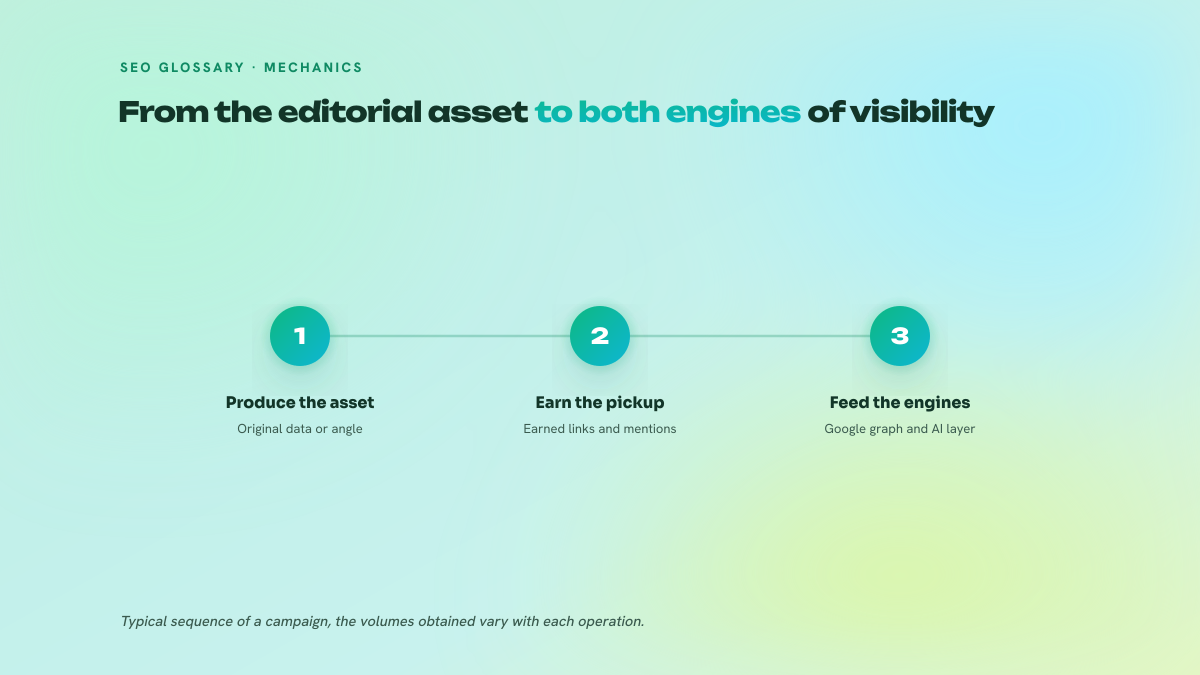
How it works in 2026: two scoreboards, one motion
A digital PR campaign in 2026 plays on two scoreboards at once. The first is classic organic search, where earned links from real newsrooms remain among the strongest authority signals a domain can accumulate. The second is AI-mediated search, and it has changed the economics of coverage. Google's AI Overviews expanded their citation surface considerably: industry tracking puts the average number of links per AI Overview at 15.2 in February 2026, up from 6.8 in November 2024. More citation slots means more chances for covered brands to appear inside the answer itself.
The signal weighting on that second scoreboard is the strategic shift. Ahrefs' study of 75,000 brands, published in August 2025, found branded web mentions correlate with AI Overview visibility at 0.664, versus 0.218 for backlinks: roughly a three-to-one difference. A follow-up extending the analysis to ChatGPT confirmed the pattern, with off-site brand signals consistently outperforming raw link counts. Practically, this means the unlinked mention in a top-tier media, long treated as a consolation prize by link builders, now carries measurable weight of its own. Digital PR is the only acquisition motion that produces both assets in the same campaign.
Practitioners feel the shift. BuzzStream's State of Digital PR 2026, surveying over 150 practitioners, found 68.2% consider digital PR more effective than twelve months earlier, up around 20 percentage points year over year, while 75% simultaneously say it has become harder to execute. Backlink acquisition remains the top goal for 85.8% of them, but 66.2% now also track AI citations as a KPI, a metric that essentially did not exist in the 2025 edition of the same survey. On the Google side, the direction of travel matches what Gary Illyes stated publicly in 2024: the engine needs very few links to rank a page, and link scoring leans on quality, relevance and trust rather than volume. Ten mediocre placements lose to one earned editorial link, and the gap widens every year.
Where digital PR sits in a netlinking operation
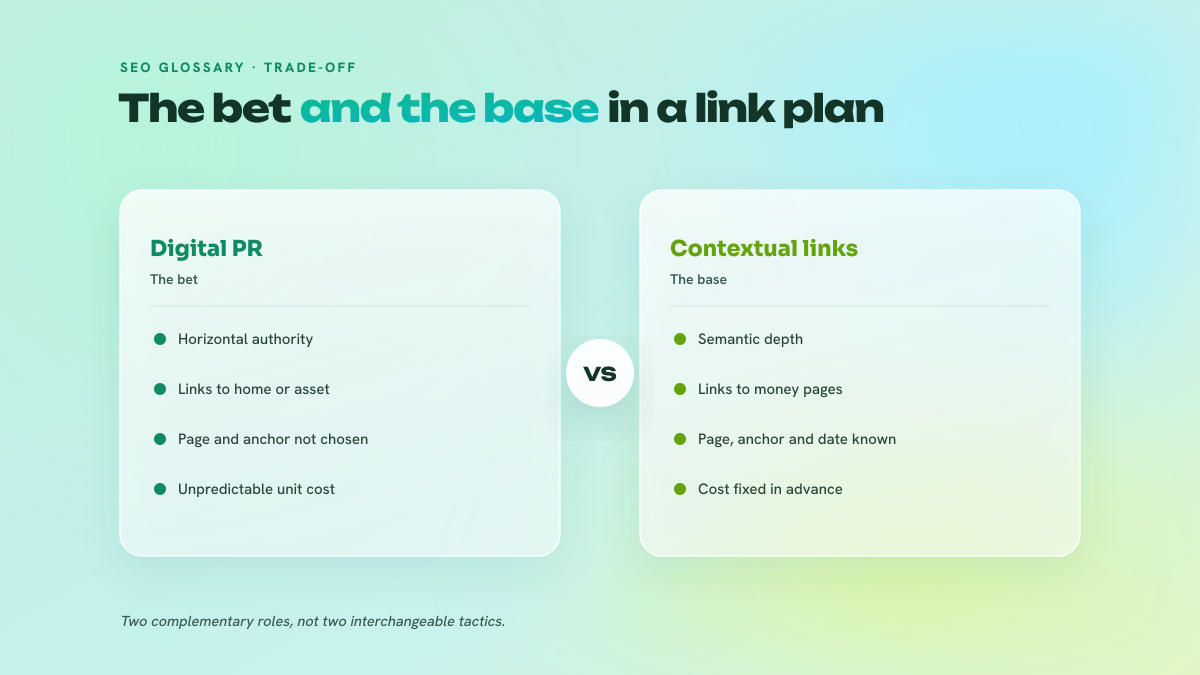
The honest limitation first: earned coverage cannot be targeted. You do not choose the anchor, the destination URL, or whether the journalist links at all. Most earned links point at your homepage or at the data asset itself, almost never at the commercial page that needs to move. A netlinking operation that runs on digital PR alone ends up with a homepage-heavy, anchor-diluted profile and money pages that stay flat.
That is why serious operations layer it. Digital PR builds the top of the authority stack: domain-level trust, brand signals, AI citation surface. Underneath, controllable placements do the precision work: sponsored editorial placements with negotiated anchors and target pages route that accumulated authority toward the URLs that convert. A classic guest post or a niche edit placed in an aged article fills the same role at different price points. The earned layer makes the controlled layer look natural; the controlled layer makes the earned layer commercially useful.
From what we see operating our own network of French editorial media at Nautilinks, the complementarity is visible in the data: sites that receive both earned mentions and calibrated editorial links consolidate rankings faster than sites fed exclusively on either. The transparent version of this trade, where you know exactly which media publishes what and when, is the part most of the market still obscures behind intermediaries.
Common mistakes we see in audits
The most expensive mistake is building the campaign for the client instead of the journalist. A study designed to flatter the brand's product category reads as advertising, and newsrooms have seen ten of them this week. The angle that lands is the one with genuine tension in it: a counterintuitive number, a regional disparity, a trend reversal. If the finding would still be interesting with your brand name removed, it is publishable. If not, it is a brochure.
Second: still leading with press releases. The Muck Rack data above puts releases at under 1% of AI-cited links, and our own outreach experience matches: a personalized pitch to twelve journalists on the right beat outperforms a release blasted to twelve hundred. Third: chasing domain authority without relevance. A personal finance brand that earns a viral pet-survey link collects a spike that never consolidates, because nothing about the coverage reinforces what the domain is supposed to be an authority on.
Fourth: treating digital PR as a stunt rather than a program. BuzzStream's 2026 data puts the typical timeframe for measurable results at 3 to 6 months, and the compounding effects, journalists who return for commentary, media that cite your annual study unprompted, only materialize when the motion repeats. A single hero campaign, however successful, buys a traffic anecdote. A quarterly data program buys a citation habit.
Running a campaign that actually lands
The sequence that works has not changed much; the bar for each step has. Start from an angle where you hold something proprietary: transaction data, survey access, operational numbers competitors cannot fake. Build the asset on your own domain, not the media's, so the coverage has somewhere durable to point. Build the press list on beat relevance, the journalist's last ten articles, not on the media's domain metrics. Then pitch individually, follow up once, and let the story travel.
This strategy walkthrough is a solid complement on the planning side, especially on choosing angles that survive editorial scrutiny.
On timing: Reporter Outreach's 2026 analysis, citing BuzzStream data, reports first placements typically going live within 2 to 3 weeks of launch, with 85.2% of practitioners seeing measurable results within six months. Budget accordingly. The median digital PR retainer sits around $5,458 per month, roughly 60% of teams run under $10,000 monthly, and the share of programs above $20,000 nearly doubled year over year, from 4% to 8.8%, as coverage gets harder to earn. Teams that cannot sustain that burn are usually better served spending part of it where outcomes are deterministic, for example when you pick individual media from a public catalogue and deal directly with the publisher, and reserving earned campaigns for the quarters where a genuinely newsworthy asset exists.
Measuring what it returns
Cost per earned link is the metric that keeps agencies honest. BuzzStream's 2026 survey puts the most common known band at $300 to $500 per link, reported by 19.6% of teams, with the agency-side average around $750. The trend matters more than the snapshot: the share of teams reporting $750+ per link jumped from 3% to 10.2% in a single year. Earned links are being repriced upward, which is precisely why they retain their signal value: what gets expensive to fake stays trustworthy to Google.
But cost per link alone undersells the channel in 2026. A complete scorecard counts linked coverage, unlinked brand mentions, net-new referring domains versus repeat media, branded search volume movement, and AI citations, the KPI two thirds of practitioners now track. Given the Ahrefs correlation data, an unlinked mention in a media AI systems already cite is an asset a paid placement cannot substitute for. The reporting discipline is to attribute each of these to the campaign window, then compare against what the same budget would have produced if used to calibrate a link acquisition campaign over several months on the controlled side of the stack. Neither answer wins universally; the ratio depends on how newsworthy your vertical actually is.
For a grounded view of what real money buys in this channel, this practitioner retrospective on a six-figure digital PR spend is one of the more honest accounts available.
The uncomfortable conclusion for anyone still running 2019 playbooks: digital PR got harder, pricier and more valuable simultaneously. The teams winning at it treat it as a permanent editorial function with a research budget, not a link building line item with a press list attached.
Nautilinks operates an owned network of editorial media. In-house written articles, transparency disclosures respected, anchor mix calibrated.
Frequently asked questions
Is digital PR worth running on a sub-$10k monthly budget?
Yes, and you would be in the majority: BuzzStream's 2026 survey shows roughly 60% of teams operate under $10,000 per month, with a median retainer near $5,458. The constraint is cadence, not viability. At that level, run one well-built data campaign per quarter instead of monthly stunts, and spend the interim on journalist relationships and reactive expert commentary, which cost time rather than production budget.
How does digital PR differ from guest posting in what it actually buys?
Guest posting buys a placement you fully control: media, anchor, target URL, publication date. Digital PR buys an outcome you influence but never control: the journalist decides whether to link and where. In exchange, you get media that never sell placements, plus unlinked brand mentions that Ahrefs' 2025 data shows correlate far more strongly with AI visibility than backlinks do. They are different instruments, not substitutes.
Should unlinked brand mentions count as campaign results?
In 2026, unambiguously yes. Ahrefs' 75,000-brand study found branded web mentions correlate with AI Overview visibility at 0.664 versus 0.218 for backlinks. An unlinked mention in a media that AI systems already cite is a durable visibility asset. Report linked and unlinked coverage separately, but count both, and track whether mentions later convert to links through a reclamation pass.
What is a realistic cost per earned link right now?
Per BuzzStream 2026, the most common known band is $300 to $500 per link, with the agency-side average around $750, and the share of teams paying $750+ more than tripled year over year. Anyone quoting $50 earned editorial links is describing something else, usually placements dressed up as earned coverage. Benchmark against your controlled-placement costs and judge each channel on what it uniquely delivers.
How long before a campaign produces something I can put in a report?
First placements typically land within 2 to 3 weeks of pitching, per Reporter Outreach's 2026 analysis of BuzzStream data, but the honest reporting window is 3 to 6 months: 85.2% of practitioners see measurable results within six months. Rankings and branded search movement lag the coverage itself. Set stakeholder expectations on the six-month horizon and report coverage velocity as the leading indicator in between.
Does a strong digital PR program make paid placements unnecessary?
No, because earned links rarely point where revenue lives. Journalists link homepages and data assets, not category or service pages. The pattern we see work is layered: earned coverage builds domain trust and AI citation surface, while controlled editorial placements route that authority to commercial URLs with precise anchors. Programs that drop the controlled layer end up authoritative and commercially flat at the same time.
Test your knowledge
Quiz: Digital PR
1/3According to Ahrefs' August 2025 study of 75,000 brands, how did branded web mentions compare to backlinks as a correlate of AI Overview visibility?