- →The March 2024 spam updates named guest-post sites and link farms explicitly; the scaled version of the tactic is over, the editorial version is tolerated.
- →Google's own documentation classifies « articles, guest posts, or press releases distributed on other sites with optimized anchor text » as link spam when built to manipulate rankings.
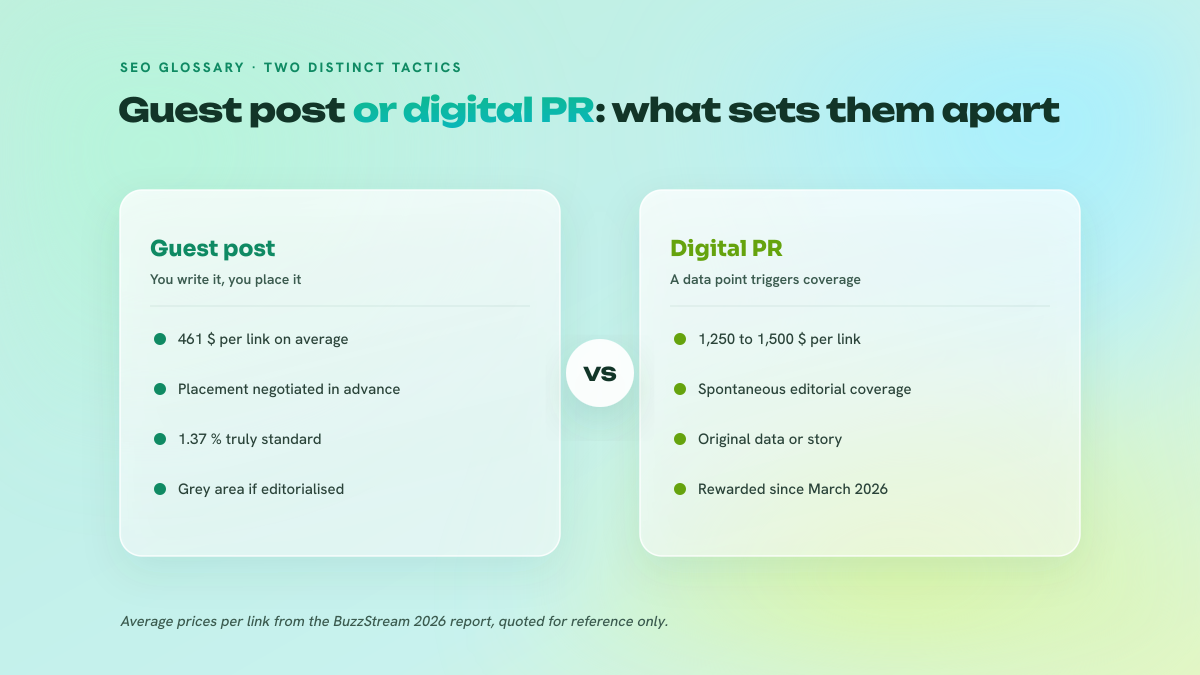
- →Pricing has bifurcated: BuzzStream's 2026 report puts the average paid guest-post link at 461 dollars, but only 1.37% of opportunities met quality standards.
- →SpamBrain now weighs link velocity, so the rhythm of your placements matters as much as the source quality of each one.
- →Guest posting is a relationship and audience play first, a link play second; when you invert that order you buy the risk without the durability.
- →For most 2026 campaigns, digital PR and editorial network placements beat generic guest posts on the same budget.
What guest posting actually is now
Strip away the tutorial-blog framing and guest posting is a simple transaction with a complicated 2026 context: you write an article, a third-party site publishes it under your byline or as sponsored content, and somewhere in that article sits a link back to a page you care about. That has been the shape for fifteen years. What changed is not the mechanic, it is what Google does with it.
The March 2024 core and spam updates are the pivot everyone in netlinking should have internalised by now. Google introduced three new spam categories at once: scaled content abuse, expired domain abuse, and site reputation abuse. In its own communication around that release (Google Search Central, March 2024) the company said the goal was to cut a large share of low-quality, unoriginal content from Search, and it named link farms and guest-post websites as targets. This was not a subtle signal. The entire inventory of « write for us » blogs that existed only to sell links became a liability rather than an asset.
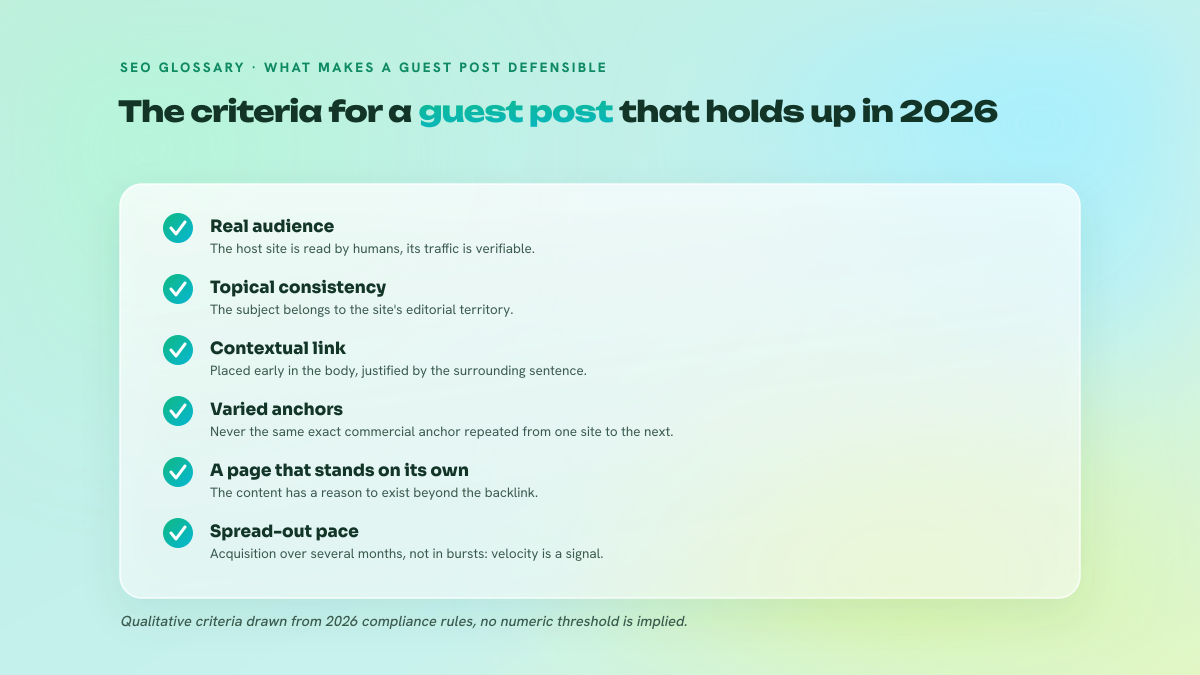
So the honest definition in 2026 is this: guest posting is an editorial placement on a real publication with a real audience, where the link is a byproduct of genuinely useful content. Everything that does not fit that description is what Google now calls link spam, and its documentation is explicit that articles or guest posts distributed with optimised anchor text to manipulate rankings fall inside the policy. If you remember one line, remember that one.
How the mechanics work in 2026
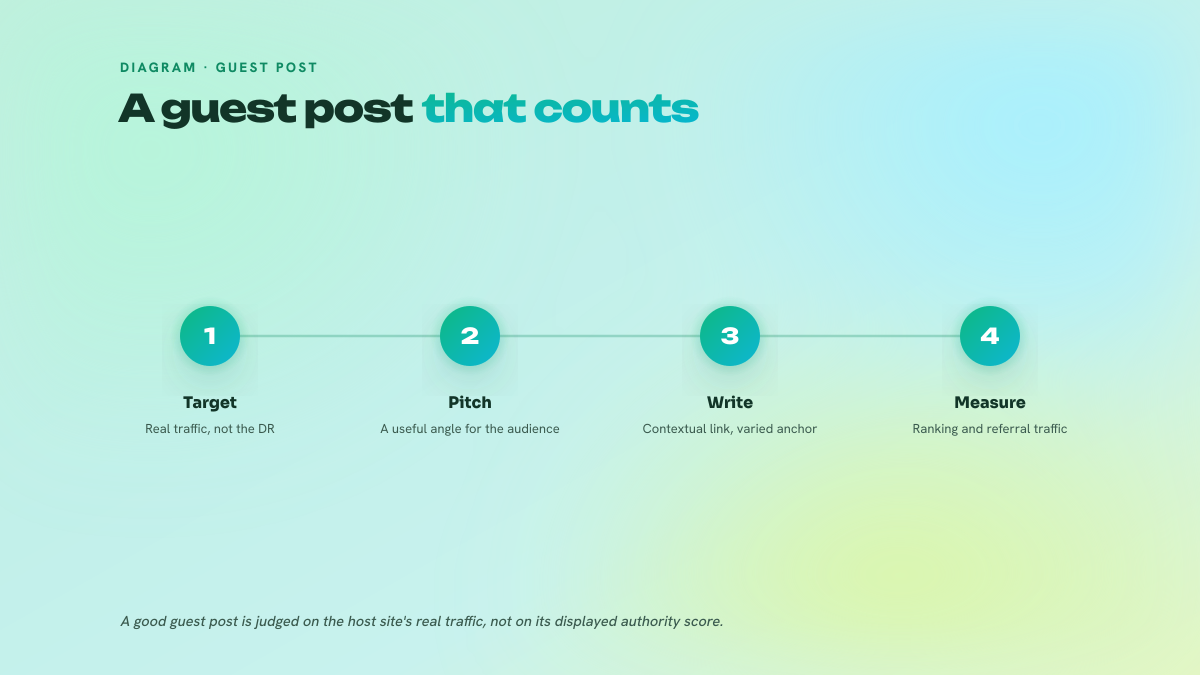
The workflow has not disappeared, it has narrowed. You identify a site with topical relevance to your target page, you study its editorial standards, you pitch a specific angle rather than a recycled listicle, you write something that would earn its place without the link, and you place a single contextual link with a natural anchor. The difference from 2018 is that each of these steps now carries a filter that did not exist before.
The first filter is velocity. Google's SpamBrain now looks at link acquisition rhythm, and unnatural patterns (a dormant domain suddenly earning hundreds of links in days) are a documented trigger independent of the quality of any single link. This is why a senior operator paces placements over months rather than firing a batch. If you want to understand why rhythm matters more than raw volume, our note on inserting links into existing articles covers the adjacent tradeoff, because insertions and guest posts feed the same velocity curve.
The second filter is the site reputation abuse policy. Google clarified in November 2024 that publishing third-party pages to exploit a host's authority is spam even when the host's own editors are involved, which closed the « first-party oversight » loophole that large media sites had leaned on. Enforcement started manual in 2024 and became increasingly algorithmic through 2025, with the August 2025 spam update cited as the culmination of that shift. The practical consequence: a link from a big-name domain in a section that Google has flagged as a parasite operation can be worth nothing, or worse than nothing.
The third filter is measurable quality, and this is where the money conversation starts. If you are commissioning placements, you want to browse the source before you pay, not after. That is the whole reason we let people work from the catalogue of media you can inspect before spending anything: real traffic, real editorial line, no black box. The alternative, buying from a broker who names the domain only after payment, is how you end up paying for the 98.6% of inventory that BuzzStream's 2026 report found did not meet quality standards.
Where it fits in a netlinking operation
Guest posting is still a legitimate lever, but its position in the stack has moved down. In a 2026 campaign we treat it as one instrument among several, chosen when the goal is contextual relevance and a controlled anchor on a topically aligned page, not when the goal is raw authority transfer. For raw authority you have better tools, and for defensibility you have press-driven coverage that earns links through original data, which the March 2026 classifiers appear to reward over generic editorial guest posts (industry analysis of the March 2026 spam change, DigitalApplied, 2026).
Where guest posting genuinely earns its place is the mid-funnel of a topical cluster: you have a money page, you have supporting content, and you want a handful of contextual signals from sites your audience actually reads. Here the tactic does what a raw metric-chase never will, because it also produces referral traffic and, occasionally, a real relationship with an editor. The link is the floor of the value, not the ceiling.
This is also where an owned network changes the maths. When we place an article inside Stringer, we are not renting authority from a stranger's domain, we operate the media ourselves, so the editorial line, the velocity, and the internal linking are all controlled rather than negotiated. That is a structurally different risk profile from buying a one-off guest slot on a site you will never see the analytics of. If your objective is a paced, editorial motion, calibrating a campaign across several months beats a spray of individually purchased posts, because the pacing itself is the compliance strategy.
What we see go wrong
The most common failure is writing for the backlink and nothing else. When the article exists only as a delivery vehicle for the link, three things happen: the content is thin, the anchor is over-optimised, and the host site accumulates a pattern of exactly these placements. Any one of those is a flag. Together they are a case study in what the March 2024 policy was built to catch. The fix is not clever, it is discipline: the article must be something you would publish even if the link were nofollow.
The second failure is ignoring the host's guidelines and editorial standards. Peers who treat every site as an identical drop target send the same generic pitch everywhere, get accepted only by the sites that accept everyone, and end up on precisely the low-quality inventory Google has devalued. The sites worth appearing on have standards, and clearing those standards is the signal that the placement is worth something.
The third failure is price naivety. The 2026 numbers are worth internalising. BuzzStream's 2026 report puts the average paid guest-post link at 461 dollars, and a genuinely high-quality placement (strong DR plus real traffic) at around 3,130 dollars. Adsy's 2026 study of 52,671 websites found the average guest-post price rose 7.5% year over year, from 427 dollars in 2025 to 459 in 2026, with the steepest increases on high-authority sites (DR 81 to 90 up 46%). If someone offers you a « DA 60 guest post » for 40 dollars, the price is telling you what Google already knows about that domain. Cheap inventory is cheap because it has been devalued, not because you found a bargain.
The fourth failure is confusing a sponsored article with a covert one. There is nothing wrong with paid placement done transparently, and an honest, clearly editorial sponsored article that reads as real journalism is a defensible asset. What gets sites demoted is the pretence: dressing a paid link scheme as organic editorial across a section of a host domain. That is the exact behaviour now under EU DMA scrutiny after publishers complained about demotions (Search Engine Land, November 2025).
Is guest posting worth it in 2026?
The honest answer is: yes, narrowly, and no, broadly. Mass guest posting for links is effectively over, and Google's 2025 to 2026 documentation says so in almost those words. The March 2026 spam update, the fastest on record at roughly twenty hours, was framed as a tightening of the March 2024 rules rather than a new policy, which tells you the direction of travel is enforcement, not relaxation.
But the editorially justified, contextually linked, genuinely useful guest article still sits in what the 2026 compliance guides describe as a gray but tolerable zone. It works when it is indistinguishable from content the host would have commissioned anyway. It fails the moment it looks like a link in a costume. For a working SEO, that means the tactic is no longer a volume play and never will be again. It is a relationship and audience play with a link attached, and it should be budgeted, paced, and quality-gated accordingly. Run it that way and it earns its keep. Run it the 2018 way and you are buying the next deindexation.
Nautilinks operates an owned network of editorial media. In-house written articles, transparency disclosures respected, anchor mix calibrated.
Frequently asked questions
Is guest posting real or fake as a ranking tactic?
It is real, but the version that worked at scale is gone. A single editorial placement on a relevant, real-audience site still passes a legitimate signal. The « fake » version is the network of write-for-us blogs that exist only to sell links, which the March 2024 spam updates explicitly targeted. If the article would not exist without the link, Google treats it as link spam, and increasingly detects it.
How much should I expect to pay for a quality guest post in 2026?
BuzzStream's 2026 report puts the average paid guest-post link at 461 dollars, and a genuinely high-quality placement at around 3,130 dollars. Adsy's 2026 study of 52,671 sites found an average of 459 dollars, up 7.5% year over year. Anything priced at a few tens of dollars is signalling that the domain has already been devalued. Price tracks real traffic and editorial standards, not claimed DA.
Does guest posting still trigger a manual action risk?
The risk shifted from manual actions toward algorithmic demotion. Google's site reputation abuse policy, clarified in November 2024, treats third-party pages published to exploit a host's authority as spam even with editor involvement. Enforcement became more algorithmic through 2025. The exposure now is a section or site quietly losing rankings, which is harder to diagnose than a manual penalty notice in Search Console.
How do I keep guest posting compliant with link velocity signals?
SpamBrain weighs the rhythm of link acquisition, and a dormant domain suddenly earning hundreds of links in days is a documented trigger. Pace placements over weeks and months rather than in batches, vary sources, and keep anchors natural rather than exact-match. The velocity curve should look like a site that earns links over time, because that is what an editorially healthy domain actually does.
Guest post or digital PR: which should I fund first?
For defensibility in 2026, digital PR usually wins. Industry analysis of the March 2026 spam change reported Google's classifiers rewarding links earned through original data and press-style coverage over generic editorial guest posts. Guest posting still fits the mid-funnel of a topical cluster where contextual relevance matters, but if your budget forces a choice, editorially earned coverage ages better than a purchased placement.
Test your knowledge
Quiz: Guest posting in 2026
1/3Which three spam categories did Google's March 2024 updates introduce that reshaped guest posting?