- →A Private Blog Network (PBN) is a set of sites created or bought back with the sole purpose of pushing links to a target site. A controversial practice, with a real penalty risk.
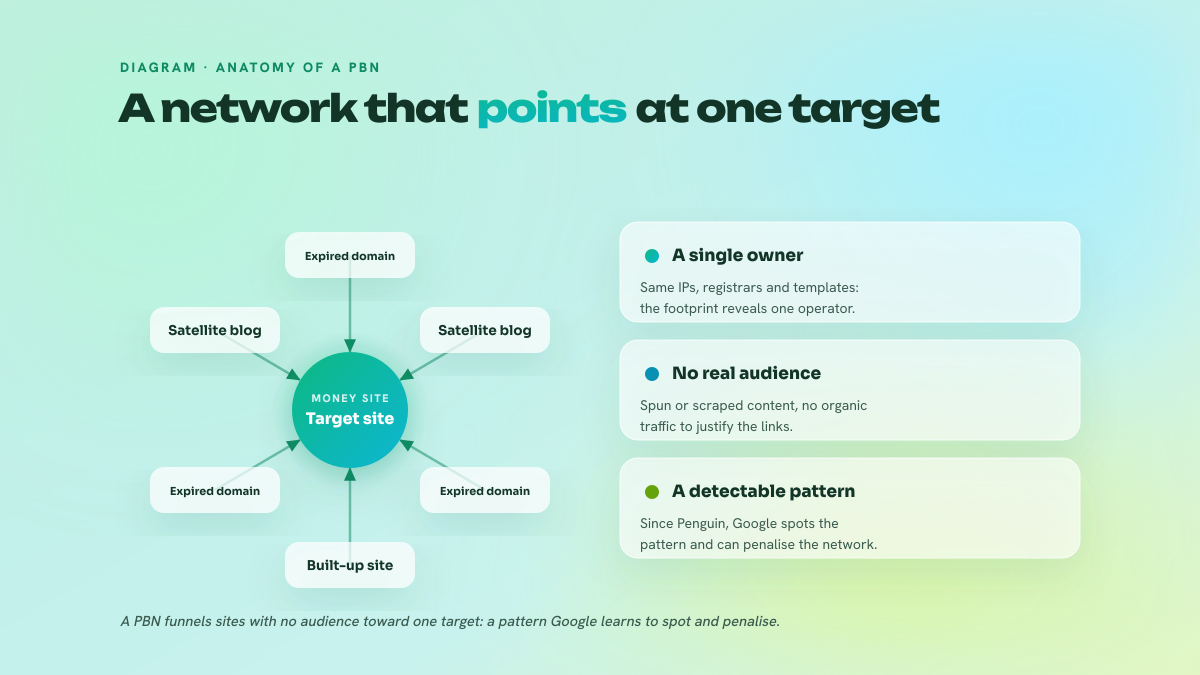
- →Typical traits: sites with generated or scraped content, little or no real organic audience, visible technical footprints (same IPs, same templates, etc.).
- →Google detects low-cost PBNs with growing efficiency since Penguin in 2012. Penalties can hit the PBN itself but also the target sites.
- →An editorial media network operated seriously, with real audience and original content, is not a PBN in the pejorative sense. That's the difference between a low-cost PBN and an owned editorial network.
Definition of a PBN
A Private Blog Network, abbreviated PBN, describes a set of websites created or bought back with the sole purpose of pushing links to a target site that the network's operator wants to promote. The name emphasises the network's private nature: its existence is known only to its operator, who uses the sites for their own SEO interest or to sell link placements.
In its pejorative usage, the term PBN specifically describes networks made up of sites without a real editorial project. Expired domains bought back for their historical backlink profile, sites built en masse with generated or scraped content, low-cost hosting, identical WordPress templates. Those networks have no purpose other than netlinking, and their sites have no real organic audience.
That pejorative definition should be distinguished from a network of seriously operated editorial media. When an operator runs several sites with a real editorial line, original content, measurable organic audience and regular publishing, you're no longer in the problematic PBN category. To see how our owned editorial network differs from a PBN in practice, the distinction is made on the editorial reality of the sites, not on their shared belonging to a single operator.
How a classic PBN works
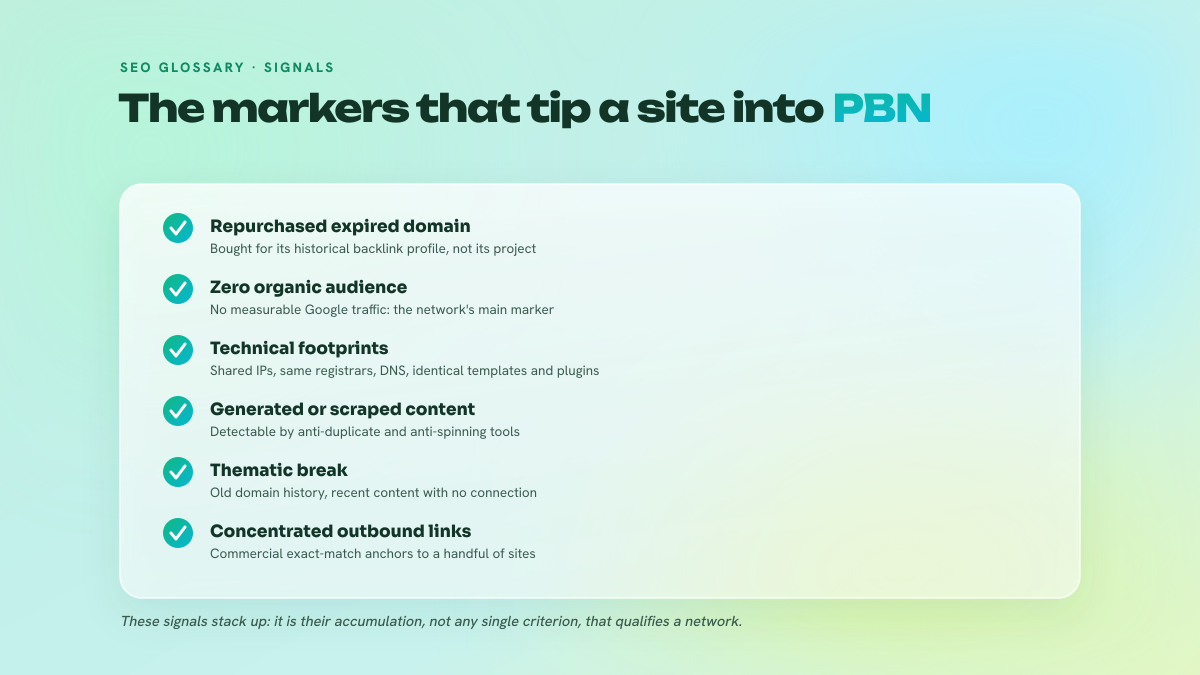
A classic PBN is built in several steps. The operator first identifies interesting expired domains, either through their history (former high-traffic sites with strong backlink profiles), or through their topical fit with the target. Acquisition runs through drop-catching tools or domain auctions.
Once the domain is acquired, the operator builds a site on it. In the low-cost version, content is generated automatically or scraped from other sites, the WordPress template is standardised, hosting sits on shared IPs. In more polished versions, content is commissioned from offshore writers, but the absence of real organic audience remains the main marker.
The network thus built serves to push links to target sites. Either for the operator's own projects, or to sell to third parties through opaque netlinking marketplaces. Anchors are often commercial exact-match, which compounds the manipulation signal.
SEO risks
The first risk is algorithmic penalty on the PBN itself. When Google identifies a network as such, it can devalue or de-index its sites. All links sent from that PBN then instantly lose their value. Target sites that depended on them see their positions drop.
The second risk is direct penalty on target sites. If Google considers the target site knowingly fed its profile with links from an identified PBN, it can apply a manual or algorithmic penalty to the target site itself. Recovery takes months of corrective work (disavow, reconsideration request).
The third risk is lost investment. Buying or maintaining a PBN costs money (domain purchase, hosting, content). If the network is identified and de-indexed, the entire investment is lost in a few days. The risk/reward ratio is particularly unfavourable compared to serious editorial alternatives.
How Google detects PBNs
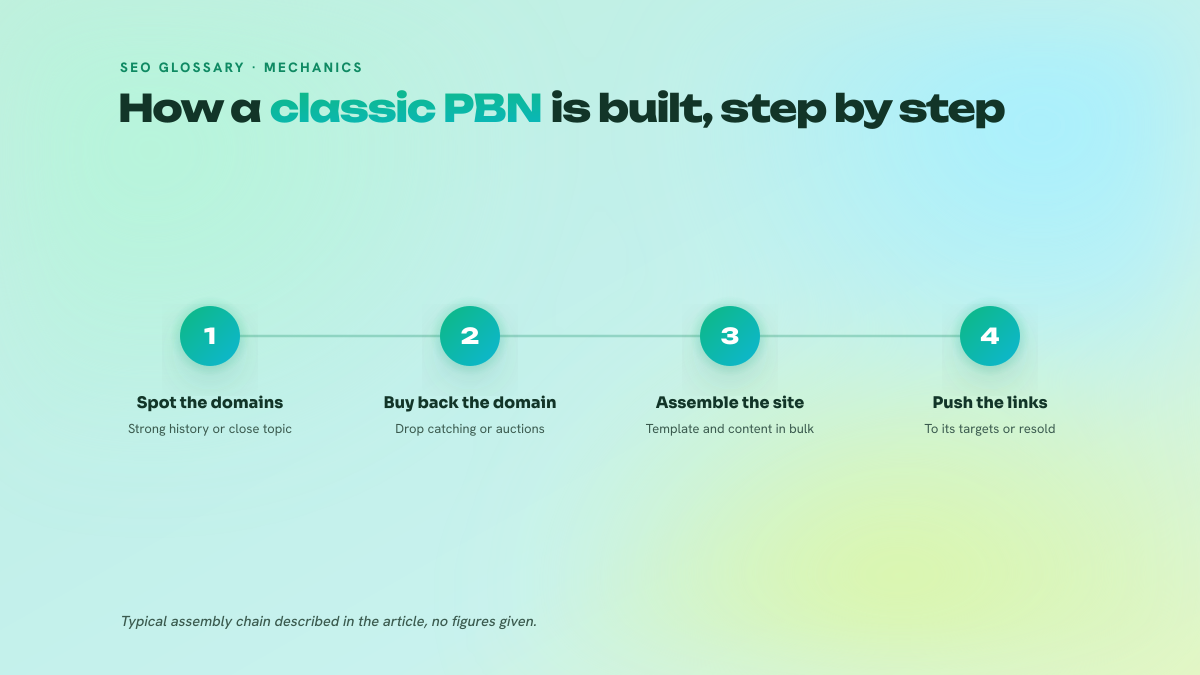
Google has invested heavily in PBN detection since the 2012 Penguin update. Detectors rely on several categories of signal. Technical footprints first: shared IP addresses, common registrars, similar DNS configurations, same WordPress templates, same plugins, same hostings. Those signals are relatively easy to identify at scale.
Content patterns next. A site with an old domain history but recent content radically different from the original topic is suspicious. Generated or scraped content gets caught by anti-duplicate and anti-spinning detectors. Overall editorial poverty (few pages, no updates, no identified authors) is an additional signal.
Link patterns finally. A site whose outbound links almost all point to a handful of commercial sites, with commercial exact-match anchors, in low editorial value articles, signals paid-placement activity. Those patterns have become very visible with modern network-analysis tools.
Owned editorial network vs PBN
An editorial media network operated seriously is not a PBN in the pejorative sense. The difference shows on several concrete dimensions. Real organic audience first: the network's sites have their own measurable Google traffic, which is impossible to fake durably. An identifiable editorial line next: each site treats its topics under its own angle, with recognisable authors, regular publishing.
Original content written by the editorial team, rather than generated automatically or scraped, marks the clearest line. When each article is written to serve a topic and commercial links integrate within a coherent editorial context, you move away from the PBN model. The format gets close to the recognised advertorial in traditional media.
Editorial transparency finally. Transparency disclosures on paid content, rel=sponsored tags on commercial links, clear terms on the economic model. All those practices are what define a genuine editorial network rather than a risky PBN, and that's the position Nautilinks defends.
Nautilinks operates an owned network of editorial media. In-house written articles, transparency disclosures respected, anchor mix calibrated.
Frequently asked questions
Are all site networks PBNs?
No. The term PBN in its pejorative usage specifically describes networks of sites created or bought back without a real editorial project, with the sole purpose of pushing links. An editorial media network operated seriously, with editorial team, organic audience and its own editorial line, is not a PBN in that sense. The difference shows in a few minutes of reading.
Is Nautilinks a PBN?
No. We operate thematic editorial media with real, measurable organic audience, original content written by our team, identifiable editorial lines. The network's sites publish regularly, treat their topics in depth, have their own organic search activity. It's an owned network, not a low-cost PBN.
Why are classic PBNs risky?
Three main reasons. First, their technical footprint is often detectable (same IPs, same WordPress templates, same hostings, same patterns). Second, their generated or scraped content is spotted by anti-spam algorithms. Third, their outbound link profiles concentrated on a few target sites betray the commercial nature. An algorithmic update can take down the entire network at once.
How do I recognise a site that belongs to a PBN?
Several signals. The site has an old domain but the current content is recent and inconsistent with the historical record. Organic audience is null or laughable while authority metrics (DR, TF) are high. Content sounds generic or generated. The writing has no identifiable human signature. Outbound links almost all point to commercial sites in a paid-placement logic.
Is buying a link from a PBN dangerous?
Yes. If Google identifies the PBN as such, it can devalue or penalise all sites that received links from it. The cost isn't just losing the link, it's the possible algorithmic penalty that's hard to correct. The risk/reward ratio is unfavourable, especially given the serious editorial alternatives that exist on the market.
Test your knowledge
Quiz: Private Blog Network
1/3A client shows you a backlink portfolio where 12 referring domains share the same C-class IP, use three recurring WordPress templates, and have no organic traffic in Ahrefs. What is the most likely diagnosis?