- →You pay for a host page's accumulated age and topical context, not for content, so vet the specific page, not the domain's headline DR.
- →2026 pricing: insertions averaged 179 dollars vs 461 for guest posts (BuzzStream, 2026), but 97.5 percent of insertion-selling sites were low quality.
- →Only 0.34 percent of sites in BuzzStream's 2026 sample were high quality and willing to place an insertion: the good publishers mostly refuse.
- →Adoption is fading, with single-digit to low-teens preference across 2026 surveys, well behind digital PR.
- →Treat insertions as a paced volume tool, not a flagship tactic, and keep anchors descriptive to avoid an exact-match footprint.
- →The March 2026 Spam Update named paid insertions and PBNs explicitly, so buy pages that would rank without your money in them.
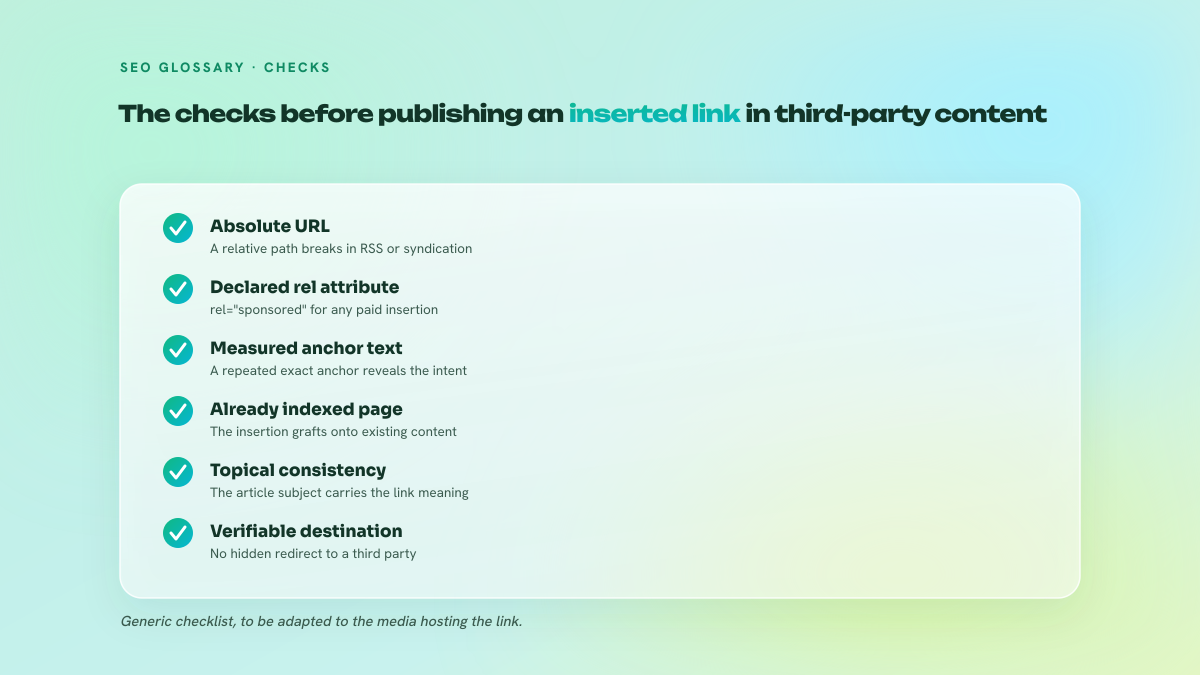
What a link insertion actually buys you
A link insertion means slotting your link into a page that already exists, already ranks, and already carries age and internal signals, instead of commissioning a fresh article to host it. That is the whole proposition: you are not paying for content, you are paying for the equity a page has accumulated since it was published. In a 2026 workflow this is the fast lane of link building, and also the corner Google watches most closely.
The industry also calls this a niche edit, and the two terms are interchangeable in every marketplace you will deal with. If you want the mechanical distinction, read our entry on how a niche edit is placed inside aged content. The short version: same tactic, different label depending on who is selling it.
This short primer walks through the definition and a concrete example if you want the ground-level version first.
What you are really buying is a shortcut past the indexing and trust-building delay of a brand-new page. A guest post lands on a URL with zero history; an insertion lands on a URL that may have three years of crawl depth, existing backlinks, and topical context wrapped around your anchor. That context is the point. A link dropped into a paragraph that already discusses your subject reads as editorial. A link dropped into a thin page built last week to sell placements reads as exactly what it is.
The signals that transfer are the host page's own authority and its topical fit, not the domain's headline metric. A DR 60 domain with an insertion buried on an orphaned, rarely-crawled page passes far less than a DR 35 domain placing you inside a well-linked, frequently-crawled article. This is why buying insertions off a DR filter alone is a beginner move. That specific page, not the domain, is what carries your link.
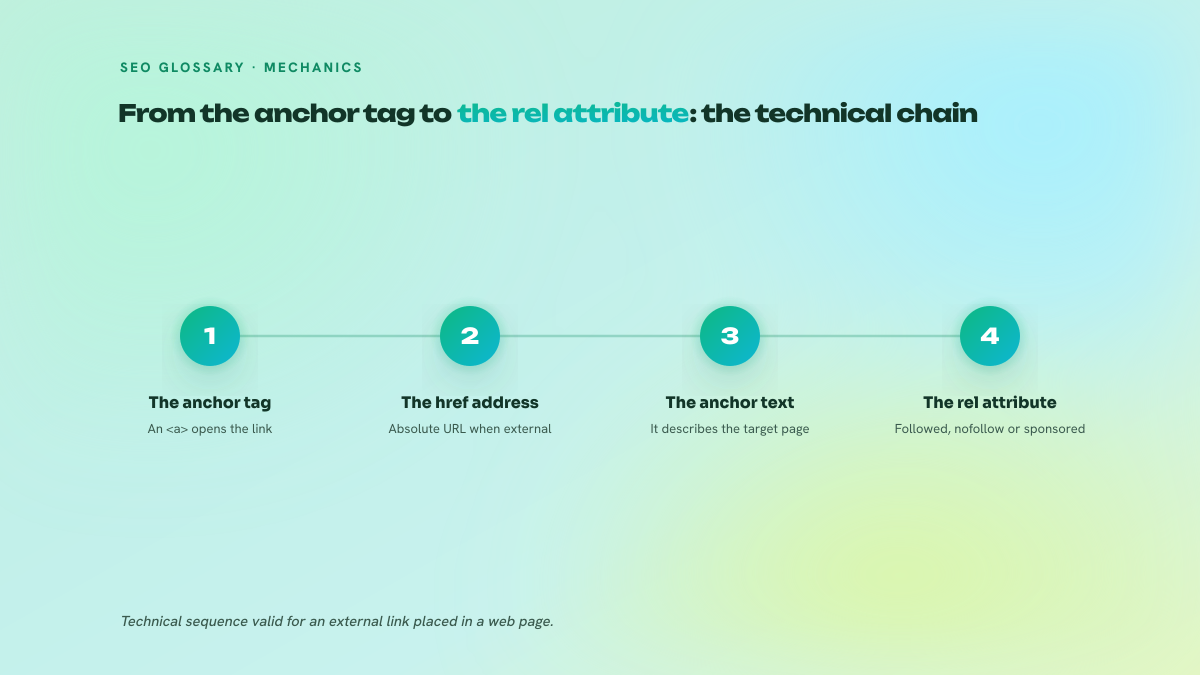
How it works, and what it costs, in 2026
Mechanically, an insertion is trivial: the publisher opens an existing post, adds a sentence or edits one, drops your anchor and link, republishes. The negotiation is where the value sits. You are choosing the host page, the surrounding sentence, and the anchor, and each of those decides whether the link ages well or gets discounted.
Neil Patel frames where link acquisition sits inside a wider strategy, useful context before you weigh cost against effect.
On price, insertions are consistently cheaper than guest posts, and the gap is documented. BuzzStream's 2025 data put the average insertion at around 141 dollars against 365 dollars for a guest post. Their 2026 dataset of 421,259 marketplace sites raised the average insertion to 179 dollars versus 461 dollars for a guest post (BuzzStream, 2026). Adsy's 2026 study of 52,671 websites landed in the same territory: 225 dollars for a niche edit against 459 dollars for a guest post, roughly 56 percent cheaper (Adsy, 2026).
Two numbers from that BuzzStream 2026 set matter more than the averages. Insertions were sold on only 14.9 percent of sites, and 97.5 percent of the sites selling them were low quality, leaving just 143 sites, or 0.34 percent of the sample, that were genuinely high quality and willing to place an insertion (BuzzStream, 2026). Read that as a market signal: the good publishers mostly do not sell edits into their real editorial, so most of what is on offer is placement-farm inventory. Price by DR confirms it, with DR 0-9 insertions averaging 113 dollars (BuzzStream, 2026). When you buy cheap, you are usually buying a page nobody reads.
This is where the sourcing model matters. Buy through a marketplace and the low-quality skew above is the pool you are fishing in. If you buy a placement straight from the publisher, you at least know the page, its traffic, and the surrounding content before you commit. At Nautilinks we operate the media in-house, so an insertion goes into a page we wrote and control, not one sourced blind from a reseller. Practically, vetting a host page takes five minutes: pull the page's own organic traffic and keyword rankings, count the existing outbound links, read the paragraph your link will sit in, check the last-modified date. If the page has no rankings, no traffic, and a wall of outbound links, the price is irrelevant.
Link insertion vs guest post vs digital PR
The honest comparison the top-ranking guides dodge: insertions win on speed and cost, lose on control and, increasingly, on peer esteem. A guest post lets you write the entire article around your link and pick the exact context; an insertion takes an existing page as-is. Read our take on when a full guest article earns its higher price for the other side of that trade.
Adoption data shows insertions sliding down the preference ranking. uSERP's State of Backlinks survey of 800 SEOs found insertions making up about 10 percent of tactics used (uSERP, 2025). Editorial.link's 2026 survey of 518 practitioners had niche edits rated most effective by only 9.4 percent, against 48.6 percent for digital PR and 16 percent for guest posting. Reporter Outreach's 2026 survey of 500 SEOs was slightly kinder, with 14 percent naming insertions their best-performing method, still behind digital PR at 34 percent and guest posts at 18 percent. The trend across every survey is the same: digital PR has taken the top spot, and insertions sit in the single digits to low teens.
One underrated upside of insertions on real pages is referral traffic. A link inside an article that pulls steady organic visits sends actual clicks, not just PageRank, and that traffic is a signal in its own right. This only holds when the host page has readers, which loops back to the same quality problem. On placement-farm inventory the referral value is zero because nobody visits the page.
Our stance: insertions are a volume and velocity tool, not a flagship. Use them to fill the middle of a link profile at a paced cadence, and reserve budget for the one or two links that actually move the needle. Blending the two is what planning acquisition over several months is for. Treat insertions as your whole strategy and you inherit the quality skew of the marketplace.
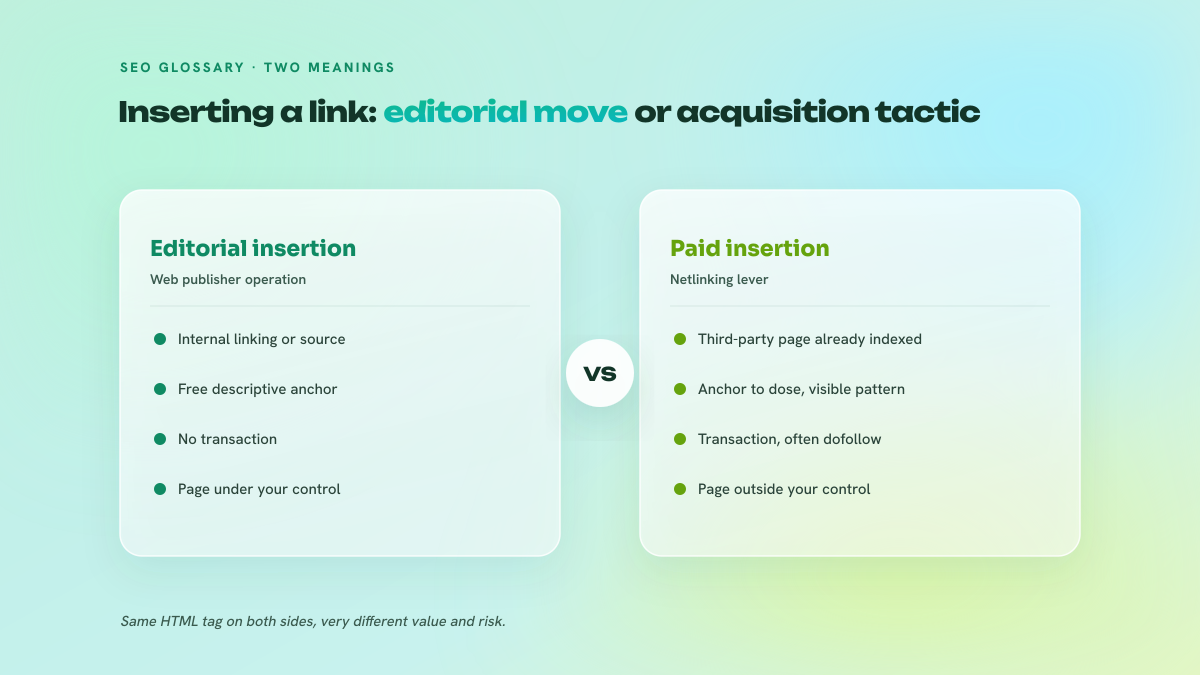
Finding insertion opportunities without leaving a footprint
The prospecting is well-trodden: search operators to surface topically relevant pages, competitor backlink analysis to find who already links to comparable content, broken-link reclamation to offer a replacement, and brand-mention monitoring to convert an unlinked mention into a link. None of that is secret.
The walkthrough below covers practical ways to surface pages worth pitching.
What the tutorials skip is the footprint problem. If every insertion you buy sits on a page whose only reason to exist is selling edits, and those pages share hosting, template, or outbound-link patterns, you are building a detectable cluster. Google's SpamBrain works at network level, and the March 2026 Spam Update explicitly named paid link insertions and PBNs among its core targets (Google, 2026). The defensible insertion is the one on a page that would exist and rank without your money in it. Prospecting that filters for real editorial pages, not for cheap availability, is the only version of this tactic worth the risk.
Where link insertion goes wrong
The recurring failure is buying the discount and ignoring the host. An insertion on a low-DR, low-traffic page that exists only to sell links passes almost nothing and adds to a footprint. The BuzzStream 2026 finding that 97.5 percent of insertion-selling sites are low quality is not a curiosity, it is the base rate you fight on every order.
The second failure is anchor greed. Aged pages tempt people into exact-match anchors because the surrounding context looks relevant, but a sudden run of commercial exact-match anchors across insertions is one of the cleaner patterns for an algorithmic discount. Keep anchors descriptive and varied, the way a real editor would phrase them.
The third is treating insertions as permanent. A publisher who sold you an edit can quietly remove it, and unlike a guest post you rarely control the page. Google's site reputation abuse enforcement, framed in its November 2025 parasite-SEO update, also means a host site can lose its own standing and drag your link's value down with it (Google, 2025). Monitor placement survival, not just placement acquisition. For links you actually want to keep, an editorial placement you can see and audit beats an anonymous marketplace edit every time.
Nautilinks operates an owned network of editorial media. In-house written articles, transparency disclosures respected, anchor mix calibrated.
Frequently asked questions
What is an example of a link insertion?
A three-year-old article on a gardening site already discusses raised beds. The publisher edits one sentence to add your anchor, linking to your compost-bin page. No new content is written, yet your link now sits inside aged, topically relevant text that already ranks and gets crawled. That editorial context is what separates a real insertion from a link dropped on a thin page built purely to sell placements.
Link insertion vs guest post, which should I choose?
Choose an insertion for speed, cost, and instant placement on an aged URL. Choose a guest post when you need full control over the article, the context, and the anchor. Insertions averaged 179 dollars against 461 for guest posts in BuzzStream's 2026 data. In practice, use insertions for volume in the middle of a profile and reserve guest posts or digital PR for the one or two links meant to move rankings.
Does link insertion still work in 2026?
Yes, on real pages. An insertion into an article with rankings, traffic, and topical fit still passes equity and referral clicks. What no longer works is buying cheap edits on placement-farm pages: SpamBrain discounts those patterns at network level, and the March 2026 Spam Update named paid insertions directly. The tactic works, the discount inventory mostly does not, and telling the two apart is the whole job.
How much should I pay for a link insertion?
Benchmarks cluster around 179 to 225 dollars on average (BuzzStream and Adsy, 2026), but price should track the host page, not the domain. A page with real organic traffic and tight topical relevance is worth several hundred; a DR 0-9 page averaging 113 dollars usually passes nothing. Pay for the page's readers and rankings, not for a headline domain metric that says nothing about the URL your link actually lands on.
Is a niche edit the same as a link insertion?
Yes, they are the same tactic under two labels, used interchangeably across marketplaces. Niche edit tends to emphasise the topical-fit angle, link insertion the mechanical act of editing a live page. Neither term implies quality on its own: a niche edit can be a pristine editorial placement or a link on a spun page, exactly like an insertion. Judge the specific page, never the vocabulary the seller uses.
Test your knowledge
Quiz: Link insertion
1/3In BuzzStream's 2026 dataset, what share of sites selling link insertions were low quality?