- →The local pack is computed per query and per physical location: there is no single «rank», only a rank for a searcher standing at a given point.
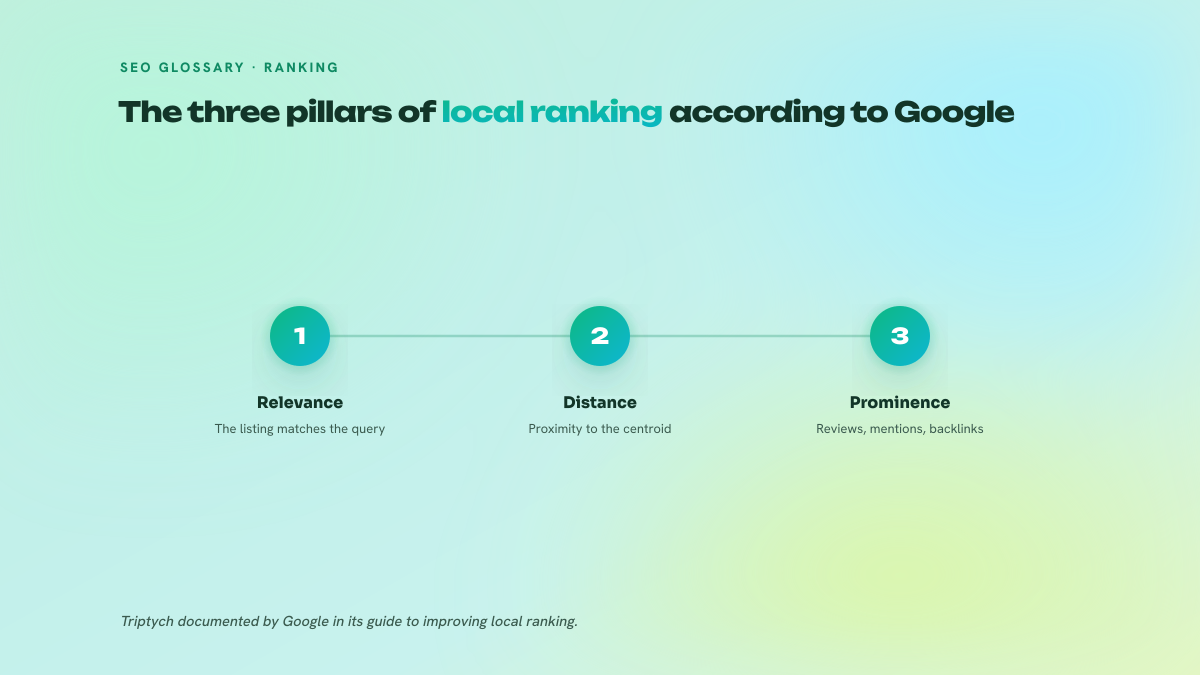
- →Google's own documentation reduces the whole system to three levers: relevance, distance, prominence. Everything tactical maps back to one of them.
- →Distance is the one factor you cannot buy or optimize, which is exactly why proximity spam (fake addresses, keyword-stuffed business names) keeps getting filtered and penalized.
- →Prominence is where off-site work lives: reviews, citations and links to the business URL feed the same trust signal that ranks the pack.
- →The 3-pack replaced the old 7-pack in August 2015 (Search Engine Land), which permanently raised the stakes: three slots, not seven, so positions 4 and below get almost no visibility.
- →Rank tracking must be geo-gridded. A flat «we rank #2» is meaningless without the coordinates it was measured from.
What the local pack really is
Strip away the marketing and the local pack is a distinct SERP feature: a map with three business listings pinned to it, injected above the classic blue links whenever Google reads local intent into a query. It is often called the «3-pack», and that number is not cosmetic. Until August 2015 Google showed a 7-pack; the rollout to three listings (documented by Search Engine Land at the time, nicknamed the «snack pack») cut the available real estate by more than half and turned local visibility into a genuinely scarce resource.
The distinction people get wrong first is local pack versus map pack versus Google Maps proper. The local pack is the block on the standard web SERP. Google Maps is the dedicated Maps interface. They draw on the same underlying index and the same business profiles, but they are ranked and filtered differently, and a listing can sit top of the local pack while ranking lower inside Maps for the same term. This short clip lays out the map pack versus Maps distinction cleanly before we go deeper.
What matters operationally: the pack is not a page you rank once. It is recomputed for every searcher based on where they physically are. A restaurant can hold the top slot for someone standing on its street and vanish from the pack for someone three kilometres away typing the identical query. Any conversation about «our local pack ranking» that ignores the searcher's coordinates is missing the whole model.
How it works in 2026
The engine behind the local pack is your business profile, not your website. A listing exists because there is a verified verified business profile tied to a location and a category, and Google ranks those profiles, then hangs the website link off them as a secondary asset. This inverts the usual SEO mental model: on-page and links still matter, but they matter as prominence signals feeding the profile, not as the thing being ranked.
In 2026 the meaningful shift versus five years ago is how much the pack has absorbed mobile and voice behaviour. The majority of local queries now originate on mobile, where the searcher's GPS position is precise and the pack fills most of the first viewport. Voice assistants read back essentially the top local result, which compresses the value of everything below slot one. If your local strategy still assumes a desktop searcher scanning ten organic results, it is calibrated for a SERP that no longer dominates.
Measurement has to match this. You cannot track the local pack from a single crawl location and call it data. Geo-grid tools (the local rank trackers in Semrush, BrightLocal and similar) sample your position across a matrix of coordinates around the business, which is the only honest way to see the shape of your visibility: strong at the storefront, decaying with distance, with dead zones a competitor owns. When someone asks «what is a local pack in Semrush», that is the answer: it is the tracked SERP feature their Local toolkit reports your gridded position in, not a separate concept.
The factors that actually move you
Google's own local ranking documentation is unusually blunt for once: it names three factors, relevance, distance and prominence, and everything tactical folds into one of them. Treat that as the map.
Relevance is how well the profile matches the query: category, services listed, and the language on the profile and the site behind it. Distance is proximity between the searcher and the business location, weighted against how far people normally travel for that service. Distance is the one lever you cannot manufacture, which is precisely why proximity spam (fake secondary addresses, virtual offices, keyword-stuffed business names) is the most consistently filtered and suspended behaviour in the local ecosystem. Do not build a strategy on a factor you can only fake.
Prominence is where the off-site work lives, and it is the factor most SEOs underweight. It aggregates review volume and quality, the consistency of your business information across the web, and, yes, links pointing to the business. Reviews carry real weight here: Google's guidance explicitly ties review quantity and score into local ranking, and from what we see in audits, a thin review profile caps how high you can climb regardless of how clean the on-page is. The other pillar of prominence is a consistent citation footprint across directories and the web, because Google reads corroboration of your name, address and phone as a trust signal.
Where the local pack meets netlinking
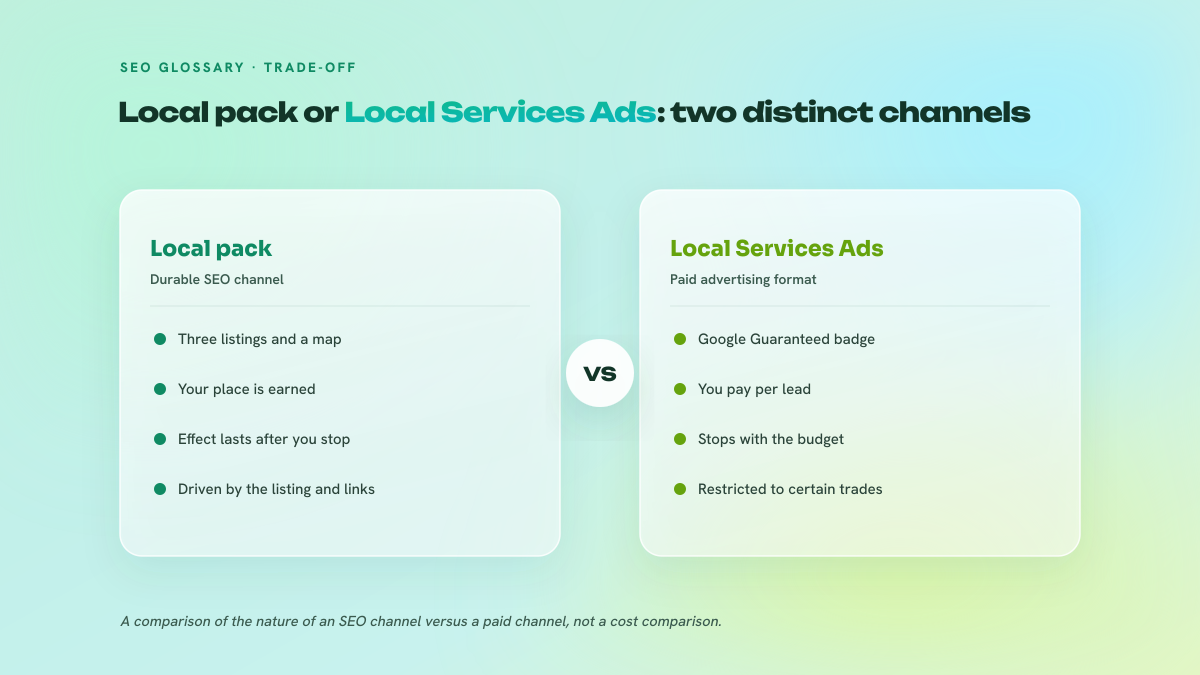
Here is the nuance that separates a local specialist from a link buyer: the local pack is not ranked by your backlink profile the way organic positions are, but links still feed prominence, and prominence is a third of the equation. The mistake is treating pack ranking as a pure link game. The correct read is that links are one input into a trust signal that also weighs reviews and citation consistency.
That said, links matter in two concrete ways for local. First, they lift the organic ranking of your location and service pages, which sit directly under the pack and catch the searcher who scrolls past the three listings. Second, editorial links from genuinely local or topically-relevant media reinforce the geographic and thematic signals Google associates with your business. A link from a regional publication about your city does double duty. This is where an honest, in-house network changes the calculus: at Nautilinks we operate the media ourselves, so a link to a local business page is placed inside real editorial context rather than sold as an anonymous slot. If you are reinforcing a local footprint, acquiring a contextual link straight from the publisher keeps the placement transparent and topically coherent, which is what the prominence signal is trying to reward in the first place. You can see exactly which media are available and on what themes through the full catalogue of owned titles, with no middleman and no hidden commission.
The stance we hold: buy links to strengthen the organic pages around the pack and to build genuine topical authority, not as a lever you expect to directly reorder the three slots. Anyone selling «local pack links» as a mechanical ranking fix is selling the wrong model.
The practical playbook
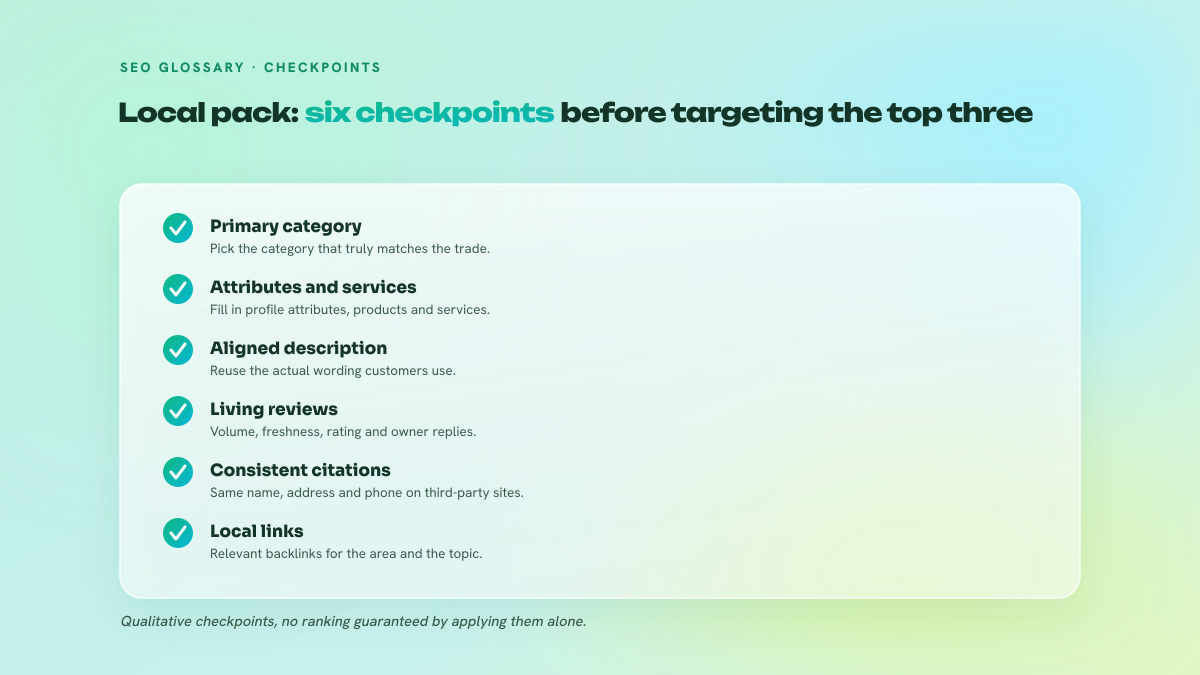
The non-negotiable foundation is a fully completed, correctly categorized business profile. Fill every field, pick the most specific primary category rather than a broad one, keep hours and attributes current, and post regularly. Incomplete profiles lose to complete ones on relevance before any other factor enters. This clip covers the essential ranking moves that reinforce the point.
On the profile, weave local and service terms into the description and services naturally, never stuff them into the business name itself. Add local business schema (LocalBusiness or the relevant subtype) to your site so Google can cross-reference the structured data with the profile; almost no competitor bothers, which makes it a cheap edge. Build a steady, non-spiky flow of reviews and reply to them, because the review signal and the freshness of it both feed prominence. Keep your name, address and phone identical everywhere, and audit citations for the stale variants that quietly erode consistency. This second clip condenses the optimization checklist.
Then track it properly with a geo-grid, not a single query. Watch the decay pattern, find the coordinates where a competitor dominates, and concentrate reviews, content and local links on the zones you are losing. And no, you do not strictly need a physical storefront: service-area businesses can rank by declaring a service area and hiding the address, though distance weighting still applies from the registered location.
Common mistakes we see
The recurring failure is treating the local pack like classic organic SEO. Teams pour budget into links and on-page while the business profile sits half-filled and the review count stagnates, then wonder why they cannot crack the three slots. The pack rewards profile completeness, reviews and consistency first; the website is support, not the star.
The second mistake is proximity gaming: spinning up fake addresses or padding the business name with a city and a keyword. It works for a fortnight and ends in suspension, and a suspended profile is far more expensive to recover than a slow-and-honest climb would have cost. The third is measurement theatre, reporting a flat «we rank #3» without saying from where, which hides the reality that you are invisible two neighbourhoods over. The fourth, and the one that quietly caps the most campaigns, is inconsistent NAP data: the same business listed under three slightly different names or two old phone numbers scattered across directories, feeding Google contradictory signals it resolves by trusting you less.
Nautilinks operates an owned network of editorial media. In-house written articles, transparency disclosures respected, anchor mix calibrated.
Frequently asked questions
What is a local pack in Semrush specifically?
In Semrush it is a tracked SERP feature inside the Local toolkit and the Map Rank Tracker. Rather than reporting one position, Semrush samples your ranking across a grid of coordinates around the business and shows your local pack visibility as a heatmap. So «local pack in Semrush» is not a different concept, it is Semrush's gridded measurement of your position in Google's actual 3-pack, letting you see where you win and where a competitor owns the zone.
Why is it called the 3-pack and was it always three?
It shows a maximum of three business listings, hence 3-pack. It was not always three: Google previously displayed a 7-pack, and rolled out the reduction to three in August 2015 (reported by Search Engine Land, nicknamed the «snack pack»). That change more than halved local visibility, so positions four and below now get almost no exposure, which is why the competition for the three slots is far sharper than it was a decade ago.
Does local SEO still work in 2026 given AI and zero-click results?
Yes, arguably more than before. Local intent is heavily mobile, where GPS is precise and the pack fills the viewport, and voice assistants read back essentially the top local result. AI overviews summarize but still surface named businesses and profiles. The mechanics shifted toward the profile and reviews, not away from local, so the discipline is alive; what died is the assumption that a desktop searcher scans ten organic links.
Can I rank in the local pack without a physical address?
Yes, if you are a genuine service-area business. Google lets you declare service areas and hide the street address on the profile. Distance weighting still applies from your registered location, so you cannot escape proximity entirely, and you still need a real, verifiable address for the initial verification. What you cannot do is invent secondary addresses to appear closer to more searchers; that is proximity spam and it gets filtered and suspended.
How much do backlinks actually influence local pack ranking?
Indirectly. Google's local model weighs relevance, distance and prominence, and links are one input into prominence alongside reviews and citation consistency, not a standalone lever. From what we see in audits, links move the organic location and service pages sitting under the pack and reinforce topical and geographic authority, but they will not mechanically reorder the three slots on their own. Treat them as authority reinforcement, not a pack switch.
What is the single biggest lever for getting into the pack?
A complete, correctly categorized business profile combined with a steady flow of quality reviews. Completeness and specific primary category settle relevance; review volume and recency feed prominence. Distance you cannot control and prominence takes time, so the fastest honest wins are almost always on the profile itself: fill every field, pick the narrowest accurate category, add local schema on the site, and keep reviews flowing rather than chasing links first.
Test your knowledge
Quiz: Local pack
1/3Which three factors does Google's own documentation name for local ranking?