SEO Glossary · Local

Geo-targeting

A campaign targeting France still reaches users in Belgium searching about France, because platforms treat location as intent as much as position. Geo-targeting is the set of controls deciding which users in which places see which ad or page, and each control ships with a default setting that quietly costs money.

Key takeaways The essentials in 30 seconds
  • Geo-targeting is three unrelated systems sharing one word: an auction filter in paid media, a serving decision on your own site, and a set of signals you can only influence in organic search. Auditing them together is how teams end up serving Googlebot a single US variant of every page.
  • In Google Ads, the targeting setting that matters is Presence versus Presence or interest, and the exclusion setting defaults to Presence only. A campaign can therefore exclude a region and keep paying for users interested in it.
  • Local rank is a distribution, not a number. Whitespark launched Local Ranking Grids in Q3 2025 from $10 per month across 225 map points, which is the honest way to see that a business ranks well beside its address and badly across its service area.
  • Semrush's September 2025 local link guidance holds up in practice: links from sites tied to the geography you serve outperform volume, and a non-linked NAP citation is not a backlink. Buy fewer, buy regionally coherent.
  • Google is no longer the only local surface. BrightLocal's 2026 Local Consumer Review Survey put Google's share as a review source at 71 percent, down from 83 percent in 2025, with Apple Maps rising from 14 to 27 percent and generative AI used for local recommendations by 45 percent of respondents against 6 percent a year earlier.
  • Fake local signals stayed a liability through Google's June 2026 spam update, which ran from 24 to 26 June 2026. Invented addresses, review incentives and geo doorway pages are the tactics that get a local footprint burned.
3 questions to test your knowledge Read first, the quiz is waiting at the bottom.
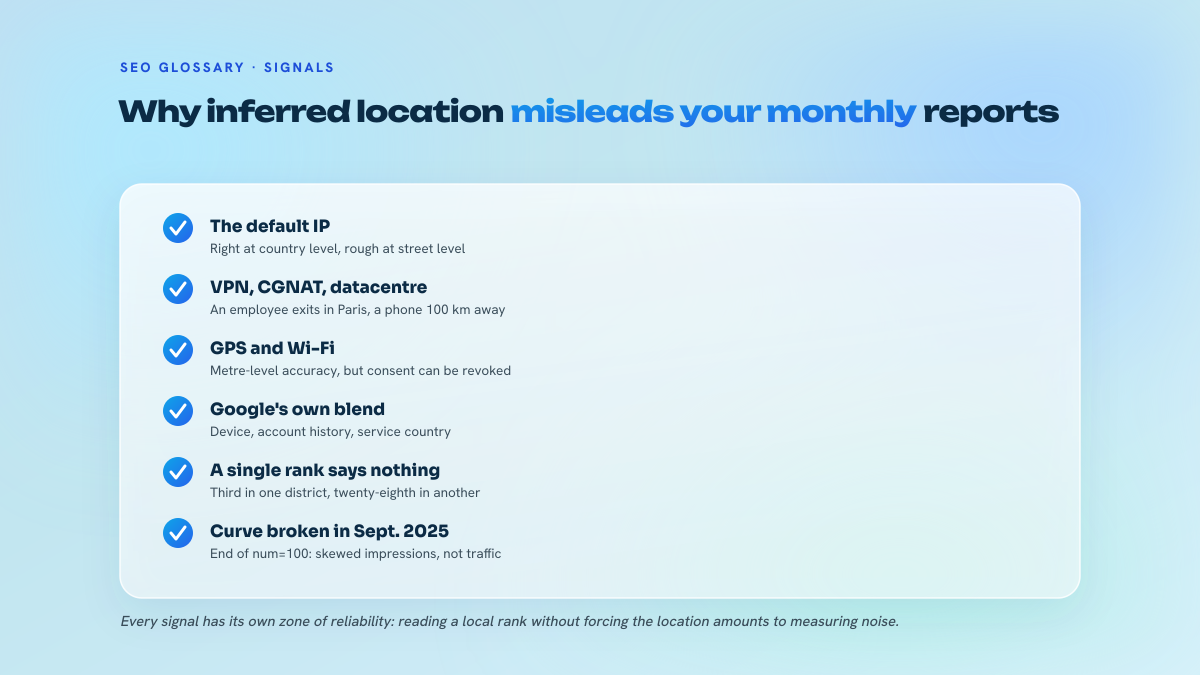
Checklist of location signals: IP address, VPN and CGNAT, GPS subject to consent, Google's blend, grid of points, disappearance of the num equals one hundred parameter.
The five points to check before trusting a local position figure.

What geo-targeting actually covers

Geo-targeting is not one feature. It is three systems that share a vocabulary and behave nothing alike. In paid media it is an eligibility filter: a campaign enters an auction only for users the platform associates with a selected location. On your own site it is a serving decision, which currency, which phone number, which regional landing page a visitor gets. In organic search it is neither, because you do not control it. Google decides which geographic flavour of a SERP a user receives, and your only lever is how clearly your pages, your entity data and your inbound links signal a geographic association.

Conflating the three is the most expensive mistake in this area. Someone reads that location targeting lifts conversion rates, implements it as an IP redirect at the edge, and finds out two months later that Googlebot, crawling largely from US addresses, has only ever seen the US variant of every page. The paid logic works because the platform knows it is targeting. The organic logic breaks because the crawler does not announce that it is a crawler with a French home address.

Geofencing is the tighter cousin: a radius or polygon drawn around a physical point, used mostly to trigger mobile ads when a device enters it. Same family, finer resolution, and a far heavier dependence on device signals rather than network signals. This short explainer shows the mechanic in a retail context, which makes the distinction from broad location targeting concrete.

Put it into practice?

Nautilinks operates an owned network of editorial media. In-house written articles, transparency disclosures respected, anchor mix calibrated.

See pricing → Buy backlinks service
BD
Benoit Demonchaux Founder · Nautilinks

Founder and operator of Nautilinks. Edits and writes the site's editorial glossary, as well as the content published across the Nautilinks network of editorial media.

Frequently asked questions

Presence or Presence and interest in Google Ads: which one for a business with a physical catchment area?

Presence, in almost every case. A locksmith serving one city gains nothing from users elsewhere reading about that city, and Presence or interest is the default, so the switch has to be made deliberately. The exception is a business that sells remotely into a region, where interest is the whole point. Check the exclusion side too: excluded locations only support Presence, so an excluded country still receives impressions from interested users outside it.

Does an IP redirect for regional content hurt indexing?

It does when it is the only route to the variant. Googlebot crawls predominantly from US addresses, so an automatic IP redirect leaves the other variants unseen and unindexed. Keep every regional version on its own stable URL, declare the set with hreflang, and use a dismissible banner or a manual switcher rather than a forced redirect. If you must redirect, exclude requests where the location cannot be resolved with confidence instead of defaulting them to one market.

Are local backlinks actually worth more than generic ones for a geographically bounded business?

Yes, and the current guidance says so plainly. Semrush's September 2025 local link recommendations favour sites associated with the geography the business serves over volume, and BrightLocal's 2026 research summary ranks inbound link quality alongside geographic relevance of content among the leading local organic influences. In practice a regional news site or a sector association in your area moves a service page that a national directory of a thousand outbound links does not touch.

How do I track visibility across a service area without paying for hundreds of keyword slots?

Use a grid product rather than more keywords. Whitespark launched Local Ranking Grids in Q3 2025 from $10 per month across 225 map points, which gives you one query measured across a geography instead of one geography measured across many queries. Pick three or four commercially decisive queries, run them as grids, and read the shape. The falloff distance from the address tells you more about competitive pressure than a rank average ever will.

Did the removal of the &num=100 parameter change local rank tracking?

It changed the cost and the noise, not the rankings. Google disabled the parameter in September 2025, observed around 11 to 14 September, so tools that pulled a hundred results per request now work with ten-result pages or make more calls. Deep position data got sparser and Search Console impressions shifted for positions 11 to 100. Treat a drop in reported impressions across that band from mid-September 2025 as a measurement artefact until you have session data proving otherwise.

Should a local business now optimise for AI assistants as a separate channel?

Not as a separate discipline. Google's official generative AI guidance, published 15 May 2026, holds that existing fundamentals drive visibility in AI Overviews and AI Mode, with no separate ranking system prescribed. What changed is measurement: Search Console added generative AI performance reporting on 3 June 2026, so you can finally compare surfaces. Given BrightLocal's 2026 finding that 45 percent of surveyed consumers used generative AI for local recommendations, monitoring it is justified. Rebuilding your stack for it is not.

Quiz

Test your knowledge

Quiz: Geo-targeting

1/3

In Google Ads, why can a campaign keep spending in a country that appears in its excluded locations?

Newsletter

GEO + SEO analyses and network case studies, in your inbox

Once or twice a month at most. No filler. One-click unsubscribe.

By subscribing you agree to receive our emails. See our privacy policy.

For an SEO, the practical boundary is this: geofencing is an advertising tactic with no organic equivalent, whereas geo-targeting has an organic half that is about clarity of signals rather than about switches you flip.

Three numbered ad setting steps: switch to presence, choose the granularity and set exclusions, then read the geographic reports.
Cleaning up an account takes three moves, in this order.

How location is inferred, and how you measure it in 2026

Every platform resolves a user to a place using the same rough stack, in decreasing order of confidence. Device GPS when the app has permission, which is precise and mobile only. Wi-Fi network and Bluetooth beacon fingerprints, which is how indoor accuracy survives inside a shopping centre. IP address, which resolves to a city at best and to a carrier hub at worst, and which mobile network address translation and VPN use degrade badly. Account level data such as a billing address or a home location saved in a Google account. And finally the query itself, since a search for a plumber in Lyon carries its own geography regardless of where the device sits.

That last one matters more than practitioners assume. A user in Paris researching a service in Bordeaux is a legitimate customer for a Bordeaux business, and the platforms know it. Treating physical presence as the only valid definition of a target location throws away demand.

Measurement moved on in the last eighteen months, in two directions worth knowing. First, location specific visibility is now tracked as a distribution rather than a rank. Whitespark launched its Local Ranking Grids in Q3 2025, with plans from $10 per month covering 225 map points, and the product exists because a business routinely ranks first within a kilometre of its address and outside the three-result map block four kilometres away. A single reported position hides that entirely. Second, rank data itself got noisier: Google disabled the &num=100 parameter in September 2025, observed around 11 to 14 September, which forced tools that collected a hundred results per request onto ordinary ten-result pages. Deep position tracking became more expensive and Search Console impression curves shifted for positions 11 to 100. Neither change is evidence of lost traffic, and reading it that way produced a lot of false alarms.

On the AI surfaces, Search Console gained generative AI performance reporting on 3 June 2026, giving dedicated visibility data for AI Overviews and AI Mode while keeping those impressions in the overall report. For anyone running geographically segmented sites, that is the first honest way to compare classic and generative visibility per market.

Two dropdowns decide most of the waste in a geo-targeted account. The targeting option offers Presence, meaning people in or regularly in your targeted locations, or Presence or interest, meaning people in, regularly in, or who have shown interest in those locations. Presence or interest is the default. For a business with a physical service radius it is usually wrong, because it pays for a user in Marseille reading about Lille. For a business selling into a region remotely, it is usually right, for exactly the same reason.

The exclusion dropdown is the trap. Excluded locations only offer Presence: people in your excluded locations. You can therefore exclude a country and keep serving users elsewhere who have shown interest in it. Every account audit that finds unexplained spend from the wrong market lands on this asymmetry sooner or later.

This walkthrough covers the configuration path, radius targeting and location groups in the current interface, which saves describing every click here.

Two habits separate accounts that hold their cost per acquisition from those that drift. Read the user locations report rather than the matched locations report, because the first tells you where people actually were and the second tells you what the system matched them to. And set the radius from drive time and competitive density, not from a round number of kilometres: a fifteen kilometre circle in central Paris and the same circle in the Creuse describe entirely different businesses. Country, region and city targeting stack with exclusions, so a national campaign with three excluded cities running on separate local campaigns is a normal, healthy structure rather than a workaround.

Meta Ads: four location layers, one default that leaks

Meta splits location into four behaviours: people living in this location, people recently in this location, people travelling in this location, and everyone in this location. The last one is the default and it is the widest, which is why so many local campaigns quietly serve tourists and passers-through. A restaurant may want exactly that. A dentist almost never does.

The second structural difference from Google is that Meta is not answering a query, so there is no interest-in-a-place signal derived from search intent. Location is inferred from profile data, device signals and IP, and the platform will widen delivery when a tightly drawn audience is too small to spend the budget. A pin drop with a small radius in a rural area does not fail loudly, it fails by drifting.

Ben Heath's troubleshooting rundown covers the symptoms that show up when delivery does not respect the geography you set, and the fixes are the same ones we apply in audits.

The operational rule: if the addressable audience in the radius is under the threshold the platform needs to exit the learning phase, either widen the radius deliberately or broaden the targeting on another axis. Do not let the algorithm make that decision on your behalf and then read the resulting spend as local performance.

The organic half of geo-targeting has no switch. It has an architecture. A market gets its own indexable page, its own on-page geography, and its own supporting signals, or it does not get treated as a market. BrightLocal's 2026 summary of local ranking research lists the leading local organic influences as dedicated pages for each service, geographic relevance of the content, and the quality and authority of inbound links. That ordering matches what we see: teams over-invest in citations and under-invest in a page that genuinely deserves to rank for a service in a city.

Where a site serves several countries, the technical layer is hreflang for language and regional variants, plus the domain strategy. A country-coded domain extension carries an unambiguous geographic association that a subfolder has to earn through content and links, which is precisely why it is a heavier commitment and not a free win.

On the link side, Semrush's September 2025 local link guidance is worth taking literally: prefer sites associated with the geographic area the business serves, and stop counting non-linked NAP citations as backlinks. They are two different assets. Regional relevance is also the reason a French business is better served by picking a media by its actual readership and ordering the link straight from the publisher than by buying a volume package with no geographic logic. It is the same argument we make about the French editorial media we run in-house: a link is worth what the surrounding audience is worth, and the sites are listed publicly so you can check the geography before you spend.

Rhythm matters as much as source. A local footprint built in a fortnight and then abandoned reads as a campaign, not as a business, which is why spreading acquisition across several months with a stated target per market beats a burst. Digital PR, local press, chambers of commerce and community organisations remain the acquisition channels that produce links a competitor cannot replicate by buying the same directory list.

What we see go wrong

Redirecting by IP without a crawlable alternative. If the only path to the German page is an automatic redirect triggered by a German address, Google indexes one variant and you have built a monolingual site with extra steps. Serve the variants at stable URLs, cross-link them, and let hreflang do the routing.

Reading a single rank as local performance. The grid view exists because the answer varies by street. A client celebrating position one is often looking at a query resolved from an IP two hundred metres from their own front door.

Assuming Google is the whole local surface. BrightLocal's 2026 Local Consumer Review Survey found Google still leading as a review source but down to 71 percent of consumers from 83 percent in 2025, while Apple Maps usage nearly doubled from 14 to 27 percent, and their representative survey of 1,002 US adults found 45 percent using generative AI for local business recommendations against 6 percent a year earlier. A separate GatherUp study of more than 1,000 US consumers in Q3 2025 found 48 percent had interacted with conversational AI while looking for local business information. Those studies measure different behaviours and should not be added together, but the direction is not ambiguous.

Chasing signals Google never confirmed. Whitespark reported that the 2025 rewording of Google's local results guidance around prominence was not a new ranking factor, and that Google rolled back a separate wording change that had been read as making community activity a ranking input. Weekly posts, keyword-stuffed review replies, geotagged images and embedded maps are not confirmed factors. Selling them as such is how agencies lose clients when the numbers do not move.

And treating fabricated local signals as a shortcut. Google's June 2026 spam update ran from 24 to 26 June 2026 and was classified as a ranking incident affecting Search, with manipulative links, scaled low-quality content and fake local signals all still in scope. Invented service addresses and incentivised reviews are a bet against an adversary with more data than you have.