- →hreflang is a hint Google can override: a wrong canonical will collapse your locale variants into one indexed URL regardless of a perfect hreflang cluster.
- →A cluster only holds if every page is self-referential and every reference is reciprocal. A single missing return tag makes Google silently ignore the whole set, per Google Search Central 2025.
- →HTML tags, HTTP headers and XML sitemap declarations are equivalent signals: pick sitemap for large or dynamic sites, HTTP headers for PDFs, and never mix conflicting declarations for the same URL.
- →Error rates are structural, not marginal: around 75% of sites using hreflang carry at least one technical error (hreflang.org study, June 2026).
- →Read hreflang success through impressions and localized clicks in the right market, not raw traffic. A wrong-locale URL ranking high is expensive: position 1 draws roughly 27.6% CTR (Backlinko, 2026).
- →Country targeting inside GSC International Targeting was deprecated in 2022. Lean on crawl tools plus the remaining hreflang error reporting.
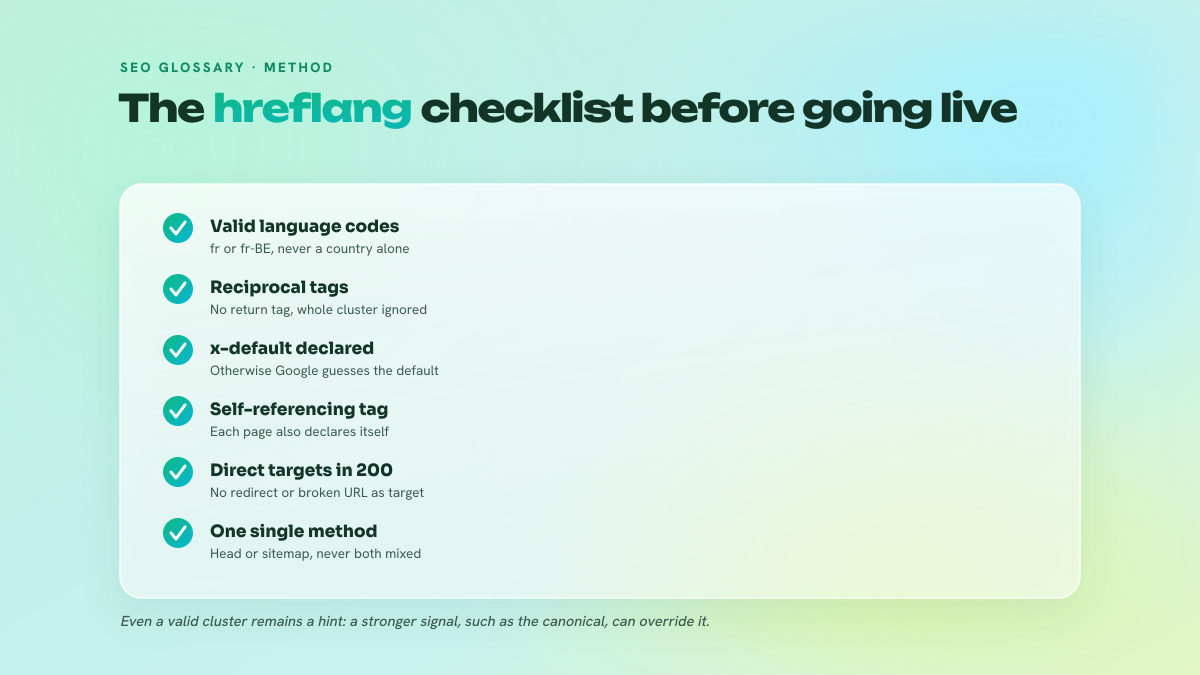
A hint, not a directive
The single most useful thing to internalize about hreflang in 2026 is that it is a hint, not a directive. Search Engine Land's November 27, 2025 guide notes that Google reiterated as recently as May 2025 that hreflang is treated as a signal, and that canonical tags, site structure, content similarity and indexation state can all override it. In practice this means a technically flawless hreflang cluster still loses if another part of your setup contradicts it. hreflang does not force Google to swap the URL, it suggests which alternate to prefer once the page is already deemed indexable and canonical.
That framing changes how you debug. When the wrong-language version shows up in a market, the reflex is to re-check the hreflang syntax. Nine times out of ten the syntax is fine and the real culprit sits upstream: a canonical pointing the local page back to the English master, or a thin translated page Google folded into its source. Fix the contradiction, not the hint.
This video gives a plain visual overview of what the tag is before we get into the mechanics.
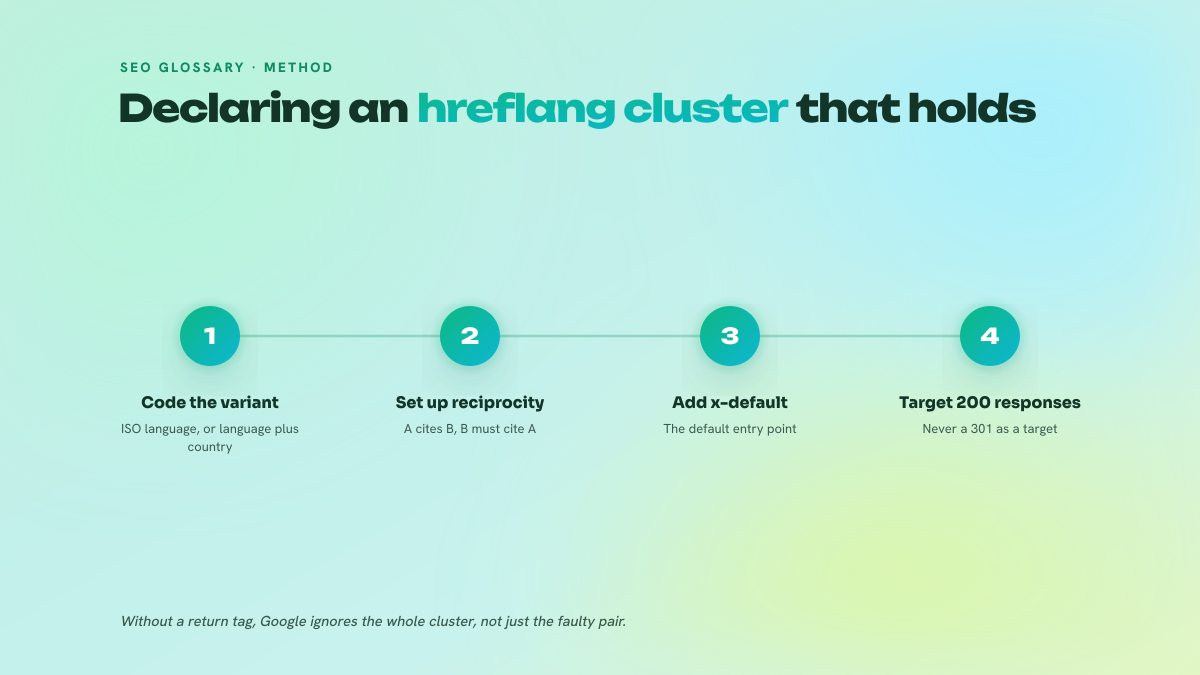
How hreflang actually works in 2026
Mechanically, hreflang is an rel="alternate" declaration that pairs a URL with a language code, optionally plus a region code. The language uses ISO 639-1 (fr, en, de), the region uses ISO 3166-1 alpha-2 (fr-BE, en-US, de-AT). Region without language is invalid: there is no such thing as a bare hreflang="BE". You also declare x-default for the fallback page shown to users whose language or region you have not explicitly covered, typically a language selector or the global homepage.
The part that trips up most teams is the cluster logic. Every URL in a language group must reference itself (the self-referential tag) and every alternate must reference back (the return, or reciprocal, tag). A March 16, 2026 hreflang guide citing Google Search Central 2025 material is blunt about the consequence: a missing return tag causes Google to silently ignore the entire cluster, and John Mueller has called hreflang one of the most complex aspects of SEO. There is no partial credit. Ten perfect pages plus one broken reciprocal reference equals zero working hreflang.
So the model to keep in your head is not «page A points to page B». It is a closed graph where every node points to every node including itself, and the graph is only valid when it is complete. That is why hreflang scales badly by hand and why the implementation method you choose matters so much.
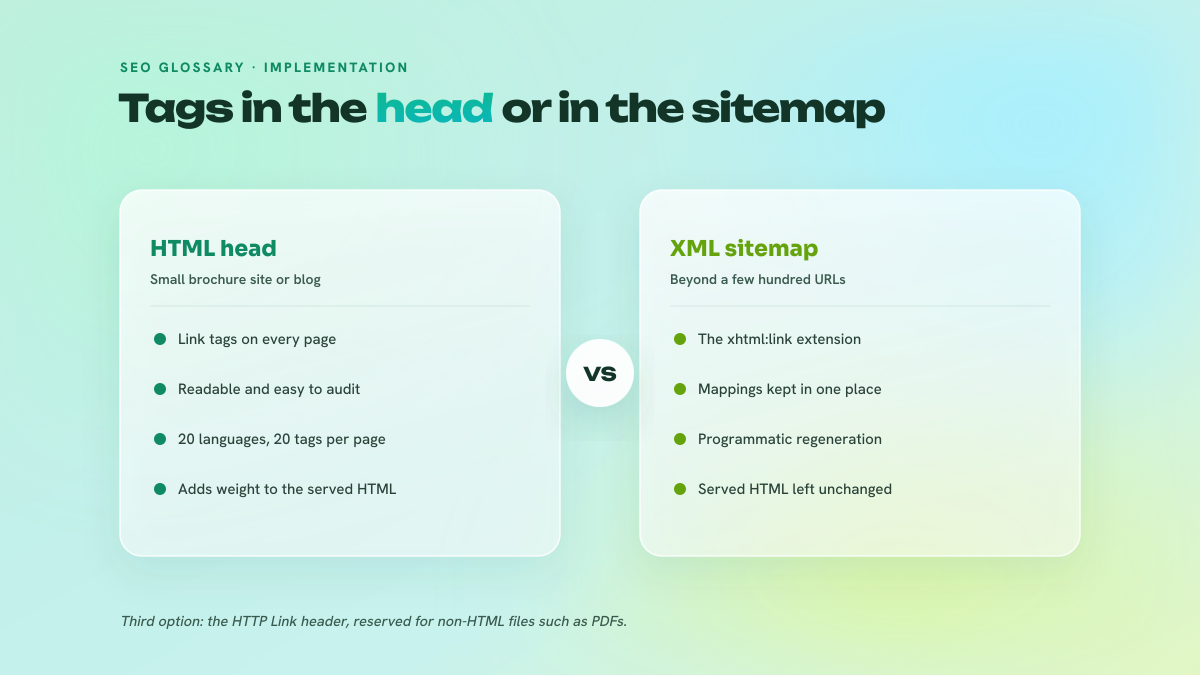
Three implementation methods, real trade-offs
There are three equivalent ways to declare hreflang, and the top-ranking guides rarely compare them honestly. HTML link tags in the <head> are the most visible and the easiest to spot-check in a browser, but they bloat the head on sites with many locales: twenty markets means twenty tags on every single page. HTTP Link headers are the only option for non-HTML resources such as PDFs, and they keep the markup clean, but they are invisible to a casual manual audit and easy for a caching layer to strip. The XML sitemap method centralizes every declaration in one file, which is why it wins on large or dynamic sites: you generate the cluster once, programmatically, instead of injecting tags into thousands of templates.
The senior stance here is simple: on anything past a handful of locales, drive hreflang from the sitemap and treat your XML sitemap as the source of truth for language variants. It removes the per-template injection risk, it survives JavaScript rendering (which HTML tags added client-side often do not), and it gives you one artifact to validate. The one rule you cannot break: never declare the same URL's alternates in two methods at once with different values. Conflicting declarations are worse than a single imperfect one.
This short guide covers the implementation basics and code examples.
Where hreflang meets a netlinking operation
hreflang looks like a pure technical-SEO concern, but it directly shapes the return on an international link campaign. When you build links to a market-specific page, you are concentrating authority on a URL you want Google to serve in that market. If hreflang is broken and Google collapses your fr-FR and fr-BE pages into one indexed URL, half your acquired links now point at a version that never surfaces where you targeted it. The equity is real, the placement is wrong.
The cost of the wrong locale ranking is not abstract. Incremys' March 17, 2026 analysis quotes Backlinko 2026 position-CTR data: position 1 draws about 27.6% CTR, position 2 about 15.8%, position 3 about 11.0%, with page-two results below 1%. A wrong-language URL sitting at position 1 in a foreign SERP burns the most valuable slot you have. And a June 1, 2026 Scalarly guide citing an Ahrefs 2025 study puts a number on the upside: sites with correct hreflang saw 47% higher organic traffic from non-primary markets than sites with incorrect or missing implementation. That is the market you are paying links to open.
This is where operating a real multi-country network changes the calculus. When we run campaigns across the French-language media we own in-house and the German side of the network, hreflang consistency between the target site's locales decides whether the link lands on the URL that actually ranks in that country. We can place a link on a German editorial page perfectly, and it still underperforms if the client's de-DE variant is canonicalized back to English. The link and the indexation signal have to agree before the campaign pays off.
The failures we see in audits
The error rates are structural, not edge cases. A hreflang.org study summarized June 15, 2026 found that roughly 75% of websites using hreflang tags carry at least one technical error. A Semrush 2023 study of 20,000 multilingual sites, cited in a May 30, 2026 guide, breaks the pathology down: 58% had internal code conflicts, 37% linked to broken or redirected URLs, 21% had language mismatches, 15% used invalid codes, and 96% of the sites with conflicts lacked self-referencing tags. Search Engine Land's November 2025 guide adds that a 2023 analysis found around 8.9% of sites in hreflang clusters using invalid language codes.
The single most damaging failure in 2026 is the canonical conflict. A May 16, 2026 LinkGraph benchmark reports that 65% of multilingual sites misconfigure canonicals against hreflang, for example canonicalizing every local /fr/ or /de/ page back to /en/, which collapses the international variants into one indexed URL. Mueller is quoted calling this the most common reason hreflang fails in practice. The fix is a discipline, not a plugin: each localized page must carry a self-referential canonical pointing to itself, never to the master-language version. hreflang and canonical must never disagree about which URL is the one true page.
Two more we flag constantly. Missing return tags, which as noted void the whole cluster silently, so nothing errors visibly and rankings just quietly fragment. And hreflang pointing at redirect chains: Mueller clarified in October 2025 that hreflang to a 301 is probably fine, but cleaner direct 200 targets are preferred for long-term stability, especially during migrations. Point hreflang at the final URL, not at a redirect you happen to still have live.
Measuring and validating
You cannot validate hreflang by eyeballing one page, because the failure is always a graph-level property. Google Search Console still exposes hreflang error reporting, but be aware that the country-targeting portion of the International Targeting report was deprecated in 2022, so that lever is gone and you lean more on crawl tools plus the remaining error data. A full-site crawler that reconstructs the cluster and flags non-reciprocal or self-missing references is the only reliable check at scale.
Read success through the right metric. With a large and growing share of searches ending without a click (Semrush 2025 estimates cited in the same Incremys analysis put it near 60%), raw traffic is a lagging and noisy signal. Watch impressions and clicks segmented by target market and language: a working hreflang setup shows up as the correct locale URL gaining impressions in its own country, not just as a global traffic bump. If you run any locale variants you deliberately keep out of the index, make sure a noindex directive and your hreflang references are not contradicting each other, because a page you exclude from the index has no business appearing as a valid alternate in a live cluster.
Nautilinks operates an owned network of editorial media. In-house written articles, transparency disclosures respected, anchor mix calibrated.
Frequently asked questions
Is hreflang a ranking factor or just a routing signal?
Neither exactly. hreflang does not boost rankings and it does not force a URL swap. It is a hint that helps Google pick which already-indexed, already-canonical variant to serve in a given language or region. Search Engine Land reiterated in November 2025 that Google can override it via canonical tags, site structure and content similarity. Its value is preventing the wrong locale from surfacing, not lifting position.
hreflang or the lang attribute, which one does Google use?
Different jobs. The HTML lang attribute helps browsers and accessibility tools, and Google has said it largely ignores it for language detection. hreflang is the machine-readable signal Google reads to map alternate language and region versions of a URL to each other. You need hreflang for international targeting. The lang attribute is good hygiene but does not drive which locale appears in the SERP.
Why did my whole hreflang cluster stop working after one page change?
Almost certainly a broken return tag. Google Search Central 2025 material confirms that if a page A references page B but B does not reference back, Google silently ignores the entire cluster, not just that pair. Change one URL, forget to update its reciprocal references elsewhere, and the whole group goes dark with no visible error. Re-crawl the full cluster and check every reference is reciprocal and self-inclusive.
Can hreflang point to a page that 301 redirects?
It works but it is not the clean setup. Mueller clarified in October 2025 that hreflang pointing to a 301 is probably ok, yet direct 200 targets are preferred for long-term stability, particularly during migrations. Practically, always declare the final destination URL. Pointing hreflang at a redirect adds a resolution step and a fragility point that tends to bite exactly when you are moving domains or restructuring locales.
How do I stop canonical tags from killing my hreflang?
Make every localized page self-referential in its canonical. The dominant 2026 failure, per a May 2026 LinkGraph benchmark, is /fr/ or /de/ pages canonicalized back to /en/, which collapses variants into one indexed URL. Each locale page must canonical to itself, and hreflang and canonical must agree on which URL is authoritative. When they disagree, canonical wins and hreflang becomes cosmetic.
Does Bing use hreflang the same way as Google?
Close enough for planning. A January 2026 technical guide notes Bing officially supports hreflang in HTML but historically leaned on the content-language signal. By 2025 and 2026, a standard hreflang implementation covers the vast majority of search traffic across engines. You do not need a Bing-specific setup: implement hreflang correctly once and it serves both, though keeping content-language accurate is a cheap belt-and-suspenders move.
Test your knowledge
Quiz: hreflang
1/3What happens to an hreflang cluster when one page is missing its return (reciprocal) tag?