- →A 301 is a consolidation instruction, not a ranking tactic: Google uses it to transfer indexing signals to the destination URL, and Moz research from 2025 puts equity preservation at roughly 90 to 99% when the redirect is configured properly.
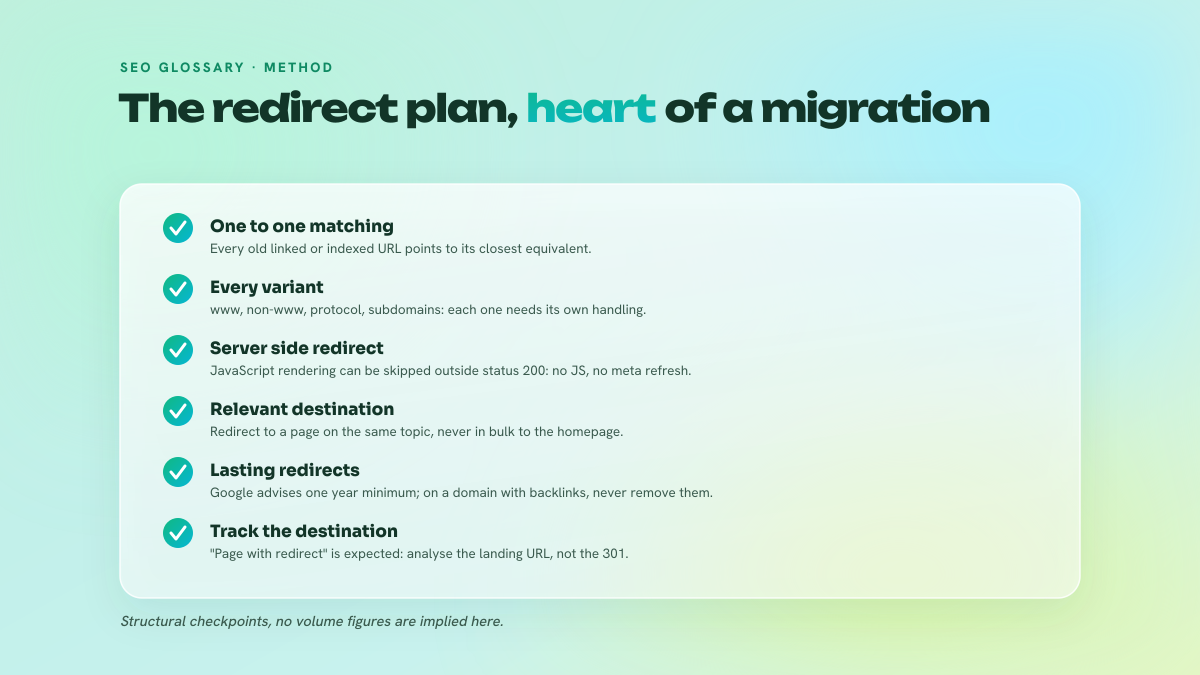
- →Server-side 3xx beats JavaScript redirects, full stop: Google's December 20, 2025 Search Central update confirmed rendering may be skipped on non-200 responses, so a JS redirect can simply never be seen.
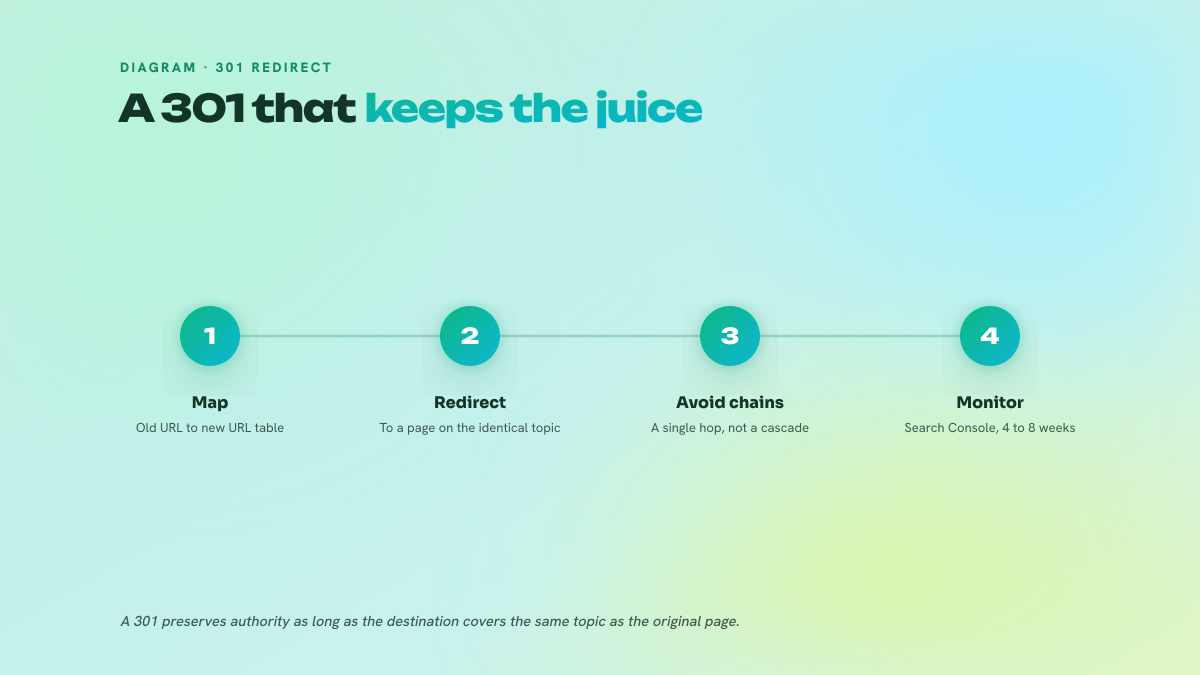
- →One hop is the operational standard. Google tolerates up to five, but every extra hop wastes crawl budget and adds latency; refactor A to B to C into A to C during every migration.
- →Redirect the old URL to its closest equivalent, never in bulk to the homepage: Google treats irrelevant mass redirects as soft 404s and the equity evaporates.
- →Keep migration redirects live for at least one year per Google's guidance, and realistically longer: an analysis of 892 migrations cited by Search Engine Journal found an average of 523 days to regain pre-migration traffic.
- →In Search Console, «Page with redirect» is expected behavior, not an error. Validate the target, then judge performance on the destination URL only.
What a 301 really signals to Google
The HTTP status code 301, «Moved Permanently», is a server-side declaration that a URL has ceased to exist at its old address and that everything it accumulated, backlinks, indexing signals, user bookmarks, should be attributed to a new one. That second part is what matters operationally. Anyone can move a page. The 301 is the mechanism that asks Google to consolidate rather than start from zero.
Google's crawling documentation, consolidated in the «Things to know about Google's web crawling» page published on March 3, 2026, describes redirects from known URLs as part of the URL discovery and consolidation layer. In plain terms: a 301 is both a forwarding address and a vote about which URL is canonical. When the redirect is unambiguous and permanent, Google usually accepts it. When it conflicts with other signals, internal links still pointing at the old URL, a canonical tag declaring something else, sitemap entries listing the retired address, Google arbitrates, and not always in your favor.
The senior framing is this: a 301 is not an SEO technique. It is plumbing. But it is plumbing through which your entire backlink profile flows, and a netlinking budget that took years to build can leak out through a redirect map assembled in an afternoon.
How Google processes 301s in 2026
Three recent clarifications from Google change how you should implement and monitor redirects this year.
First, rendering. A Search Central update from December 20, 2025 clarified that JavaScript rendering may be skipped for non-200 status codes, redirects included. The practical consequence is blunt: a client-side JS redirect sits in a rendering queue that may never process it, while a server-side 301 is read on the first fetch. If your stack currently redirects via JavaScript, on a headless frontend or a tag-manager hack, treat it as technical debt with a deadline.
Second, site moves. On June 17, 2026, Google updated its site move documentation: during a domain change, you now submit a Change of Address request for every relevant domain variant, www and non-www included, rather than assuming one covers all (ppc.land, June 2026). The redirects themselves work exactly as before; what changed is the explicit expectation that you handle signal consolidation per variant. The same guidance repeats the baseline that too many teams still ignore: keep redirects active for at least one year, submit fresh sitemaps, and monitor both the old and the new property after launch.
Third, reporting. Current Search Console guides make a point that saves pointless debugging: the «Page with redirect» status in the Indexing report is normal. A URL returning a 301 is not supposed to be indexed itself. The audit task is to verify the redirect points where you intended, then evaluate performance on the destination. Chasing indexation of a redirecting URL is chasing a ghost.
On equity transfer, the best available quantification comes from Moz research published in 2025: well-configured 301s preserve roughly 90 to 99% of link equity, while 404s and soft redirects lose virtually all of it (cited by Webflow's July 2026 redirect guide). Nobody outside Google knows the exact figure, but the asymmetry is the point. The difference between a mapped 301 and a dead URL is close to the difference between keeping and deleting the backlink.
Where 301s sit in a netlinking operation
Link equity is a budget, and 301s are how you avoid burning it during structural change. Three scenarios dominate in practice.
Migrations are the obvious one, and the data is sobering. A 2025 Ahrefs study reports that around 60% of website migrations result in measurable organic traffic loss even when redirects are attempted, and an analysis of 892 migrations cited by Search Engine Journal found an average of 523 days to regain pre-migration traffic (via GreenGeeks' 2026 migration checklist). The single biggest risk reducer is unglamorous: map every indexed old URL to its closest equivalent new URL with a 301 or 308. Skipping that step is expensive. Ahrefs research from 2024 found that sites migrating URLs without proper 301s lose on average 38% of organic traffic within 30 days, and about a quarter of that loss is permanent.
Expired and acquired domains are the second scenario, and the one closest to what we do. Across the French editorial media we operate at Nautilinks, most sites started life as expired domains carrying legacy backlink profiles pointing at URLs that no longer exist. Recovery starts with an archive-based inventory of every URL that ever earned a link, then a redirect map to restored or equivalent content. Without that map, the backlink profile you paid for at auction points at 404s. When you evaluate the cost of that leakage, it helps to know what replacing lost equity costs on the open market: a redirect map is almost always the cheaper repair.
The third scenario is the one link buyers underweight: the durability of the URLs your links land on. A placement pointing at a page that later gets redirected through two hops, or worse, dropped, degrades silently. It is one reason we argue for buying from operators who control their own inventory long-term, and why placements that land on stable, redirect-free URLs are worth more than their listed metrics suggest.
The magnitude of getting this wrong is documented. A technical SEO case study published in May 2026 (Valery/ChatVal) describes a September 2024 rebrand that changed URL formats without redirects, leaving 324,580 pages returning 404. After a full 301 mapping shipped in late August 2025, organic sessions grew from 14,918 in Q4 2024 to 220,570 across 2025, a 1,379% year-over-year increase attributed to fixing the URL structure. Nothing about the content changed. The plumbing did.
301 vs 302, 308 and 410: the decision rule
The status code family is smaller than the blog posts about it. A 302 («Found») and a 307 signal a temporary move: Google keeps the old URL as canonical and expects it back. A 308 is the strict sibling of the 301, permanent but preserving the HTTP method, which matters for APIs and form endpoints more than for content pages. For SEO consolidation, 301 and 308 are functionally equivalent; pick whichever your infrastructure emits cleanly.
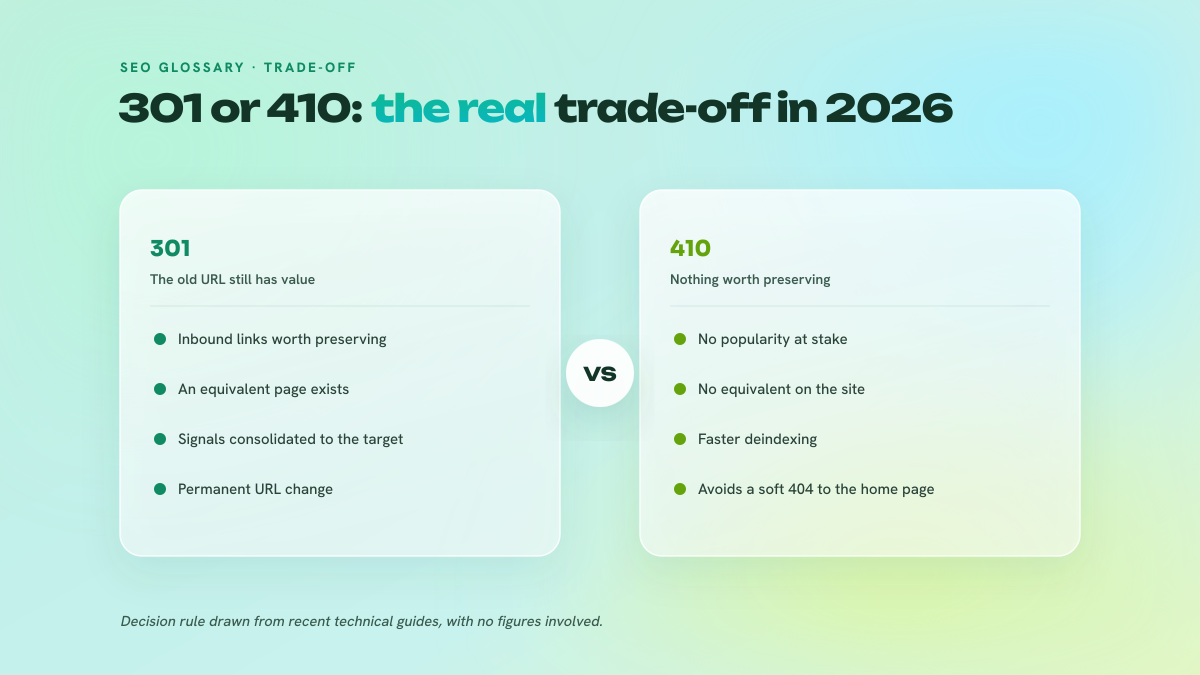
The decision that actually requires judgment is 301 versus 410. Current technical guidance converges on a simple rule: use a 301 when the old URL has external links or authority worth consolidating into a live equivalent; use a 410 («Gone») when you want faster deindexing and there is no equity worth preserving (Incremys, 2026). A 410 tells Google to stop asking. A 301 tells it where to look instead. Redirecting a zero-backlink, zero-traffic page «just in case» clutters your redirect table and your crawl; deleting a page that carries referring domains throws money away. Check the backlink profile before you choose, every time.
Persistent misuse of 302s where 301s belong is less catastrophic than it was a decade ago, Google eventually treats long-lived 302s as permanent, but «eventually» is doing unpaid work in that sentence. During the interpretation window, canonicalization can flap between old and new URLs. If the move is permanent, say so with the correct code from day one.
The failures we keep finding in audits
Redirect chains top the list. Google's guidance, relayed in a 2025 SEOTesting review of Search Console redirect errors, recommends keeping chains to five hops or fewer, and Search Console will flag chains beyond that. But the practitioner standard in 2026 is stricter: one hop, refactoring any A to B to C sequence so A points directly at C. Chains waste crawl budget, add latency, and compound equity loss at each step. They accumulate silently across successive migrations: the HTTP-to-HTTPS redirect from 2019 feeds the domain move from 2023 which feeds last year's URL restructure. Nobody designed the chain; everybody inherits it.
Loops are rarer but total. In September 2025, Search Engine Journal documented Google's own documentation serving an infinite 301 loop between removed structured-data pages and their changelog, describing it as bad for users and crawlers alike. If Google's docs team can ship a loop, so can yours. Crawl your redirect table after every deploy, not just after migrations.
Mass-redirecting deleted content to the homepage is the third classic. Google treats a redirect to an irrelevant target as a soft 404: the equity does not transfer, and the report fills with noise. Redirect to the closest topical equivalent, a parent category if no equivalent exists, and accept a 410 when nothing relevant remains.
Two quieter failures round out the list. Internal links left pointing at redirected URLs force every crawl through an unnecessary hop; post-migration, update the links themselves, the redirect is a safety net, not a substitute. And redirects dropped too early: teams sunset redirect rules at exactly twelve months while the old URLs still receive crawler hits and referral traffic. Check server logs before removing anything. From what we see in audits, redirect rules that still catch traffic at month eighteen are common on sites with old, distributed backlink profiles.
Auditing redirects: a working SEO's routine
The tooling is stable and the workflow fits in a morning. Screaming Frog's redirect chains report surfaces multi-hop sequences and loops; crawl in list mode with your full historical URL inventory, not just the current site, because the URLs that matter are precisely the ones no longer linked internally. Search Console's Indexing report tells you how Google classifies each redirect; the Change of Address tool handles domain-level moves, now per variant. Ahrefs' «Best by links» filtered on 404 and 301 status isolates the pages where external equity is at stake, which is where remediation hours should go first.
Sequence a migration in this order: freeze the old URL inventory, map every indexed URL to its equivalent, ship server-side 301s, update internal links to point directly at destinations, submit the new XML sitemap, file Change of Address requests for each variant, then monitor both properties. Expect turbulence: well-executed migrations typically take two to eight weeks to recover, and John Mueller has put ranking stabilization at four to twelve weeks depending on site size (via GreenGeeks, 2026). Traffic dips inside that window are weather. Dips beyond it are diagnosis.
The stance worth internalizing: redirects are where technical SEO and netlinking stop being separate disciplines. Every 301 decision is a decision about where acquired authority flows. Treat the redirect map as a first-class asset, version it, audit it quarterly, and it will quietly outperform most of the tactics that get more attention.
Nautilinks operates an owned network of editorial media. In-house written articles, transparency disclosures respected, anchor mix calibrated.
Frequently asked questions
Do 301s still lose a fixed percentage of PageRank per hop?
No fixed per-hop tax is supported by current data. The best available quantification is Moz's 2025 research: well-configured 301s preserve roughly 90 to 99% of link equity, while 404s and soft redirects lose virtually all of it. The real losses come from implementation, chains, irrelevant targets treated as soft 404s, and redirects dropped while still receiving hits, not from an inherent per-hop percentage.
How long should migration redirects stay live before I can remove them?
Google's guidance says at least one year, but treat that as a floor, not a schedule. An analysis of 892 migrations cited by Search Engine Journal found an average of 523 days to regain pre-migration traffic, and old URLs with distributed backlink profiles keep receiving crawler and referral hits well past month twelve. Check server logs for residual traffic on redirect rules before sunsetting them. Rules still catching hits stay.
301 or 410 for content I'm deleting during a site cleanup?
Check the backlink profile first. If the URL has referring domains or residual traffic, 301 it to the closest topical equivalent so the equity consolidates. If it has neither, a 410 gets it deindexed faster than a 301 and keeps your redirect table clean. The mistake in both directions is skipping the check: redirecting worthless URLs clutters crawl paths, and deleting linked URLs discards equity you could have kept.
Why does Search Console show «Page with redirect» as not indexed, and should I fix it?
That status is expected behavior, not an error. A URL returning a 301 is not supposed to be indexed itself; Google indexes the destination. The audit task is to confirm the redirect points at the URL you intended and that the destination is indexed and performing. Only investigate when the redirect target is wrong, when the status appears on URLs that should return 200, or when the destination fails to get indexed.
Are JavaScript redirects ever acceptable as a substitute for server-side 301s?
Not anymore, if they ever were. Google's December 20, 2025 Search Central update clarified that JavaScript rendering may be skipped for non-200 responses, meaning a client-side redirect can sit unprocessed indefinitely while a server-side 301 is read on first fetch. Use JS redirects only where you genuinely cannot touch the server, and treat each one as technical debt to migrate. For anything involving link equity, server-side 3xx is the only reliable mechanism.
What changed in Google's site move process in 2026?
On June 17, 2026, Google updated its site move documentation to require a Change of Address request for every relevant domain variant, www and non-www included, instead of assuming one submission covers all. The redirects themselves behave exactly as before; the change clarifies how signals are consolidated across variants. Practically: verify each variant as a Search Console property before the move, and file the request for each one that carried traffic or links.
Test your knowledge
Quiz: 301 Redirect
1/3During a migration, a legacy URL with 40 referring domains redirects A to B to C to D. What is the correct remediation in 2026?