- →rel=canonical is a hint Google weighs against redirects, internal links, sitemap inclusion and hreflang; when those signals contradict your declaration, Google overrides it and reports the verdict in Search Console.
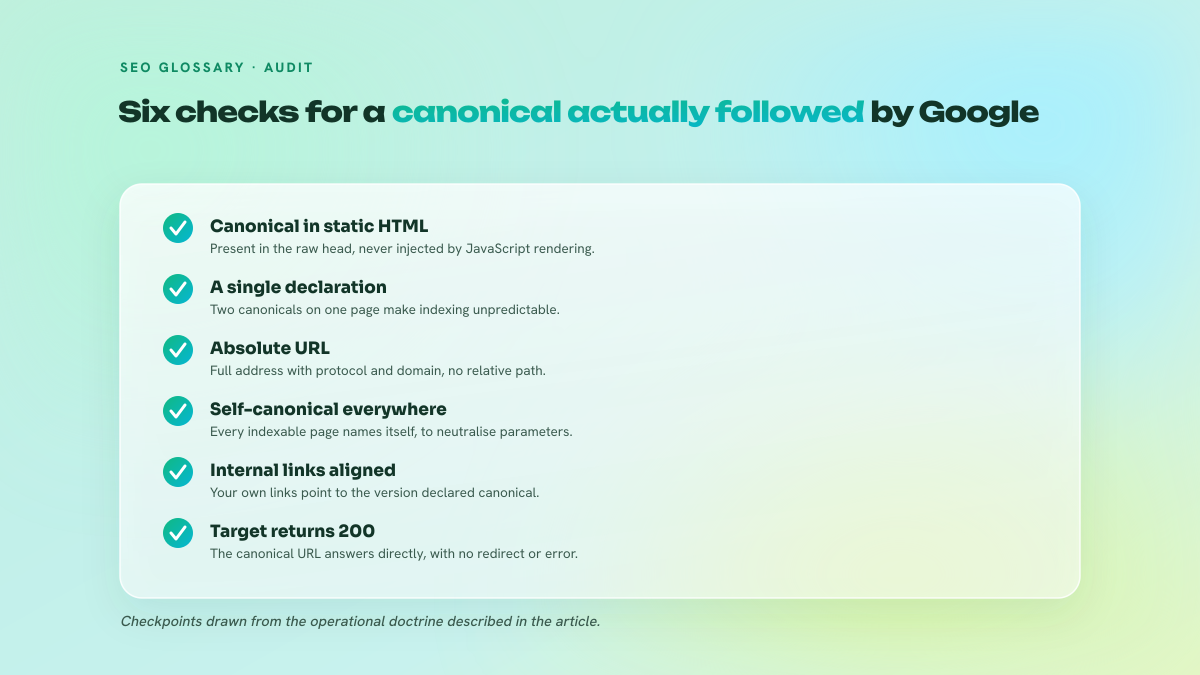
- →Only 7% of desktop pages and 9% of mobile pages canonicalize away from themselves (Web Almanac 2025); the self-referential canonical on everything else is cheap insurance against parameters and scrapers, keep it.
- →Since Google's December 18, 2025 JavaScript SEO documentation update, the standard is explicit: set the canonical in static HTML and never let JavaScript mutate it.
- →In netlinking, verify canonicals at both ends before paying: the exact URL your backlinks point at, and the publisher's article template. A hub-pointing canonical silently nullifies a placement.
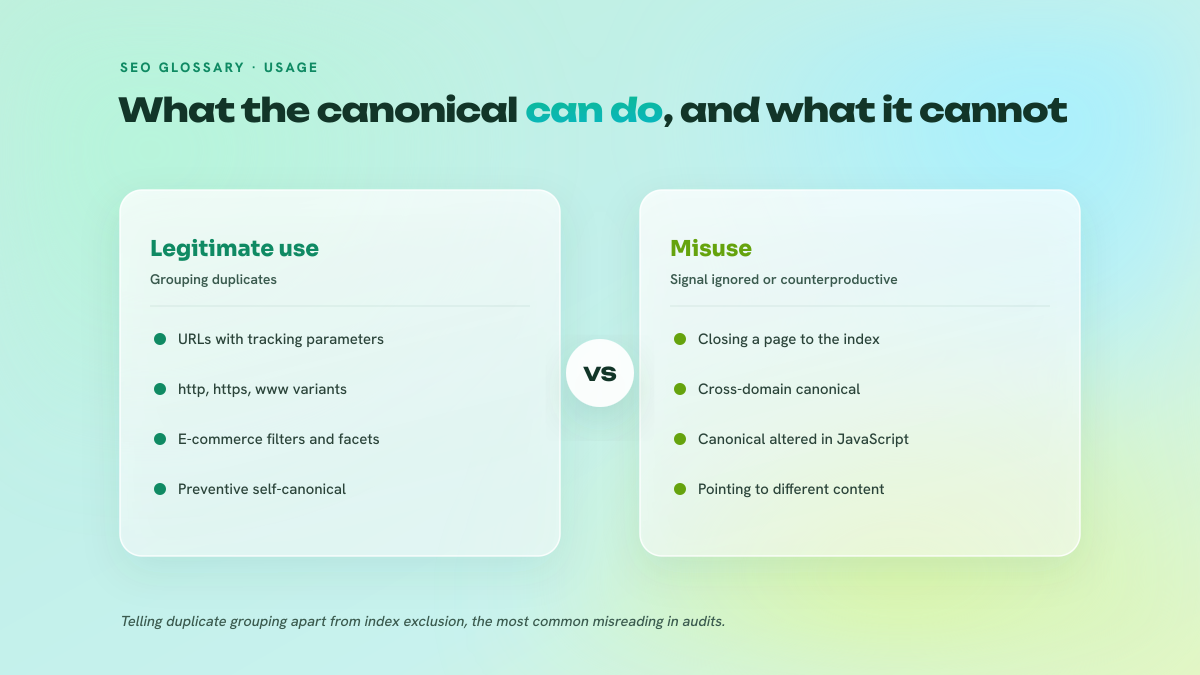
- →Never use a canonical as a deindexation tool. If the pages are not genuine duplicates, Google ignores the hint; noindex and 301 exist for that job.
- →Canonical implementation errors remain endemic: JetOctopus found issues in 90% of its large-site audits in 2025. Assume yours has some until a crawl proves otherwise.
What a canonical tag actually does (and what it never did)
Strip away the tutorials and a canonical tag is a consolidation request you file with a search engine: of these near-identical URLs, please index this one and credit it with the cluster's ranking signals. The operative word is request. Google's own documentation classifies rel=canonical as a hint, and Google overrides declared canonicals every day when stronger signals disagree. Every serious decision you make about canonicalization flows from that asymmetry: you are not configuring behavior, you are casting one vote in an election where Google counts a dozen other ballots.
For the base case in two minutes, this short explainer covers it well:
The element itself lives in the page head as a link element with rel=canonical, or as an HTTP header for non-HTML documents like PDFs. Adoption is now a platform default rather than an SEO decision: per the Web Almanac 2025 edition (published January 2026), 68% of desktop pages and 67% of mobile pages carry a canonical tag, up from 65% the year before, with growth driven mostly by CMS and plugin defaults rather than manual work. The more telling figure: only 7% of desktop pages and 9% of mobile pages canonicalize to a different URL. The overwhelming majority of canonical tags are self-referential, and that is correct behavior, not waste. A self-referential canonical is cheap insurance against URL parameters, session IDs, scraped copies and tracking-tagged links creating indexable variants of your page.
How Google actually selects canonicals in 2026
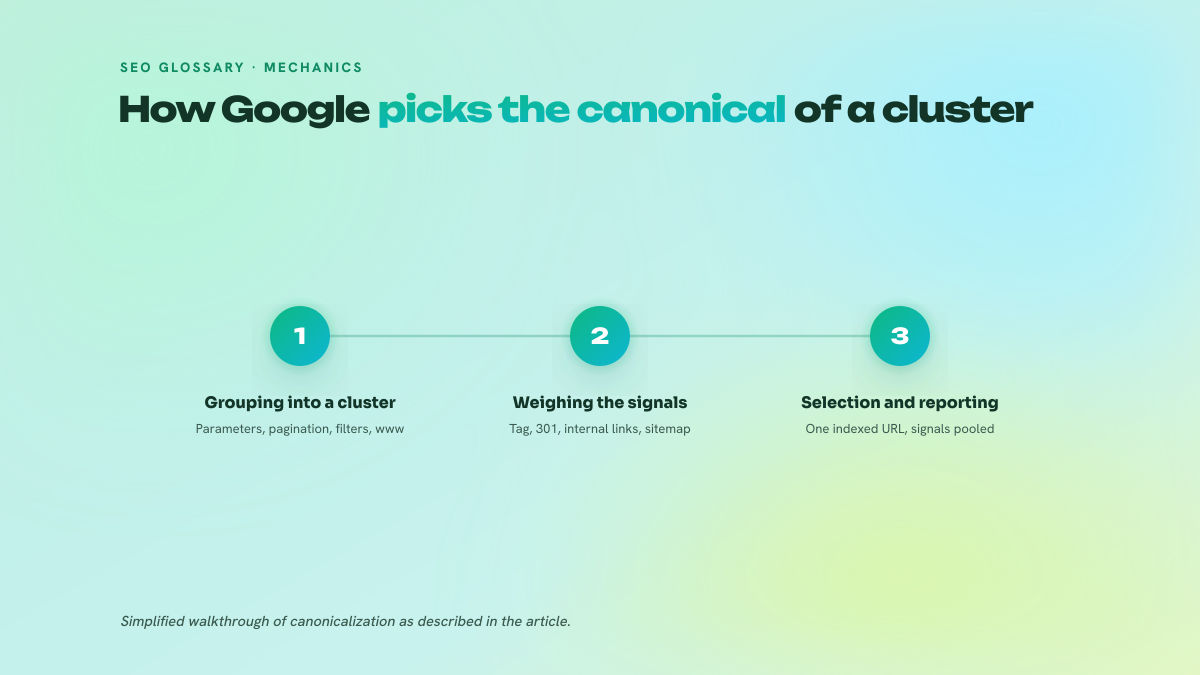
Googlebot does not read your canonical tag and comply. It clusters duplicate and near-duplicate pages, then elects a representative URL for each cluster from a stack of signals: 301 redirects, internal linking patterns, presence in the XML sitemap, HTTPS over HTTP, URL simplicity, membership in an hreflang group, content similarity, and yes, the declared canonical. When those signals agree, your declaration is honored and you never think about it again. When they disagree, Google votes with the majority.
Google's own explanation of how it picks between duplicate URLs is worth the watch:
The verdict shows up in Search Console as « Duplicate, Google chose different canonical than user ». Treat that status as diagnostic gold, not an error to suppress: it tells you precisely where your internal links, redirects or sitemap contradict what you declared. In the audits we run, the most common cause is internal navigation still pointing at a parameterized or non-preferred version of a page while the canonical points elsewhere. Google reads the internal links as your real opinion.
Two data points frame the 2026 stakes. A GSQi analysis published in early 2026 documented cases where Google ignoring a declared canonical cascaded into AI search surfaces, which reuse Google's canonical selection: lose this election and the wrong URL is what AI answers cite. Meanwhile the HTTP header variant of the signal remains marginal at 0.6% of desktop pages (Web Almanac 2025). Use it for PDFs and other non-HTML assets; everywhere else, the head element is the convention that crawlers and audit tools expect to find.
Where canonicals decide the outcome of a netlinking operation
In a netlinking operation, canonicalization is the plumbing that decides whether a paid or earned link actually credits the page you are trying to rank. Backlinks rarely point at the exact canonical URL: publishers add UTM parameters, link the www variant of an apex-canonical site, drop the trailing slash, or link http out of habit. Each of those variants must resolve, via redirect or canonical, to your preferred URL, or the equity you paid for evaporates into an orphan duplicate that Google may index separately or discard.
The same discipline applies on the publisher side. Before paying for a placement, check that the medium serves a clean self-referential canonical on its article pages: a template-level canonical pointing at a category hub or homepage silently nullifies every link inside the article. It is one of the first things we verify across the media catalogue we operate in-house, and it belongs on your checklist whenever you commission placements on external sites. A placement on a page Google canonicalizes elsewhere is a placement you did not buy.
Syndicated content is where canonical strategy meets spam policy. Google updated its canonicalization guidance for syndicated content in May 2024 (Search Central changelog), aligning it explicitly with its spam policies, and the direction of travel has held through 2026: the cross-domain canonical is the weakest form of the signal, and Google feels free to index the syndicated copy anyway when it looks stronger than the original. If you syndicate for reach, accept that the partner version may outrank yours unless the partner applies noindex on their copy.
JavaScript, rendering and the December 2025 guidance
On December 18, 2025, Google updated its JavaScript SEO documentation with a section specifically on canonicals in JS-rendered pages, and the guidance is blunt: set the canonical URL in static HTML and do not let JavaScript change it. If you must inject via JS, either match exactly what the raw HTML already declares, or omit the canonical from the initial HTML entirely and inject a single, consistent value. Multiple canonicals, or a canonical that mutates during rendering, produce what Google diplomatically calls unexpected indexing results.
The Web Almanac 2025 data shows why Google bothered writing this down. Canonical presence in raw HTML sits at roughly 64.4% of desktop pages and rises to 66% once rendering completes: a measurable slice of the web now depends on JavaScript to inject its canonical, which is precisely the pattern the December 2025 guidance constrains.
For single-page applications the operational rule is simple: canonicals belong at the server or edge layer, not in the client bundle. Then verify both states. Fetch the raw HTML with curl, inspect the rendered DOM through the URL Inspection tool in Search Console, and compare. If the two disagree, you are running a canonicalization lottery, and Google draws the ticket.
The mistakes we keep finding in audits
The error rate in the wild is remarkable for such a well-established standard. JetOctopus reported in August 2025 that 90% of the large-site audits it ran that year surfaced incorrect canonical usage, and a 2025 Ranktracker roundup citing Screaming Frog data puts canonical implementation errors at roughly 40% of websites. Our own audit experience matches: the tag is everywhere, correct usage is not.
The recurring failure is using the canonical as a pseudo-deindexation tool: pointing thin or expired pages at some other URL to « clean up » the index. If the pages are not genuine duplicates, Google notices the content mismatch, ignores the hint, and you have gained nothing except one more inconsistent signal in the cluster. Removing pages from the index is a job for a noindex directive, not for canonicalization.
The other classics: pairing canonical with noindex on the same page, two contradictory instructions where the noindex can be processed before the canonical is consolidated; canonicalizing to a URL that is blocked in robots.txt or answers with a redirect or 404, when the target must be crawlable and indexable for consolidation to happen at all; and shipping multiple canonical elements from stacked SEO plugins, in which case Google may disregard all of them. Every one of these is trivially detectable with a crawler, which is why finding them at this frequency in 2026 audits says more about process discipline than about knowledge gaps.
Canonical vs noindex vs 301: the decision framework
The framework we apply is short. Use a canonical when two URLs serve substantially the same content and both must keep resolving for users: parameter variants, print versions, A/B test URLs, syndication where you accept the risk. Use noindex when the page must exist for users but has no business in a search index: internal search results, thin tag archives, funnel steps. Use a 301 when the old URL has no reason to exist at all: it is the strongest, least ambiguous consolidation signal, and the only one of the three that Google treats as close to binding.
The gray zone is near-duplicate editorial content, several articles chasing the same query. Canonicalizing the weaker ones to the strongest works only if the content genuinely overlaps; otherwise merge the articles and redirect. This walkthrough covers that exact scenario:
Make the check cadence boring and regular: crawl for canonical anomalies quarterly, review the duplicate statuses in Search Console monthly, and verify the canonical of every URL you plan to build links toward before the campaign starts, not after. Canonicalization is unglamorous plumbing, but it decides which URL gets credit for everything else you do.
Nautilinks operates an owned network of editorial media. In-house written articles, transparency disclosures respected, anchor mix calibrated.
Frequently asked questions
Does a canonical tag consolidate link equity the way a 301 redirect does?
When Google honors it, broadly yes: signals from the duplicate cluster are consolidated onto the canonical URL. The difference is reliability. A 301 is close to binding; a canonical is a hint Google can override when internal links, redirects or sitemap entries disagree. For a URL that should permanently disappear, redirect. Reserve the canonical for cases where both URLs must keep serving users.
Why does Search Console report that Google chose a different canonical than the one I declared?
Because stronger signals contradicted your declaration. Google clusters duplicates and elects a representative using redirects, internal linking, sitemap inclusion, HTTPS, hreflang and content similarity alongside the tag. The usual culprit is internal navigation still linking the non-preferred variant. Fix the contradiction rather than the tag: align internal links, sitemap URLs and redirects with the canonical you want, and the status resolves on the next recrawls.
Are cross-domain canonicals still worth using for syndicated content in 2026?
They are the weakest form of the signal. Google updated its syndication guidance in May 2024 (Search Central changelog) and aligned canonicalization with its spam policies; in practice Google often indexes the syndicated copy anyway when it sits on a stronger domain. If you control the partnership, ask the partner to noindex their copy. If you cannot, syndicate for referral traffic and brand, not for rankings.
Is a self-referential canonical on every page actually necessary?
Yes, and the data says most of the web agrees: per the Web Almanac 2025, around two thirds of pages carry a canonical while only 7 to 9% canonicalize to a different URL. The self-referential tag defends against UTM parameters, session IDs, scrapers and tracking-tagged inbound links creating indexable variants. It costs nothing, ships by default in every serious CMS, and removes an entire class of duplicate-content ambiguity.
When is the HTTP header version of rel=canonical the right choice?
For non-HTML resources: PDFs, images, feeds, anything without a head element. On regular pages, prefer the HTML link element; it is what crawlers, plugins and audit tools expect, and per the Web Almanac 2025 only 0.6% of desktop pages use the header variant. One caution: never ship both a header and an HTML canonical with different values, conflicting declarations invite Google to ignore both.
Can Google's canonical selection affect what AI search engines cite?
Yes. A GSQi analysis from early 2026 documented cases where Google ignoring a declared canonical cascaded into AI-driven surfaces that reuse Google's index and canonical choices, so the URL cited in AI answers was the one Google elected, not the one the site declared. Canonical hygiene is now part of AI visibility work, not just classic indexation housekeeping.
Test your knowledge
Quiz: Canonical Tag
1/3When internal links and redirects contradict a declared rel=canonical, what does Google typically do?