- →PAA stopped being a pure extraction surface: AlsoAsked data reported by Search Engine Roundtable on 16 October 2025 put 38 % of English PAA answers as AI-generated, against 17.8 % a few months earlier, so the classic « rank a passage, win the box » loop only applies to part of the inventory.
- →Treat PAA as a visibility and topical-mapping asset, not a traffic line: Ahrefs' December 2025 re-analysis measured a 58 % drop in position-one organic CTR when an AI Overview is present, and informational position-one CTR falling from 7.6 % in December 2023 to 3.9 % in December 2025.
- →Any PAA prevalence figure without country, device, query set, date range and a definition of « presence » is unusable. 2026 compilations range from ~49.5 % desktop to 75 % depending on the sample, and those numbers must never be averaged together.
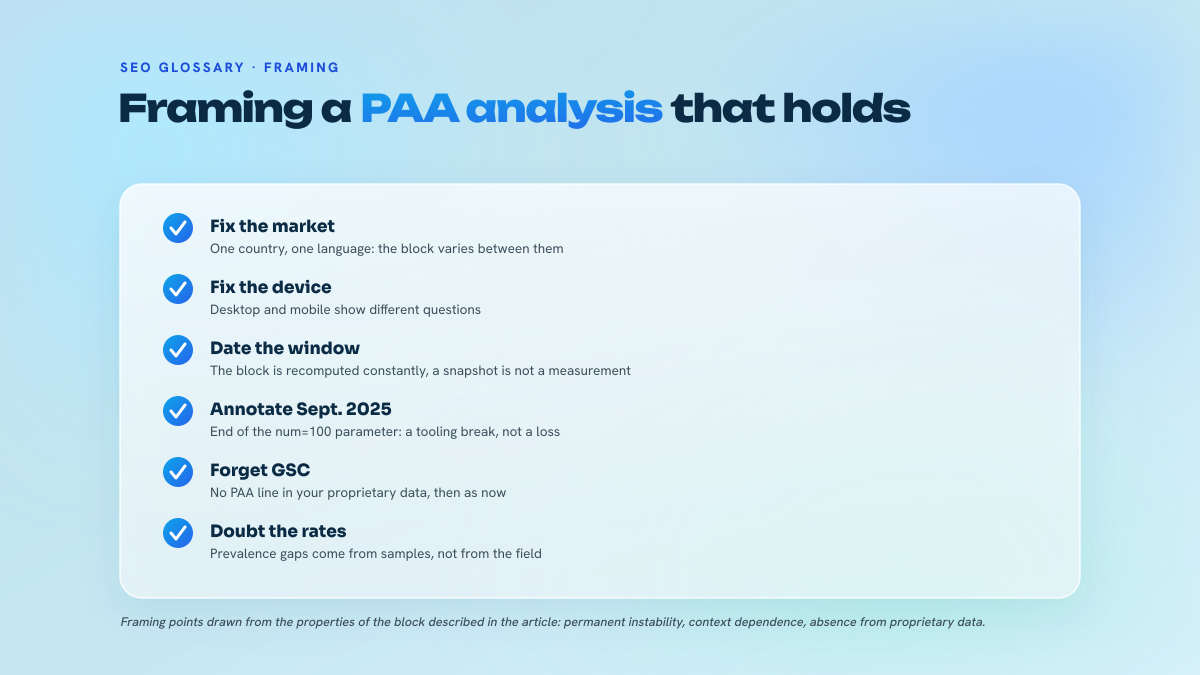
- →Your historical PAA trend lines break in September 2025, when Google disabled the &num=100 parameter and rank trackers lost reliable depth. Annotate that date before anyone reads a drop as a ranking loss.
- →The durable asset is the question tree, not the slot. PAA questions come from real query logs and are the cheapest source of article angles, H2 phrasing and natural anchor variety we have.
- →Google's 3 June 2026 Search Console reports cover AI Overviews and AI Mode, not PAA. There is still no first-party PAA reporting, so anything you present to a client is third-party scraping with third-party error bars.
What a PAA box actually is in 2026
The interface has barely moved in a decade: a stack of collapsible questions injected into the results page, each one opening into a short answer with an attributed source URL, each expansion pushing more questions into the stack. What changed is the machinery underneath, and the change is large enough that most PAA advice written before 2025 is now wrong in a way that costs real production hours.
For most of its life the PAA answer was an extraction. Google picked a passage from an indexed page, framed it as an answer, and credited the URL. That is why PAA and the snippet block at the top of the page were effectively the same optimisation job: same passage engineering, same question-shaped headings, same 40-to-60-word direct answer sitting above the depth. Win one, you tended to win the other.
That equivalence is broken. AlsoAsked data reported by Search Engine Roundtable on 16 October 2025 found that 38 % of English-language PAA answers were labelled AI-generated, up from 17.8 % a few months earlier, more than doubling inside roughly a quarter. A July 2025 industry report citing BrightEdge had already put 12.6 % of PAA results as full AI Overviews rather than snippet-style extractions. Two different vendors, two different methodologies, one direction of travel.
So the honest description of a 2026 PAA box is a hybrid surface: part passage extraction with a real source URL you can compete for, part generated summary where no single page won anything and the citation is a byproduct of the generation. You cannot tell which one you are looking at from a rank tracker export. You have to look at the SERP. That single operational fact reorganises everything below.
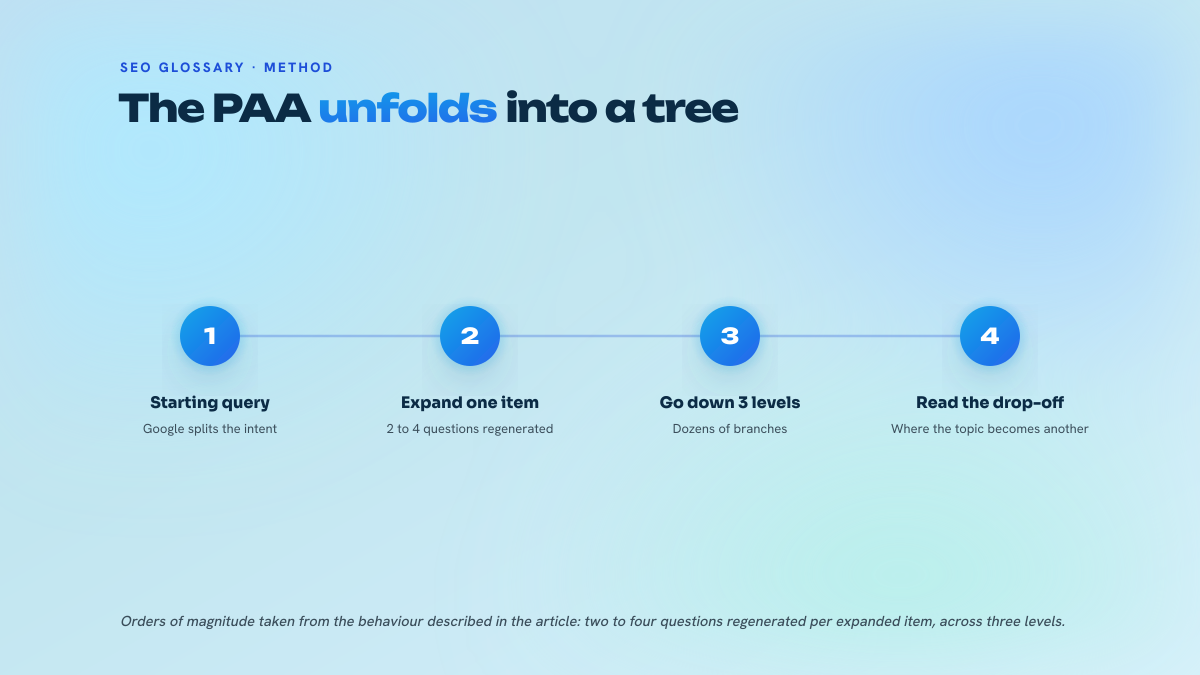
The second thing worth stating plainly: the questions themselves are a separate asset from the answers. They are mined from real query logs and expand as the user interacts, which makes the PAA tree the closest thing to a public read on how Google clusters intent around a topic. The answer slot may be worth less than it was. The question corpus is worth more.
Mechanics and measurement: why your PAA data is worse than it was
Start with prevalence, because this is where most client decks embarrass themselves. A 2026 compilation put PAA on roughly 49.5 % of desktop and 52.3 % of mobile searches. Other 2026 summaries report roughly 65 % or 75 %. Those numbers are not contradictory, they are simply different keyword universes, countries, devices and definitions of what counts as presence. Search Engine Land, working from industry tracking data, reported a 34.7 % increase in US PAA visibility between February 2024 and January 2025, and that 63 % of PAA interactions happened on mobile.
The discipline here is not complicated but it is rarely applied: a PAA prevalence figure is meaningless unless it declares country, device, query set, date range, whether « presence » means the initially visible questions or the expanded tree, and whether AI-generated answers are counted as PAA at all. Combine two vendor figures built on different definitions and you get a number that describes nothing. We refuse to put a single global PAA percentage in a deliverable for exactly this reason.
Then there is the measurement break. In September 2025 Google disabled the &num=100 parameter, and rank trackers lost the ability to retrieve a hundred results in one request. Ahrefs said the change reduced how many results it could check beyond page one. The consequence for PAA reporting is specific: any trend line that spans September 2025 contains a scraper-side discontinuity that looks exactly like a visibility loss. If you hand a client a chart showing PAA presence collapsing in the autumn of 2025 without annotating that date, you are reporting an instrumentation change as an SEO event.
First-party data does not save you either. On 3 June 2026 Google announced dedicated Search Console reports for generative AI features, covering AI Overviews and AI Mode with impressions and appearing URLs. That announcement created no PAA report. PAA impressions remain folded into ordinary Search Console performance data with the position of the containing block, which is why nobody, including us, has clean first-party PAA attribution. Everything operational you do here rests on third-party scraping, so build the sampling protocol before the dashboard: fixed depth, initially visible questions only, same device, same locale, same time of day.
Where PAA earns its place in an SEO and netlinking operation
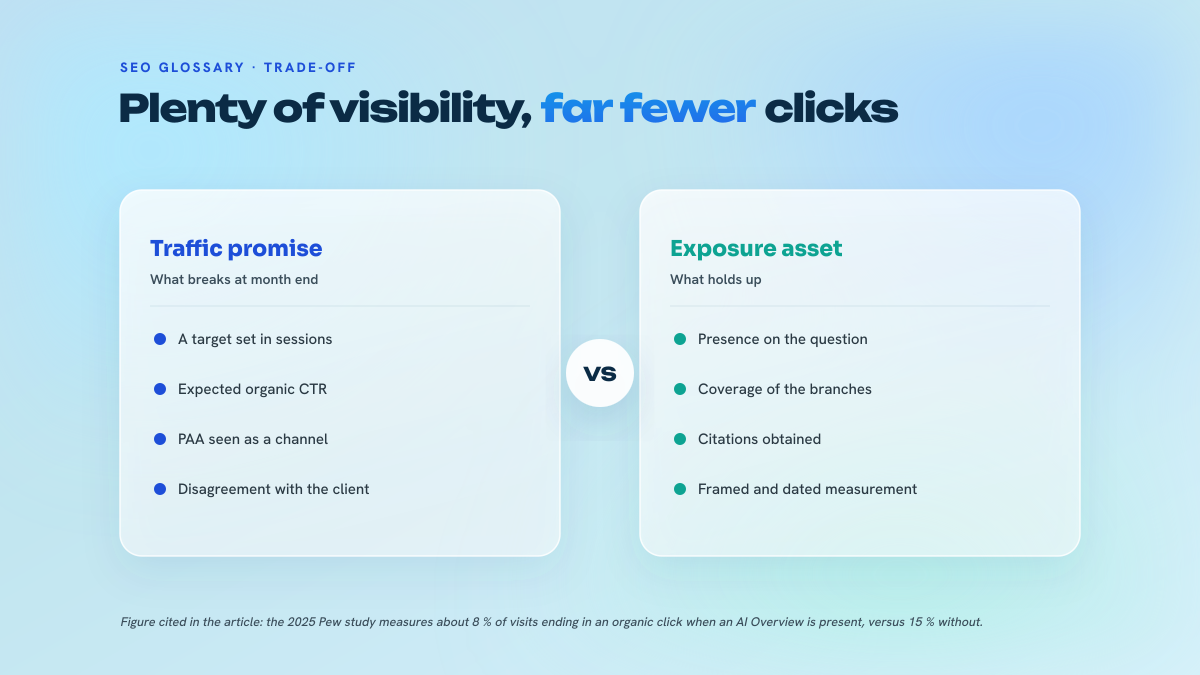
The value of a PAA placement has shifted from traffic to exposure, and the numbers on that shift are not subtle. Ahrefs' December 2025 re-analysis found that AI Overviews reduced the organic click-through rate of the position-one result by 58 %, with informational position-one CTR falling from 7.6 % in December 2023 to 3.9 % in December 2025. Pew's 2025 behavioural study, as relayed in later industry coverage, found users clicked a traditional result on roughly 8 % of visits where an AI Overview appeared, against 15 % without one, with clicks on links inside the Overview itself at roughly 1 %. On an informational query in 2026, a PAA slot is a brand impression that happens to carry a link.
That is not the same as worthless. It is a different line item. A PAA citation contributes to the entity-level signal that generative surfaces reuse, it puts your domain name in front of someone mid-research, and it correlates with the depth of coverage a site holds on a subject. What it does not do is fill a session-based ROI model. Price it as visibility, report it as visibility, and stop promising traffic from it.
The higher-leverage use is upstream. A PAA tree is a free, continuously refreshed map of how a topic decomposes into sub-intents, and it is a far better input to a content plan than a keyword export sorted by volume. On the French editorial media we operate, the article angles inside a cluster are planned from question trees rather than from volume tables, because volume tables collapse five distinct intents into one head term while the PAA tree keeps them separate. The same corpus feeds anchor work: questions phrased the way people actually phrase them are the cleanest source of natural anchor variety when you plan placements through a catalogue of media you can browse and filter yourself, and they keep you away from the repetitive exact-match phrasing that makes a link profile look assembled.
One caution on stability. Semrush and Datos, analysing more than 10 million keywords, tracked AI Overview incidence rising from 6.49 % in January 2025 to nearly 25 % in July, then falling back to 15.69 % in November 2025. Google also expanded AI Overviews to more than 200 countries and territories and over 40 languages in May 2025. A surface that triples and then halves inside a year is not a surface you rebuild a strategy around every quarter. Set your cadence to two readings a year, not twelve.
What we see go wrong
The most expensive mistake is industrial FAQ production. Someone exports four hundred PAA questions, hands them to a writer at scale, and ships a wall of thin question-and-answer blocks under every page. It fails for a simple reason: generic FAQ text is precisely the material a generated answer replaces without ever citing you. Ten questions answered with something first-hand beats four hundred answered with paraphrase.
The second is chasing the expanded tree. Expanding a PAA box generates further questions in-session, and people build enormous keyword lists from depth-four expansions that no other user will ever see in that order. The initially visible questions are the stable surface. Everything below is a per-session artifact.
The third is optimising a page for a PAA slot on a SERP where the answer is already generated. There is no passage to win. You are writing for an extraction that is not happening. Check the box before you brief the article, not after.
The fourth, and the one that damages client relationships, is reporting PAA impressions as traffic. Given the CTR figures above, a month where PAA presence doubles and sessions stay flat is the expected outcome, not an anomaly to explain away.
The fifth is a netlinking error specifically: pointing paid placements at a page whose only measurable asset is a PAA slot. Link equity is a budget and it should go to pages that can rank and convert. A page that earns an impression inside an accordion is not that page.
Working the surface without wasting budget
Write question-shaped headings and put a direct answer of forty to sixty words in the first passage under each one, then go deep below it. This is unchanged advice and it still works on the extraction half of the inventory, with the useful property that it also makes the page more quotable by generative systems. Do not lean on structured data markup for eligibility: it helps machines parse the page, it does not buy the slot.
Track presence, not position. Position inside a PAA box is not a meaningful metric, and the tools reporting it are inferring it. Presence, source URL and whether the answer looks generated are the three fields worth storing.
On tooling, keep the spend proportionate to what the surface returns. AlsoAsked now advertises live geo-specific PAA data with API access, asynchronous requests and webhook support, with 2026 pricing reported by third-party pricing pages at $12 per month Basic, $23 Lite and $47 Pro. Verify at checkout before quoting those to a client. Ahrefs' Brand Radar methodology draws on Google's PAA corpus alongside a keyword database it describes as 110 billion keywords, and the same vendor reported a 2025 update expanding its ChatGPT and Perplexity indexes tenfold, including long-tail queries derived from PAA. Twelve to fifty dollars a month for a question corpus is a rounding error next to a content or link budget, which is worth remembering when you are arbitrating what a campaign actually costs: our own rates are public and itemised for the same reason, because a line you cannot see is a line you cannot arbitrate.
Last, connect the PAA read to the rest of the results page. A question box sitting under a generated summary at the top of the results behaves nothing like one sitting under three blue links, and a 2026 study claimed PAA appeared alongside AI Overviews on roughly 90 % of AI-Overview SERPs. Read the whole SERP or you will optimise for a box in isolation and wonder where the clicks went.
Nautilinks operates an owned network of editorial media. In-house written articles, transparency disclosures respected, anchor mix calibrated.
Frequently asked questions
Is winning a PAA slot still the same job as winning a featured snippet?
Only on the extraction half of the inventory. When Google pulls a passage from a ranking page, the work is identical: question-shaped heading, direct answer in the first forty to sixty words, depth underneath. When the answer is generated, and AlsoAsked data reported in October 2025 put that at 38 % of English PAA answers, there is no passage contest to enter. Check what the box is actually doing on your target SERP before briefing anything.
Why did my PAA visibility appear to collapse in late 2025?
Check your instrumentation before your rankings. Google disabled the &num=100 parameter in September 2025, and Ahrefs stated the change reduced the number of results it could check beyond page one. Trackers that previously pulled a hundred results per request lost depth, and lost depth reads as lost visibility in a trend line. Annotate that date in every historical PAA chart, then look for a real cause only in what survives the annotation.
Can I measure PAA performance in Search Console?
Not distinctly. PAA impressions are folded into ordinary performance data with the position of the containing block. Google's 3 June 2026 announcement added reports for AI Overviews and AI Mode, exposing impressions and appearing URLs, but created nothing PAA-specific. Anything you present as PAA performance is third-party scraping, so document the sampling protocol, fixed depth, device and locale, and present it with the error bars it deserves.
Which PAA prevalence figure should I quote to a client?
None, on its own. 2026 sources range from roughly 49.5 % desktop and 52.3 % mobile up to 65 % or 75 %, because they use different keyword universes, countries, devices and definitions of presence. Quote the one whose methodology matches your client's market and query set, state that methodology in the same sentence, and never average two vendor figures. A number without its sampling frame describes nothing.
Does a PAA placement justify pointing paid links at the page?
Rarely. Ahrefs measured a 58 % drop in position-one organic CTR where AI Overviews appear, and informational position-one CTR falling to 3.9 % by December 2025, so an accordion impression converts poorly. Send link equity to pages that can rank and convert, and treat the PAA slot as a signal that the page covers a real sub-intent, which is a reason to strengthen the cluster, not a reason to buy placements for that URL specifically.
Is mass FAQ production off the table entirely?
As a volume play, yes. Generic paraphrased answers are exactly what a generated PAA answer replaces without citing anyone. Ten questions answered with something first-hand, a measurement, a threshold, an observation from your own operations, outperform four hundred answered from the same three competitor pages everyone else summarised.
Test your knowledge
Quiz: People Also Ask (PAA)
1/3According to AlsoAsked data reported by Search Engine Roundtable on 16 October 2025, what share of English-language PAA answers was labelled AI-generated?