- →A snippet is an extraction, not a ranking you buy: Google lifts a passage from a page already in the top five, so authority to rank comes first and formatting second.
- →AI Overviews are substituting for snippets, not stacking with them: Semrush's December 2025 study shows FS and AIO co-occurrence fell from 34% to 18% between March and November 2025.
- →Aggregate snippet prevalence still rose year over year, to 23.7% of SERPs in 2026 per Semrush and BrightEdge, but the format now lives on the long tail and question-shaped queries.
- →The box is a lease, not a deed: Ahrefs measured a 64% drop in snippet visibility over H1 2025 on a Google layout test before it recovered.
- →Winning is not always winning the click: a snippet that fully answers a query can cut CTR to 23.4% (Searchlab, 2026), so match the format to whether you actually want the visit.
- →Best win rate comes from stealing beatable snippets on queries where you already rank 2 to 8, not from chasing terms you don't rank for.
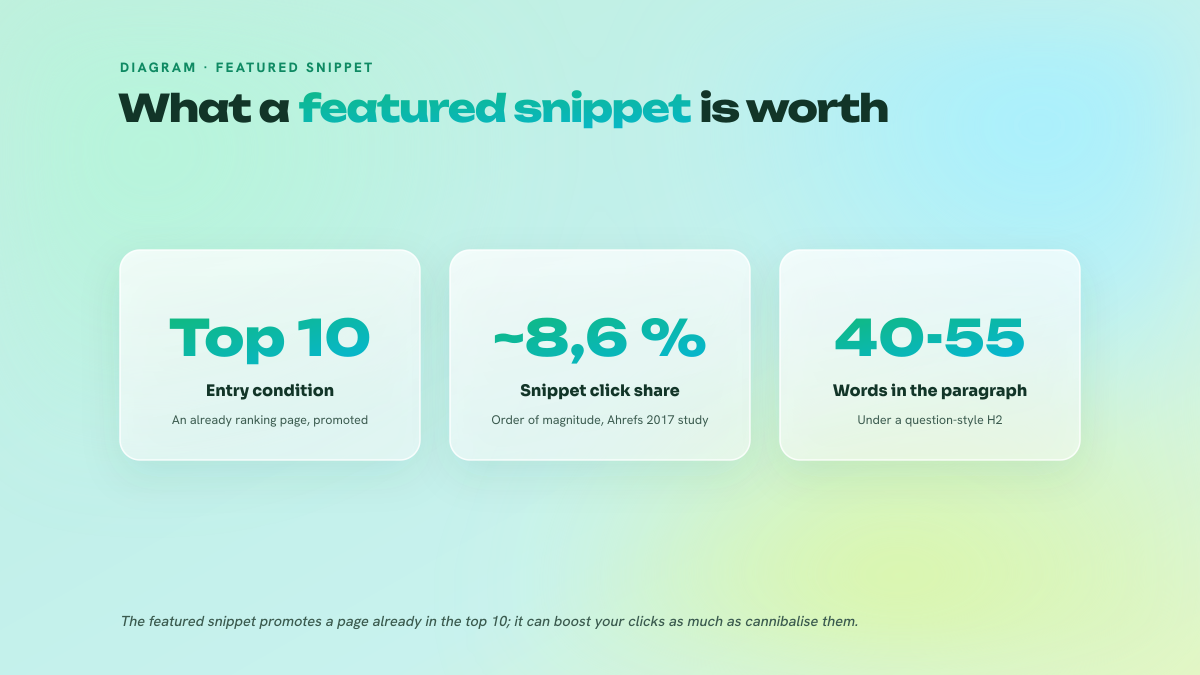
What a featured snippet actually is in 2026
A featured snippet is not a ranking you buy or a schema you toggle on. It is an extraction: Google pulls a passage, a list or a table from a page already ranking on page one and promotes it above the blue links, in what the industry nicknamed «position zero». The source page keeps its organic slot and gains the box on top. That mechanic has not changed since Google first shipped the format. What changed is everything around it.
Here is a concise visual primer before we go into the operational detail.
The honest read for 2026: the featured snippet now competes for the same real estate as the AI Overview. Google rolled out AI Overviews in the US in May 2024 and expanded globally through 2025. By early 2026 they appear on roughly 58% of queries and frequently push the classic snippet off the top (DigitalApplied, 2026). Semrush's AI Overviews study, updated December 2025 across more than 10 million keywords, found that snippets and AI Overviews rarely co-occur: co-occurrence fell from 34% in March 2025 to 18% in November 2025. Read that as substitution, not coincidence. When Google can answer with a generated summary, it often stops drawing the snippet box at all.
That does not make the format dead. Semrush and BrightEdge's 2026 analysis of 214 million queries reports featured snippets on 23.7% of SERPs, up from 19.2% in 2025. The paradox is real: aggregate prevalence rose year over year while AI Overviews ate the highest-value informational queries. The snippet survives on the long tail and on queries where Google does not yet trust a generated answer. Understanding how the layout of a Google results page allocates that vertical space is now part of the job.
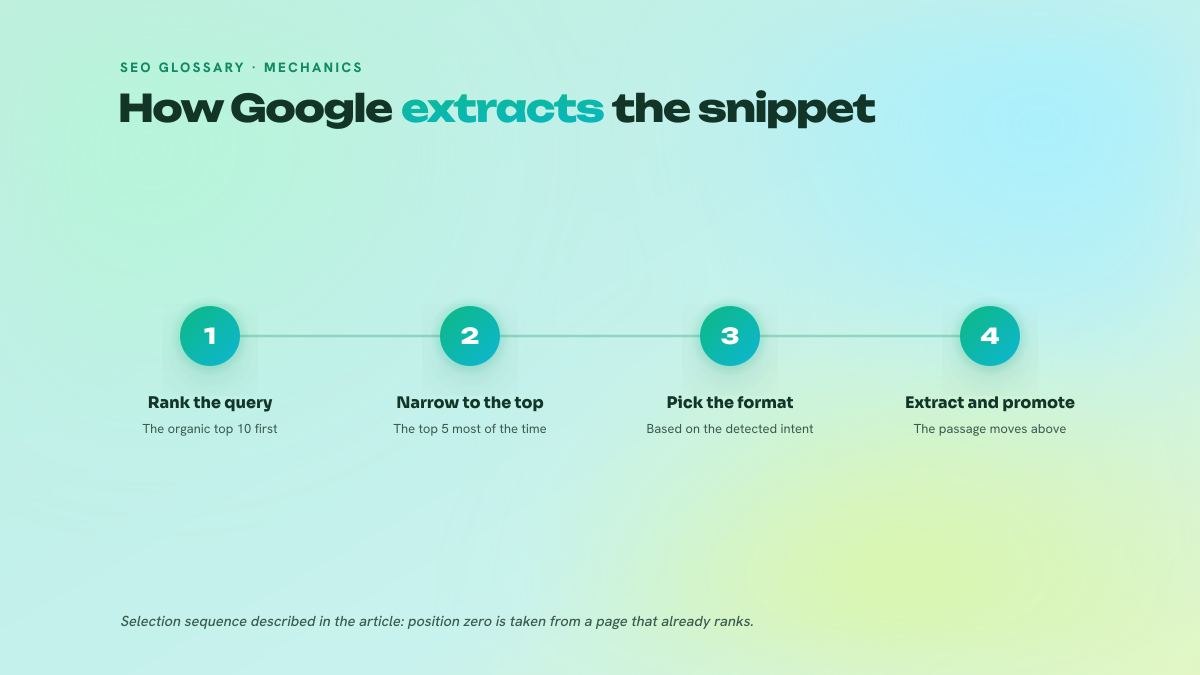
How Google picks and formats the box
Mechanically, a featured snippet is a passage-ranking problem layered on top of classic ranking. Google first needs your page in the top ten, usually the top five, for the query. Then a separate extraction pass decides which passage answers the question best, and in which format: paragraph, ordered list, unordered list, table, or increasingly video. You do not «apply» for a snippet, you make one passage trivially liftable.
The format is dictated by query intent, not by your preference. A «how to» query tends to pull a numbered list, a «what is» query pulls a paragraph of 40 to 60 words, a comparison pulls a table. Backlinko data reported by SHNO (2025) shows only 4.3% of single-word queries trigger a snippet against 55.5% of ten-word queries, and 54% of featured snippets come from low-volume long-tail searches under 50 monthly searches. That is the operational tell: snippets live where questions are explicit. Video snippets are a growing format too. Wistia and TubeBuddy's 2026 study found video featured snippets in 33.8% of how-to queries, up from 26% in 2025, with YouTube holding 74.2% of those placements.
Volatility is worth respecting. Ahrefs' 2025 study of 1 million US desktop SERPs found featured-snippet visibility fell 64% between January and June 2025, from 15.41% to 5.53% of queries, while sitelinks grew 906% in the same window. Google was openly testing layouts. Prevalence recovered into 2026, but the lesson holds: a snippet is a lease, not a deed, and Google can reclaim the box on an algorithm test with zero notice.
Where snippets fit a netlinking operation
For a netlinking operation the featured snippet is a downstream signal, not the objective. You do not build links to win a snippet, you build authority so the page ranks in the top five, and the snippet becomes an available upside on question-shaped queries. If a page is not already in the extraction pool, no amount of on-page formatting conjures the box. This is where the kind of authoritative links that push a page into the top five do the real work: a page needs enough topical trust to enter the pool before the passage pass even considers it. In practice we treat snippet capture as a proxy for «this page is both authoritative and cleanly structured», which is exactly the profile a well-calibrated link campaign is meant to produce.
The CTR case is still strong when you win. First Page Sage's 2025 and 2026 meta-analysis puts CTR near 42.9% when your URL is the snippet, the highest of any SERP element. Searchlab's 2026 figures are more conservative: 35.1% average for the snippet position versus 31.7% for a standard position one, and as low as 23.4% when the snippet fully answers the question and the user has no reason to click. Both can be true, methodologies differ. The senior read: a snippet that fully answers a transactional-adjacent question can cost you the click, while a snippet on a research query that needs depth still earns it. Match the format to whether you actually want the click.
There is a branding angle worth naming. The Similarweb and Baymard 2026 study cited by Amra and Elma found users who saw a zero-click featured snippet but did not visit the site still had 38% higher brand-name recognition than those shown only a standard listing. In a world where 62.5% of Google queries in 2026 end without a click, up from 58% in 2025 per the same study, even an unclicked snippet buys exposure. For a network that owns its media, that owned-surface visibility across the media we operate in-house is the honest version of «impressions», measurable in Search Console rather than sold as vanity reach.
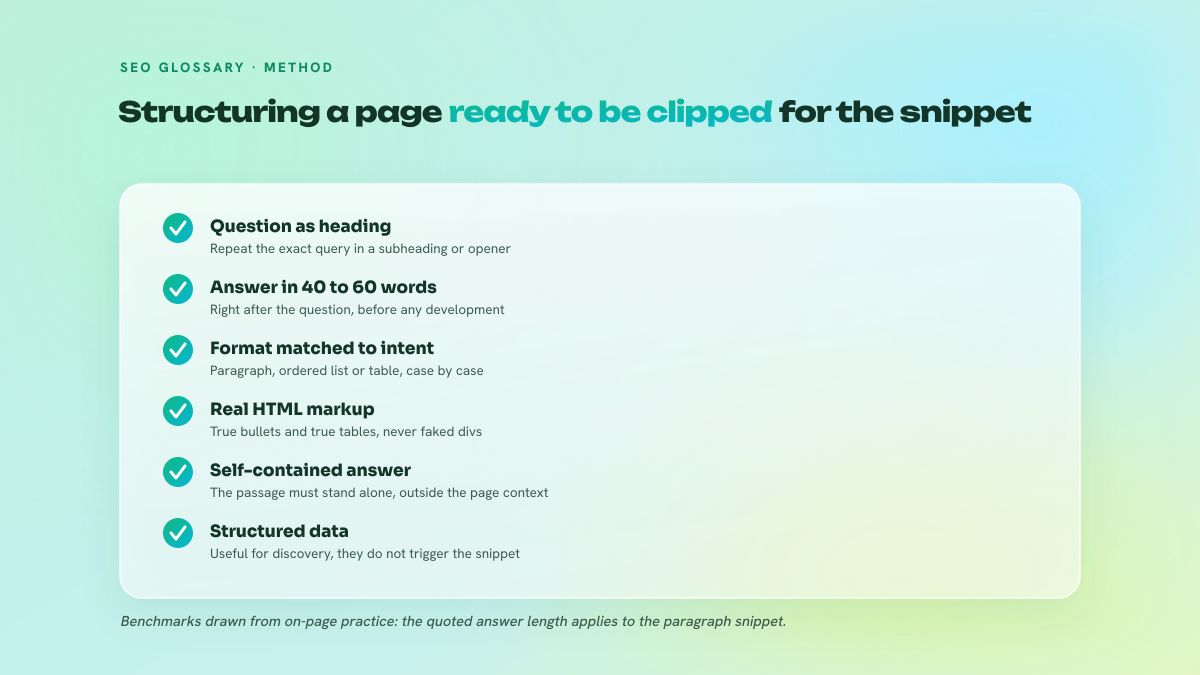
How to optimize a page for extraction
Optimizing for a snippet is a formatting and answer-clarity exercise on a page that already ranks. Start by isolating the question and answering it in one self-contained block near the top: 40 to 60 words for a paragraph snippet, no pronouns that depend on the previous sentence, the query phrasing echoed once in a preceding H2 or H3. Google lifts what it can lift cleanly.
This walkthrough shows a real-world version of that reformatting in practice.
Match the format to intent. If the SERP currently shows a numbered list, give Google a numbered list with short parallel steps and a heading above it. If it shows a table, build a real HTML table, not an image. Structured data helps Google understand a page but does not «grant» a snippet: there is no markup that forces the box, and Google's own documentation is explicit that snippets are selected programmatically. The nosnippet, data-nosnippet and max-snippet directives control whether you appear, not whether you are chosen.
The most common win in practice is stealing an existing snippet. Find queries where a competitor holds the box and you already rank in the top five, then reformat your passage to answer more cleanly and concisely than theirs. Snippet ownership is contestable on almost every query, and the incumbent is often a page that was never optimized for extraction, it just happened to be liftable. That is your opening. One honest caveat for 2026: weigh the effort against AI Overview displacement. If a query already shows an AI Overview and no snippet, optimizing a passage for a box that no longer renders is wasted work. Check the live SERP first, and where the query has moved to generated answers, track how your pages surface across AI answers instead of fighting for a box that Google stopped drawing.
Finding opportunities and tracking the box
Finding snippet opportunities is a filtering job, not guesswork. The reliable pattern: pull the keywords where you rank positions 2 to 8, filter to those that currently trigger a snippet, then sort by the ones where the holder is beatable. Semrush, Ahrefs and Moz all expose a «SERP features» filter that flags snippet-triggering keywords inside your existing rankings, which is where most realistic wins hide.
This is a concrete method for surfacing those opportunities inside a tool.
People Also Ask boxes are the second vein. PAA questions map directly to the question-shaped queries that trigger paragraph snippets, and a page that answers a cluster of related questions cleanly often earns both the box and PAA real estate. Our entry on the way Google surfaces follow-up questions covers that overlap in depth. Manual SERP inspection with search operators still beats tools for edge cases: search the exact question, see what Google currently lifts, and judge whether your passage is cleaner.
Tracking matters more than winning once, because the box is a lease. Search Console is the honest baseline: filter by query, watch impressions and average position on question-shaped terms, and correlate position-one impressions with CTR swings that betray a snippet gained or lost. Third-party rank trackers flag the SERP feature explicitly, and a Python pull against the Search Console API lets you monitor snippet-eligible queries at scale. The number that matters is not «do we hold a snippet» but «did winning it move clicks», and in 2026 that answer is increasingly «sometimes», which is exactly why you measure instead of assume.
Nautilinks operates an owned network of editorial media. In-house written articles, transparency disclosures respected, anchor mix calibrated.
Frequently asked questions
Are featured snippets still worth chasing in 2026?
Yes, selectively. Aggregate prevalence actually rose to 23.7% of SERPs in 2026 (Semrush and BrightEdge), and the box still delivers the highest CTR of any SERP element when you own it. The caveat is displacement: AI Overviews now appear on roughly 58% of queries and often replace the snippet. Chase snippets on the long tail and on question-shaped queries where no AI Overview renders, and skip terms where Google already generates an answer.
Can one page hold more than one featured snippet?
Yes. A single page can win snippets for many different queries, because each snippet is a per-query extraction, not a page-level award. A well-structured guide that answers a cluster of related questions cleanly can hold the box across dozens of long-tail variations at once. What a page cannot do is hold two snippets on the same SERP for the same query, since Google draws one box per result set.
How long does it take to win a snippet once you rank?
If you already sit in the top five, reformatting a passage can win the box within one or two crawl-and-refresh cycles, often days rather than months. If you are not yet in the extraction pool, the timeline is your ranking timeline, which for a competitive query is a link-and-authority problem measured in weeks or months. The formatting is fast, earning the position that makes it eligible is not.
Do AI Overviews mean the end of featured snippets?
Not the end, but a substitution on the highest-value queries. Semrush's December 2025 study found snippet and AI Overview co-occurrence dropped from 34% to 18% over 2025, meaning Google increasingly picks one or the other rather than both. The snippet retreats to the long tail and to queries Google does not answer generatively. Treat it as a shrinking surface, not a dead one, and always check the live SERP before optimizing.
Does structured data help win a featured snippet?
It helps Google parse your page but does not grant the box. Google's documentation is explicit that snippets are selected programmatically from the passage that best answers the query. Schema improves eligibility for rich results and can clarify content, but the direct levers are clean formatting, a self-contained 40-to-60-word answer, and matching the list or table format Google already shows. The nosnippet family of directives only controls whether you appear, not whether you are chosen.
Test your knowledge
Quiz: Featured snippet
1/3Per Semrush's December 2025 AI Overviews study, how did featured-snippet and AI-Overview co-occurrence change across 2025?