- →A panel is a Knowledge Graph record being rendered, not a page you own: verification buys you a suggestion channel and a few editable fields, never editorial control.
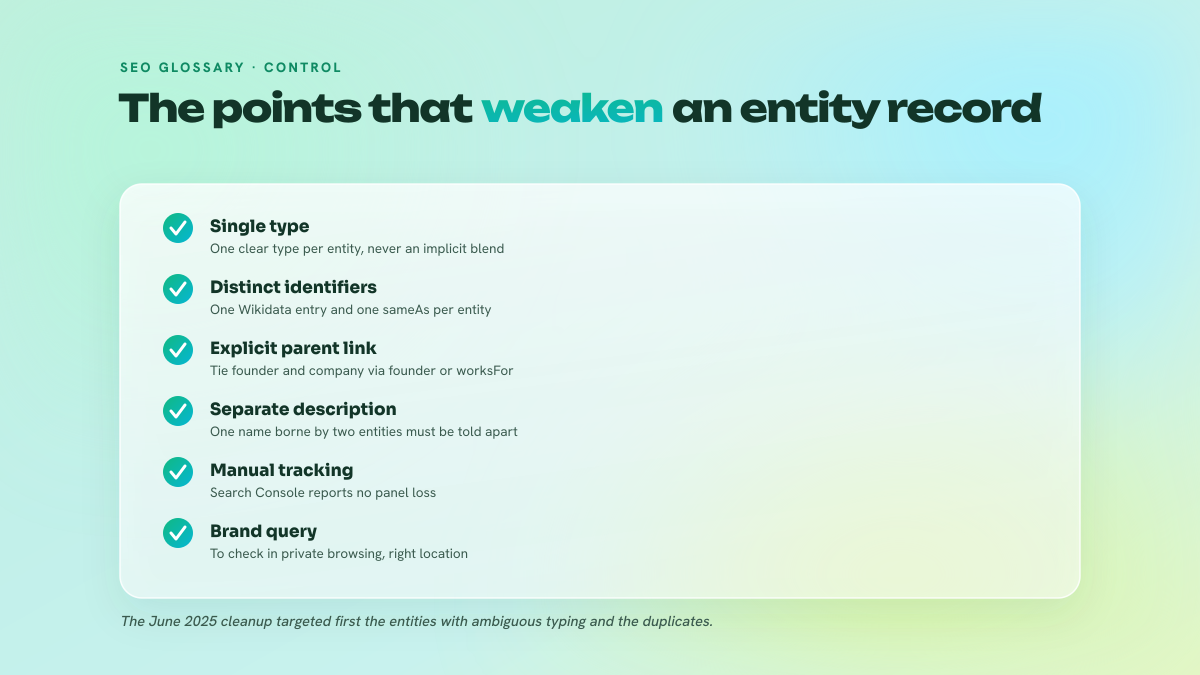
- →Google's June 2025 clarity cleanup removed over 3 billion entities, roughly 6.26 % of the graph (Search Engine Land), with ambiguous typing as the explicit target. Disambiguation is now the gating factor, not volume of mentions.
- →Panel presence is reversible and its loss is silent: no Search Console message, no traffic cliff. Track it as a SERP feature field on brand queries every week or you find out from the client.
- →Direct traffic value is marginal, around 1.4 % of total SERP click-through on brand queries for local business panels according to a 2026 analysis of knowledge panels. The payoff sits upstream, in entity credibility.
- →Semrush's 2025 AI Overview citation study puts branded web mentions at r = 0.664 against r = 0.218 for backlinks, with about 75 % of citations coming from the top 12 organic results. Links buy eligibility, the entity layer buys the citation.
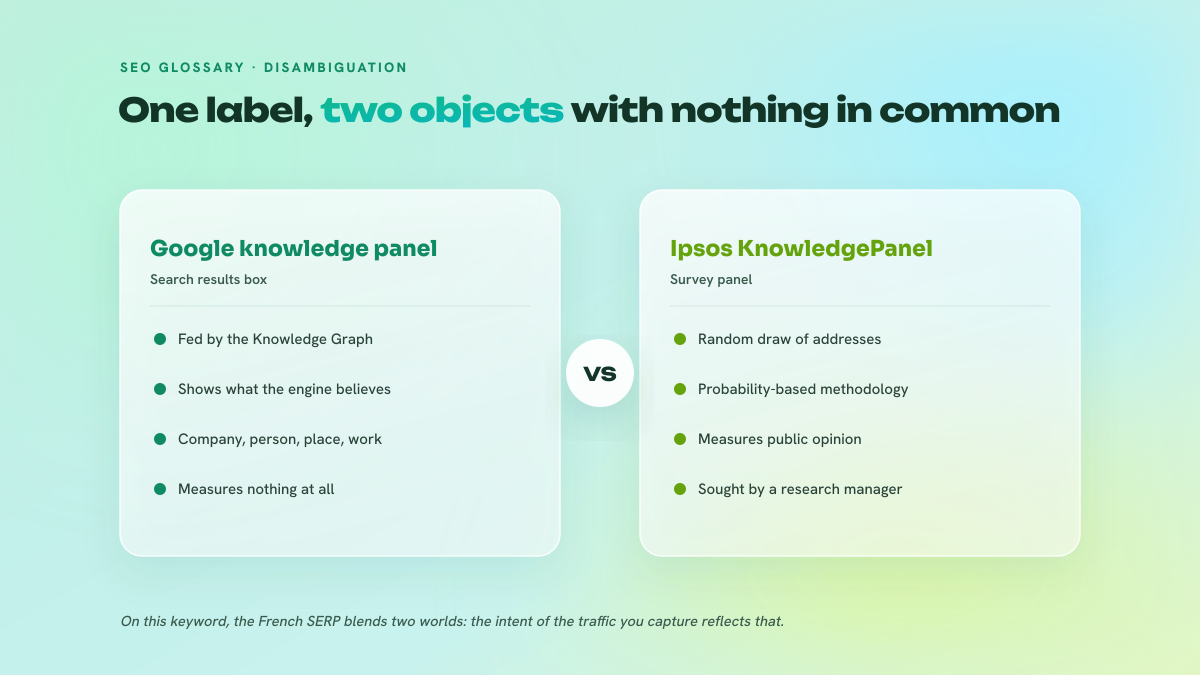
- →Ipsos KnowledgePanel is a probability-based survey panel with no connection to Google. Keeping the two intents separate is basic hygiene in keyword research on this term.
What a knowledge panel really is
The block sitting to the right of desktop results, or above them on mobile, is not a rendering of your website. It is a rendering of a record in Google's Knowledge Graph: a machine-readable entity carrying a type, a set of properties, and a list of sources that corroborate them. Panels are generated automatically from information available across the web, which is another way of saying that the page you control is one input among many, and rarely the decisive one.
That single fact reorganises the workflow. You do not optimise a panel. You make an entity unambiguous enough that Google keeps a record of it, and you make the data behind that record consistent enough that Google is willing to show it publicly. The panel is a symptom of successful entity resolution, not a position you win. A site can rank first on its own brand name for years without ever triggering one, because ranking answers the question « which document », while a panel answers the question « which thing ».
It also belongs to a different family from the other blocks on the results page. An answer box extracted from a ranking document points back to a URL and can be won by rewriting that page. A panel points back to an entity, and the levers are external: licensed databases, Wikipedia and Wikidata, a Google Business Profile for local entities, structured data on the official site, and web mentions that repeat the same facts about the same subject. Claiming ownership does not create the record. It attaches a suggestion channel to a record that already exists.
How Google decides who gets one in 2026
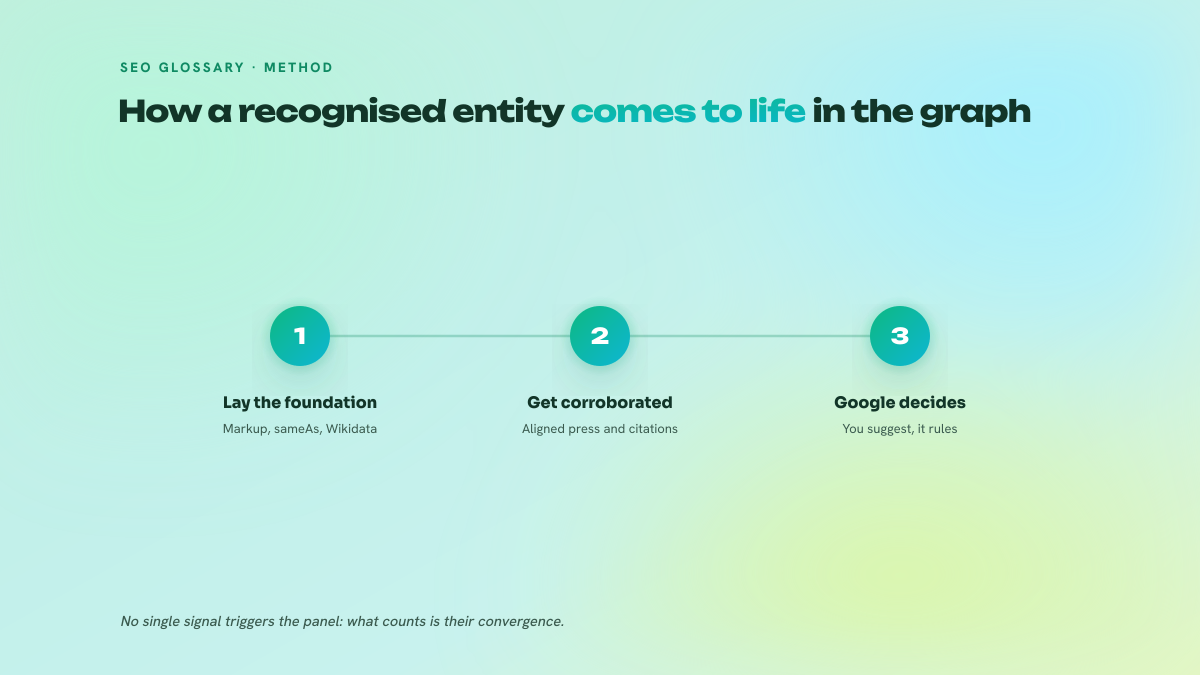
Two conditions, both necessary. The entity has to be typed without ambiguity, as a company, a person, a local business, a work. And independent, reasonably reliable sources have to agree on the same facts about it. Everything in a serious entity programme reduces to those two: identifiers that pin the type (Wikidata, Crunchbase, LinkedIn, a verified Business Profile where the entity is local), Organization or Person schema on the official site with a sameAs array pointing at exactly those identifiers, and coverage that repeats one framing rather than five.
What has changed more recently is the threshold and the volatility. Search Engine Land documented Google's June 2025 « clarity cleanup », the largest contraction of the graph in a decade: over 3 billion entities erased in a week, around 6.26 % of the graph, with ambiguously typed entities and short-lived events named as the targets. Kalicube's Knowledge Graph Sensor, cited in a July 2026 analysis of SERP feature shifts, recorded graph visibility dropping off a cliff on 26 June 2026, followed by a major Knowledge Graph update on 28 June 2026. The same analysis, comparing April 2025 with July 2026 on Semrush Sensor data for the United States, finds entity-based features including panels shrinking while AI Overviews expand.
Read that as a stance rather than a scare: fewer entities hold a panel today than before those cleanups, and holding one is a reversible state. Which makes measurement part of the job. Panel presence belongs in your tracked fields on brand queries, in whatever rank tracker exposes the composition of the results page, or in a weekly scripted capture if your tool does not. Losing a panel generates no notification, no Search Console message, and no traffic drop large enough to surface in analytics. You typically discover it when a client asks why their logo disappeared.
One threshold worth internalising: corroboration counts across sources, not across occurrences. Fifty mentions on a single domain move nothing. Eight to fifteen pieces of coverage on distinct, editorially real properties, all naming the entity the same way, is the shape that works, and it matches what a 2026 operational guide built on PR, Wikidata and schema campaigns reports as the realistic input volume.
The other KnowledgePanel: Ipsos, and why the collision matters
Type the term into a keyword tool and the volume splits across two unrelated things. Ipsos KnowledgePanel is a probability-based online survey panel: individuals are recruited offline through random address-based sampling of the general population, not by self-selection on a website, and that recruitment method is precisely what lets the results be projected onto a national population and used for public opinion, political and health research. Ipsos operates it in the United States and runs equivalent probability panels in France and other markets. It is a legitimate company running a legitimate research instrument, it pays modest incentives to its members, and it has no relationship of any kind with Google.
This review of the survey side gives a fair sense of what members actually get out of it:
Two consequences for anyone working the term. First, search volume on « knowledgepanel » is not a measure of interest in Google's feature, it is survey recruitment intent blended with entity SEO intent, and a page that tries to serve both usually ranks for neither. Second, the collision is a textbook illustration of what the graph now filters out: one string mapping to a market research product and to a search feature. Wherever your own brand name collides with a common noun, a film title or another company, disambiguation work is not cosmetic polish. The legal name in schema, an alternateName property, sector-pinning identifiers, that is the entire job, and skipping it is the most common reason a well-covered brand still has no record.
What a panel is actually worth in a netlinking operation
Not traffic. A 2026 analysis of knowledge panels puts local business panels at roughly 1.4 % of total SERP click-through on brand queries. Meanwhile, click-stream syntheses from SparkToro and Datos place the share of Google searches ending with no click at around 58 to 60 %, with panels, answer boxes and AI summaries doing the absorbing. A panel is a control surface on your own brand query and an insurance policy against a competitor's ad or a review aggregator owning the visual centre of the page. Selling it as an acquisition channel is dishonest.
Its real leverage sits one layer up. Semrush's 2025 study of AI Overview citations found branded web mentions correlating with citation frequency at r = 0.664, against r = 0.218 for traditional backlinks, while roughly 75 % of citations still came from pages already inside the top 12 organic results. Seer Interactive measured in November 2025 that organic click-through on queries carrying an AI Overview fell by around 61 to 65 % versus prior periods. Put those three numbers side by side and the conclusion is not that links stopped working. It is that links buy the top-12 eligibility, and the entity layer decides whether the generative surface trusts you enough to name you inside it.
Which is why the two budgets should never be split. An editorial placement that names the brand, its founder and its sector in the same paragraph does two jobs: it passes a link and it deposits a corroboration a parser can read. A placement where the brand appears only inside the anchor does one. We apply that rule across the French editorial media we operate, and it is the first filter worth applying when browsing a catalogue of media you can inspect before ordering anything: does this publication actually write about companies and people, or does it publish anchors surrounded by filler.
Claiming a panel, and what goes wrong
Claiming costs nothing. You sign in to a Google account, run the brand query, use the claim option on the panel, and verification runs through ownership signals Google already trusts, usually the official site via Search Console or an existing Business Profile. What verification grants is a suggestion channel plus a handful of editable fields. It is not editorial control, and Google will decline a correction when the sources it reads contradict you. Anyone quoting a fixed price for a guaranteed panel is quoting a timeline they do not control. Budget instead for the coverage and the structured data that produce one, the same way you put a number on a placement before you commit to it.
The walkthrough below covers the claim flow itself, the least interesting part of the job but worth watching once:
What we see go wrong, in rough order of frequency. Naming drift first: the site says Acme, the press says Acme Group, LinkedIn says Acme SAS, and the graph ends up weighing three candidate entities with thin evidence each instead of one with solid evidence. Then schema theatre: Organization markup shipped without a sameAs array, or a sameAs pointing at profiles that are empty, abandoned or returning 404. A 2026 case study of AI Overview citations found complete Organization schema with sameAs on 87 % of cited business sites against 11 % of a randomly sampled small business set, and that gap is the one most technical audits never close. Then Wikidata edited like a marketing asset, unsourced, reverted within days, and now sitting in the record as a contradiction. And finally the reflex of treating a disappearance as a manual action: after June 2025 and June 2026, a vanished panel is far more likely to be a graph update, so the first move is to check corroboration and typing, not to draft a reconsideration request.
The expensive mistake is the last one on the list: chasing a panel for an entity nobody independently writes about. No corroboration, no record, no panel, and no volume of markup will fabricate a third-party opinion. Once identifiers, schema and coverage are genuinely in place, expect 3 to 12 months for a company and 6 to 18 months for a personal brand, per the same 2026 operational guide. If the honest answer is that nobody outside the company has any reason to describe it, the entity programme is premature and the money belongs upstream, in earning that reason.
Nautilinks operates an owned network of editorial media. In-house written articles, transparency disclosures respected, anchor mix calibrated.
Frequently asked questions
Our panel disappeared overnight after a Google update. Is that a penalty we can appeal?
Almost never. Panels are not awarded and cannot be revoked as a sanction, they reflect whether the Knowledge Graph still holds a confident record. Search Engine Land documented over 3 billion entities removed in June 2025, and Kalicube's sensor flagged another major graph update on 28 June 2026. The productive response is to re-check entity typing, verify that your sameAs identifiers still resolve, and look for recent contradictory data, not to file a reconsideration request.
Is Ipsos KnowledgePanel connected to Google in any way?
No. Ipsos KnowledgePanel is a probability-based online survey panel where members are recruited by random address-based sampling of the general population, which is what makes its data usable for public opinion and policy research. It is a market research product, paid in modest incentives, run by a listed research company. The naming overlap with Google's feature is coincidental and it pollutes keyword data on the term, so treat the two intents as separate topics.
Does verification give us editorial control over what the panel displays?
It gives a suggestion channel and a few directly editable fields, nothing more. Claiming is free and runs off ownership signals Google already trusts, typically Search Console or a Business Profile. Corrections are evaluated against the sources Google reads, so a suggestion that contradicts Wikipedia, Wikidata or the press will be declined. The durable fix for a wrong fact is to correct it at the source that Google is citing, then suggest the edit.
If mentions matter more than links for entity recognition, should we cut the link budget?
No, and the data says why. Semrush's 2025 AI Overview citation study reports branded mentions at r = 0.664 versus r = 0.218 for backlinks, but also that roughly 75 % of citations come from pages already in the top 12 organic. Links buy that top-12 eligibility. The adjustment is qualitative: prefer editorial placements that name the brand, the founder and the sector in prose over placements where the brand appears only inside the anchor.
How do we monitor panel presence across a portfolio of client brands?
Treat it as a tracked SERP feature on each brand query rather than a one-off check. Most rank trackers expose feature flags per keyword, and where they do not, a weekly scripted capture of the brand query is enough. Log presence, the displayed name, and the fields shown. Losing a panel produces no Search Console notice and no measurable traffic drop, so without a tracked field the loss surfaces weeks later, usually from the client.
Test your knowledge
Quiz: Knowledge panel
1/3What did Google's June 2025 « clarity cleanup » consist of, according to Search Engine Land?