- →Discover selection is eligibility plus interest match, not ranking: there is no position to hold and no keyword to target, so the usual Search playbook transfers only partially.
- →Google's February 2026 core update was scoped to Discover alone, ran from 5 February to 27 February 2026 (Google Search Status Dashboard), and pushed toward local, in-depth, non-sensational content: a Discover drop during that window is not evidence of an organic ranking loss.
- →Discover concentrated the field: NewzDash measured unique domains in the US top 1,000 falling from 172 to 158 between late January and mid-February 2026, an 8.1% reduction.
- →Dependency is the real risk, not eligibility: NewzDash put Discover at 67.51% of Google-generated publisher traffic in Q4 2025 across 400+ publishers, and the December 2025 core update produced publisher-reported drops of 50 to 98%.
- →Vertical decides whether Discover is worth engineering for: Raptive's 2025 breakdown put it at roughly 76% of Google traffic for news, about 50% for tech, gaming, sports and travel, and 2% for food.
- →Measure Discover in its own Search Console report, never blended with Search, and remember reporting itself can break: Google logged Discover data incorrectly on 7 and 8 May 2026.
Discover is a push channel inside a pull company
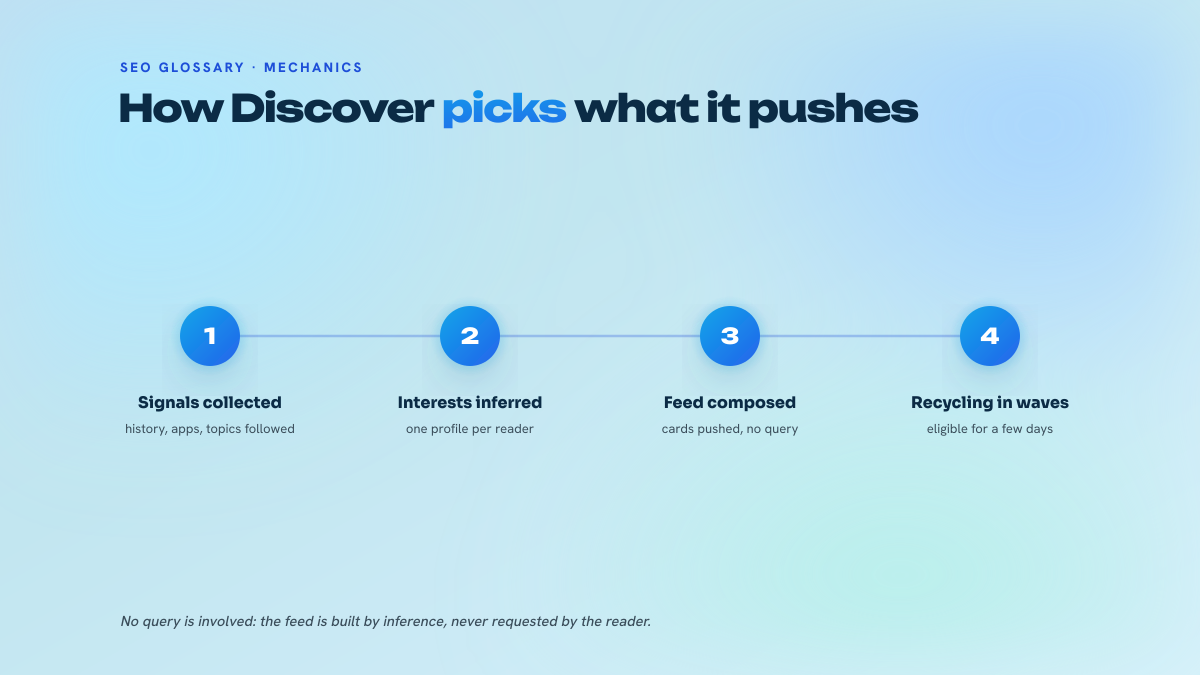
Every other surface an SEO works on answers a query. Discover does not. Google decides, without anyone typing anything, that a given article deserves a card in the feed of a given person on a given morning. That one difference reorganises the whole workflow: no keyword to target, no position to defend, no stable demand curve to forecast against. What you optimise is eligibility plus interest match, and both move under you.
The feed lives in the Google app on Android and iOS, on the Chrome new tab on mobile, and one swipe right from the home screen on most Pixel and Samsung devices. Desktop is still the open gap. Google announced at Search Central Live Madrid on 9 April 2025 that Discover would come to the desktop google.com homepage, and as of December 2025 that rollout had not gone global, with limited testing observed in Australia and New Zealand (PPC Land, December 2025). Treat desktop Discover as a product direction, not a channel you can plan a 2026 budget around.
Selection draws on Web & App Activity, the topics a user chose to follow, their location, and their history with a given source. The same interests panel a reader edits in the Google app settings is where a real person can decide they never want your masthead in their feed again. That asymmetry is what publishers underrate: in the query-driven results page you compete against other documents on a topic, in Discover you compete against the rest of a person's attention, including their football club and their local paper.
How selection actually works after February 2026
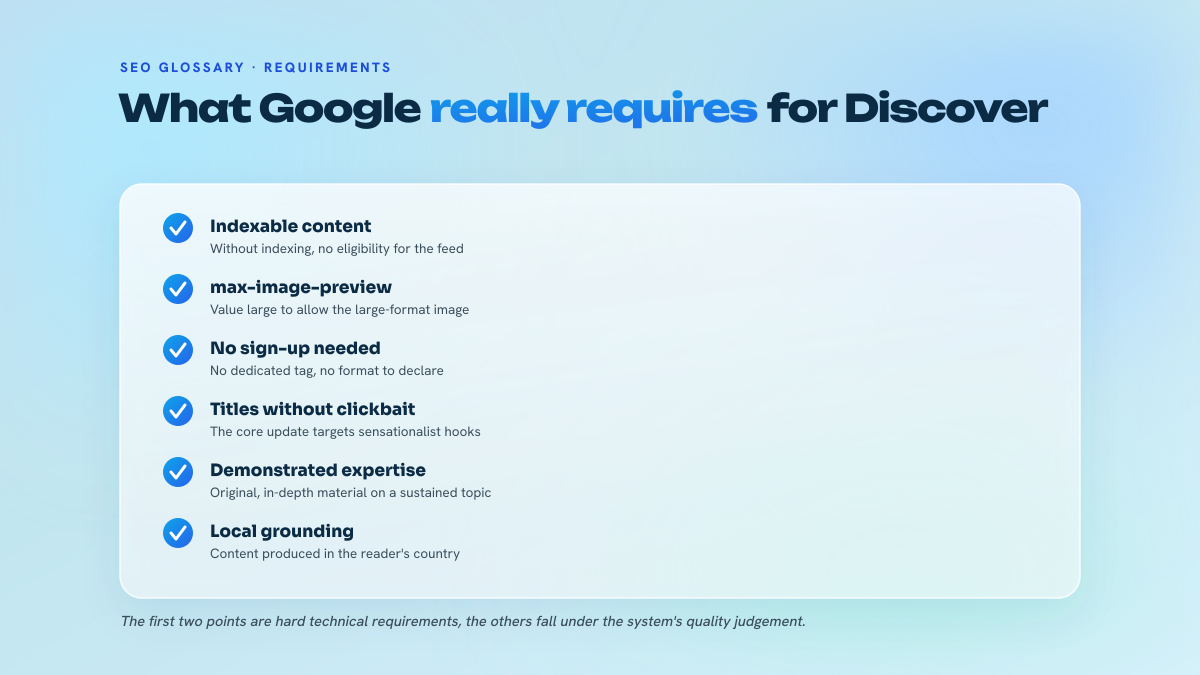
Google shipped its first Discover-specific core update on 5 February 2026, initially for English-language users in the United States, and finished rolling it out on 27 February 2026, roughly 22 days, according to the Search Status Dashboard (Search Engine Journal, February 2026). The stated directions were unusually explicit for Google: more locally relevant content from sites based in the user's country, less sensational and clickbait content, and more in-depth, original and timely material from sites that demonstrate expertise on a topic (PPC Land, February 2026).
The measured effect was concentration. NewzDash compared 25 to 31 January 2026 with 8 to 14 February 2026 using DiscoverPulse panel data from millions of US users, and found unique domains in the US top 1,000 falling from 172 to 158, an 8.1% reduction. California-local articles in the top 100 rose from 10 to 16, and New York-local domains appeared roughly five times more often in the New York feed than in the California feed (Search Engine Journal, February 2026). Institutional X.com posts also rose from 3 to 13 items in the US top 100, most of them from established media brands. These are third-party panel observations, not Google-confirmed ranking factors, and NewzDash itself noted that headline markers alone could not prove clickbait had actually declined.
The second structural change is AI summaries in the feed. Google tested them on selected Trending cards in July 2025, they were reported as broadly rolling out on stable Android by 21 August 2025, and Google confirmed a US rollout in October 2025. Marfeel data reported in December 2025 found AI summaries occupying 51% of Discover feed positions in test markets including the US, Brazil and Mexico. Read that carefully: it is a sample, not a global figure, and public evidence does not establish a universal click-through collapse. What it does change is the job to be done. Being the source consolidated into an in-feed summary is a different objective from writing a headline that earns a tap, and it rewards the same signals that make a page quotable elsewhere: clear attribution, original reporting, structure a machine can lift.
One practical consequence of the scoping: because the February update touched Discover and not conventional Search, a Discover collapse inside that window is not a broad algorithm demotion of the site. Check the two reports separately before you write the post-mortem.
What Discover changes for a netlinking operation
Discover has no direct link to link acquisition, and anyone selling you otherwise is selling. What it changes is how you read a host site before you place anything on it. A media property whose audience arrives overwhelmingly through the feed has a traffic curve that can halve in a week without any editorial change, and a set of pages whose value to a buyer is short-lived by construction. That matters when you are paying for placement on the strength of a traffic screenshot.
The vertical decides how much of this applies. Raptive reported roughly 1 billion Discover clicks a year across its publisher network, and its 2025 vertical breakdown put Discover at about 76% of Google traffic for news, around 50% for technology, gaming, sports and travel, and 2% for food. A recipe site with a healthy curve is not living on Discover, a news vertical almost certainly is. When we assess a host for the link-building programmes we run, a site whose traffic is 70% feed-driven gets valued on its evergreen archive, not on its peak month.
On our side the arithmetic is the same. Across the French editorial media we operate in-house, Discover is treated as upside, never as the basis for what a placement is worth: the durable part of the audience is query-led and archive-led, and that is what we underwrite. If you want to see how that translates into what a placement actually costs, the grid we publish openly is built on referring-domain quality and stable organic traffic, not on a good Discover week.
Measuring Discover without fooling yourself
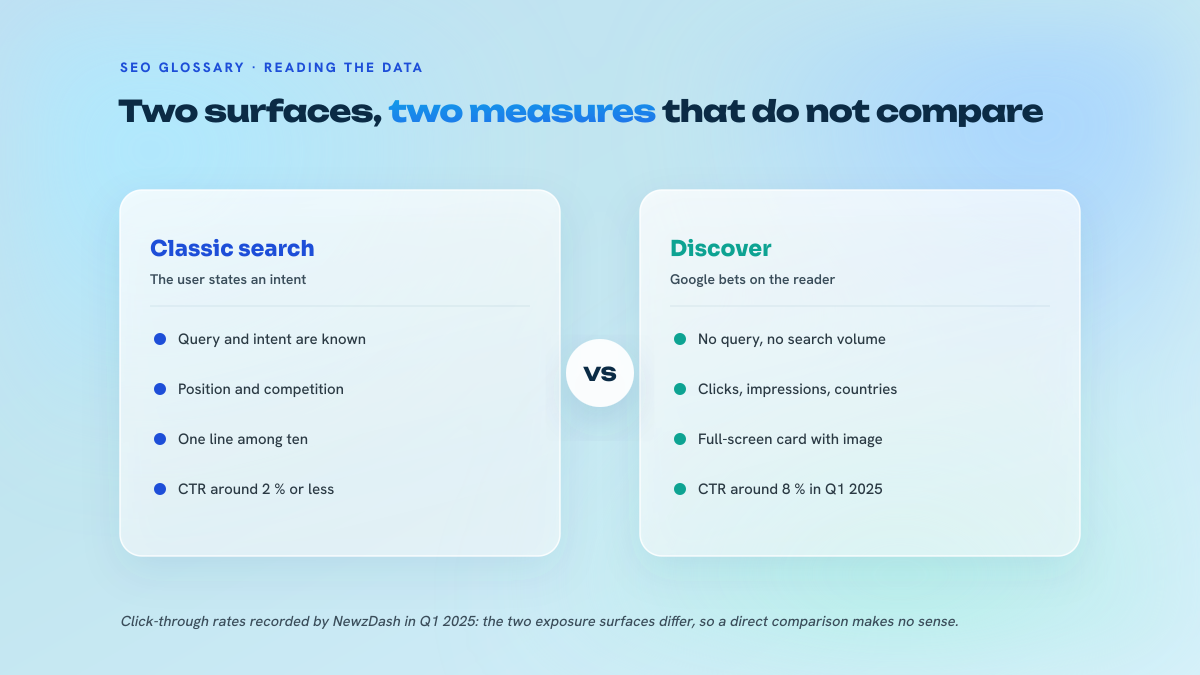
Discover has its own report in Search Console, separate from the Search performance report, and it only appears once a property has accumulated enough Discover impressions. Google refreshed its Discover documentation on 9 March 2026, which is worth re-reading if your internal playbook predates that. Blending Discover and Search clicks into one dashboard number is the single most common measurement mistake we see: the two channels have different volatility, different intent, and different click-through economics. NewzDash data cited across the industry put average Discover click-through around 8% in Q1 2025 against roughly 2% or less for conventional Search, which means a modest impression shift in the feed moves your total session count more than a real ranking change does.
Be equally careful with share figures. NewzDash's December 2025 analysis of more than 400 news publishers reported Discover's share of Google-generated publisher traffic rising from 37.03% in 2023 to 67.51% in Q4 2025, with Web Search falling from 51.10% to 27.42%. Those are shares, not absolute growth: a publisher can post that exact split while losing traffic overall. Chartbeat and Press Gazette figures split Google referrals differently again, at roughly 17% Discover and 8% Search, on a different panel. Neither is a universal benchmark for your site.
And the instrument itself can fail. Search Console logged Discover data incorrectly on 7 and 8 May 2026, and Google confirmed the errors could reduce reported clicks and impressions while leaving actual delivery untouched. Before you launch an investigation into a two-day dip, check the Search Console data anomalies page.
When the feed goes quiet, on both sides of the screen
Two very different problems share the same phrasing. Readers who ask where their Discover feed went are almost always looking at a device-level cause: the feed disabled in the Google app settings, Web & App Activity switched off, the home screen swipe turned off in the launcher, or an app that needs its cache cleared after an update. This short walkthrough covers the Android side of it:
Nautilinks operates an owned network of editorial media. In-house written articles, transparency disclosures respected, anchor mix calibrated.
Frequently asked questions
Is a Discover collapse during a core update a sign my site was demoted in Search?
Not necessarily. The February 2026 update was scoped to Discover rather than conventional Search, so a feed drop inside that window says nothing about your organic rankings. Open the two Search Console reports side by side: if Search clicks and average position held while Discover fell off, you have a feed eligibility or interest-match problem, not a quality demotion. The December 2025 update was a broad core update rather than a Discover-scoped one, which is why the check matters.
Can I use Discover traffic as a valuation input when buying a placement on a media site?
Only with a heavy discount. Publishers reported Discover declines of 50 to 98% during the December 2025 rollout, including one case going from roughly 90,000 daily clicks to zero. A traffic screenshot dominated by feed sessions can be worth a fraction of that a month later. Value the host on its query-led archive and its referring domains, and treat the Discover component as upside you are not paying for.
Do AI summaries in the feed mean headlines no longer matter?
Headlines still matter, the objective is just wider. Marfeel data reported in December 2025 found AI summaries occupying 51% of Discover feed positions in test markets including the US, Brazil and Mexico, which shifts part of the game from earning a tap to being the source a summary consolidates. Public evidence does not show a universal click-through drop, so optimise for both: accurate headlines and content structured clearly enough to be quoted.
Should I plan for desktop Discover in a 2026 traffic forecast?
No. Google announced desktop Discover at Search Central Live Madrid on 9 April 2025, and by December 2025 broad availability had not happened, with limited testing observed in Australia and New Zealand. Industry estimates of a 10 to 15% traffic uplift from desktop expansion are projections, not measured results. Build the eligibility work so you benefit if it ships, forecast as if it does not.
How do I tell a real Discover loss from a Search Console reporting glitch?
Check Google's data anomalies page before anything else. Discover logging failed on 7 and 8 May 2026, and Google confirmed the errors reduced reported clicks and impressions while delivery itself was unaffected. A genuine loss usually shows as a sustained impression decline across many URLs rather than a sharp one or two day notch that recovers on its own. Analytics sessions are a useful cross-check since they are logged independently.
Is Discover worth engineering for outside news publishing?
It depends entirely on vertical. Raptive's 2025 breakdown put Discover at roughly 76% of Google traffic for news, around 50% for technology, gaming, sports and travel, and 2% for food. If you run a recipe or evergreen service site, the technical eligibility work costs almost nothing and you should do it, but building an editorial calendar around the feed would be misallocated effort. In news-adjacent verticals it is already the majority channel.
Test your knowledge
Quiz: Google Discover
1/3What did NewzDash measure about domain diversity in the US top 1,000 after the February 2026 Discover core update?