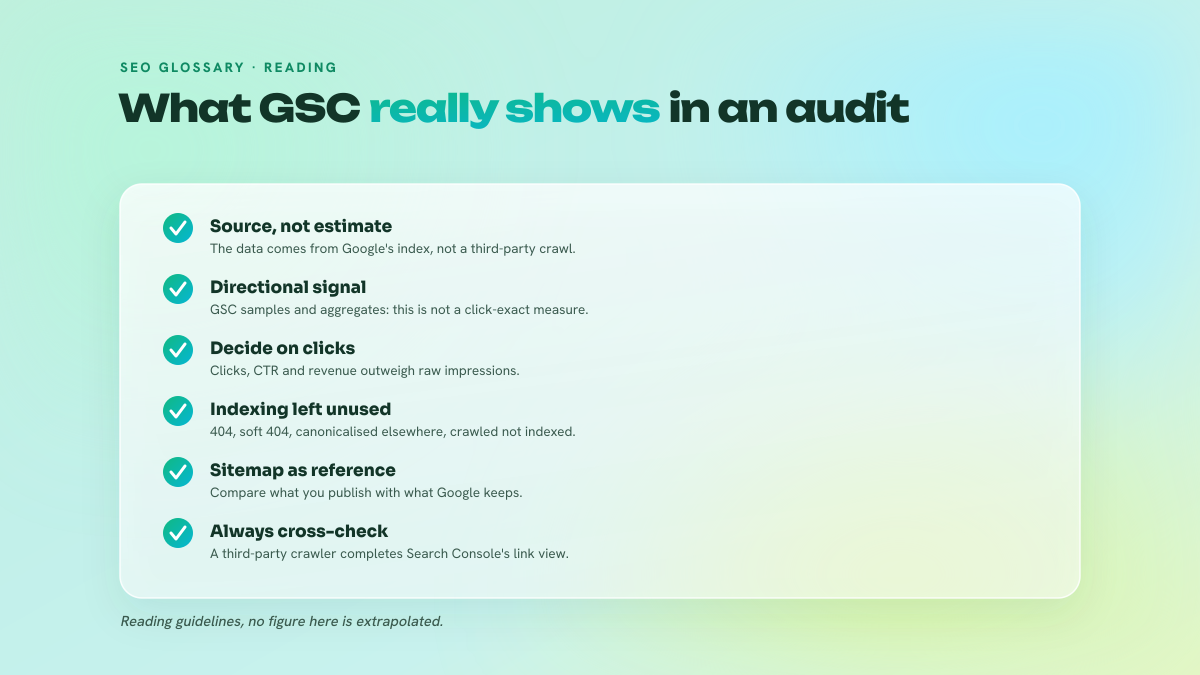
- →GSC is the canonical view of what Google indexes and counts, but « canonical » does not mean « accurate »: several 2026 reports carried multi-month logging errors.
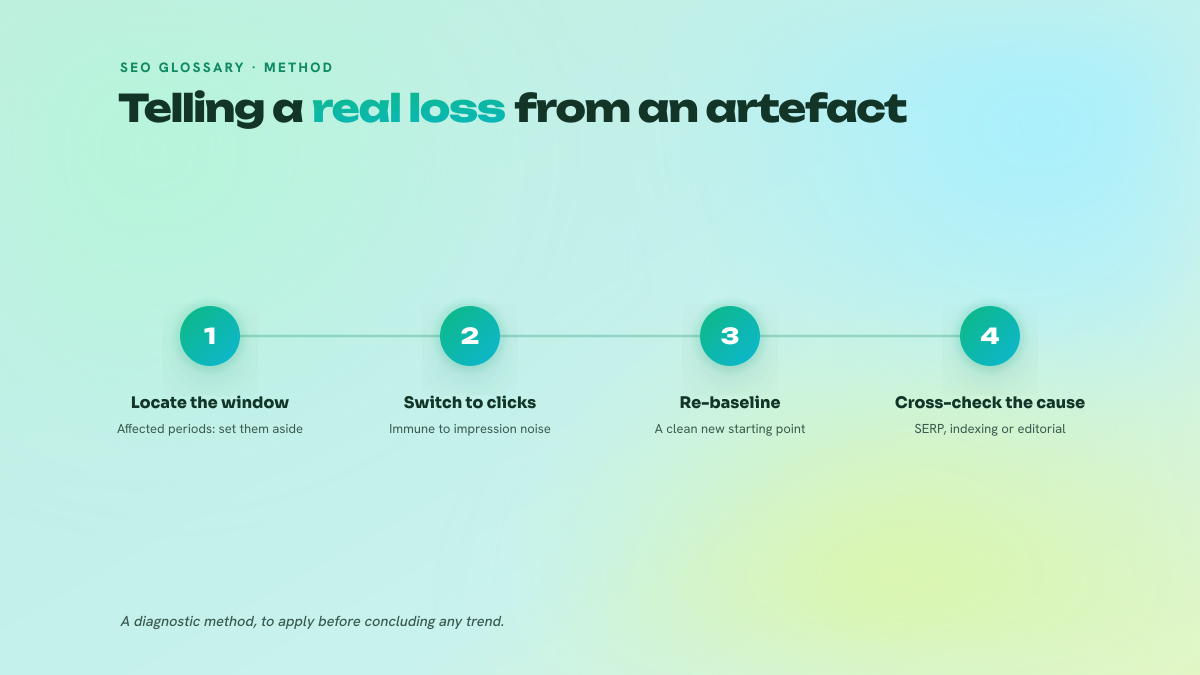
- →Impressions between 13 May 2025 and 27 April 2026 are structurally unreliable (Google logging error, per Search Engine Roundtable); anchor trend analysis on clicks and conversions instead.
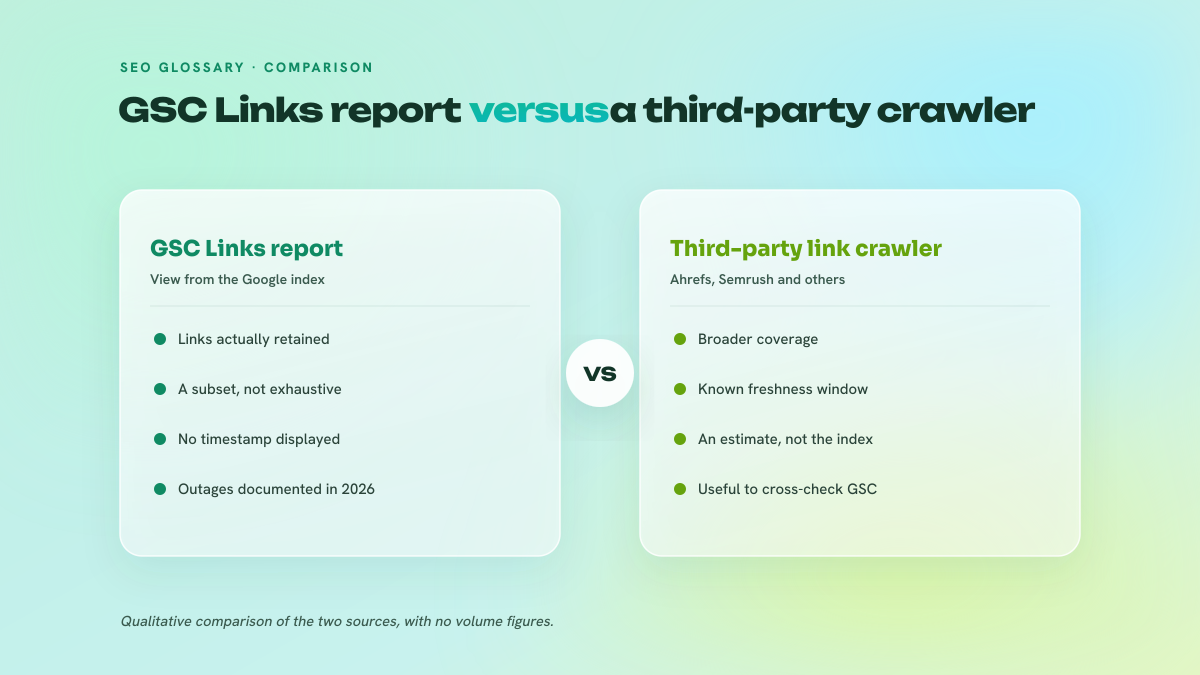
- →The Links report broke for roughly three weeks in mid-2026 and was fixed on 12 June 2026 (Digital Applied); re-baseline every backlink profile after that date rather than trusting the interim drop.
- →Since the &num=100 change (baseline 8 September 2025 per OPASCOPE), historical impressions were inflated by scraper loads; do not compare pre- and post-September 2025 impression counts as if they were the same metric.
- →Google shipped dedicated Search Generative AI performance reports on 3 June 2026, finally isolating AI Overviews and AI Mode visibility that used to be folded silently into the main Performance report.
- →GSC is pre-click search-side data and GA4 is post-click behavior data; joining query-level GSC exports with GA4 landing-page sessions is where most of the real reporting value sits.
What GSC really is, beyond the dashboard
Every other tool in your stack models Google from the outside. Ahrefs crawls the web and infers a backlink graph. Semrush samples SERPs and estimates positions. Google Search Console does none of that: it reports what Google itself recorded about your site. It is first-party telemetry of the relationship between your pages and the index, not a user-analytics product. That single distinction explains most of the confusion around it.
Read this way, GSC answers three questions no external tool can answer with authority: which queries actually surfaced your URLs, which pages Google has decided to index (and why the rest are excluded), and which backlinks Google itself attributes to your domain. For a netlinking professional the last point is the one that matters, because it is the closest thing you will ever get to Google's own opinion of your link graph. When you cross-check what you built against what a crawler like Ahrefs reports, GSC is the reference the crawler is trying to approximate.
The catch, and the reason this entry exists, is that being first-party does not make it accurate. In 2026 several core reports shipped with logging errors that lasted months. Treating GSC as gospel is a rookie move; treating it as Google's own draft, occasionally smudged, is the senior read.
Setup and the data model that trips people up
Setup is trivial and yet people still misconfigure it. You add a property, then you verify ownership. Two property types exist and the choice is not cosmetic. A domain property (verified through a DNS TXT record) aggregates every subdomain and both protocols under one roof, which is what you almost always want. A URL-prefix property only covers the exact scheme and host you enter, so an https-only prefix silently drops http and www traffic. The HTML-file and meta-tag methods still work, but DNS verification is the one that survives a redesign because it does not depend on a file staying live in your root.
The following walkthrough is a clean beginner-level tour of adding a property and moving around the interface for anyone onboarding a junior on the setup step:
The data model is where seasoned people still get burned. Performance data is capped at 16 months of history, so if you want year-over-year comparisons you export to BigQuery via the bulk export or you lose the window. Data is also sampled and anonymised: queries triggering only a handful of impressions are withheld to protect user privacy, which means the sum of per-query clicks never equals the property total. Position is an average weighted by impressions, not a rank you held at any single moment. None of this is a bug, but every one of these behaviours has been mistaken for one in a client call.
The reports that actually move a workflow
Four surfaces do the real work. The Performance report gives you clicks, impressions, average CTR and average position, sliceable by query, page, country, device and search appearance. URL Inspection tells you, for a single URL, whether it is indexed, when it was last crawled, which canonical Google chose and whether structured data was read. The Pages report (index coverage) explains why URLs are excluded: crawled-not-indexed, discovered-not-indexed, blocked by robots.txt, soft 404, server error. And Sitemaps is where you submit and monitor your XML sitemaps, which remains the fastest way to feed a large or freshly restructured site into the crawl queue.
Google's own training video on submitting and managing sitemaps is the reference here, and it is worth watching before you debug a « discovered, currently not indexed » problem, because a stale or malformed sitemap is a common root cause:
The operational move most people miss is mining the Performance report for CTR gaps rather than ranking gaps. A page ranking in positions four to eight with a CTR well below the average for that band is a title and meta-description problem, not a link problem, and you can fix it in an afternoon. Only once the on-page CTR opportunities are exhausted do you reach for links to push a cluster from page two onto page one. That sequencing is where GSC pays for itself before you spend a euro on netlinking.
GSC vs GA4: two halves of the same click
This is the comparison every peer eventually asks about, and the honest answer is that the two tools sit on opposite sides of the click. GSC is pre-click: it knows the query, the impression and whether the user clicked, but it goes dark the instant they land. GA4 is post-click: it knows nothing about the query (Google stripped keyword data from analytics years ago) but everything about what happened on the site, sessions, events, conversions, revenue. Neither is a substitute for the other, and anyone pitching one as « the SEO tool » is selling you half a picture.
This short explainer lays out the split cleanly if you need a visual to settle the debate internally:
The value is in the join, not in either tool alone. Export query-level GSC data, export landing-page sessions and conversions from GA4, and stitch them on the URL. Now you can say not just « this page gets 4,000 clicks » but « this page gets 4,000 clicks that convert at a rate worth building links toward ». That revenue-weighted view is what separates a report that informs a budget decision from a screenshot of a line going up. Where GSC and GA4 disagree on session or click counts, remember they are counting different events at different moments, so a mismatch is expected, not a data error.
Where GSC data lies to you in 2026
2026 was a rough year for GSC data integrity, and pretending otherwise will get you caught out in a client review. Three episodes matter.
First, impressions. Google disclosed a logging error that mis-reported impressions in the Performance report from 13 May 2025 to 27 April 2026, roughly fifty weeks, and only marked it resolved in May 2026 (Search Engine Roundtable). Any impression-trend analysis spanning that window is standing on sand. Separately, the deprecation of the &num=100 parameter removed a layer of scraper-inflated impressions; OPASCOPE recommends treating 8 September 2025 as a fresh baseline and comparing clicks, not impressions, across that line. In practice this means impressions before September 2025 were structurally higher than the real human demand, so a « drop » that autumn was mostly bots leaving the log, not traffic leaving your site.
Second, the Links report. On 12 June 2026 Search Engine Roundtable documented the Links report « broken pretty badly », with many sites showing zero or drastically reduced link counts. Search Engine Land reported on 26 May 2026 that Google was temporarily serving weeks-old link data while a fix was in progress, and Digital Applied notes the report was fixed on 12 June 2026 after about three weeks of instability, advising SEOs to re-baseline backlink profiles afterward. If you ran a link audit off GSC during late May or early June 2026, run it again. It also helps to know, per a John Mueller confirmation in August 2025, that the Links report is one of the few GSC reports with no « last updated » timestamp, so you cannot tell from the interface how fresh the numbers are.
Third, AI. Google clarified that AI Overviews impressions and clicks were already folded into the main Performance report, and on 3 June 2026 launched dedicated Search Generative AI performance reports splitting out Search and Discover generative surfaces (Google Search Central). This finally lets you quantify AI Overviews visibility that used to hide inside your aggregate numbers. It matters because a GrowthSRC Media 2025 study of 200,000 keywords, cited by Launchcodex, found average organic CTR for position one fell from 28% in 2024 to 19% in 2025, a relative decline of about a third, largely attributed to AI Overviews pushing classic listings down. If your position held but your clicks fell, this report is where you prove it was the SERP layout, not your page.
Reading GSC as a netlinking operator
For link building specifically, the Links report remains the closest view of the backlinks Google actually uses, which is why it stays the reference even after a buggy year. But directional is the right word for it. Long-term counts are suspect: one site cited by Search Engine Roundtable dropped from 2.5 million reported links in 2018 to 215,000 in 2023, driven by undocumented methodology changes as much as by lost links. So the discipline is: use GSC to see which linking domains and anchor patterns Google associates with you, then corroborate volume and quality with a crawler. Pairing the GSC view with a third-party index like Semrush gives you both Google's opinion and an independent count to sanity-check it.
When you then decide to build, GSC also tells you where to point the links. The queries sitting on the edge of page one, the pages with strong CTR but weak average position, the clusters where Google clearly understands the topic but has not yet promoted you: that is your target list. Feeding it into a campaign you can shape media by media before ordering keeps the acquisition tied to actual ranking opportunity rather than vanity URLs. At Nautilinks we work the other direction too, matching a client's GSC target pages against the catalogue of media we operate in-house so the topical fit is real, not a keyword match on a spreadsheet.
The last habit worth keeping: after any link campaign, watch the Performance report for the target queries, not the Links report for a link count. Links are the input; impressions and clicks on the pages you reinforced are the output. If you would rather source a placement straight from the publisher and measure it the same way, the loop stays clean: build, wait for the crawl, read the query-level movement in GSC. That is the whole feedback cycle, and GSC is three of its four steps.
Nautilinks operates an owned network of editorial media. In-house written articles, transparency disclosures respected, anchor mix calibrated.
Frequently asked questions
Can I trust GSC impression trends across 2025 and 2026?
Not without caveats. Google logged impressions incorrectly from 13 May 2025 to 27 April 2026 (Search Engine Roundtable), and the &num=100 change removed scraper-inflated impressions around 8 September 2025 (OPASCOPE). Any impression trend crossing those dates mixes different measurement regimes. Anchor your analysis on clicks and conversions, which stayed reliable, and treat pre-September 2025 impressions as inflated rather than comparable to later figures.
Is GSC's Links report enough for a backlink audit?
It is the canonical view of what Google counts, so start there, but do not stop there. The report broke for about three weeks and was fixed on 12 June 2026 (Digital Applied), and it carries no « last updated » timestamp (John Mueller, August 2025). Long-term link counts also drift due to undocumented methodology changes. Use it directionally for anchors and linking domains, then corroborate volume with an independent crawler.
How is GSC different from GA4 in one sentence?
GSC is pre-click search-side data (which queries surfaced you, whether users clicked) while GA4 is post-click behaviour data (what happened once they landed, including conversions and revenue). GSC has the query; GA4 has the outcome. The real value comes from joining them on the URL so you can weight ranking opportunities by conversion value, which neither tool can do alone.
Does GSC now show AI Overviews visibility separately?
Yes, since 3 June 2026. Google launched dedicated Search Generative AI performance reports splitting Search and Discover generative surfaces (Google Search Central), so you can isolate AI Overviews and AI Mode metrics that were previously folded into the aggregate Performance report. This matters because a GrowthSRC Media 2025 study found position-one CTR fell from 28% to 19% year over year, largely from AI Overviews, and now you can quantify that on your own property.
Why do my per-query clicks not add up to my total clicks in GSC?
GSC withholds low-volume queries to protect user privacy, so any query with only a few impressions is anonymised and excluded from the breakdown while still counting toward the property total. The gap widens on sites with a long tail of rare queries. This is by design, not a data loss, and it is why you should never present the sum of visible queries as your true total in a report.
Should I use a domain property or a URL-prefix property?
Use a domain property in almost every case. It aggregates all subdomains and both protocols under one verification, so you never silently miss http, www or subdomain traffic. It requires a DNS TXT record, which also survives a site redesign better than an HTML file. Reserve URL-prefix properties for cases where you genuinely need to isolate a single subdomain or protocol for reporting.
Test your knowledge
Quiz: Google Search Console
1/3What was structurally unreliable in GSC between 13 May 2025 and 27 April 2026?