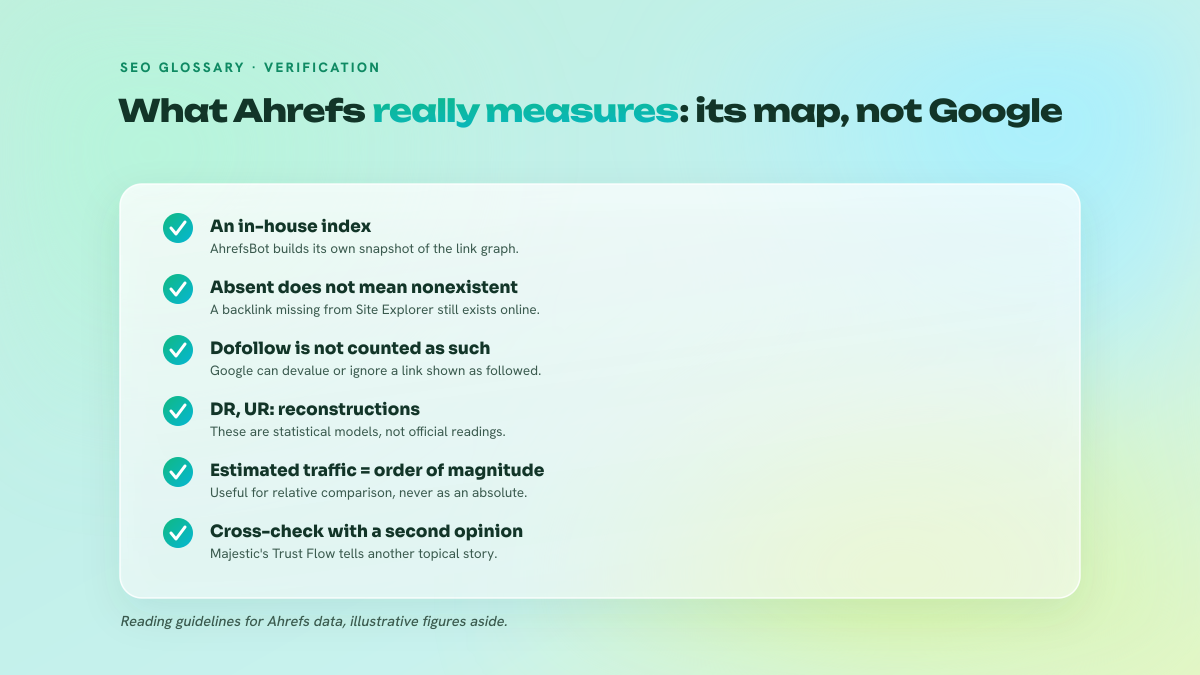
- →Ahrefs is first a crawler and an index; every feature is a view on that index. Its authority in netlinking comes from being the market's shared reference, not from any connection to Google's actual link graph.
- →The September 26, 2025 recalibration of Domain Rating and URL Rating moved many sites 6 to 10 DR points without a single backlink changing. Any link pricing model pegged to raw DR inherited that volatility overnight.
- →Ahrefs' own February 2026 study on roughly 300,000 keywords found AI Overviews cut position-1 clicks on informational queries by about 58%. The tool that prices your links is also telling you the click value behind those rankings is shrinking.
- →Organic traffic figures in Site Explorer are modeled estimates, useful for ranking prospects against each other, unreliable as absolute numbers. Always cross-check a domain you plan to buy links from against first-party data when you can get it.
- →Since the paid trial was removed, Ahrefs Webmaster Tools is the honest free entry: full Site Audit and limited Site Explorer on verified domains. Enough to monitor your own sites, not enough to vet other people's.
A crawler company, not an SEO tool
Strip away the interface and Ahrefs is a web-scale crawling operation with a query layer on top. The company operates what is widely documented as the second most active crawler on the web after Googlebot, fetching several billion pages every 24 hours to maintain an index of tens of trillions of external backlinks. Site Explorer, Keywords Explorer, Content Explorer, Rank Tracker: all of them are windows onto that single asset. That is the correct frame for judging the product, because the quality of every answer it gives you is bounded by the freshness and coverage of that crawl, not by the elegance of the dashboard.
For a netlinking professional, the operational reality is blunter. Ahrefs metrics, Domain Rating first among them, have become the settlement currency of the link market. Marketplaces filter their catalogues by DR, sellers price placements by DR brackets, buyers set floors like « DR 40 minimum » in their briefs. None of this has anything to do with how Google evaluates a link. Google has repeatedly stated it uses no third-party authority score, and DR is a logarithmic measure of one company's view of one crawl of the link graph. The metric matters because everyone agreed it matters. A senior operator holds both ideas at once: DR is economically real and algorithmically fictional.
That distinction is not pedantry, it decides how you use the tool. Ahrefs is excellent at answering relative questions: is this referring domain profile stronger than that one, is this site's estimated organic visibility growing or decaying, which competitor gained links this quarter. It is structurally incapable of answering absolute questions like « how much PageRank does this link pass ». Treat it as a comparator, never as an oracle.
How the machinery works in 2026
The 2026 version of Ahrefs is noticeably different from the tool most consultants formed their habits on. The most consequential change for link builders came on September 26, 2025, when Ahrefs recalibrated the algorithms behind Domain Rating and URL Rating. Sites dropped 6 to 10 DR points, sometimes more, with no actual backlink loss. Ahrefs confirmed it was a recalibration of its own authority model, not anything Google-related, yet the ripple through the link market was immediate: every price list, every marketplace filter and every reporting deck pegged to raw DR values silently shifted. If your link vendor's « DR 50 » of August 2025 is a « DR 43 » today, the site did not get worse. The ruler changed.
Before going further, this walkthrough of the current product is worth twenty minutes of your time:
On the feature side, the center of gravity moved from rankings to visibility in the broad sense. Keywords Explorer now emphasizes Traffic Potential over raw search volume and toggles across Google, YouTube, Amazon and TikTok. Brand Radar, launched in 2025 on a database of more than 100 million prompts, tracks brand presence across ChatGPT, Perplexity, Gemini, Copilot and Google AI Overviews; per the Ahrefs changelog, its AI visibility reports were consolidated into a single aggregated view on June 30, 2026. The same changelog notes that on May 21, 2026, competitor limits rose to 20 per project across Site Explorer, Rank Tracker and Competitive Analysis. Ahrefs also shipped an MCP server and expanded its REST API, which means backlink and keyword data can now feed your own agents and internal tooling rather than living inside the web app.
Access economics changed too. The free trial is gone, replaced by two entry points: Ahrefs Webmaster Tools, free on domains you verify, and a low-commitment Starter tier. G2's pricing snapshot from April 2026 lists the range at $29 per month for Starter up to $1,499 for Enterprise, and 2026 reviews put Lite at $129 per month and Standard at $249. The credit and seat model introduced in 2023 remains the quiet cost multiplier: a three-person team burns through allowances far faster than the sticker price suggests.
Ahrefs vs Semrush: the honest split
The eternal comparison deserves a non-diplomatic answer. If your operation is netlinking-first, Ahrefs wins, and it is not particularly close. The backlink index is fresher and deeper, the referring-domains views are faster to read, and workflows like Link Intersect and broken-link prospecting are simply better tooling for finding placement opportunities. Where Semrush positions itself is breadth: PPC data, social tooling, content marketing modules, local SEO. A generalist agency juggling paid and organic will get more surface area per euro from Semrush. A link building shop will use 20% of Semrush and 80% of Ahrefs.
This head-to-head comparison shows the difference in practice rather than in feature tables:
Two nuances keep this from being a blanket endorsement. First, keyword databases disagree, and neither is ground truth: volumes are modeled from clickstream panels, so a French long-tail query can show 0 in one tool and 200 in the other. Second, on AI visibility both vendors are racing to own the same narrative, and both products are young. Brand Radar's prompt-based approach is promising, but treat any « AI share of voice » number from either vendor as directional at best. The methodology is not stabilized and the underlying assistants change monthly.
The pragmatic pattern we see in mature teams is not either-or: Ahrefs as the daily driver for the link graph, plus first-party data as the arbiter. Rank tracking disputes between tools get settled by what Google Search Console actually recorded, not by whichever third-party index flatters the report.
Where it earns its seat in a netlinking operation
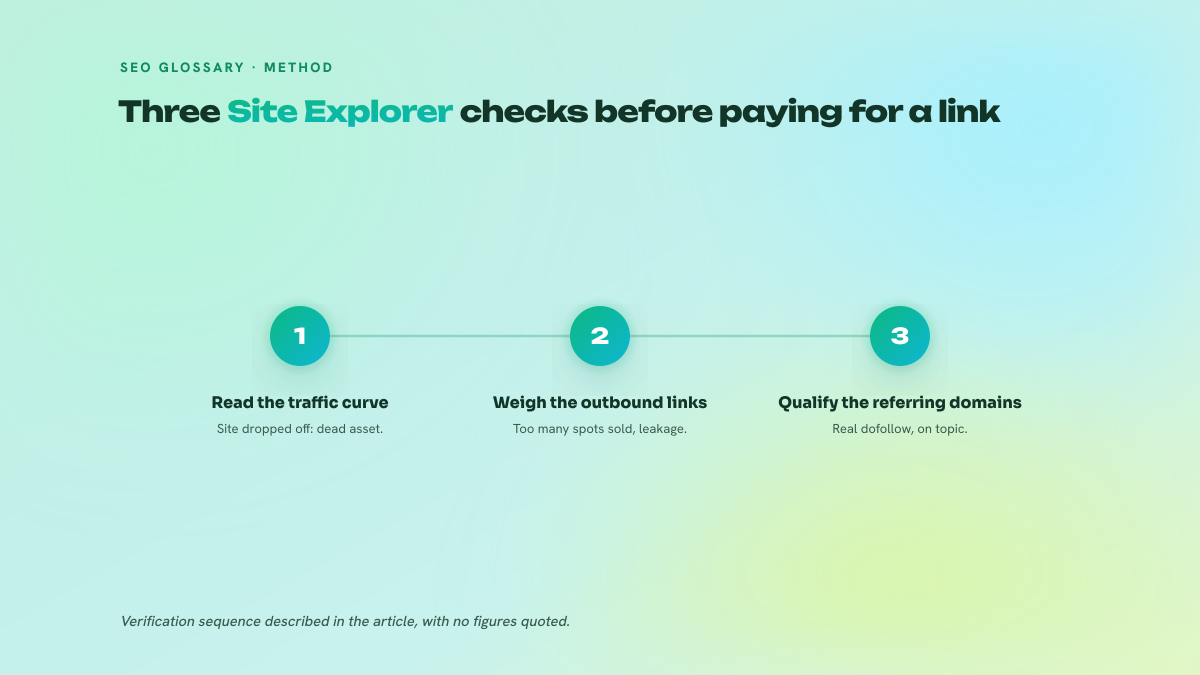
In a working link operation, Ahrefs shows up at three moments. First, prospecting: Link Intersect against a handful of competitors remains the highest-yield source of realistic targets, sites that already link to pages like yours and therefore plausibly will again. Second, vetting: before money moves, you read the prospect's referring-domain curve for the shapes that matter, a cliff after a core update, a suspicious spike of low-quality domains, anchor-text distributions that scream a link scheme. Ten minutes in Site Explorer kills most bad placements before they are bought. Third, monitoring: verifying that paid links actually went live, stayed dofollow and got indexed, because a meaningful share of sold links quietly disappear within a year.
The vetting step is where the market's information asymmetry lives, and it is worth naming. Most link marketplaces show you a DR, a price, and nothing else; the actual domain is revealed after purchase, so you cannot run your own Ahrefs check until the money is committed. That opacity is precisely what an owned, transparent model removes: when the full list of media is public before you spend anything, your Site Explorer audit happens before the order, not after. It also changes what you pay for. On an anonymous marketplace, DR is the product. On a transparent network, DR is just one input you weigh against topical fit and real traffic, which is how the metric was meant to be used. That is the workflow we built Nautilinks around, and it is why we would rather let a buyer run their whole campaign against openly published editor prices than hide behind a metric bracket.
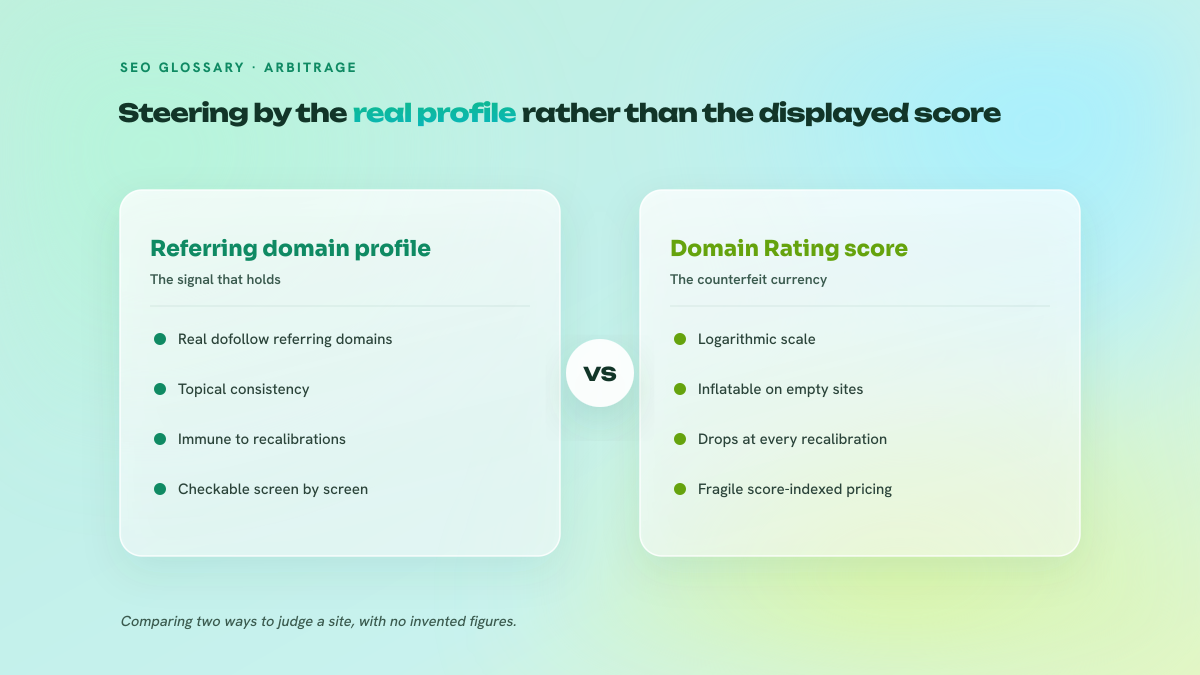
One more operational note: since the September 2025 recalibration, smart buyers have shifted their floors from DR alone to composite filters, typically a minimum count of dofollow referring domains plus evidence of organic traffic on the estimated keywords. A DR threshold on its own is now the easiest filter to game and the least stable over time.
Common mistakes: reading estimates as measurements
The most expensive mistake is treating Site Explorer's organic traffic number as a measurement. It is a model: estimated positions multiplied by estimated volumes multiplied by an assumed CTR curve. From what we see in audits, the figure can diverge from real analytics by a factor of two in either direction, and the divergence is worst exactly where link sellers live, small sites with long-tail rankings. Use it to rank fifty prospects against each other; never use it to justify a price in absolute terms.
The second mistake is ignoring what Ahrefs' own research says about the value of the rankings you are buying links for. The company's February 4, 2026 study, run on roughly 300,000 keywords with aggregated Search Console data comparing December 2023 to December 2025, found that when an AI Overview is present on an informational query, position-1 organic CTR falls from a modeled baseline of about 3.7% to about 1.6%, a reduction of roughly 58%. If your netlinking targets are informational money pages, the click value of the ranking you are building toward has been repriced, and your cost-per-acquired-visit math needs to reflect that. Fewer teams have updated their models than admit it.
Third: chasing DR as a campaign KPI. DR responds to referring-domain accumulation on a logarithmic scale, so it moves fast early and then barely at all, and Google reads none of it. A campaign reported in DR points is a campaign optimized for a vendor's vanity metric. Report in rankings, in indexed linking pages, in referring domains with real traffic, in revenue if you can trace it.
Last, the tooling trap of over-subscription. Many teams pay for Standard or Advanced tiers to vet a handful of domains per month, when Ahrefs Webmaster Tools covers monitoring their own properties for free and a Starter seat covers light competitive checks. Match the tier to the actual query volume of your operation, and remember the seat and credit system means the advertised price is the floor, not the bill.
Nautilinks operates an owned network of editorial media. In-house written articles, transparency disclosures respected, anchor mix calibrated.
Frequently asked questions
Is Ahrefs Webmaster Tools enough to run a netlinking operation?
No, and it is not meant to be. AWT gives you full Site Audit plus limited Site Explorer data on domains you verify, so it covers monitoring your own backlink profile and catching lost links. What it cannot do is the buy-side work: vetting third-party domains, running Link Intersect against competitors, or auditing a prospect's referring-domain history. For that you need a paid tier, and since Ahrefs removed its trial in 2025, the $29 Starter plan is the cheapest way to test the buy-side workflows.
What did the September 2025 DR update actually change for link buyers?
On September 26, 2025, Ahrefs recalibrated Domain Rating and URL Rating. Many sites lost 6 to 10 DR points with zero backlink change, which Ahrefs confirmed was a metric recalibration, not a Google event. Practically, every DR-indexed price list and marketplace filter shifted overnight. If a vendor still quotes pre-recalibration DR values, or if a price seems pegged to a bracket the site no longer sits in, renegotiate. It also strengthened the case for composite vetting filters over DR-only floors.
How reliable are Ahrefs traffic estimates for valuing a link placement?
Reliable relatively, unreliable absolutely. The number is modeled from estimated rankings, estimated volumes and an assumed CTR curve, and on small long-tail sites, exactly the profile of most link-selling media, it can be off by 2x in either direction. Use it to rank prospects against each other and to spot trend direction. To value a specific placement, ask for first-party evidence, Search Console screenshots or analytics, and treat refusal as signal.
Ahrefs or Semrush if I can only pay for one?
Decide by operation type, not feature counts. Netlinking-first: Ahrefs, because the backlink index depth, freshness and prospecting workflows like Link Intersect are the daily-driver tools you will actually live in. Mixed agency work spanning paid, content and local: Semrush buys more breadth per euro. Keyword volumes disagree between the two because both model from clickstream panels, so whichever you pick, settle ranking disputes with Google Search Console data, not with the other tool.
Does Ahrefs help with AI search visibility, or is that marketing?
It is real but young. Brand Radar, launched in 2025 on a 100M+ prompt database, tracks brand mentions across ChatGPT, Perplexity, Gemini, Copilot and Google AI Overviews, and got a consolidated cross-platform report on June 30, 2026 per the Ahrefs changelog. The more actionable output today is Ahrefs' research on impact: their February 2026 study found AI Overviews cut position-1 clicks on informational queries by about 58%. Track AI visibility, but treat share-of-voice scores as directional until methodologies stabilize.
Test your knowledge
Quiz: Ahrefs
1/3What happened to Domain Rating on September 26, 2025?