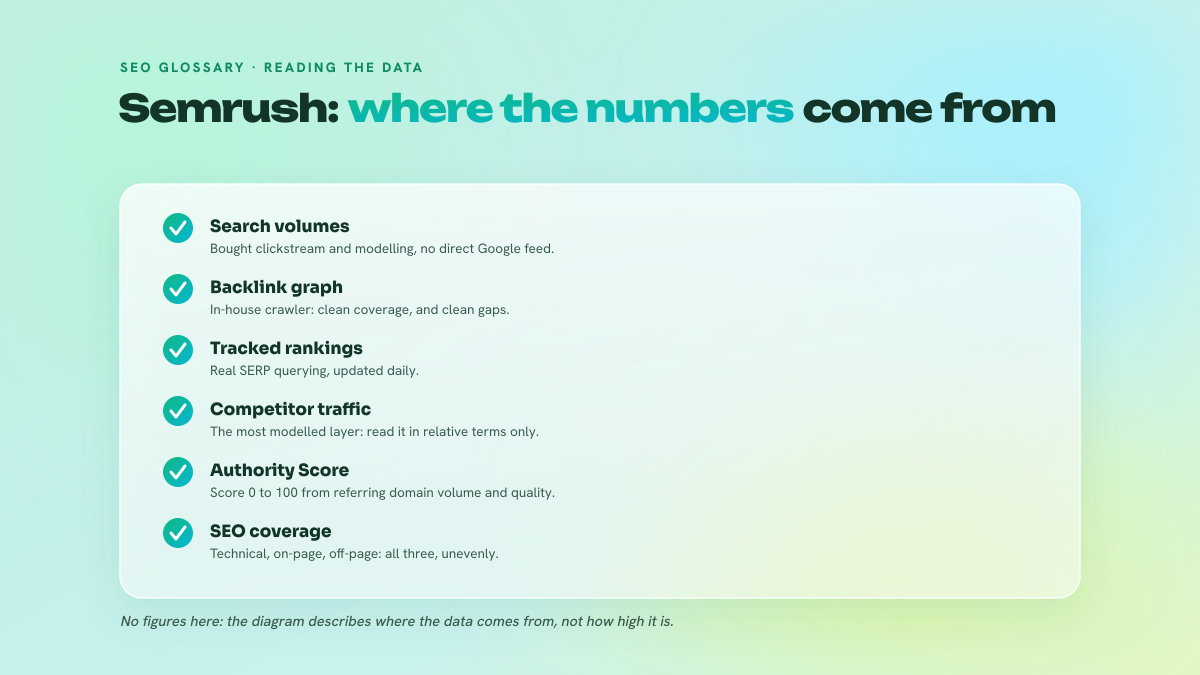
- →Semrush is a keyword and competitive intelligence platform first, a backlink tool second: for link prospecting its index is usable but trails Ahrefs, so cross-check before you buy placements.
- →Authority Score is a proprietary 0-100 metric, not a Google signal. Treat it as one filter among many, never as an acceptance threshold on its own.
- →2026 SEO pricing is Pro $139.95, Guru $249.95, Business $499.95 per month, but per-seat and add-on costs commonly push real spend to 2-3x base (multiple 2026 pricing breakdowns).
- →The genuinely new value is the AI Visibility Toolkit ($99/mo per domain) and the Semrush One bundle launched October 2025, tracking mentions across ChatGPT, Perplexity, Gemini and Google AI Overviews.
- →Guru is the honest entry point for a content team because it unlocks historical data and the full topic research toolkit; Pro is fine for a solo prospecting links.
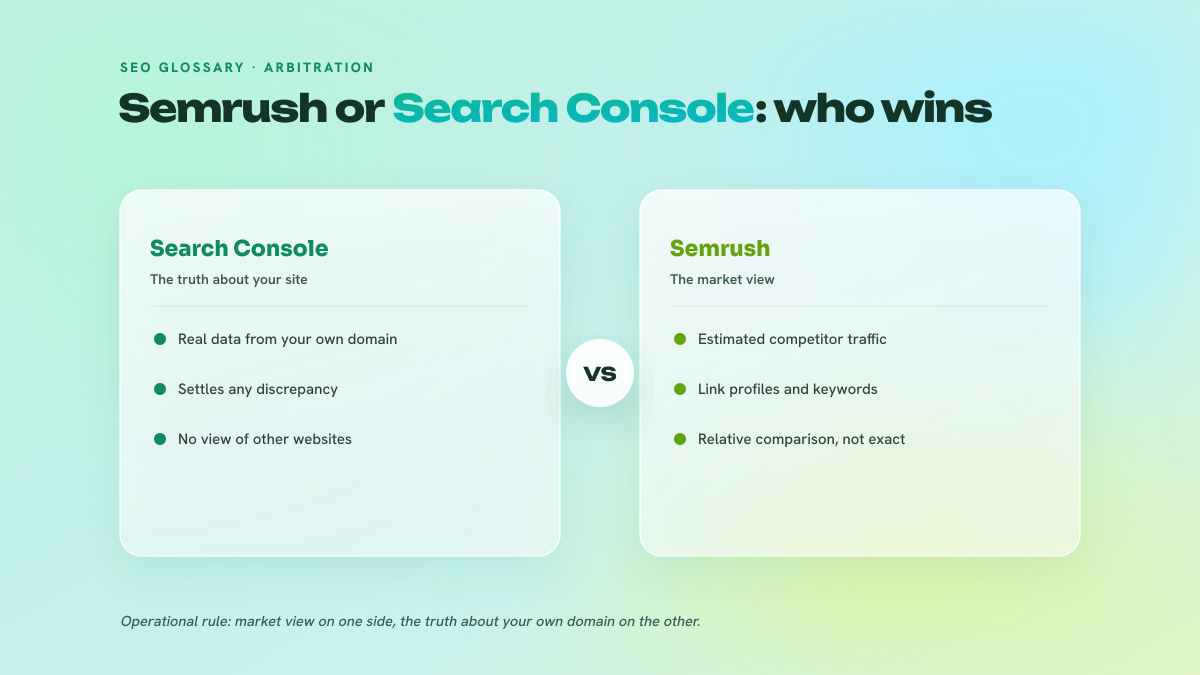
- →Semrush is best used as a decision layer over your link buying, not as the source of truth for whether a media is worth a placement.
What Semrush actually is in 2026
Ask ten SEOs what Semrush does and you get ten answers, which tells you something: it is a suite, not a single tool. At its core it is a competitive intelligence platform built on a large keyword and SERP database, with modules bolted around it for site audit, content, rank tracking, PPC and backlinks. The company reported roughly 117,000 paying customers as of Q3 2025 and $443.6M in 2025 revenue, up 18% year over year (Semrush financials, quoted in 2026 reviews). That scale matters because the keyword data quality depends on the size of the click-stream and SERP crawl behind it, and Semrush is one of the two datasets, alongside Ahrefs, that most French agencies actually trust.
This official overview is a useful two-minute primer before we get into where the tool earns its keep and where it does not:
The honest framing for a netlinking professional: Semrush is a keyword and market-analysis platform first, and a backlink tool a distant second. Its Backlink Analytics module is real and improving, but from what we see in audits its index consistently surfaces fewer referring domains on French media than Ahrefs does on the same target. If your only job today is deep link prospecting, that gap is the whole story. If your job is understanding a competitor's organic footprint, keyword gaps and content angles, Semrush is arguably the stronger seat.
How the data and pricing really work
Two numbers get abused more than any others in Semrush: Authority Score and the traffic estimate. Authority Score is a proprietary 0-100 metric blending link signals, organic traffic estimation and a spam component. It is Semrush's answer to Ahrefs' Domain Rating, and like every third-party score it is a model, not a Google signal. A Semrush study on 1,000 domains found Authority Score correlated with AI mentions at only around 0.334 (Pearson), which is a weak-to-moderate link, exactly the caution you should apply before treating any single score as gospel. If you want a cleaner picture of how a media actually performs in Google, cross it with the search performance data a publisher can share from Search Console rather than trusting an estimate alone.
On pricing, the public 2026 numbers on the classic SEO track are consistent across independent breakdowns: Pro at $139.95/mo, Guru at $249.95/mo and Business at $499.95/mo, with roughly a 15-17% discount on annual billing (multiple 2026 pricing analyses). Pro gives a solo operator 5 projects, 500 tracked keywords and 100k pages crawled per month, but no historical data. Guru is widely described as the real starting line for a serious content team because it unlocks historical data and the full topic research toolkit. Business adds API access and white-label reporting, which matters for agencies and is dead weight for many in-house teams. The trap is per-seat pricing and add-ons: a three-person Guru team can clear $600/mo once extra seats and toolkits stack up, so effective cost often lands at 2-3x the sticker (2026 pricing breakdowns). When you are weighing that spend against what a campaign actually costs, it is worth putting the tool budget next to what a calibrated batch of placements runs before you commit annually.
The genuinely new layer is AI visibility. Semrush launched a standalone AI Visibility Toolkit at $99/mo per domain (1 domain, 1 user, 25 tracked prompts in the base), and in October 2025 it launched Semrush One, a bundle unifying the classic SEO toolkit with AI visibility tracking across ChatGPT, Perplexity, Gemini and Google AI Overviews. Their own AI Overviews study, covering more than 10 million keywords and refreshed in December 2025, found AIO appearing on roughly 15.7% of queries by late 2025 after peaking at 24.6% in July 2025. That is the context that makes an AI visibility module more than a marketing skin: the surface is real and volatile enough to be worth monitoring.
This walkthrough of the 2026 search playbook is useful here, because it frames why the competitive surface keeps widening toward generative answers.
Where it fits a netlinking operation
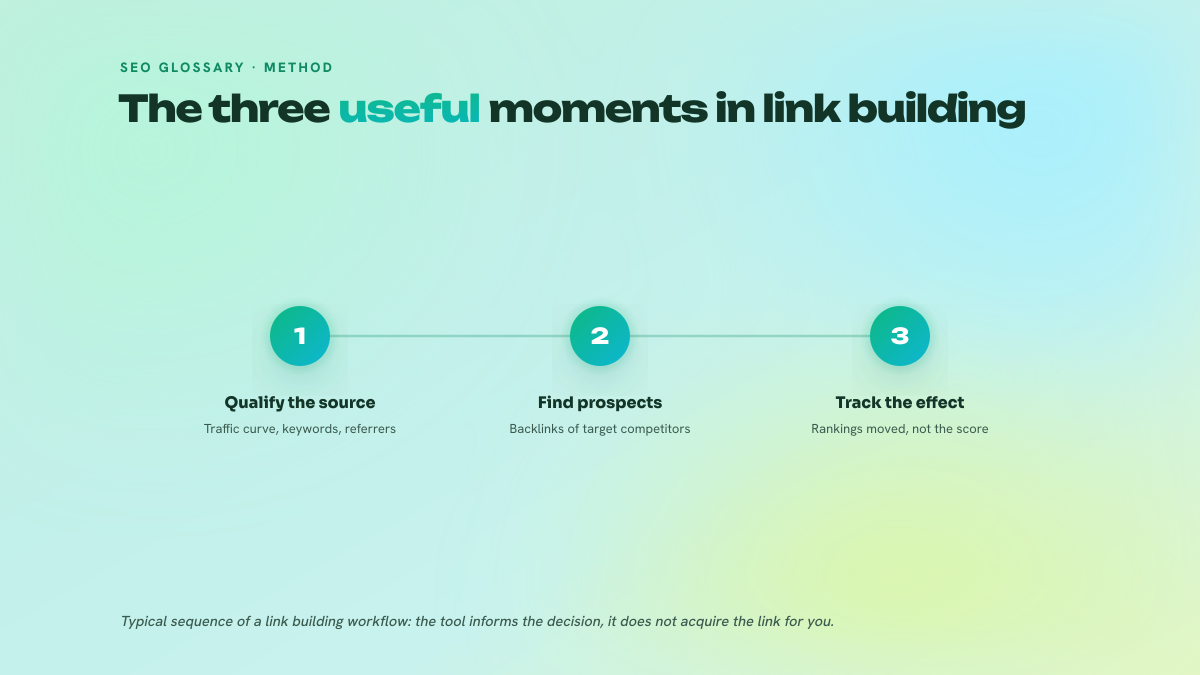
In an operation that runs its own media, and we run our own French editorial media at Nautilinks, Semrush earns its seat in three jobs. First, keyword and topic gap analysis: pointing it at a target and its competitors to find the terms where a backlink plus a matching article can move a position. Second, tracking the organic trajectory of both the sites we place on and the client we are pushing, so a campaign is measured against ranking movement, not just links delivered. Third, sanity-checking a media before a placement by reading its organic traffic curve and topical relevance, not its Authority Score.
That last point is where a lot of buyers go wrong. A high Authority Score on a media tells you a model likes its link profile; it tells you nothing about whether that media has real, sustained organic traffic on topics adjacent to your target. We would rather place a link on a smaller French site with a clean traffic curve and on-topic content than on an inflated domain with a great score and a suspicious backlink graph. This is the difference between buying a metric and buying an actual placement directly from the publisher. If you want to skip the guesswork, working from a catalogue of French media you can filter by real traffic and topic removes the step where Authority Score does your thinking for you. And when the whole point is topical and geographic fit, an in-house editorial network you can inspect directly beats a score you cannot audit.
Semrush also matters on the reporting side. When a campaign is measured over months, its historical keyword data and position tracking let you show a before-and-after on the exact terms you targeted. That is more defensible to a client than a raw list of acquired links, and it is the kind of evidence that separates a campaign you can renew from one you cannot.
What we see go wrong in audits
The recurring mistake is treating Semrush's backlink index as complete. It is not, and neither is anyone's. When we audit a target's link profile, Semrush and the reference backlink index most auditors reach for first disagree on referring-domain counts routinely, sometimes by 20-30% on the same site. If you buy or reject a placement on a single tool's link count, you are acting on a partial map. Cross-reference at least two datasets before a decision with money attached.
The second mistake is confusing traffic estimates with reality. Semrush's organic traffic figure is a model derived from keyword rankings and estimated CTR. In a world where zero-click is the norm, that model drifts. A Semrush 2025 study reported that 58.5% of US Google searches and 59.7% of EU searches end without a click, and for Google's AI Mode specifically, Semrush data from September 2025 put roughly 93% of searches ending zero-click. When that much of the SERP delivers no clicks, an estimate built on ranking-times-CTR overstates the traffic a keyword actually sends. Read the trend and relative scale, not the absolute number.
The third mistake is buying the wrong plan. Teams pay for Business when they never touch the API or white-label reports, or they run three people through one Pro seat and hit limits weekly. Match the plan to the job: Pro for a solo prospector, Guru for a content team that needs historical data, Business only if you genuinely need API pulls or client-facing white-label. And do not over-index on the AI visibility add-ons unless AI search is a live concern for your niche; for many French B2B verticals the AIO footprint is still thin enough that the module is a nice-to-have, not a must.
Tactical takeaways for a working SEO
Use Semrush for what it is best at and stop asking it to be your backlink oracle. Run keyword gap and competitive analysis in Semrush, verify link data across at least two indexes, and judge media on their traffic curve and topical fit rather than on Authority Score. If you are deciding between Semrush and its peers, the honest answer is that most serious operations run both a keyword suite and a dedicated backlink index; if forced to one, pick by your dominant job. Content and market work leans Semrush, deep link prospecting leans a backlink-first tool like the trust-and-citation-flow index built purely around links.
The tutorial below is a decent hands-on starting point before you commit budget to a plan.
On budget, decide annually only after you have used the trial to confirm the seats and toolkits you actually need, because the base price is rarely the real price. And treat the AI visibility layer as a monitoring investment, not a growth lever: it tells you whether you are being cited by ChatGPT or Perplexity, it does not make it happen. What makes it happen is still the same work, relevant content and links from media a real reader would trust.
Nautilinks operates an owned network of editorial media. In-house written articles, transparency disclosures respected, anchor mix calibrated.
Frequently asked questions
Is Semrush's backlink data good enough to run link prospecting on its own?
It is usable but not sufficient alone. In audits, Semrush surfaces fewer referring domains on French media than a backlink-first index like Ahrefs, and the two disagree on counts routinely, sometimes 20-30% on the same target. For a decision with money attached, cross-reference at least two datasets. Semrush is stronger for keyword and competitive analysis than for exhaustive link discovery, so use it as the decision layer, not the source of truth.
How much does Semrush actually cost per month in 2026?
Public 2026 pricing on the SEO track is Pro $139.95, Guru $249.95 and Business $499.95 per month, with a 15-17% cut on annual billing (multiple 2026 breakdowns). The real cost is usually higher: per-seat pricing and add-ons commonly push a small team to 2-3x the base, and a three-person Guru team can clear $600/mo once extra seats stack up. AI visibility is separate, from $99/mo per domain.
Should I trust Semrush's Authority Score when vetting a media?
Treat it as one filter, never a threshold. Authority Score is a proprietary 0-100 model, not a Google signal, and a Semrush study on 1,000 domains found it correlated with AI mentions at only around 0.334 Pearson. A high score can sit on an inflated domain with a suspicious link graph. Judge a media on its organic traffic curve and topical relevance to your target, and cross-check with real Search Console data when a publisher will share it.
Is the AI Visibility Toolkit worth it or is it marketing?
It is real but niche-dependent. It tracks mentions across ChatGPT, Perplexity, Gemini and Google AI Overviews at $99/mo per domain, and Semrush One bundles it with the SEO suite since October 2025. Semrush's own data shows AI Overviews on roughly 15.7% of queries by late 2025, so the surface exists. If AI search is live in your vertical, it is useful monitoring. For many French B2B niches the AIO footprint is still thin, making it a nice-to-have rather than essential.
Semrush or Ahrefs for a netlinking operation?
Most serious operations run both, a keyword suite and a backlink index. If forced to one, pick by your dominant job. Semrush is the stronger seat for keyword gap, topic research and competitive market analysis. A backlink-first tool wins for deep referring-domain discovery. For vetting placements you want both anyway, since neither index is complete and they disagree often enough that a single source misleads you.
Which plan should a small in-house team pick?
Match the plan to the job. Pro suits a solo operator prospecting links, but it has no historical data. Guru is the honest starting line for a content team because it unlocks historical data and the full topic research toolkit. Business only pays off if you genuinely need API access or white-label client reports, which most in-house teams do not. Buying Business for features you never touch is the most common overspend we see.
Test your knowledge
Quiz: Semrush
1/3How should a netlinking pro treat Semrush's Authority Score when vetting a media for a placement?