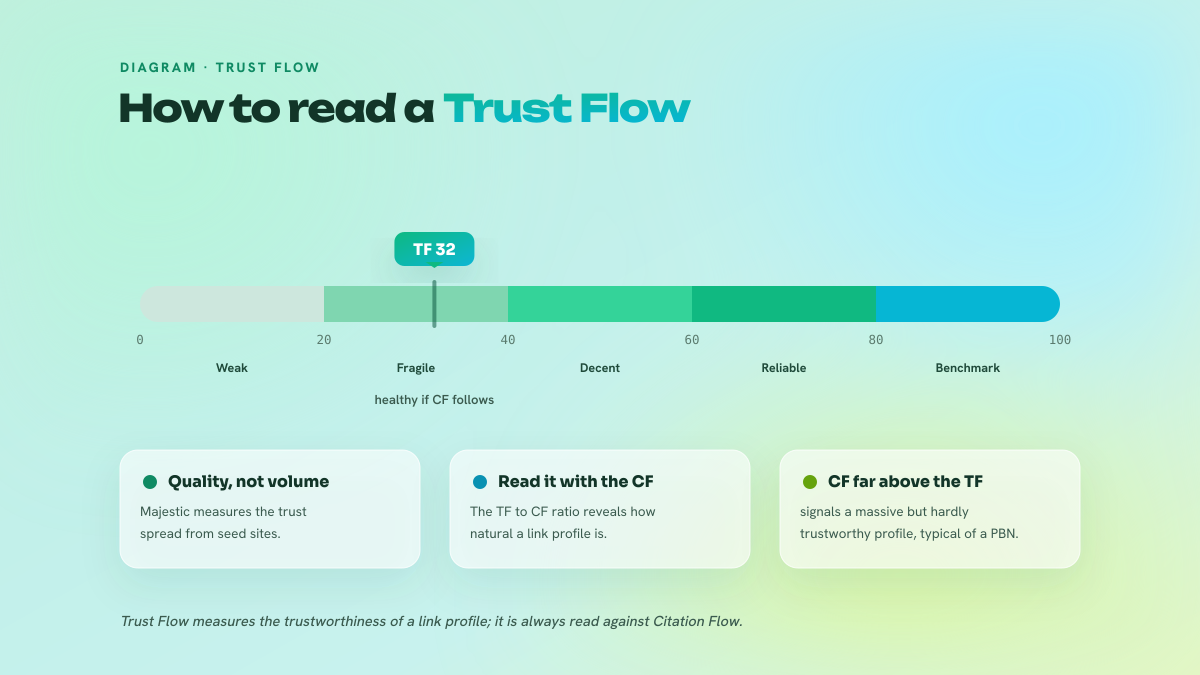
- →Trust Flow is a 0-100 score developed by Majestic to measure backlink quality, based on trust rather than quantity.
- →It's computed from a core of trusted sites (seed sites) selected manually by Majestic, with the score propagated through the link graph.
- →Trust Flow is always read alongside Citation Flow (same score, but based on quantity). The TF/CF ratio reveals profile naturalness.
- →A site with high TF and high CF is healthy. A CF much higher than TF signals a massive but unreliable profile, typically a PBN or a spammy site.
Definition of Trust Flow
Trust Flow, abbreviated TF, is a 0-100 score developed by Majestic, one of the three big SEO data providers along with Ahrefs and Moz. Launched in 2012, it aims to address a recurring critique of classic authority scores: their ability to be manipulated artificially through accumulating links from sites that are themselves dubious.
Majestic's innovation was to introduce the notion of trust into the calculation. Rather than weighting links by the raw authority of source sites, Trust Flow traces links back to a core of reference sites recognised for their editorial quality. The closer a site sits, in the link graph, to those trusted sources, the higher its Trust Flow climbs.
How Majestic calculates Trust Flow
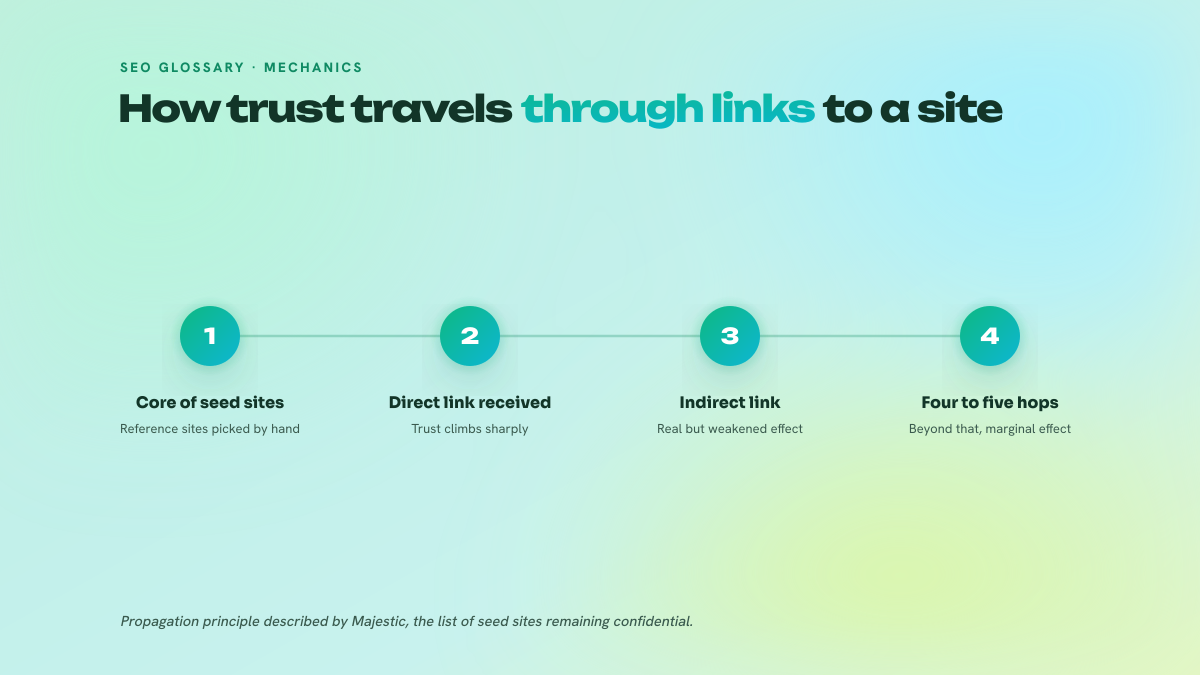
The calculation rests on a core of so-called seed sites, manually selected by Majestic. Those sites are recognised in their domain for editorial reliability and overall quality: major universities, established institutional media, reference organisations in their sectors. The exact list remains confidential to prevent manipulation, but the principle is known.
The Trust Flow of a given site is computed from the propagation of trust from those seed sites through the link graph. If a site receives a direct link from a seed site, its trust climbs noticeably. If a site receives a link from a site that itself receives links from seed sites, the effect is smaller but real. Beyond four or five hops in the graph, the effect becomes marginal.
That mechanic is particularly resistant to manipulation. Buying a thousand links from low-quality sites doesn't raise Trust Flow because those source sites themselves have little trust to transmit. To raise TF, you need to obtain links from sites close to the seed sites, which requires real editorial quality.
Link with Citation Flow
Trust Flow is always presented alongside Citation Flow, abbreviated CF. Citation Flow uses the same propagation mechanic, but without the seed-site weighting. It simply measures the quantity of authority received from any linking sites. A site with many backlinks will have a high CF, regardless of the quality of those sources.
The combined TF/CF reading reveals the nature of the profile. A site with TF 30 and CF 32 is healthy: it receives links in number and quality in balanced fashion. A site with TF 5 and CF 50 is suspicious: it accumulates volume without quality, typical of a PBN or a site that has multiplied spammy link purchases.
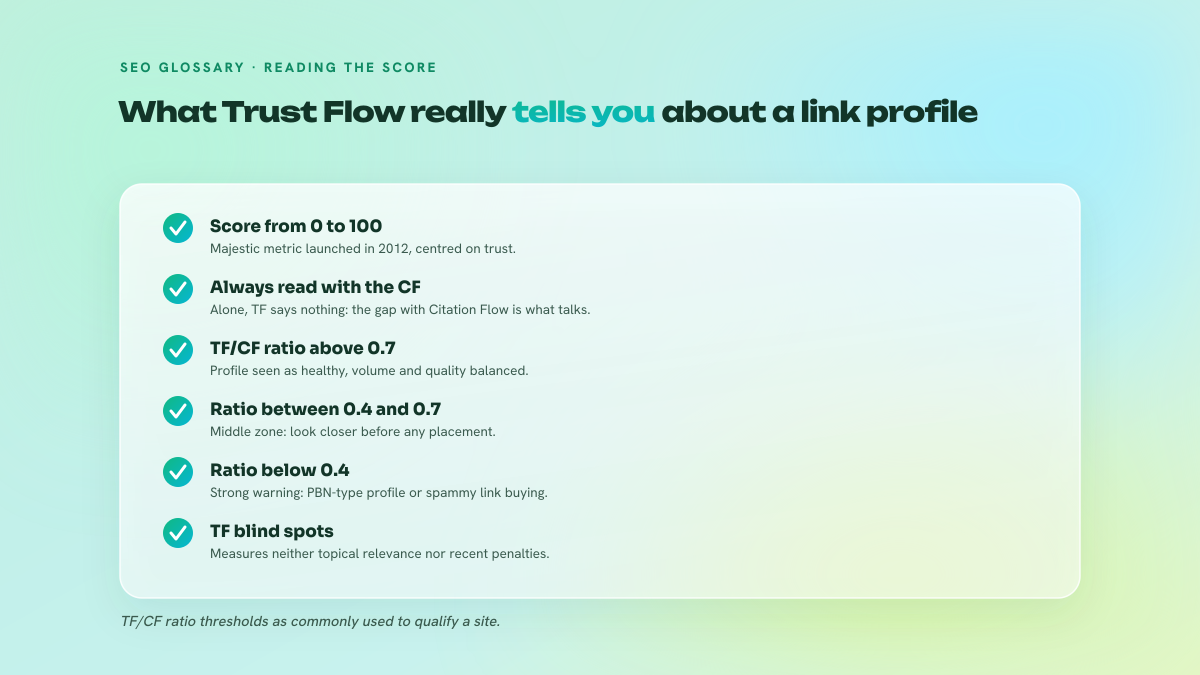
The TF/CF ratio has become a standard indicator for quickly qualifying a site before a link placement. Above 0.7, the profile is considered healthy. Between 0.4 and 0.7, it's middling. Below 0.4, it's a strong warning signal, to investigate before paying for a placement.
Usefulness in netlinking
Trust Flow plays several concrete roles in netlinking practice. First, the rapid filtering of a catalogue. When evaluating fifty candidate sites for a placement, TF lets you discard the manifestly weak ones in seconds, without having to dig through their profiles in detail. On netlinking platforms, TF is often shown next to each site alongside CF, the same way the metric is exposed on every entry of our editorial network catalogue so buyers can sort media by Trust Flow before placing an order.
Second, tracking your own evolution. Watching your TF every six months gives a rough indication of your link profile's trajectory. If TF stagnates or drops despite acquisition activity, that signals the obtained links lack sufficient quality to move the score.
Third, identifying toxic sites in your own profile. When you analyse a site's backlink sources, spotting links from domains with very low TF and high CF helps identify potentially problematic sources, candidates for a disavow if they pose algorithmic risk. On the acquisition side, the inverse heuristic applies when teams buy a backlink filtered by Trust Flow and a healthy TF/CF ratio rather than chasing raw volume.
Limits of Trust Flow
TF isn't perfect. First limit, the seed-site selection favours certain topics. The mostly English-speaking institutional and academic sites overrepresent some niches at the expense of others. A site in a niche poorly covered by seed sites can have an artificially low TF despite real quality.
Second limit, TF doesn't capture topical fit. A link from a TF-50 site off-topic is worth less than a link from a TF-20 site in your exact niche. Editorial relevance remains a criterion that TF and CF cannot measure.
Third limit, TF lags behind Google algorithmic changes. A Google penalty or a major profile change takes time to show up in Majestic's TF. For operational analyses, cross-referencing TF, Ahrefs DR and real organic traffic remains the most reliable method.
Nautilinks operates an owned network of editorial media. In-house written articles, transparency disclosures respected, anchor mix calibrated.
Frequently asked questions
Are Trust Flow and Domain Authority the same thing?
No. Majestic's Trust Flow is computed from a core of manually selected trusted sites, which makes it less manipulable. Moz's Domain Authority rests on a more statistical formula with about forty signals. Both measure authority but Majestic is generally considered less inflatable artificially.
What is a good Trust Flow?
It depends on context. For a niche site, a TF of 15-25 is solid. For an established media, you're looking at 30-40. For very large institutional sites, 50+. But like with DA, the raw number matters less than its consistency with the site's sector and its relationship to Citation Flow.
What is the TF/CF ratio used for?
It reveals link profile naturalness. A ratio close to 1 (TF nearly equal to CF) indicates a healthy profile, where each link brings as much trust as citation. A ratio much below 1 (TF significantly lower than CF) signals a massive but unreliable profile, typically obtained through bulk purchase of low-quality links.
How do I check a site's Trust Flow?
Majestic offers a limited free demo and a paid subscription for in-depth analysis. Several third-party tools expose Trust Flow via the Majestic API, some free for occasional checks. Point checks remain accessible; volume analysis requires a subscription.
Should I prioritise a high-TF site for a backlink?
TF is a good quick filter but not sufficient. A TF-35 site in your topical niche is worth more than a TF-50 site off-topic. TF must be combined with topical fit, real organic traffic and editorial context to evaluate a placement.
Test your knowledge
Quiz: Trust Flow
1/3A site shows Trust Flow 12 and Citation Flow 48. What does this profile most likely indicate?