- →DR measures one thing only: the strength of a site's backlink profile relative to every other site in Ahrefs' index. It ignores traffic, content quality, and site age entirely, so it should never be read alone.
- →The September 26, 2025 Ahrefs recalibration cut 6 to 10 points from many sites without any change in their backlink profiles. A DR drop since then usually means the scoring changed, not the site.
- →Ahrefs' own 2025 study found a correlation of just 0.131 between DR and rankings. DR predicts how competitive a site can be, it does not predict where a page ranks.
- →Campaign data published in 2026 puts the ROI sweet spot for placements at DR 30 to 50: agencies charge 3 to 5 times more for DR 60+ without a proportional return, outside YMYL niches where DR 40+ remains a sensible floor.
- →DR can be artificially inflated for 15 to 100 dollars in a few months (userp.io comparative study), so always cross-check it against organic traffic and the quality of referring domains before paying for a placement.
- →Google's internal siteAuthority signal, exposed in the May 2024 Content Warehouse API leak, is not DR and is not visible to you. Third-party authority scores are proxies, never the thing itself.
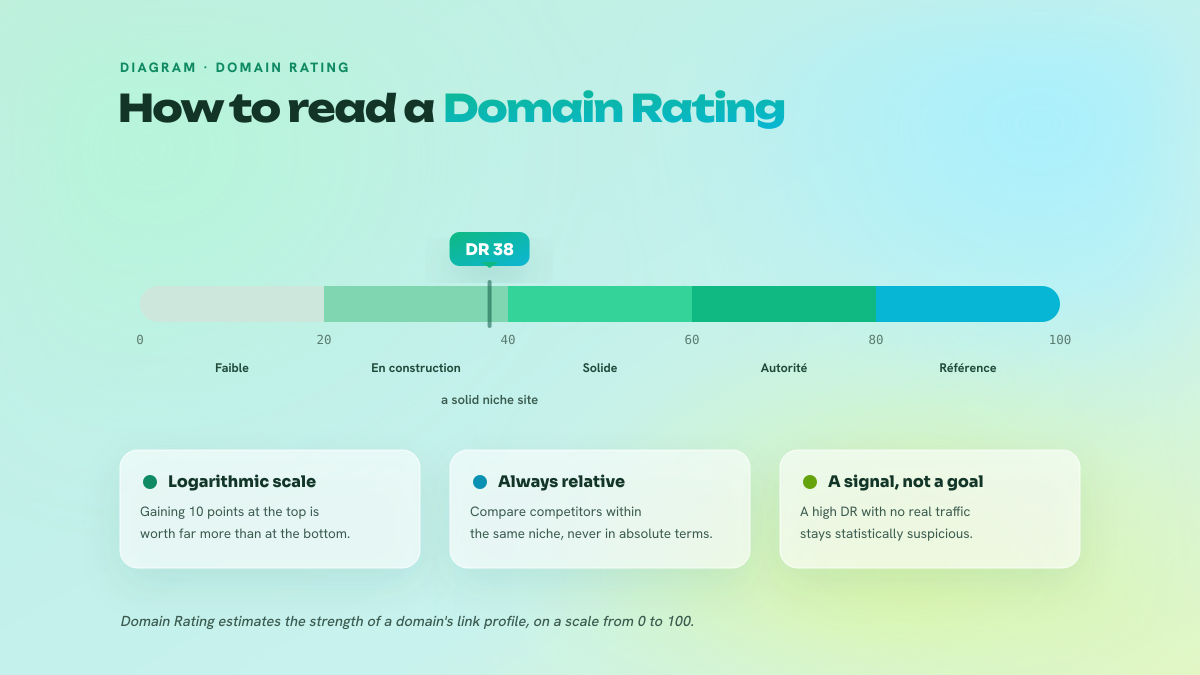
What DR actually measures, beyond the dictionary line
In a working netlinking operation, Domain Rating is a triage tool: it tells you, in one glance, whether a site's backlink profile is strong enough to bother analysing further. That is its entire job. Ahrefs' own documentation, updated October 31, 2025, is unambiguous: DR is a relative score from 0 to 100 built solely from the backlink graph, and Ahrefs recommends using it primarily to select sites worth getting links from, not as an absolute quality grade.
The word « solely » matters more than most practitioners admit. DR does not look at organic traffic, content depth, indexation health, topical relevance, or site age. A site can carry a DR of 55 while receiving forty organic visits a month, and DR will not flag that. Whatever authority a domain projects through its score, the underlying reality is a weighted count of referring domains pointing dofollow links at it, nothing else. Treating DR as a general quality metric is the single most common misreading we correct in audits.
It also helps to place DR among its rivals. Moz's Domain Authority attempts to predict ranking probability and mixes in machine-learned signals; Majestic's Trust Flow weights proximity to a seed set of trusted sites. DR is the most transparent of the three precisely because it claims the least: it is a backlink-strength score, full stop. That narrowness is a feature when you know it, and a trap when you don't.
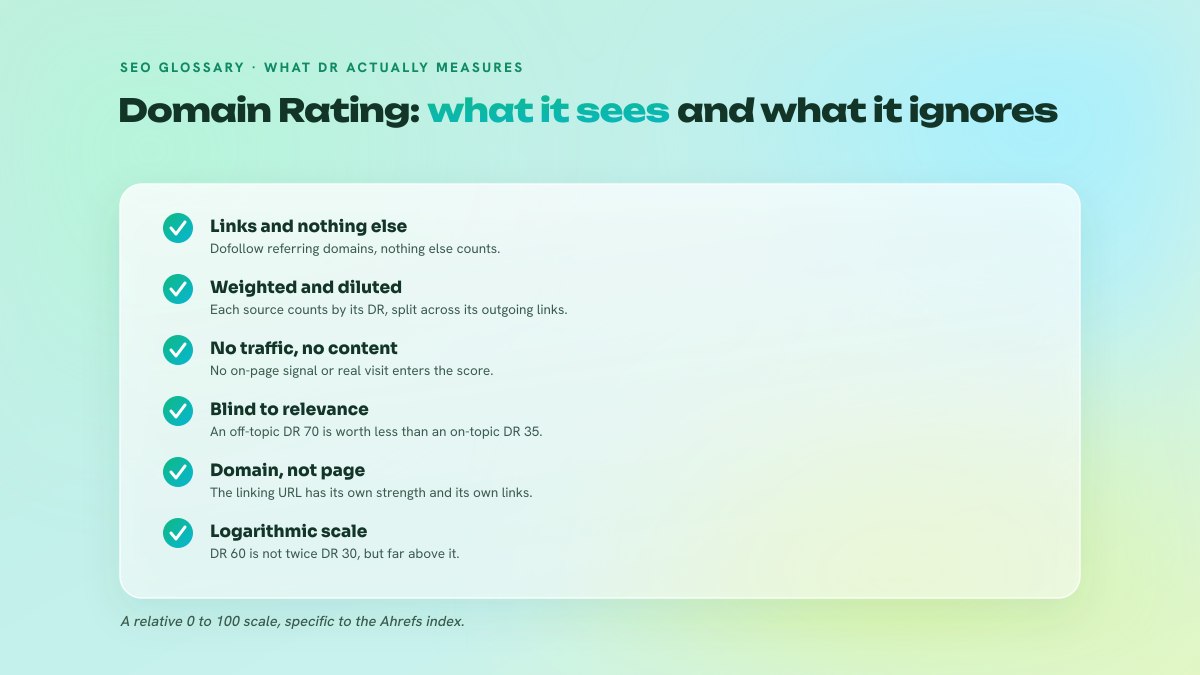
How DR is calculated in 2026
The mechanics have three moving parts. First, how many unique domains link to the target with at least one dofollow link. Second, the DR of those linking domains, so authority flows through the graph recursively. Third, dilution: a linking domain's contribution is split across every unique site it links out to, which is why a dofollow link from a DR 70 site linking to 12,000 domains passes less than one from a DR 40 site linking to 300. The scale is logarithmic: moving from DR 20 to 30 requires far less link equity than moving from 70 to 80, which is why progress feels fast early and glacial later.
This short video from Ahrefs walks through what DR is and what it is actually good for:
The defining event of the past year was the recalibration Ahrefs shipped on September 26, 2025, touching both DR and its page-level sibling URL Rating. Agencies reported drops of 6 to 10 points or more across large portfolios with zero change in the underlying backlink profiles (Techwyse and Outrank coverage, September 2025). Ahrefs framed the update as a fight against score inflation: low-quality referring domains now weigh much less, and spammy or manipulative link patterns are filtered more aggressively. The operational consequence is real: cheap directories, mass guest posts, and PBN-style farms move DR less than they did in 2024, while a smaller number of genuine editorial links moves it relatively more. If you benchmarked prospects against pre-2025 DR values, those benchmarks are stale.
What a good DR looks like, with real numbers
The honest answer to « what is a good DR » is: good for what? Ahrefs published its own data on this in a June 2, 2026 article, reporting a correlation coefficient of 0.131 between DR and SERP rankings from a 2025 study. That is a small positive correlation, nowhere near deterministic. The same piece states plainly that DR is not a Google ranking factor: Google does not consume Ahrefs' metric, and no amount of DR growth changes anything inside Google's systems directly.
What DR does track is competitiveness. A DR 10 site can absolutely rank page one on low-competition long-tail queries, while commercial keywords contested by DR 60+ domains are usually out of reach for it. For link buying specifically, a 2026 analysis of real campaign data (monkeygoals.com) locates the best cost-benefit at placements on DR 30 to 50 sites: agencies routinely charge 3 to 5 times more for DR 60+ placements, and the ranking return rarely scales with the invoice. The exception the same analysis carves out is YMYL, where a DR 40 floor remains a reasonable discipline for health, finance, and legal niches.
The practical reading grid we apply: below 20, the site must win you over on relevance and traffic alone; 30 to 50 is the working zone where price and impact meet; above 60, you are paying for prestige as much as for equity, so the placement needs another justification, brand visibility or a genuinely rare audience.
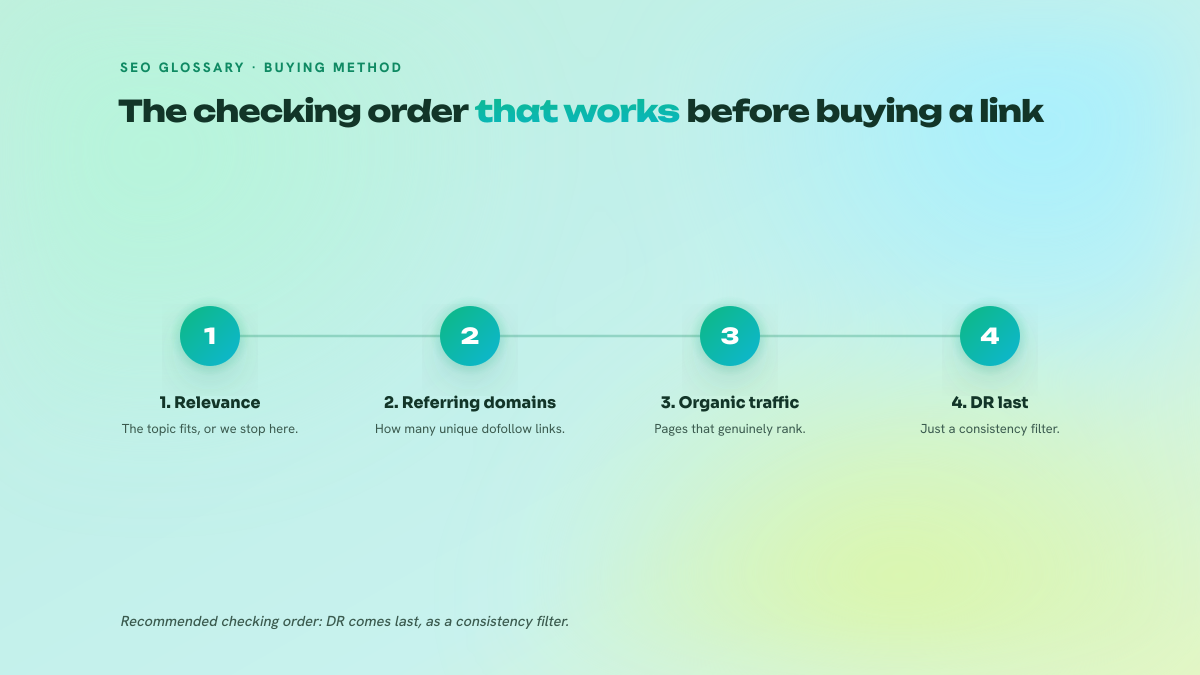
Where DR fits in a netlinking operation
In day-to-day link prospecting, DR is the first filter, never the last. A sane vetting sequence reads DR alongside organic traffic (is anyone actually visiting?), traffic trend (is the site decaying?), referring-domain quality (who links to the linker?), and topical proximity to your money pages. Automated prospecting stacks in 2026 already work this way, filtering candidates on DR, traffic, spam score, and relevance together rather than DR alone. Any workflow that stops at the DR number is buying the label, not the product.
The metric also shapes pricing across the entire link market, which is where transparency starts to matter. Because publishers price by DR tier, an opaque reseller chain gives everyone upstream an incentive to inflate or cherry-pick metrics. This is one reason we publish the metrics of every site in our network openly: you can browse the full media catalogue with DR, traffic and referring domains displayed for each site before spending anything, and compare our numbers against your own Ahrefs export. When the metric drives the price, the metric should be verifiable.
The same logic applies at purchase time. If you source a link directly from the operator who owns the media, there is no intermediary with a margin to protect by dressing up a weak domain. DR then plays its correct role: one input in a decision you control, priced without a hidden commission.
Where DR reading goes wrong
The first failure mode is treating DR as unfakeable. A comparative study by userp.io found that both Moz DA and Ahrefs DR can be artificially inflated within a few months for as little as 15 to 100 dollars, using exactly the kind of low-cost link volume the metric was supposed to reward. The September 2025 recalibration raised the cost of this game but did not end it. A DR 50 site with no organic traffic, a spiky referring-domain graph, and outbound links to casinos and CBD shops is a DR 50 shell, and Google's systems will treat links from it accordingly.
The second failure mode is assuming Google sees what you see. Google runs its own domain-level signals: the May 2024 Content Warehouse API leak exposed an internal siteAuthority attribute, confirming some domain-wide scoring exists, but it is not DR, it is not calculated like DR, and you will never read it in a dashboard. Meanwhile Google's enforcement has been tightening around DR-chasing behaviour specifically: the August 2025 spam update targeted unnatural link building, the December 2025 revision of the link spam policy defines spam as any practice manipulating links with intent to manipulate ranking, and the March 2026 spam update, rolled out alongside a core update, explicitly went after link schemes, PBNs, and purchased links designed to inflate authority. Buying links purely to raise a third-party score is now the most legible possible footprint.
The third failure mode is panic over score movement. A DR that drops several points while your backlink profile is stable is, since late 2025, most often Ahrefs recalibrating or pruning its index, not a lost link and certainly not a Google penalty. Check the referring-domains graph before you check your pulse.
Raising DR without gaming it
DR rises as a side effect of doing netlinking properly, and every shortcut around that sentence got more expensive this year. Post-recalibration, the levers that still move the score are the honest ones: dofollow links from domains that have authority of their own, that link out sparingly, and that were earned or bought in an editorial context a human would recognise as legitimate. Linkable assets, original data, studies, tools, remain the cheapest way to attract those domains at scale, because a page worth citing collects referring domains without a negotiation per link.
Ahrefs' own tutorial on lifting DR is worth the fifteen minutes, if only to notice how little of it is about tricks:
Two closing disciplines from what we see in audits. First, stop reporting DR as a campaign KPI to clients or management: report rankings, traffic, and referring-domain growth, and let DR follow. A campaign that targets the score invites exactly the link patterns the 2025 and 2026 spam updates were built to catch. Second, pace matters as much as quality: a steady acquisition rhythm on relevant, trafficked domains compounds, where a burst of high-DR placements decays. That is the cadence you get when you run a calibrated campaign through a single transparent platform instead of stacking one-off buys from opaque catalogues: fewer links, better ones, and a DR curve that reflects something real.
Nautilinks operates an owned network of editorial media. In-house written articles, transparency disclosures respected, anchor mix calibrated.
Frequently asked questions
My DR dropped 8 points in late 2025 but I didn't lose any backlinks. What happened?
Almost certainly the September 26, 2025 Ahrefs recalibration, which hit DR and UR simultaneously. Agencies reported drops of 6 to 10 points or more across sites whose backlink profiles hadn't changed. Ahrefs down-weighted low-quality referring domains and tightened spam filters to fight score inflation. Verify by checking your referring-domains graph: if it's flat while DR fell, the scoring moved, not your profile, and no remediation is needed.
Is DR a Google ranking factor in any form?
No. Ahrefs states it directly in its June 2026 article: Google doesn't use Domain Rating, it's a third-party metric. Their 2025 study measured a correlation of 0.131 between DR and rankings, small and far from causal. Google runs its own domain-level signals, including the siteAuthority attribute exposed in the May 2024 API leak, but those are internal, computed differently, and invisible to you. DR predicts competitiveness, not position.
What DR threshold should I set when vetting link prospects?
As a working range, DR 30 to 50 is where 2026 campaign data (monkeygoals.com) locates the best ROI: DR 60+ placements cost 3 to 5 times more without proportional impact. For YMYL niches, keep a DR 40 floor. But never use the threshold alone: require real organic traffic, a stable trend, and topical relevance. A DR 45 site with genuine readership beats a DR 65 shell every time.
Can a site's DR be artificially inflated, and how do I detect it?
Yes. A userp.io comparative study showed both DR and Moz DA can be inflated within months for 15 to 100 dollars. The September 2025 recalibration made this harder but not impossible. Detection signals: DR high relative to organic traffic, a referring-domains curve with sudden vertical spikes, linking domains that are themselves shells, and outbound link neighbourhoods full of gambling or pharma. Cross-check DR against traffic before paying for any placement.
How is DR different from Moz DA and Majestic Trust Flow, and which should I use?
DR is the narrowest and most transparent: backlink strength only, recursive through the graph, dofollow-weighted. Moz DA tries to predict ranking probability with machine-learned inputs. Trust Flow measures proximity to a curated seed set of trusted sites, useful for spotting toxic neighbourhoods. In practice, use DR for prospect triage because it's the market's pricing standard, then sanity-check with traffic data. Mixing three authority scores rarely tells you more than one score plus traffic.
How often does DR refresh, and how fast do new links show up in it?
A 2026 AiLeads guide reports DR updates roughly every 7 to 10 days with monthly full index scans, and a 24 to 72 hour lag between Ahrefs crawling a new link and the score reflecting it. Practically: judge a placement's DR effect after a full month, not the next morning, and remember the score also moves when Ahrefs recalibrates its index, independently of anything you did.
Test your knowledge
Quiz: Domain Rating
1/3What did the September 26, 2025 Ahrefs update change about DR?